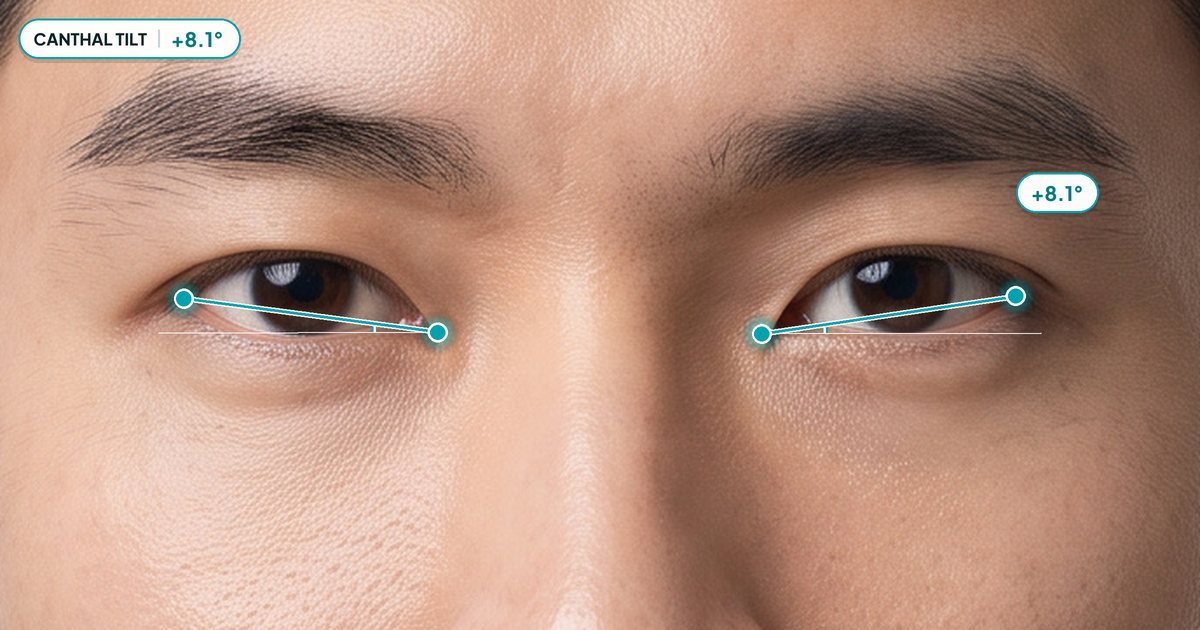
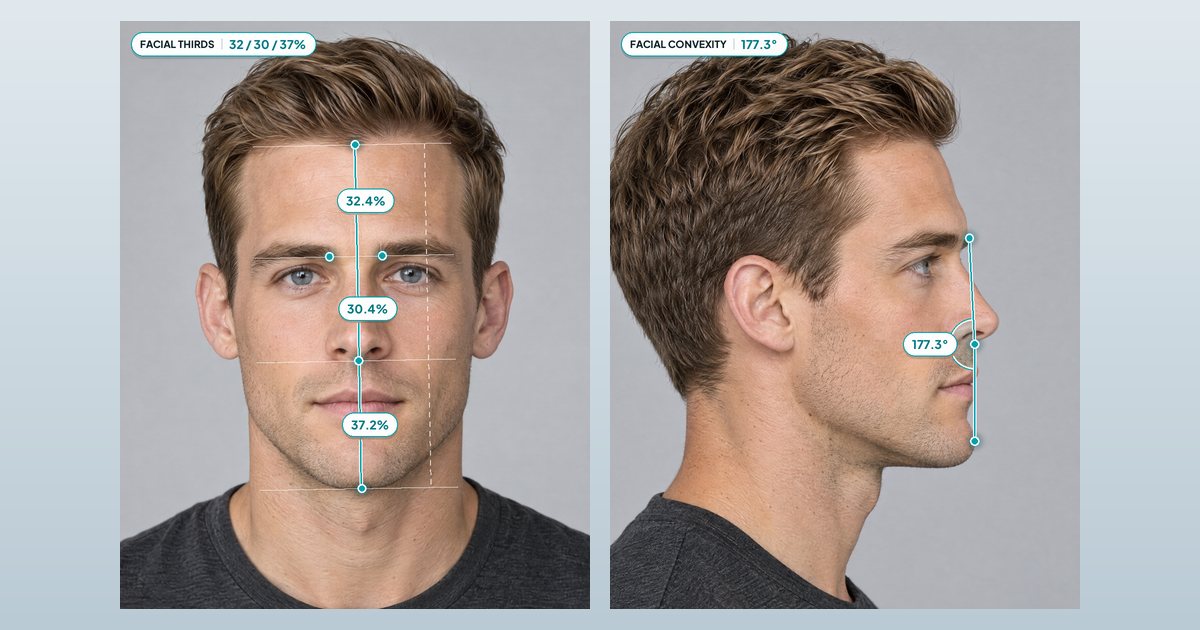
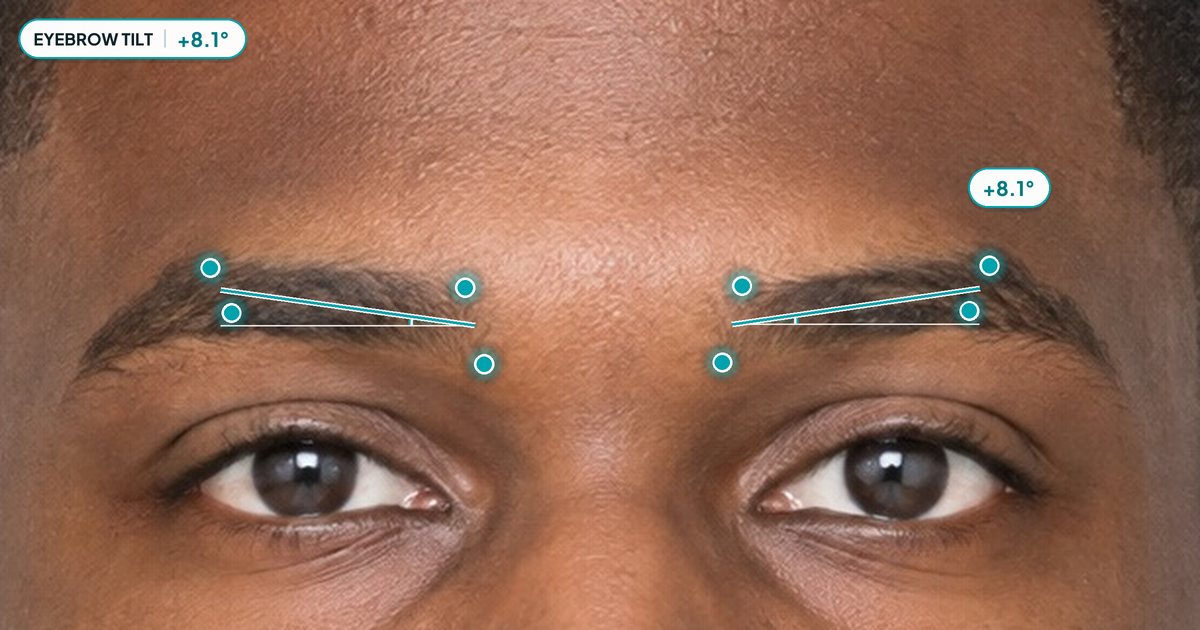
Negative canthal tilt: how common it is and what helps
A negative canthal tilt means your outer eye corner sits lower than your inner one, often by a millimeter or less. A mild one is fairly common in white adults of European ancestry and rare in Latino and East Asian adults. Before you trust the reading, check the photo: a phone held below your eyes can fake one.
The short version
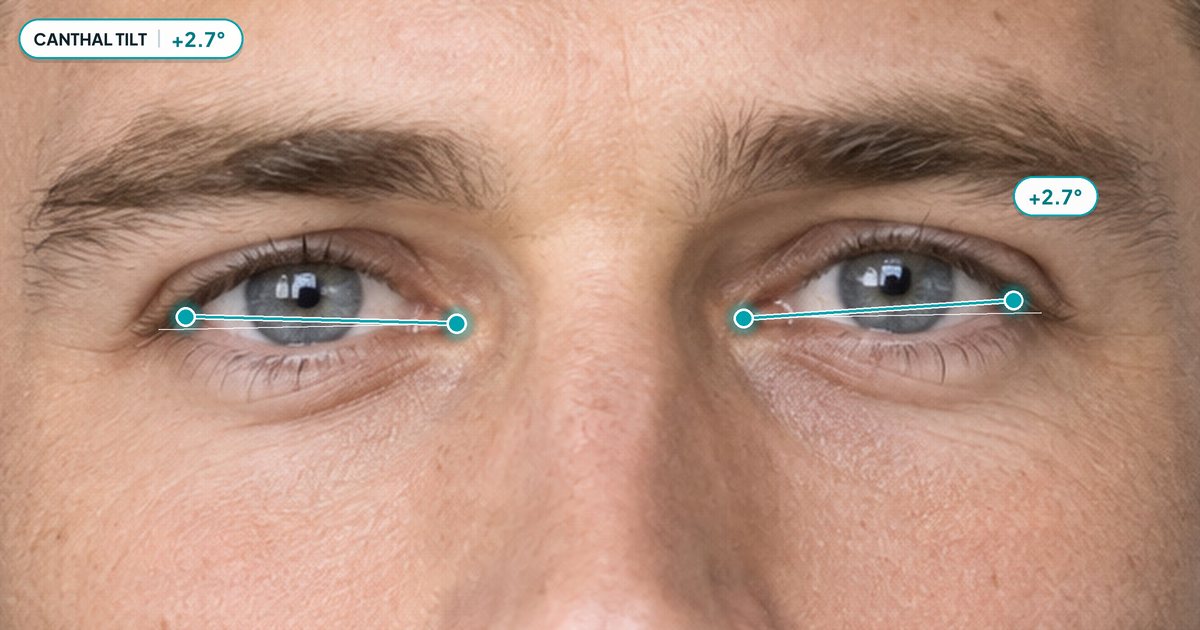
- Falling short of your ideal range doesn't mean your eyes tilt down. Two of our three example faces measure +2.7 and +4.4, under the 6 to 7.7 degrees they are scored against, and both still lift at the outer corner.
- By our estimate, about one in five young white adults of European ancestry reads below zero, because that group averages only about +2 degrees. In Latino and East Asian samples, which average around +6 and +8, it is fewer than 1 in 100.
- Check the camera before the eyes. In our 3D model, every 5 degrees of chin-up flattens the reading by about 1 degree, and a phone held below your eyes does the same. On our flattest face, 3 degrees of head roll pushes one eye below zero in a photo that isn't leveled on the pupils.
- The outer corner is tied by a tendon to bone, and we found no study showing that exercises, taping or mewing move it. Brow tails, frames, liner, sleep and photo angle change what people see.
- Our report calls any level or negative tilt a focus area, but on our sample face the gap between the worst possible tilt and an ideal one is about a tenth of a point overall: 6.97 against 7.09 out of 10.
A negative canthal tilt is smaller than it sounds: at about half a millimeter of corner height per degree, a reading of -2 puts your outer eye corner roughly 1 mm below the inner one. At that size, the angle of your phone can matter as much as the shape of your eyes. In our model, a selfie taken with the phone about a hand’s width below your eyes is enough to take our flattest example face from +2.7 to about zero.
The two men below are scored against an ideal range that starts at +6 degrees. They measure +2.7 and +4.4. Do their eyes tilt down? No.
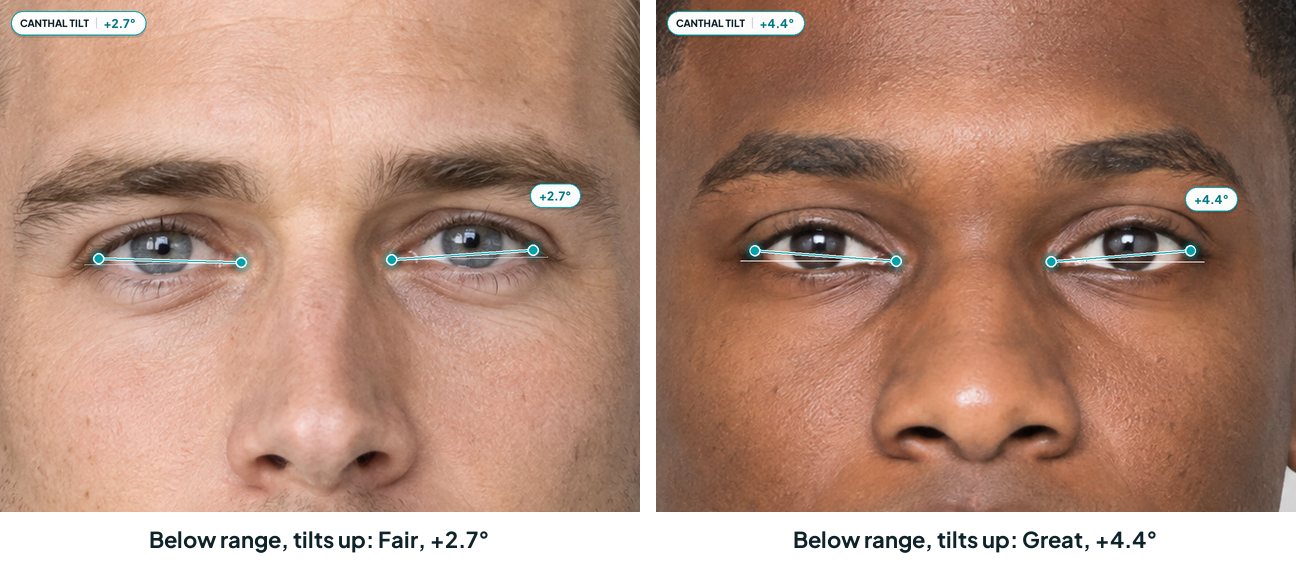
A “negative” label can come from your eyes, your camera or a rating that treated “below the ideal” as “tilts down”. Only the eyes count. The faces above sit below the ideal and still tilt up, and two photos will show whether your label came from the camera.
What is a negative canthal tilt, and what isn’t one?
A negative canthal tilt means the line from your inner eye corner to your outer eye corner slopes down against a level line, so the angle comes out below zero. The corners are the canthi, medial at the nose and lateral at the side, and our report names the measurement after the outer one: lateral canthal tilt.141
Most eyes tilt up. In every young-adult group in the studies we cite, the average sits above zero.123 Our three example faces read +2.7, +4.4 and +8.1 degrees. Even the flattest, at +2.7, lifts his outer corner about 1.3 mm on an eye about 27 mm wide. “Neutral” means roughly level, and there is no agreed cut-off for it.
Our engine places four points where the upper and lower lids meet, levels the photo on the line between your pupils and averages the two eyes. A photo can’t see bone, so all four points sit on the lids. How the points are placed has the full method, and our canthal tilt guide has the step-by-step photo check and the ideal ranges by sex and heritage.
Our own report can add to the confusion. Its “Focus area” label starts below +1.7 degrees for men and +2.5 for women (higher for some heritages). Every level or negative reading gets it, and so do some that still tilt up. It means far from your ideal range, nothing more. Crossing zero adds no extra label and no sudden drop in the score.
How common is a negative canthal tilt, and what counts as extreme?
By our estimate, about one young white adult in five has a negative canthal tilt, against fewer than 1 in 100 in Latino and East Asian samples. The gap comes from the averages: about +2 degrees in young white adults of European ancestry, around +6 and +8 in the other two.12 If your family is Latino or East Asian and a selfie reads negative, check the camera first: the two-photo check further down takes a few minutes.
| Group (study) | Average tilt | Share reading below 0 (our estimate) |
|---|---|---|
| Young non-Latino white adults in the US, 18 people aged 18 to 391 | +2.3 to +2.7° | about 1 in 8 to 1 in 4 |
| White adults in Germany, around age 272 | about +1.8° (our conversion) | about 1 in 4 |
| White adults in Germany, around age 772 | about 0° (our conversion) | about half |
| Latino adults aged 18 to 391 | about +6° | fewer than 1 in 100 |
| East Asian adults aged 18 to 391 | about +8° | fewer than 1 in 100 |
The last column is ours, not a study’s. No one we found has counted this in the general population, so we worked each share out from each study’s average and spread, assuming a normal curve. Measuring a 3D corner on a flat photo adds error, which widens the spread, so the true shares are probably a little lower. The samples are also small, and each study drew its level line its own way. Read the column as common versus rare.
Outside the table, South Indian adults average about +5 for men and +6 for women.3 Black adults aren’t in the table because the data are too thin: one small set of norms published in 1994, which the standard terminology reference itself flags as limited.4 Your own level photo will tell you more than any group average.
A +2 is ordinary among young white adults and less common in the East Asian sample, and that says nothing about whose eyes are better.
Age moves it a little. In the German study, older adults’ outer corners sat lower and closer to the nose, and the drop in tilt showed late, mainly past 70 to 80.2
Another number goes round: that 20 to 30% of people have a negative tilt. We couldn’t find a source for it. By our estimate it’s close for young white adults and far too high for the Latino and East Asian samples.
What counts as extreme? There is no fixed degree. In medical terms, eyes count as “downslanting” when the slant sits more than two standard deviations below the average, or is clearly lower than typical for age.4 Using the averages and spread of the young white samples above, we put that line at around -2 to -4.5 degrees, so -1 sits well inside the normal spread and -2 is borderline at most.12 In the Latino, South Indian and East Asian samples, whose averages sit higher, the same line falls between about 0 and +4.5 degrees. There, even a slightly negative reading is outside the usual spread.13
One thing is worth an eye doctor’s look: an outer corner that has started to droop in recent weeks or months, especially on one side, or a lower lid that pulls away from the eye. A tilt you have always had is how your eyes are built.
Is a negative canthal tilt bad?
No. A mild negative canthal tilt is a variation in eye shape, and in the largest study we found it was one eye feature among several, not the one most linked to attractiveness.5
It gets a lot of hate online anyway. Forum threads call it “prey eyes” and treat it as a flaw. The much-repeated claim that 93% of people prefer a positive tilt traces back to a 2007 study of edited female faces. What the researchers boosted was “medial canthal tilt”, a feature named for the inner corner rather than the line from corner to corner, though they think the two are linked. And the 93% counts forced choices between two pictures, not people.6
The research is less one-sided. One study lifted the outer corner on an edited face and showed it to 2,081 people: they rated the steeper version less attractive and less trustworthy, and men and women alike saw it as less masculine.7 More upward is not automatically better. In that largest study, of 3,517 Asian adults, a more positive tilt did go with higher attractiveness scores, yet the gap between brow and lid and the gap between the inner eye corners had the strongest links.5 Those scores came mostly from an AI model, so treat it as a direction. That goes for most of this research: small samples, one population at a time, mostly women’s faces, and thin evidence on men.
The claim you’ll meet most is that a negative tilt makes you look tired or sad. No study we found lowered only the outer corner and measured that. What has been tested is nearby. On one edited face, a lower outer brow and upper lid read as more tired, though only 20 people rated it.8 After a night without sleep, faces were rated as having more hanging eyelids and swollen eyes, and as looking sadder.9 The tested suspects are brows, lids and sleep.
Brows and sleep are in your hands. The angle isn’t. In our scoring, though, it costs less than the label suggests.
| Reading | Score, men | Score, women | Sample face, overall |
|---|---|---|---|
| In range (men +6 to +7.7°, women +6.8 to +8.5°) | 10, Ideal | 10, Ideal | 7.09 |
| +2.7° (the sample face) | 5.4, Fair | 4.2, Fair | 7.04 |
| 0° (level) | 2.1, Focus area | 1.5, Focus area | 7.00 |
| -2° | 0.9, Focus area | 0.6, Focus area | 6.98 |
Scores are out of 10, on the ranges in the first row. The sample face is a man, so the last column uses the men’s scores.
Below about -2 degrees the curve flattens out, so -2 and -6 cost almost the same. The full swing of this one angle, from its lowest score to Ideal, moves the sample face between about 6.97 and 7.09 out of 10. Canthal tilt is 1 of 33 equally weighted front measurements in the Harmony score, and it can’t sink a face on its own.
If you came here from a positive-versus-negative argument: a mild upward tilt is the most common shape,1 and in an Italian study, faces picked at beauty contests did slant more steeply.10 Steeper doesn’t keep winning, though; that’s the 2,081-rater study above. The full argument is in positive vs negative canthal tilt.
Do you have a negative canthal tilt, or is it your camera?
Your camera can fake a negative canthal tilt. A phone held low, a raised chin or looking down at the screen can flatten a mildly positive tilt to about level,1112 and in our model past zero. A slight head roll can even make one eye read negative on its own.
We ran this on the 3D face mesh of our three example faces, tipping each chin up in the model. Every 5 degrees flattened the reading by about 1 degree. The sample face reached 0 at about 12 to 14 degrees, the +4.4 face at about 21, and the +8.1 face was still positive at 30. Flatter tilts flip first. A phone 10 cm (4 in) below your eyes at a 40 cm (16 in) selfie distance works like about 14 degrees of chin-up, enough to take the sample face to about zero. That’s a model estimate, not a photo test.
A published photo study of 12 young women found a bigger effect: 15 degrees of chin-up took the outer corner from 2.55 mm above the inner one to 0.13 mm, nearly level.11
Tucking your chin does the reverse. In our model, 15 degrees of chin-down takes the sample face from +2.7 to about +5.5.
| What you see | Likely cause | What to do |
|---|---|---|
| Flat or negative in selfies, not in photos others take | Phone low or chin raised11 | Lens at eye height, chin level |
| Lower when you look at the screen | Looking down can make the eye opening more down-slanted12 | Look into the lens |
| One eye negative, the other clearly positive | Head roll: 3 degrees of it would split our sample face into about -0.4 and +5.7, same average | Average both eyes, or level the photo on the pupils |
| Different in photos taken minutes apart | A smile or squint changes the lid opening; a close selfie distorts the face | Relaxed face, 1.5 m (5 feet) away, 2x or 3x zoom |
To check yours, take two photos.
- A level one: a friend about 1.5 m (5 feet) away, lens at your eye height, zoomed to 2x or 3x. Alone, prop the phone at eye height and use the rear camera on a timer. Keep your chin level and your eyes on the lens rather than the screen, with a relaxed face, no glasses and hair clear of your eyes.
- Then your usual selfie at arm’s length, phone a little below your face.
- On each photo, draw a line from the inner corner of each eye, where the lids meet beside the nose, to the outer corner, where they meet at the side (not the end of any liner). Compare it with a level line through the inner corner, drawn parallel to the line between your pupils. Your phone’s markup tool is enough. If one eye tips down and the other up, your head was slightly rolled: check that the level line runs parallel to the pupil line, then judge both eyes together.
- If the level photo slopes up and the selfie looks flat or down, the camera did it. For a number in degrees, follow how to measure your canthal tilt from one photo.
If the careful level photo still reads 0 or below, the camera is off the hook. That reading is yours, and the next two sections cover what sets it and what helps.
Our engine can’t undo a raised or tucked chin on a front photo, so take the front photo for your scan the way you took the level one: phone at eye level, chin level, eyes on the lens.
What causes a negative canthal tilt?
A negative canthal tilt is mostly built in. The outer corner hangs on the lateral canthal tendon, which attaches to Whitnall’s tubercle, a small bump of bone on the eye-socket side of the cheekbone.13 That anchor sits a few millimeters inside the rim (about 4.4 mm on average in one study of 54 skulls), out of reach of anything you can do from the outside.
| What sets it | Changes? | What it means for you |
|---|---|---|
| Where the tendon is anchored to bone13 | Barely changes in adults | Sets your baseline |
| Ancestry | Fixed | Group averages run from about +2 to +8 degrees1 |
| Lids and tendon with age | Slowly, late in life | The outer corner sits a little lower2 |
| Outer brow and upper-lid skin | Over years | The outer brow drops earlier and further than the inner brow, and a low brow plus loose lid skin can fold over the outer corner (lateral hooding)14 |
| Sleep, puffiness, expression, makeup, frames and camera | Day to day | Changes what people see and how a photo measures, not the anchor911 |
Short of surgery, nothing you can do moves where the corner is attached. What you can change sits on top of that anchor: the lids and brow tail, and how your camera sees them.
Negative canthal tilt vs downturned eyes
Canthal tilt is only the corner-to-corner line. “Downturned” describes the whole eye shape, and that look can come from a low brow tail or a hood of skin over the outer corner.14 Eyes can look downturned even when the corners tilt up.
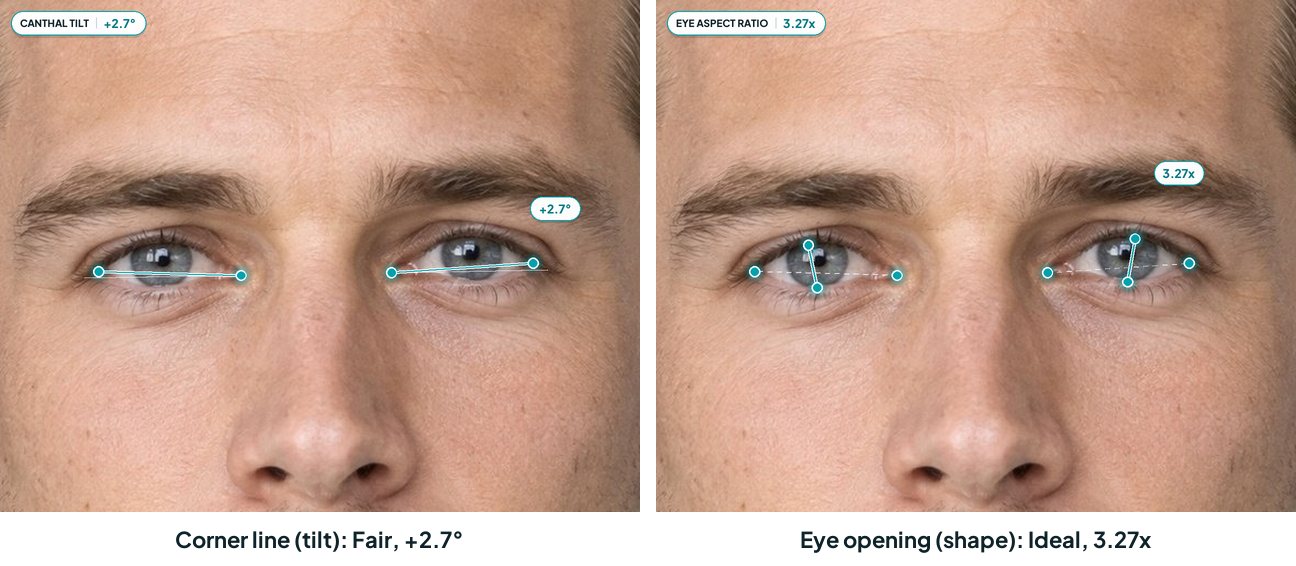
The report also rates eyelid hooding, eye bags and the white below the iris on their own, at 8, 8 and 9 out of 10 on this face, and none of them feeds the tilt number. If your eyes look downturned, those three ratings are where to look first.
How to fix a negative canthal tilt without surgery
You can’t fix a negative canthal tilt naturally if fixing means moving the corners. You can change how the eye area reads, and you can stop your photos making it look worse than it is. Five moves do that, in this order: a camera at eye level, a full brow tail, frames with a straight or upswept top line, liner that lifts before the outer corner, and enough sleep.
Skip the exercises, mewing, taping and pulling the skin back. The corner is tied by a tendon to bone,13 and we found no trial that supports any of them. Tape or a tight hairstyle lifts skin only while it’s on.
The order is our judgment, not a research ranking. The photo comes first because it’s the only change that moves the number.
Start with the photo
For photos you post, hold the camera level with your eyes or a touch above. When someone else takes the picture, ask them to raise the phone to your eye height instead of shooting from their chest.
Brows and glasses
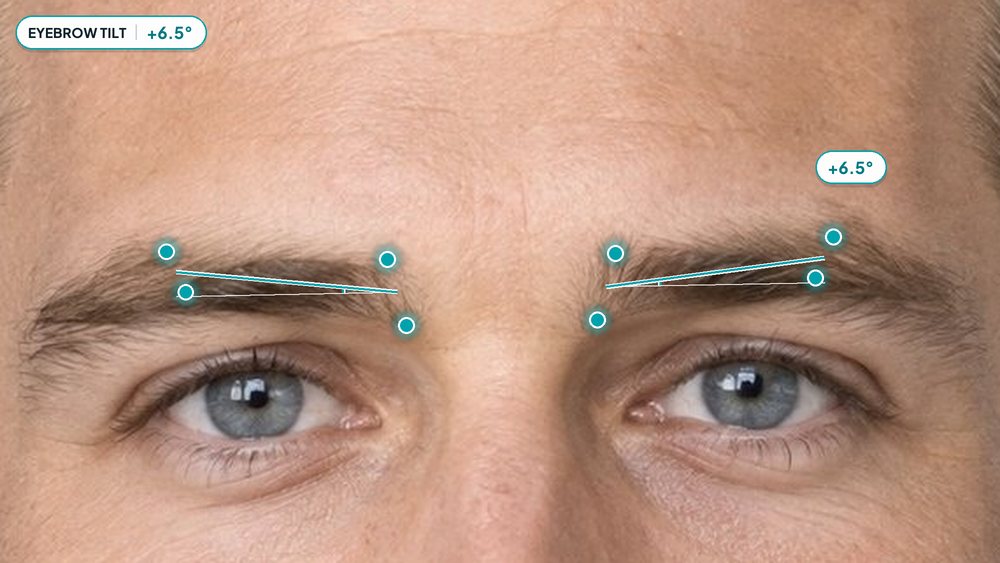
The brow tail is the part that frames the outer corner, and it’s the part that drops first with age.14 In the edited-face study above, brow shape changed the expression more than brow height did,8 so the shape of the tail deserves more of your attention than how high the brow sits.
Trim strays that hang under the outer third, and don’t over-thin the tail. If you fill your brows, keep the tail on a line that doesn’t fall below the brow head.
Glasses draw a line of their own across the eye area. A straight or slightly upswept top line carries the eye up, and frames that droop at the sides do the opposite. That’s styling judgment rather than research, and it’s the same tip our report gives.
Eyeliner and makeup for a negative canthal tilt
Keep the line thin through the inner half and let it thicken over the outer third, then flick the end up toward the brow tail before the lid starts to curve down. Late flicks follow the droop. The usual makeup-artist advice is to skip heavy liner along the outer lower lashes, where it can make the corner read lower. Mascara on the outer upper lashes and a little lighter shadow on the outer lid finish it.
In lab tests, liner or mascara made eyes look up to 6% larger through an illusion,15 but whether a wing changes how tilted an eye looks is still untested as far as we know. A wing changes where the eye seems to end. Our points are meant to sit where the lids meet, and makeup doesn’t move the eye corners themselves.
Sleep and puffiness
Lids are the part of the eye area that changes overnight, so time the photos that matter for after a full night’s sleep. If the night was short anyway, a cold rinse may take the edge off morning puffiness. Our report rates puffiness separately from the tilt, as eye bags: 8 out of 10 on the sample face.
Whatever your level photo shows, don’t judge the angle on its own. Take the +2.7 man from the top of this page. If his corners sat level, his tilt would score 2.1 instead of 5.4, and his overall would move from 7.04 to 7.00 out of 10. His eye shape would still score Ideal and his eyelid hooding 8 out of 10, as his sample report shows. To see how your own tilt sits among the rest, get your face measured: 65+ measurements from two photos, in about a minute.
Questions people ask
Can you fix a negative canthal tilt naturally?
Not the angle itself. The outer corner is tied by a tendon to bone, and we found no trial that supports exercises, mewing or taping; tape lifts skin only while it is on. What you can change naturally is what people see: a tidy brow tail, frames with a straight top line, regular sleep and less morning puffiness. Check the photo too: in our model of an example face, about 12 to 14 degrees of chin-up turned a +2.7 tilt into 0.
Can a negative canthal tilt be attractive?
Yes. Tilt is one eye feature among several. In a study of 3,517 Asian adults scored mostly by an AI model, a more positive tilt went with higher scores, but the gap between brow and lid and the gap between the inner eye corners linked more strongly. On an edited face with a raised outer corner, 2,081 raters gave lower attractiveness scores, so more upward is not always better. On our sample face, a level tilt would take the overall from 7.04 to 7.00 out of 10.
Does a negative canthal tilt make you look tired?
Not on the evidence so far. No study we found lowered only the outer eye corner and measured how tired a face looked. What has been tested points elsewhere: a lowered outer brow and upper lid read as more tired on an edited face, and after a night without sleep people were rated as having more hanging eyelids and swollen eyes. Brows and sleep are the parts of that you can change.
What counts as an extreme negative canthal tilt?
There is no fixed degree. In medical terms, eyes count as downslanting when the slant sits more than two standard deviations below the average for age. For young white adults of European ancestry we put that line at around -2 to -4.5 degrees, so -1 sits well inside the normal spread. In Latino, South Indian and East Asian samples it sits at or above zero, so there a slightly negative reading is already unusual. A corner that has started to droop recently is worth an eye doctor's look.
Is a negative canthal tilt the same as downturned eyes?
No. Downturned describes the whole eye shape, while canthal tilt is only the line between the two corners. A drooping outer brow plus loose upper-lid skin can fold over the outer corner and make eyes look downturned even when the corners tilt up. Our report measures the corner line and the eye opening separately, and rates eyelid hooding on its own.
What eyeliner works for a negative canthal tilt?
Keep the line thin through the inner half, thicken it over the outer third and flick the end up toward the brow tail before the lid curves down. Makeup artists usually skip heavy liner along the outer lower lashes. That changes how your eyes read, not the angle: liner doesn't move the eye corners, where the measured points are meant to sit. In lab tests, liner or mascara made eyes look up to 6% larger, but a wing's effect on tilt is untested as far as we know.
Sources
-
Fry CL, Naugle TC Jr, Cole SA, et al. The Latino eyelid: anthropometric analysis of a spectrum of findings. Ophthalmic Plast Reconstr Surg. 2017;33(6):440-445. doi:10.1097/IOP.0000000000000821. Full text on PMC ↩↩↩↩↩↩↩↩↩↩
-
Liu J, Rokohl AC, Liu H, et al. Age-related changes of the periocular morphology: a two- and three-dimensional anthropometry study in Caucasians. Graefes Arch Clin Exp Ophthalmol. 2023;261(1):213-222. doi:10.1007/s00417-022-05746-y. Full text on PMC ↩↩↩↩↩↩↩
-
Vasanthakumar P, Kumar P, Rao M. Anthropometric analysis of palpebral fissure dimensions and its position in South Indian ethnic adults. Oman Med J. 2013;28(1):26-32. doi:10.5001/omj.2013.06. Full text on PMC ↩↩↩
-
Hall BD, Graham JM Jr, Cassidy SB, Opitz JM. Elements of morphology: standard terminology for the periorbital region. Am J Med Genet A. 2009;149A(1):29-39. doi:10.1002/ajmg.a.32597. Definition on the NIH Elements of Morphology site ↩↩
-
Wang B, Ran Z, Deng Y, et al. Associations between palpebral fissure morphology and AI-derived facial attractiveness scores in Asian adults. J Plast Reconstr Aesthet Surg. 2026;123:135-143. doi:10.1016/j.bjps.2026.09.005. Abstract on PubMed ↩↩
-
Bashour M, Geist C. Is medial canthal tilt a powerful cue for facial attractiveness? Ophthalmic Plast Reconstr Surg. 2007;23(1):52-56. doi:10.1097/IOP.0b013e31802dd7dc. Abstract on PubMed ↩
-
Kempa J, Kasielska-Trojan A, Gabryszewski M, et al. Understanding the impact of eyebrow and lateral canthal height on the perception of character traits: a rating-based analysis of 2081 participants. J Plast Reconstr Aesthet Surg. 2025;104:417-425. doi:10.1016/j.bjps.2025.03.040. Abstract on PubMed ↩
-
Knoll BI, Attkiss KJ, Persing JA. The influence of forehead, brow, and periorbital aesthetics on perceived expression in the youthful face. Plast Reconstr Surg. 2008;121(5):1793-1802. doi:10.1097/PRS.0b013e31816b13fe. Abstract on PubMed ↩↩
-
Sundelin T, Lekander M, Kecklund G, et al. Cues of fatigue: effects of sleep deprivation on facial appearance. Sleep. 2013;36(9):1355-1360. doi:10.5665/sleep.2964. Full text on PMC ↩↩
-
Sforza C, Dolci C, Grandi G, Tartaglia GM, Laino A, Ferrario VF. Comparison of soft-tissue orbital morphometry in attractive and normal Italian subjects. Angle Orthod. 2015;85(1):127-133. doi:10.2319/012814-75.1. Full text on PMC ↩
-
Vaca EE, Bricker JT, Mioton LM, Fagien S, Alghoul MS. The influence of sagittal head tilt on periorbital appearance: implications for clinical photography and the evaluation of postoperative results. Aesthet Surg J Open Forum. 2022;4:ojab043. doi:10.1093/asjof/ojab043. Full text on PMC ↩↩↩↩
-
Read SA, Collins MJ, Carney LG, Iskander DR. The morphology of the palpebral fissure in different directions of vertical gaze. Optom Vis Sci. 2006;83(10):715-722. doi:10.1097/01.opx.0000236811.78177.97. Abstract on PubMed ↩↩
-
Malakhov S, Lukacikova P, Shmarhalov A, et al. Morphological analysis of Whitnall’s tubercle: an anatomical landmark in orbital surgery. Anat Cell Biol. 2025;58(4):521-527. doi:10.5115/acb.25.130. Full text on PMC ↩↩↩
-
Kashkouli MB, Abdolalizadeh P, Abolfathzadeh N, et al. Periorbital facial rejuvenation; applied anatomy and pre-operative assessment. J Curr Ophthalmol. 2017;29(3):154-168. doi:10.1016/j.joco.2017.04.001. Full text on PMC ↩↩↩↩
-
Matsushita S, Morikawa K, Yamanami H. Measurement of eye size illusion caused by eyeliner, mascara, and eye shadow. J Cosmet Sci. 2015;66(3):161-174. Synopsis on the journal’s site ↩
Spotted a mistake? Email support@faceratinglab.com and we will fix it.