What makes a man handsome: 6 face traits, measured
A handsome man's face tends to have a jaw nearly as wide as his cheekbones (about 90% in famous faces), full brows, a lean face, healthy-looking skin and some masculinity softened by something friendlier, like an easy smile. No single feature carries it: in one test of five features, each carried about a fifth of what made a face attractive.
The short version
- Famous handsome faces narrow only a little from the cheekbones to the jaw: in one 2026 study of 156 famous men, the jaw averaged about 90% of cheekbone width, and our men's range is 87.5 to 91.5%.
- Brows matter more than most lists admit: in a 2018 test of five features, brow thickness and the jaw counted a bit more for attractiveness than cheekbones or eye size.
- Some masculinity seems to help, up to a point. In 1990 studies the most mature-looking faces were not rated highest, and our most masculine example face scores just below a softer one whose proportions fit together better.
- Of the things you can change, a lean face had the strongest link to ratings in a study of 101 men. Heavy stubble beat both a full beard and a clean shave.
- Even faces that score well miss most ranges. The best of our three example faces sits inside his ideal range on 29 of 66 measurements, and none of the three splits into equal thirds.
Charles Leclerc, Daniel Craig and Henry Cavill look nothing alike, and all three get called handsome. Each pairs something strong with something soft, and that pairing is probably a big part of what makes a man handsome. A classic set of 1990 studies found the same pattern: women gave higher ratings to men who mixed mature features with youthful ones, and the most mature-looking faces did not win.1
Cavill has a square jaw and heavy, straight brows, and an easy expression takes the edge off. Craig is all rugged angles, softened by pale blue eyes. Leclerc comes at it from the other side: boyish features over a clean jaw.
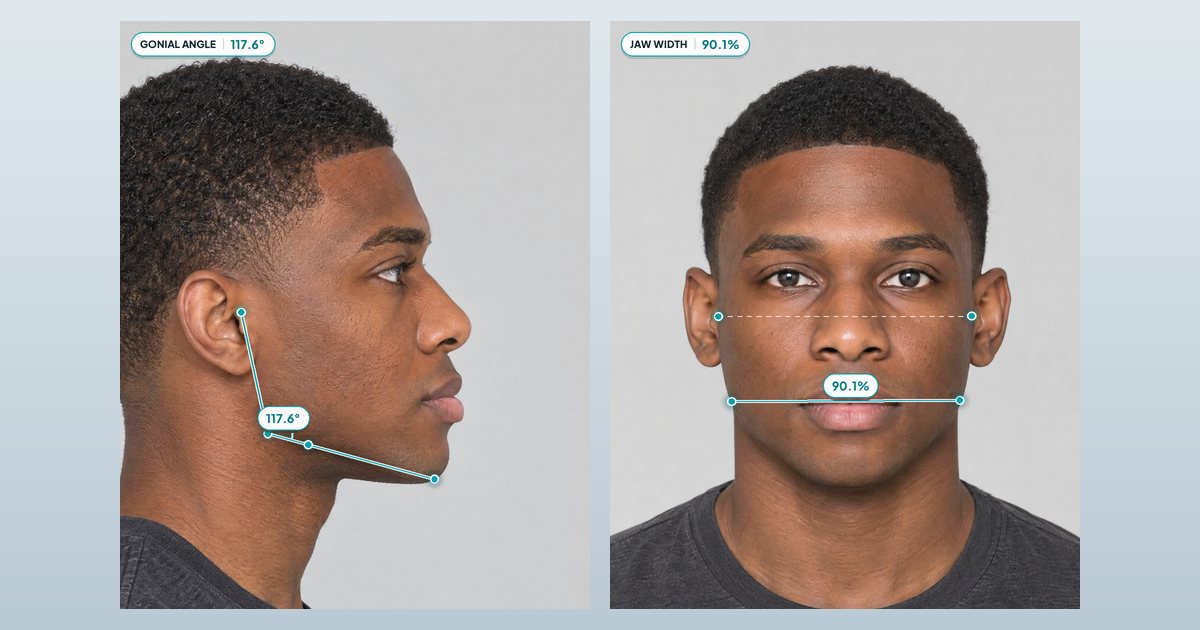
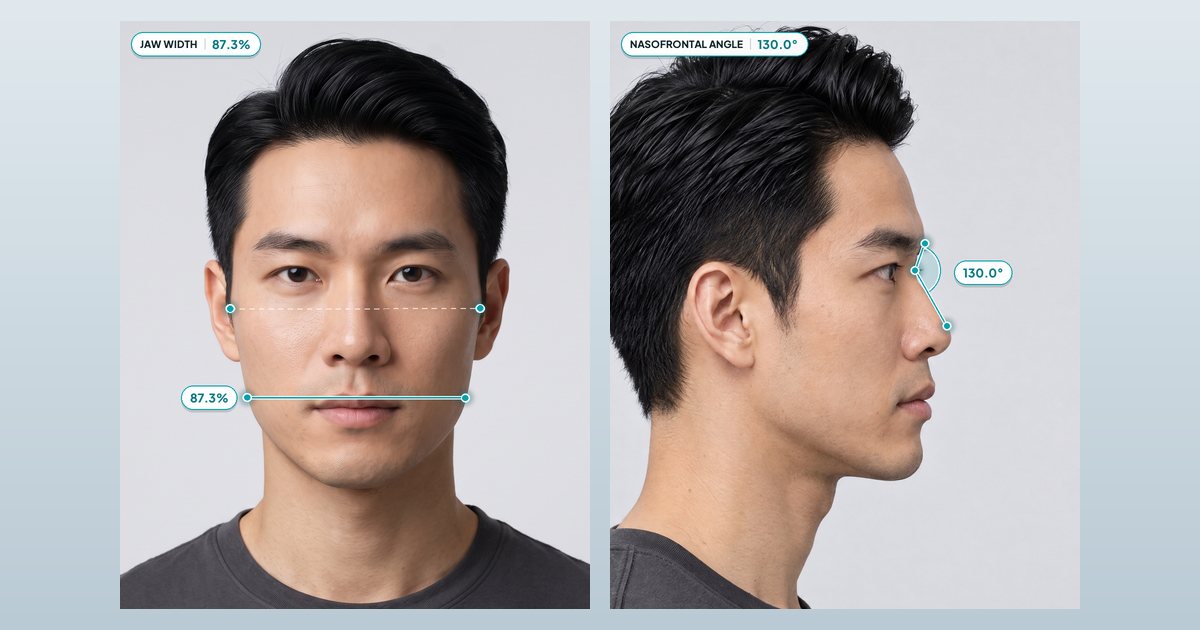
One proportion does show up in famous male faces. A 2026 study measured photos of 156 male celebrities with software and found the jaw averaged about 90% of cheekbone width, across six ethnic groups. Nobody rated those faces, so the study shows what famous faces share and stops there.2 Our three example faces, below, all land within 3 points of that 90%. The man in the middle is the one in our sample report.
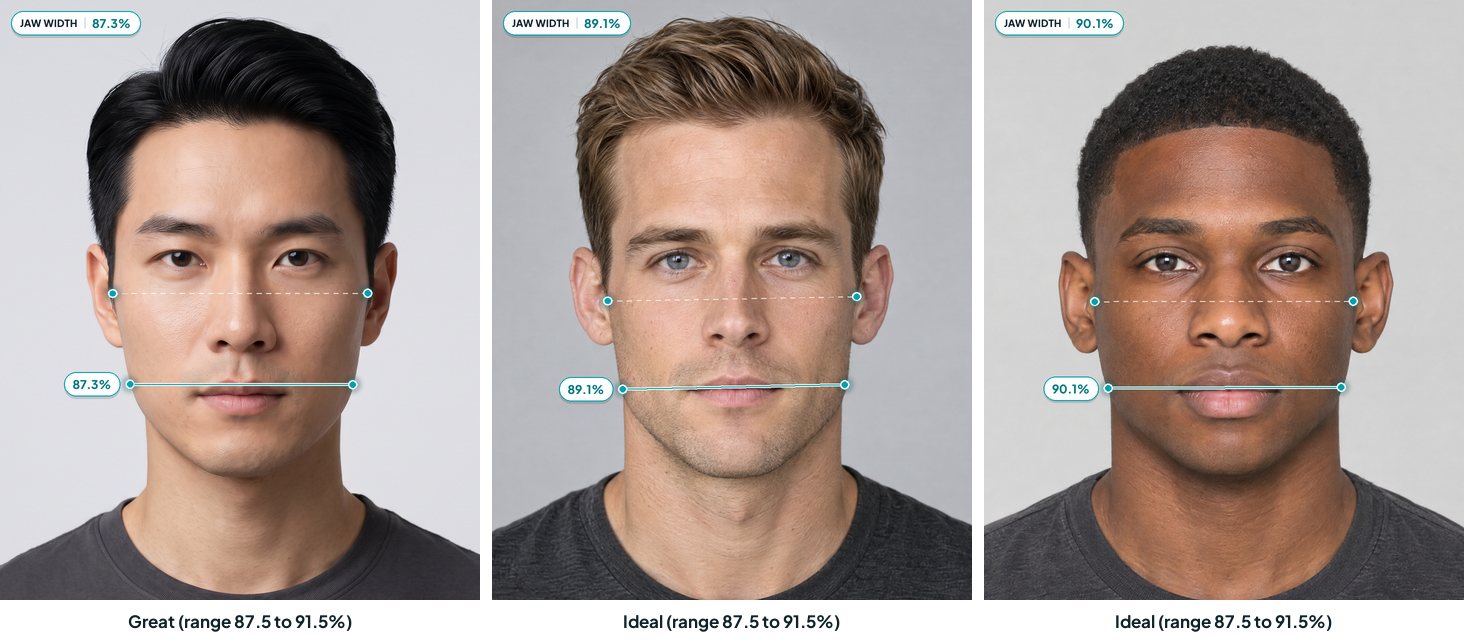
That ratio is the first of six traits below. You can check most of them yourself from two phone photos and a free photo editor on a computer. Of the ones you can change, how lean your face looks had the strongest link to ratings.
What makes a man handsome, feature by feature
A man looks handsome when strong and soft features meet in one face: a jaw almost as wide as his cheekbones (about 90% in famous faces), full and fairly flat brows, a lower third a little longer than the other two, a lean face with healthy-looking skin, some masculinity but not the most, and tidy grooming.12
Those six traits keep turning up in studies of what makes a man attractive, in famous faces and in our own ranges. None wins on its own. When a 2018 study changed five features at once, their weight in attractiveness ratings split almost evenly: brow thickness 21%, jaw 20%, face height 20%, eye size 19%, cheekbones 18%.3
| Trait | What research found | Our ideal range, men (women) | Can you change it? |
|---|---|---|---|
| Jaw almost as wide as the cheekbones | A more masculine jaw scored better on men’s faces than women’s;3 about 90% in 156 famous faces2 | Jaw 87.5 to 91.5% of cheekbone width (84 to 88%) | Set by bone; leanness and your beard line change how it reads |
| Full brows, fairly flat | Brow thickness and jaw counted a bit more than cheekbones or eye size3 | Brow tilt 6.5 to 11 degrees (10.5 to 15) | Ridge fixed; thickness, length and arch shape are grooming |
| Some masculinity, not the most | Faces mixing mature and youthful features rated higher;1 women’s pull toward masculine faces was mild11 | Jaw and brow ridge are 40 of 99 points in our Masculinity rating | Mostly fixed; expression and photos are yours |
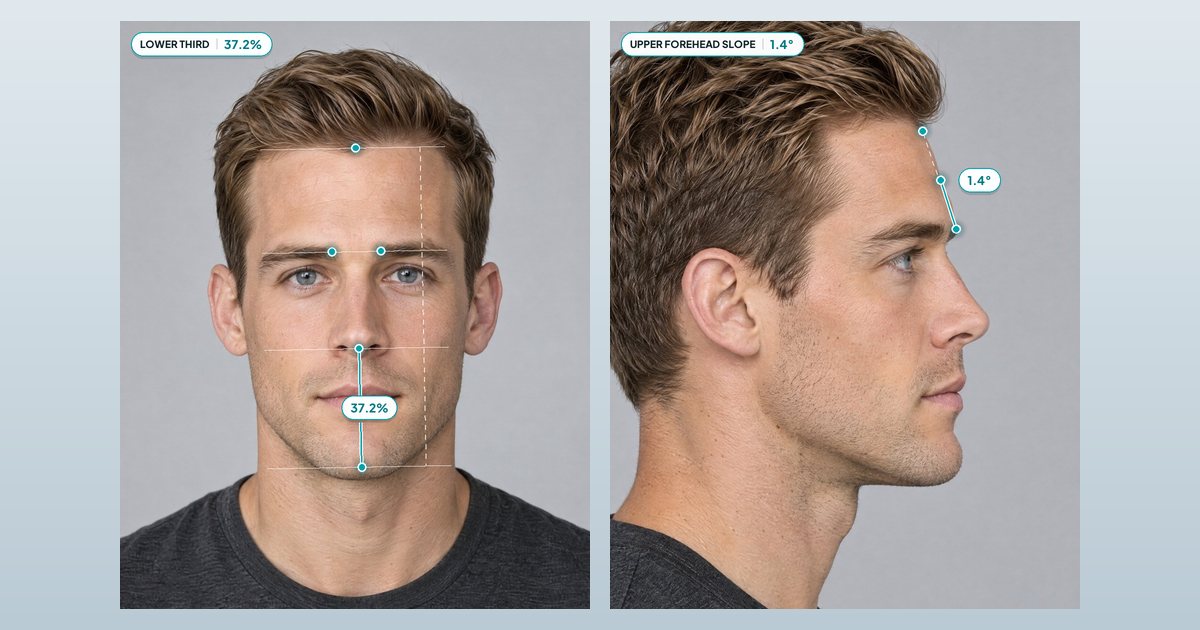
| A slightly longer lower third | A lower face of average height rated best;6 famous faces have the lower third largest2 | Lower third 33.9 to 37% of face height (30 to 33.1%) | Fixed; a beard changes how it reads |
| A lean face with healthy-looking skin | Face fat was the strongest single cue in 101 men;4 healthy-looking skin helped with shape held the same7 | Rated from the photo, no line drawn | Yes |
| Grooming (beard and brows) | Heavy stubble beat a full beard and clean-shaven8 | Brow length 0.69 to 0.76 of cheekbone width (0.65 to 0.72), the drawn line grooming moves most | Yes |
Two limits before the details. Taste is only half shared: in ratings of 200 faces in a large twin study, what people agreed on explained 48% of the variation, and the rest was personal.9 And a photo can’t show height, build, confidence or humor, the things people answering this question online bring up again and again. This page sticks to the face.
A jaw almost as wide as the cheekbones
In famous handsome faces and in our ranges the taper is slight: on our three faces the jaw is about 14 to 17 mm narrower than the cheekbones (estimated). A woman’s face is expected to taper more, to 84 to 88% of cheekbone width. Our men’s range lands right on the celebrity study’s 90%,2 though we didn’t take it from there.
Wider isn’t better past a point. At 100% the jaw would match the cheekbones, the taper all three of ours have would be gone, and the number would sit well outside our range. From the side, the jaw angle has its own range, 115 to 121 degrees for men (118 to 124 for women), and two of our three faces sit inside it.
The chiseled jawline people mean by “a strong jaw” is a separate thing: definition. Our report rates it from the photo instead of drawing a line, and jaw and chin definition make up half of our Angularity pillar. A defined jaw is part bone and part leanness, and leanness is the part you control.
Prominent cheekbones did well in Cunningham’s 1990 studies,1 but in the five-feature test above they carried the least weight, and the more prominent version was not the one preferred.3 Cheekbones aren’t the master key forums make them.
Full, fairly flat eyebrows
Brows are the trait most lists of handsome features skip, yet in that same test brow thickness tied with the jaw. Thicker brows were preferred on men’s and women’s faces alike, and more strongly on women’s, which surprised the authors.3 That’s the hair. Our report also rates the bone under it: Brow Ridge carries 20 of the 99 Masculinity points, as many as the jaw, while eyebrow thickness gets 4. So the studies and our scoring weigh different parts of the brow. They changed the hair; our Masculinity score weighs mostly the bone, and brow density counts again in Features.
From the front, our men’s range for brow tilt is 6.5 to 11 degrees, flatter than the women’s 10.5 to 15. The man in the header image sits at 10.5, inside the men’s range and right where the women’s starts. From the side, the nasofrontal angle measures where the brow meets the nose, and both the brow and the bridge of the nose shape it: 116 to 128 degrees for men, 139 to 151 for women. Measured the way we draw it, that 23-degree gap is one of the largest between the sexes in our ranges, so a man’s face is expected to have a deeper step from brow to nose.
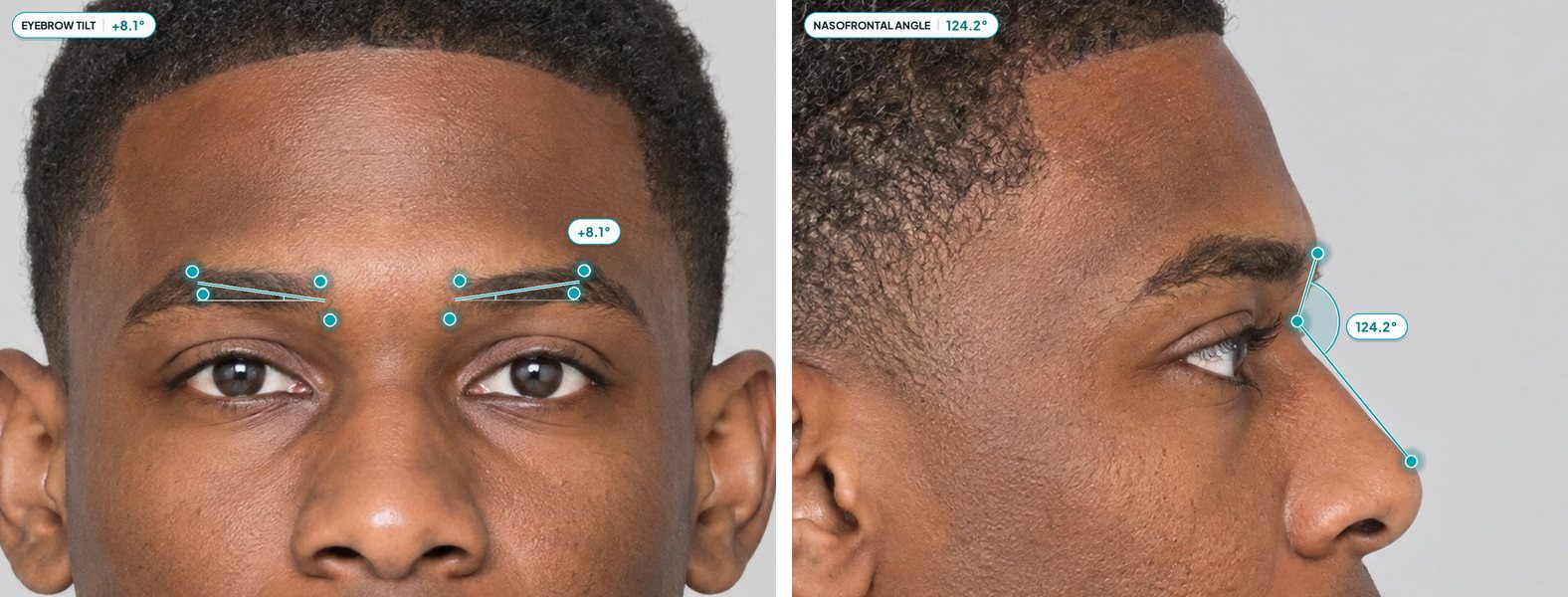
The man in the header image also has the softest step, 130.0 degrees: over the 128 printed above, but inside his own range, which shifts with heritage. The man from our sample report has the deepest, 115.0, a degree under the range. That step is mostly bone, and the ridge stays put. Thickness, length and arch shape are grooming, and they’re the easy part.
What women find attractive in a man’s face
Women in Cunningham’s studies liked the same strong-plus-soft mix: they gave higher ratings for a large chin and prominent cheekbones, and also for large eyes and a big smile.1 Our reading: cute leans youthful, rugged leans mature, and handsome usually has both.
Eyes and a smile are the soft side of that mix, and both come with a catch. In the five-feature test, eye size counted less than brows and jaw, and the version with enlarged eyes ranked lowest.3 The smile’s catch comes from a 2011 study: men were rated more sexually attractive looking proud than looking happy.10 How your eyes are shaped and set is what our eye shapes and canthal tilt guides measure.
Some masculinity, but not the most
Masculinity seems to work like salt: some helps, and the most can be too much.
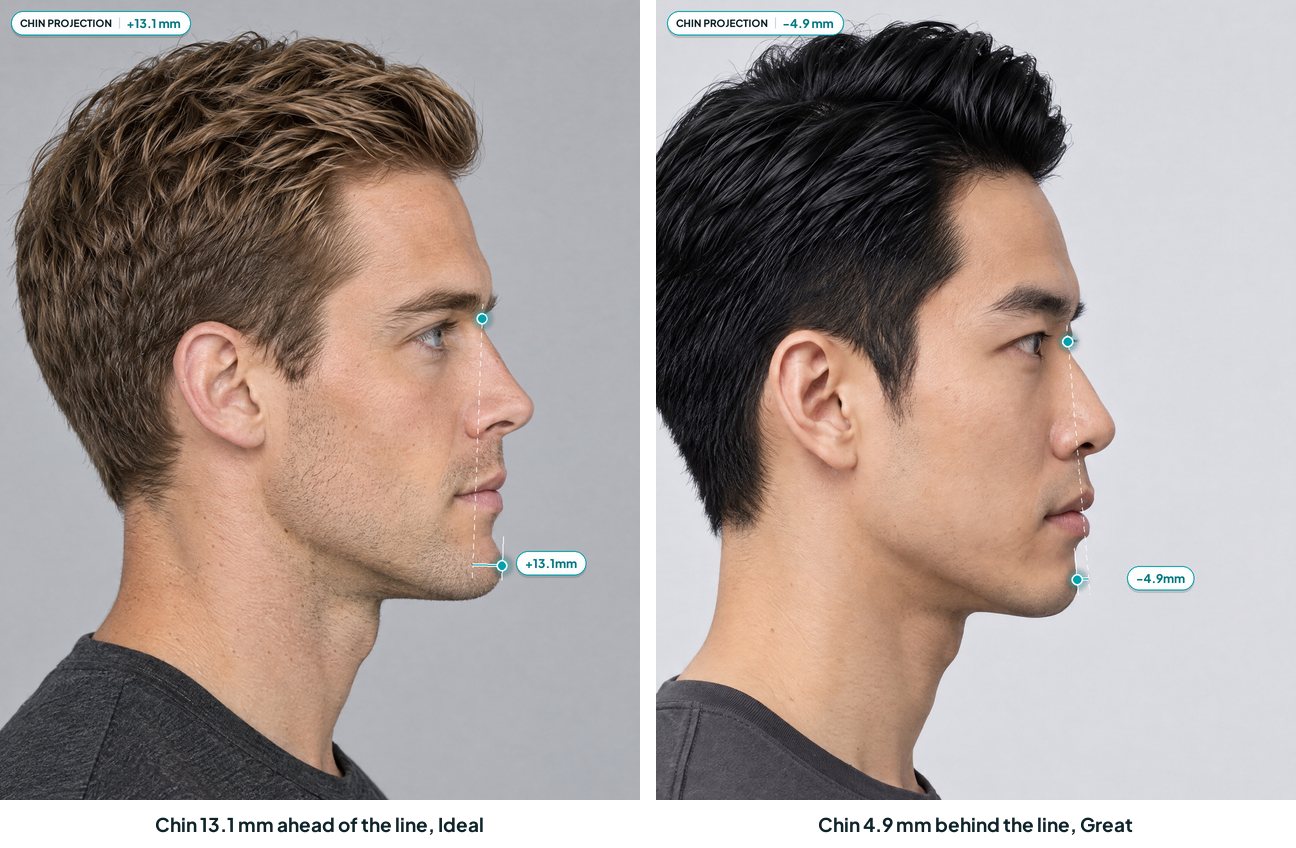
Our own faces point the same way. The man from our sample report has the most forward chin and the top Masculinity score, 7.25. The man in the header image has the chin furthest back and the lowest Masculinity and Angularity. He edges ahead overall anyway, 7.12 to 7.04, mostly because his proportions fit together better: his Harmony, one of the 4 pillar scores behind the total, is 7.25 against 5.92.
The pull toward masculinity is weak. Tested weekly, 584 women preferred masculinized men’s faces by about 0.4 on a scale from -3.5 to +3.5, small but consistent. It also didn’t rise and fall with their hormones, which leaves the popular claim about ovulation without good evidence.11 The evidence splits by method: rated by people, masculinity predicted men’s attractiveness;4 measured from face landmarks, it did not.12
The usual reason given, that masculine features advertise good health, has thin support: in the study of 101 men, face traits had only weak links to measured health. More masculine-looking men did slightly better on one measure of sperm movement, a borderline group average that tells you nothing about any one man’s photo.4
Face width works differently. A face that is wide for its height reads as more dominant, yet across studies it was rated somewhat less attractive, more so by women.5
One caveat: most of this research used White, Western samples. Across 12 populations, women in several small-scale societies preferred average or even feminized men’s faces.13
Balanced proportions with a slightly longer lower third
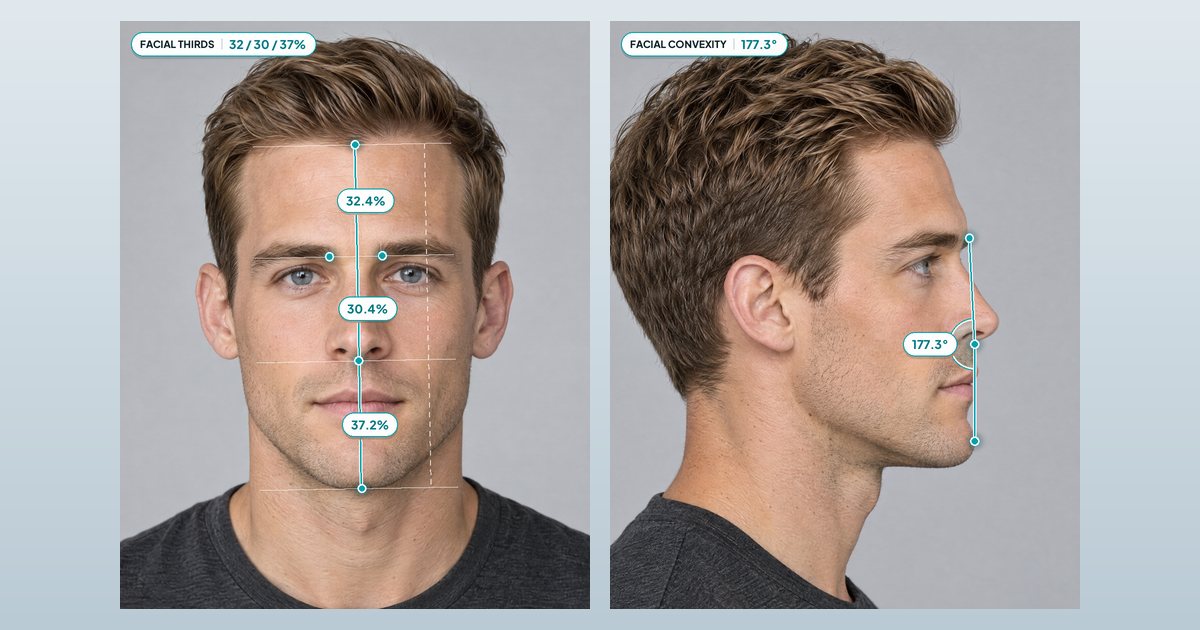
In famous male faces, the lower third, from the base of the nose to the chin, was the largest,2 and our men’s ranges expect it to run a little longer than the other two.
Equal thirds is an old art rule, and when 153 young adults were measured, the classical vertical proportions fit worst of all the old canons.14 A lower face of average height rated best in a study of profile silhouettes, and longer lower faces lost more points than shorter ones.6 So “a little longer” means a little. The lower third holds the jaw and chin, which is why it carries so much of what reads as male.
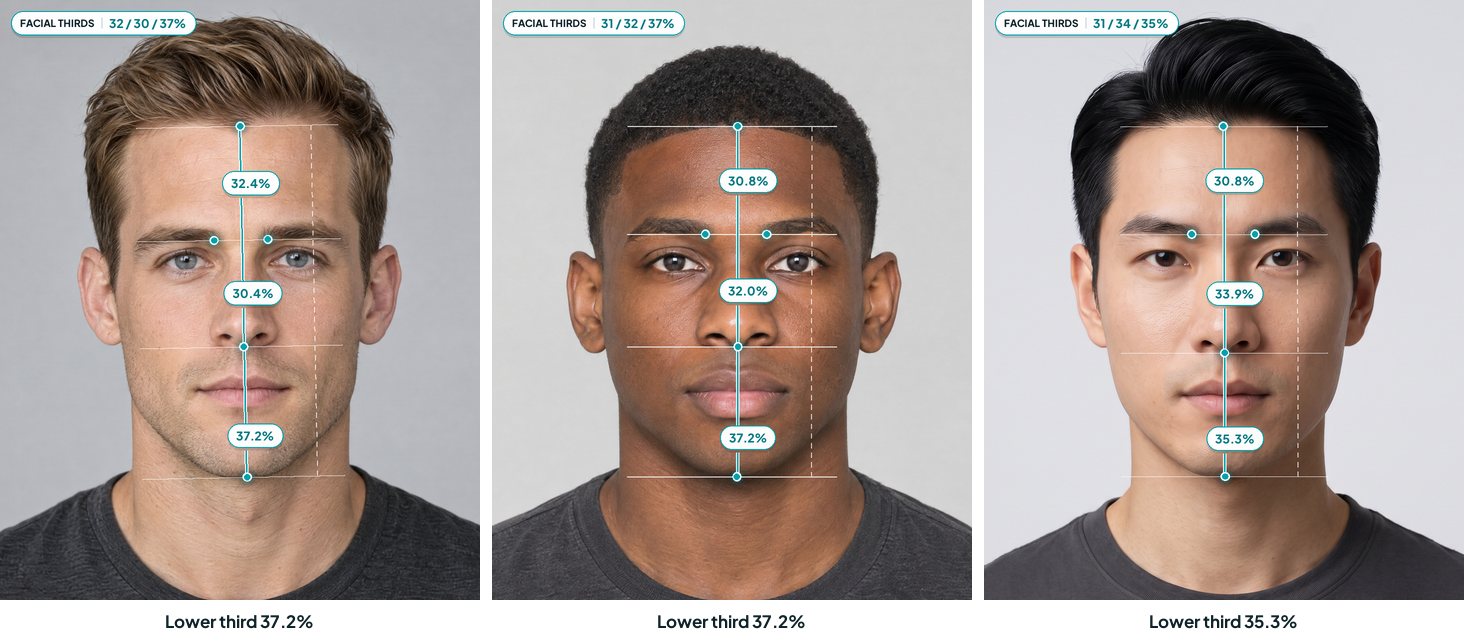
Our men’s range for the lower third is 33.9 to 37%, against 30 to 33.1% for women: about 7 mm apart on a face 19 cm tall (estimated), the widest gap of the three thirds. Only the man in the header image has all three thirds inside his ranges. The other two run long at the bottom, 37.2% each, and the man from our sample report also misses narrowly at the top and middle, yet still scores 7.04, second best here. The full thirds table has the rest.
The perfect male face and symmetry
Is there a perfect or ideal male face? No. Even the best of our three sits inside his ideal range on 29 of 66 measurements, against 20 each for the other two, and all three score Good. The closest research gets is an average face: faces nearer the average shape rate a bit higher, but the effect is weak.12 The golden ratio fares no better: it wants a face 1.618 times as long as it is wide, and our men’s range for that ratio, measured to cheekbone width, is 1.34 to 1.37.
Symmetry, the other thing forums swear by, barely separates our faces: 9.62 to 9.77 out of 10, and the top scorer is the least symmetric. The research splits the same way masculinity did: symmetry judged by raters went with attractive men’s faces,4 while asymmetry measured from landmarks did not predict attractiveness in a set of men’s and women’s faces.12 Our guess is that when people like a face, they also see it as more symmetric.
How to check your own face with two phone photos
You can measure the drawn lines on a computer, in any editor that shows the cursor position, such as Paint, GIMP or Photopea. Skin and leanness you judge by eye.
- Take a front photo and a true side photo the way our scans are taken. Have a friend use the rear camera, or prop the phone up on a timer. Stand about 1.5 m (5 feet) away with the phone zoomed in and the lens at eye height: chin level, jaw relaxed, lips closed, hair off your forehead, window light, no filter. The full photo checklist explains why distance matters.
- Jaw to cheekbones. Mark the widest points of your cheekbones, just in front of your ears and a little below eye level (the dashed line in the jaw figure near the top of this page), and your jaw corners, where the outline turns toward the chin, about level with the mouth. Divide jaw width by cheekbone width and multiply by 100. On the man from our sample report, 565 px / 634 px = 89.1%. Men’s range: 87.5 to 91.5%. Women’s: 84 to 88%. Clenching or a slight head turn changes the visible width, so keep the jaw relaxed and face the camera square on.
- Thirds. Mark your hairline, brow level, the base of your nose and the bottom of your chin, the same four level lines as in the thirds figure, then divide each gap by the total. Sample: 289, 271.5 and 331.5 px of 892 = 32.4, 30.4 and 37.2%. If your hairline has moved back, trust the lower third more than the top one.
- Brows. As in the brow close-up, draw a line from the middle of the inner brow to the middle of the arch, not to the tail, and note how far it rises and runs across. The angle is about 57 x rise / run, so 14 px up over 100 px across is about 8 degrees (men 6.5 to 11, women 10.5 to 15; the canthal tilt method uses the same math). Then add the head-to-tail spans of both brows, measured straight across, and divide by cheekbone width: men 0.69 to 0.76, women 0.65 to 0.72.
- Chin in profile. Level the side photo on the line from the top of your ear opening to the lower rim of your eye socket. Draw a vertical line through the dip at the top of your nose. Our ranges put the chin 1.5 to 15 mm in front of it, for men and women alike. Behind the line isn’t the same as a recessed chin: our report still scores a chin 4.9 mm behind it Great. To turn pixels into mm, divide 190 by your hairline-to-chin height in pixels on the same photo: that’s mm per pixel, the same 19 cm our scans assume.
- Leanness and skin. In daylight, unfiltered, check for a clear line under your jaw and chin, and look at how healthy your skin looks.
- Count how many traits land inside the ranges, then stop counting. Each of our three example faces misses the range on at least two of the lines above, and all three score Good. If some of yours land outside, the next section covers what is yours to change.
Hand marks are rough. Six pixels on a 634 px cheek width move the ratio by about 1 point, and every mm value is an estimate.
A report does the whole job on both photos: software places the points (how that works), draws all 65+ measurements and adds 46 visual ratings for what a ruler can’t measure, such as definition, leanness, skin and grooming.
What you can change, starting with face fat
Bone sets most of what the sections above measure. Everything below is yours to change, roughly in order of how strong the evidence looks to us. Change one at a time and photograph it the same way each time, so you can tell whether it worked.
A leaner face
Face fat was the single biggest cue in one study of 101 men photographed the same way, with more fat counting against. It outweighed masculinity and symmetry.4 That study compared different men and followed no one who lost weight, so it can’t promise a change. Our scoring leans the same way, though: how lean the cheeks look and how clean the line under the chin is make up a third of the Angularity pillar. If you carry extra weight, losing some with food and exercise you can keep up is where that study points first. Stop before your cheeks look hollow.
Healthy-looking skin
Healthy-looking skin made men’s faces more attractive even with face shape held the same,7 while measured skin color (how light, red or yellow it was) did not predict attractiveness in one Western Australian sample.4
Skin is the heaviest of the 8 groups in our Features pillar, yet it cost our three clear-skinned faces only 0.12 to 0.23 points. The rest of their Features loss was spread across small details such as creasing and under-eyes. If you want a routine, keep it simple: daily sunscreen, a gentle cleanser, a moisturizer and enough sleep.
Heavy stubble over a full beard
Heavy stubble, about 10 days of growth, came out above a full beard when 1,453 women and 213 men rated a set of 12 men, three at each of four lengths of facial hair. Clean-shaven came last every time. Beards and clean shaves both gained when they were rare, a sign that fashion moves the target.8 In our scoring, facial hair is 4 of 99 Masculinity points, so going from none to full moves that pillar by 0.4 at most. The man in the brow close-up is clean-shaven in his photos and gets 4 for Facial Hair, against 7 and 6 for the other two. Try about 10 days of growth with a clean neckline and cheek line, then judge it on your own photo. If it grows in patchy, keep it shorter and judge that instead.
Fuller brows and tidy hair
Brow length is the line on this page your grooming moves most: tweezers can shorten it and a brow pencil can extend it. Reshaping the arch can shift the brow tilt as well. Our three faces measure 0.61 to 0.62, short of the men’s range of 0.69 to 0.76 (women 0.65 to 0.72). That range is ours; the research we found tested brow thickness, not length. On a face about 135 mm wide, roughly 5 mm more per tail would lift 0.61 to 0.69 (estimated).
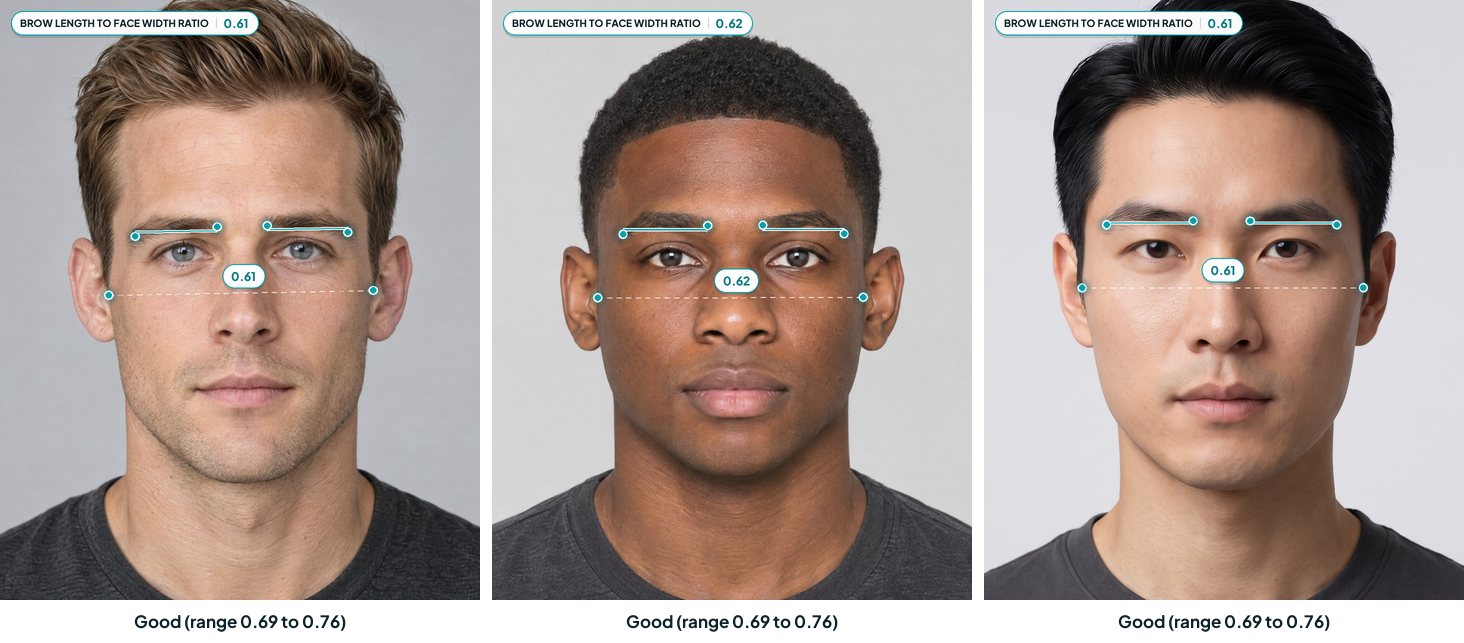
So tidy between the brows, let the tails grow out, and if you trim, cut only the long hairs, never the outline. Sparse tails shorten the measured span, and a brow pencil or gel can fill them in.
Hairline and hair length carry only 8 of the 99 Masculinity points, but Features rates hair again, for hair loss, thinning and dryness. On the man from our sample report, those cost more than his skin did, 0.40 points against 0.18. Dryness is the one a good conditioner helps with. A regular trim keeps the cut tidy, and if your hair is thinning, a shorter cut usually makes it less obvious in photos.
A relaxed smile, in the right photos
Smile in the photos people see: social, work and most dating photos. Men were rated sexier looking proud than happy in that 2011 study, so a dating profile can carry both: a relaxed smile and one calm, confident shot. A smile also shows your teeth, so everyday brushing and flossing count here too. Keep the smile out of a measurement photo. It lifts the cheeks and pulls the mouth corners, which moves several of the lines on this page, so our scans ask for lips closed and jaw relaxed.
Questions people ask
What features make a man handsome?
A jaw nearly as wide as the cheekbones, full brows (our ranges also expect them fairly flat), a lean face, healthy-looking skin, masculine features balanced by softer ones such as a relaxed smile, and a lower third a little longer than the other two. No single feature decides it: in a 2018 test of five features, each carried only 18 to 21% of the weight in attractiveness ratings.
What makes someone handsome?
Handsome is mostly said of men, and the research centers on men's faces: a lean face, healthy-looking skin, full brows, a jaw almost as wide as the cheekbones and some masculinity, but not the most. A few cues hold for anyone: faces closer to the average shape rate a little higher, and thicker brows helped on women's faces as well as men's. About half of anyone's taste in faces is personal.
What is the most attractive facial feature on a man?
No single feature wins. When a 2018 study changed five features at once, brow thickness carried 21% of the weight, the jaw and face height 20% each, eye size 19% and cheekbones 18%, so the gaps were small. Of the cues you can change, how lean the face looked had the strongest link to ratings in a study of 101 men. And only about half of anyone's taste in faces is shared.
What makes a man attractive to a woman?
On the face, mostly a mix of mature and youthful features. In classic studies from 1990, women rated men with a large chin and prominent cheekbones, plus large eyes and a big smile, as more attractive, though a 2018 test gave cheekbones and eye size the least weight. In one large study, women on average preferred slightly masculine faces, but only mildly, and the preference did not clearly track their hormone levels. About half of anyone's taste in faces is personal.
What makes a man attractive physically?
On the face, looking lean was the strongest predictor of ratings in one study of 101 men, ahead of masculinity, symmetry and averageness. Healthy-looking skin also helped, even with face shape held the same, and in a 2018 test the jaw and brows counted a bit more than the cheekbones. Height and build count too, but a face photo can't show them, so a face analysis leaves them out.
What is the difference between handsome and cute?
Our reading of the research: cute leans on youthful features such as large eyes and a softer face, rugged leans on mature ones such as a large chin and a heavy brow, and handsome usually combines the two. In classic studies from 1990, women rated men with that mix as more attractive, and the most mature-looking faces did not score highest. Neither word has a measurement behind it.
Is there a perfect male face?
No. People share only about half their taste in faces, so no single face wins with everyone, and the old artists' proportions, equal thirds included, fit real faces poorly when they were measured. Our analysis uses ranges instead of one ideal face. Even the best of the three example faces we measured sits inside his ideal range on 29 of 66 measurements, and all three still score Good. The highest scorer of the three also has the least symmetric face.
Can you become more handsome?
Yes, within limits. Bone sets your jaw width, brow ridge and proportions, but several cues are yours to change. A leaner-looking face was the strongest predictor of ratings in one study of men, healthy-looking skin helps, heavy stubble was rated above clean-shaven, thicker brows were preferred, and a relaxed smile usually helps in the photos people see. Change one thing at a time and compare photos taken the same way, at the same distance and in the same light.
Sources
-
Cunningham MR, Barbee AP, Pike CL. What do women want? Facialmetric assessment of multiple motives in the perception of male facial physical attractiveness. J Pers Soc Psychol. 1990;59(1):61-72. doi:10.1037/0022-3514.59.1.61. Abstract on PubMed ↩↩↩↩↩
-
Grillo R, de Andrade TJD, Rodrigues dos Santos LA, Samieirad S, Fernandes LA, Melhem-Elias F. Frontal facial analysis of male celebrities attractiveness standards through artificial intelligence. J Stomatol Oral Maxillofac Surg. 2026;127(4):102776. doi:10.1016/j.jormas.2026.102776. Abstract on PubMed ↩↩↩↩↩↩
-
Mogilski JK, Welling LLM. The relative contribution of jawbone and cheekbone prominence, eyebrow thickness, eye size, and face length to evaluations of facial masculinity and attractiveness: a conjoint data-driven approach. Front Psychol. 2018;9:2428. doi:10.3389/fpsyg.2018.02428. Full text on PMC ↩↩↩↩↩↩
-
Foo YZ, Simmons LW, Rhodes G. Predictors of facial attractiveness and health in humans. Sci Rep. 2017;7:39731. doi:10.1038/srep39731. Full text on PMC ↩↩↩↩↩↩
-
Geniole SN, Denson TF, Dixson BJ, Carré JM, McCormick CM. Evidence from meta-analyses of the facial width-to-height ratio as an evolved cue of threat. PLoS One. 2015;10(7):e0132726. doi:10.1371/journal.pone.0132726. Full text on PMC ↩
-
Johnston DJ, Hunt O, Johnston CD, Burden DJ, Stevenson M, Hepper P. The influence of lower face vertical proportion on facial attractiveness. Eur J Orthod. 2005;27(4):349-354. doi:10.1093/ejo/cji023. Abstract on PubMed ↩↩
-
Jones BC, Little AC, Burt DM, Perrett DI. When facial attractiveness is only skin deep. Perception. 2004;33(5):569-576. doi:10.1068/p3463. Abstract on PubMed ↩↩
-
Janif ZJ, Brooks RC, Dixson BJ. Negative frequency-dependent preferences and variation in male facial hair. Biol Lett. 2014;10(4):20130958. doi:10.1098/rsbl.2013.0958. Full text on PMC ↩↩
-
Germine L, Russell R, Bronstad PM, et al. Individual aesthetic preferences for faces are shaped mostly by environments, not genes. Curr Biol. 2015;25(20):2684-2689. doi:10.1016/j.cub.2015.08.048. Full text on PMC ↩
-
Tracy JL, Beall AT. Happy guys finish last: the impact of emotion expressions on sexual attraction. Emotion. 2011;11(6):1379-1387. doi:10.1037/a0022902. Abstract on PubMed ↩
-
Jones BC, Hahn AC, Fisher CI, et al. No compelling evidence that preferences for facial masculinity track changes in women’s hormonal status. Psychol Sci. 2018;29(6):996-1005. doi:10.1177/0956797618760197. Full text on PMC ↩↩
-
Lee P, Li J, Rafiee Y, Jones BC, Shiramizu VKM. Further evidence that averageness and femininity, rather than symmetry and masculinity, predict facial attractiveness judgments. Sci Rep. 2025;15(1):5498. doi:10.1038/s41598-025-86974-0. Full text on PMC ↩↩↩
-
Scott IM, Clark AP, Josephson SC, et al. Human preferences for sexually dimorphic faces may be evolutionarily novel. Proc Natl Acad Sci U S A. 2014;111(40):14388-14393. doi:10.1073/pnas.1409643111. Full text on PMC ↩
-
Farkas LG, Hreczko TA, Kolar JC, Munro IR. Vertical and horizontal proportions of the face in young adult North American Caucasians: revision of neoclassical canons. Plast Reconstr Surg. 1985;75(3):328-338. doi:10.1097/00006534-198503000-00005. Abstract on PubMed ↩
Spotted a mistake? Email support@faceratinglab.com and we will fix it. First published .