Recessed chin or head angle? How to check yours and what helps
A recessed or receding chin sits well back from a line dropped straight down from the root of your nose, seen side-on with your head level. By orthodontic norms, anywhere from about 11 mm behind that line to 15 mm in front is normal, so a chin that sits a little behind it is nothing unusual.
The short version
- Check your head angle before your chin. All three of our example side photos were tilted, and leveling them moved the chin reading by 4.2 to 8.9 mm, about 1.9 mm for each degree of tilt.
- Sitting a little behind the line doesn't make a chin recessed. Our report still scores a chin 8 mm behind it Good, 6.2 out of 10, and only calls it a focus area past about 11.7 mm behind, just beyond the orthodontic normal range.
- In rating studies a chin moved up to 4 mm either way was barely noticed, and a chin pushed too far forward was rated worse than one set slightly back.
- A side photo shows the skin outline, so it can't tell a small chin from a set-back jaw. If your upper front teeth sit well ahead of the lower ones with your back teeth together, that part is a question for a dentist.
- No trial shows that jaw exercises move an adult chin. The biggest change you control is the photo, with your head level and the camera 1.5 m away. After that comes the line under the chin, with a long neck, a short beard with the neckline set just under the jaw for men and contour under the jaw edge for women.
Before you decide you have a recessed chin, check how you held your head. On a side photo, each degree you tuck or lift it moves your chin about 1.9 mm against a line drawn straight down the photo from your nasal root. Tuck 5 degrees for a selfie and a chin at the textbook norm, about 2 mm in front of that line,1 reads about 7 mm behind it.
It works the other way too. The man in one of our example photos had his head tipped back 5 degrees, and his chin read 4.0 mm in front of the line. Leveled, it sits 4.9 mm behind. That still scores Great, 8 out of 10, and his face has the top score of our three examples.
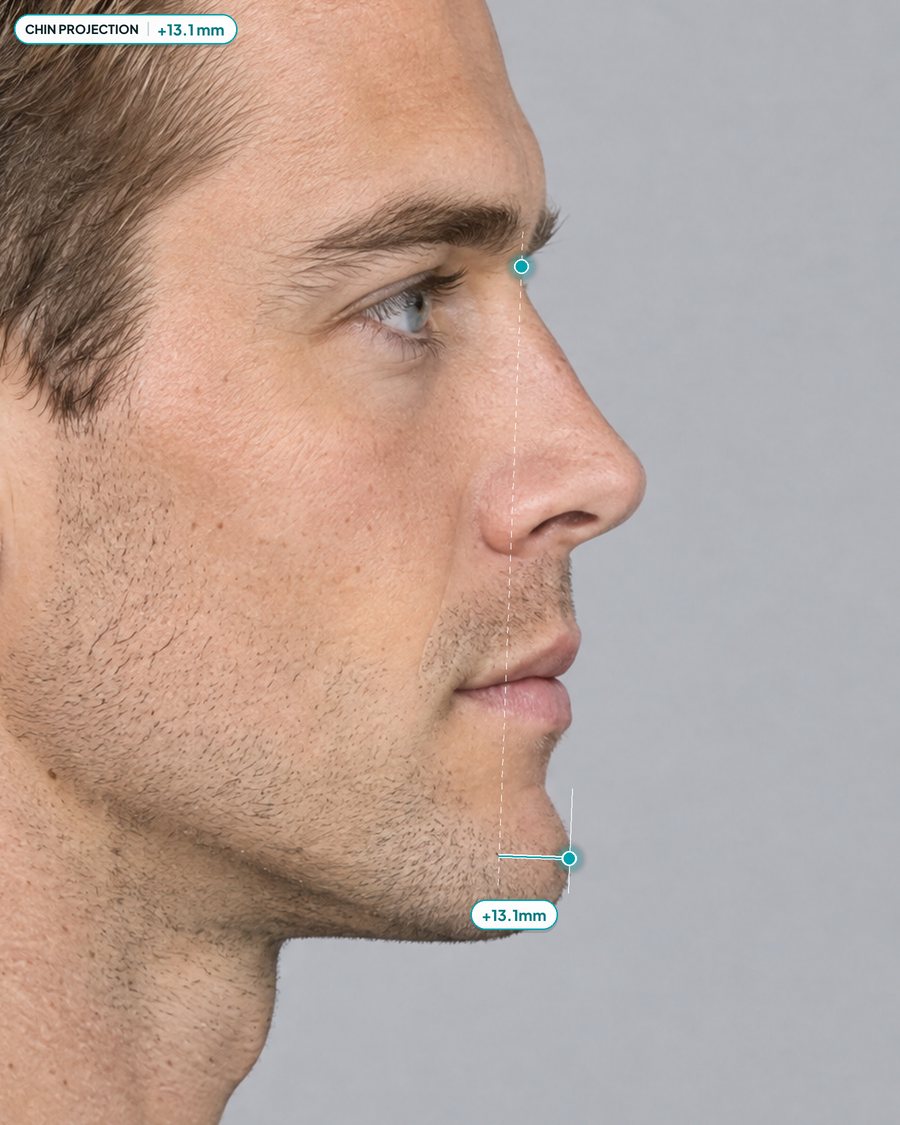
So level the photo first, then judge the chin. The seven-step check below needs only your phone and its photo editor.
Is it a recessed chin or just your head angle?
Often it’s the angle. On our example faces the chin sits 104 to 110 mm below the nasal root, so a small nod swings it a long way against a line that starts at the top. It goes back when you tuck and forward when you lift. It’s plain geometry. About 7 degrees carries a chin across our whole 13.5 mm ideal range.
And people carry their heads differently. A 2025 study took side X-rays of 81 orthodontic patients aged 16 to 30 in their natural head position. On average their ear-to-eye-socket line, the Frankfort plane, sat almost level, but individuals ranged from about 9 degrees below level to 8 above.2 So standing naturally doesn’t guarantee a level photo. Leveling on your own ear and eye socket is the best simple fix, though even that line is only a stand-in for true level.
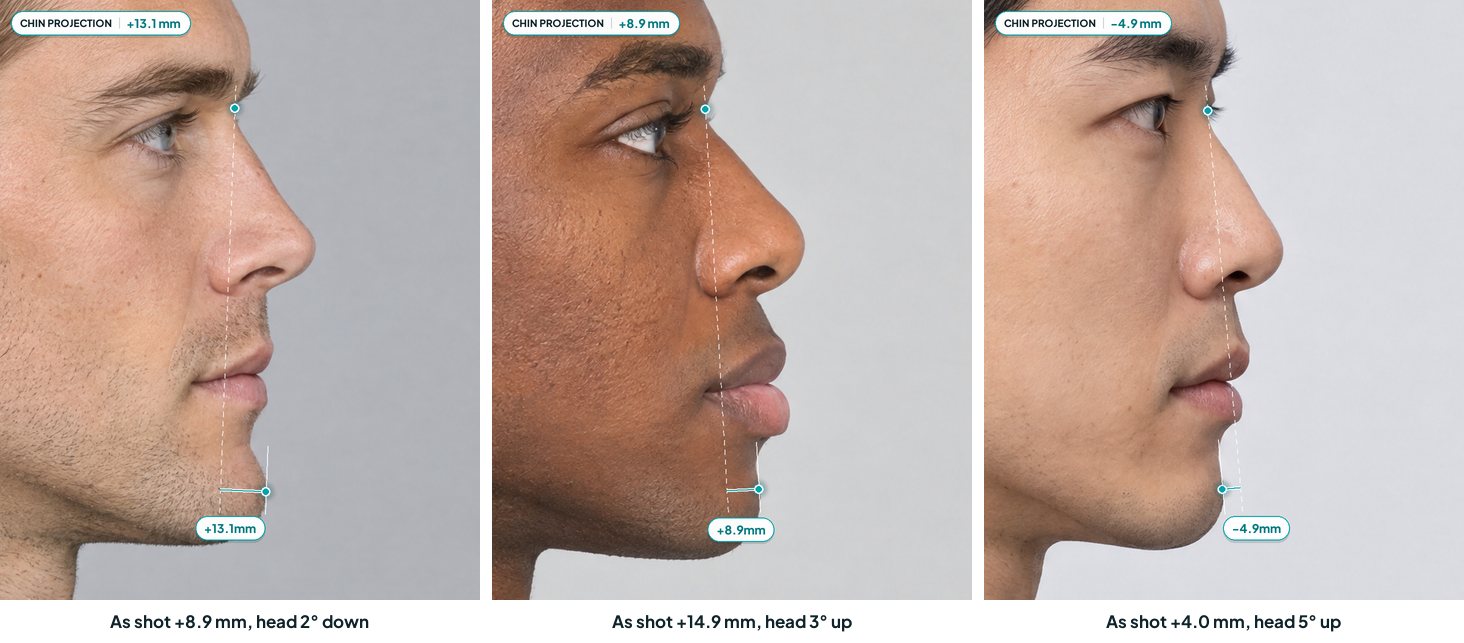
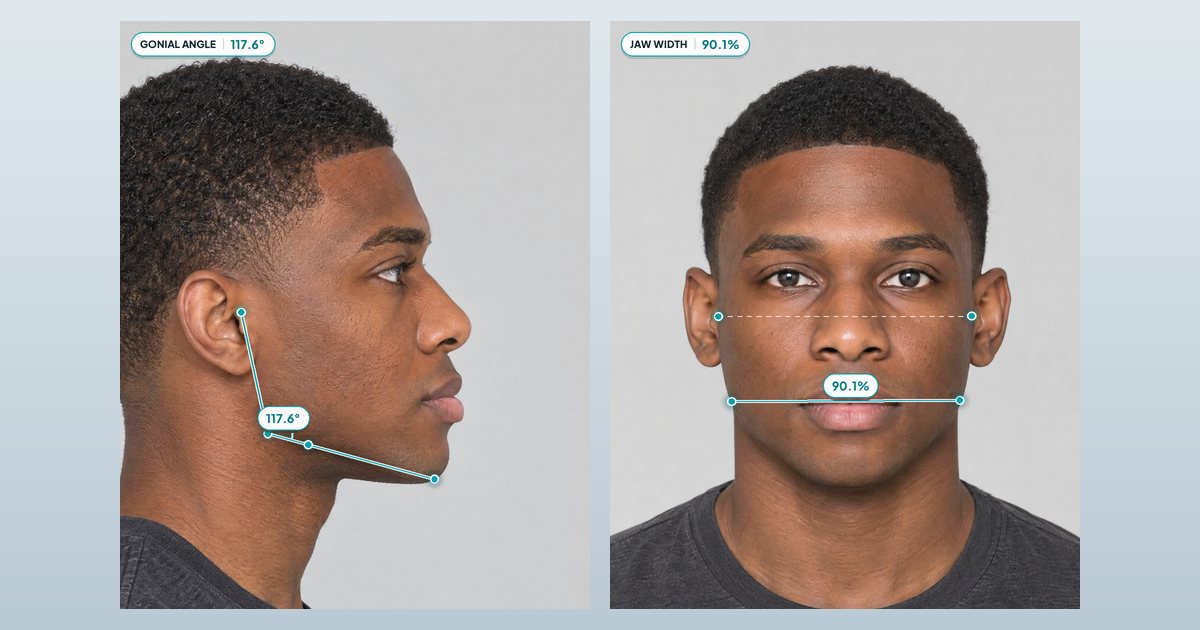
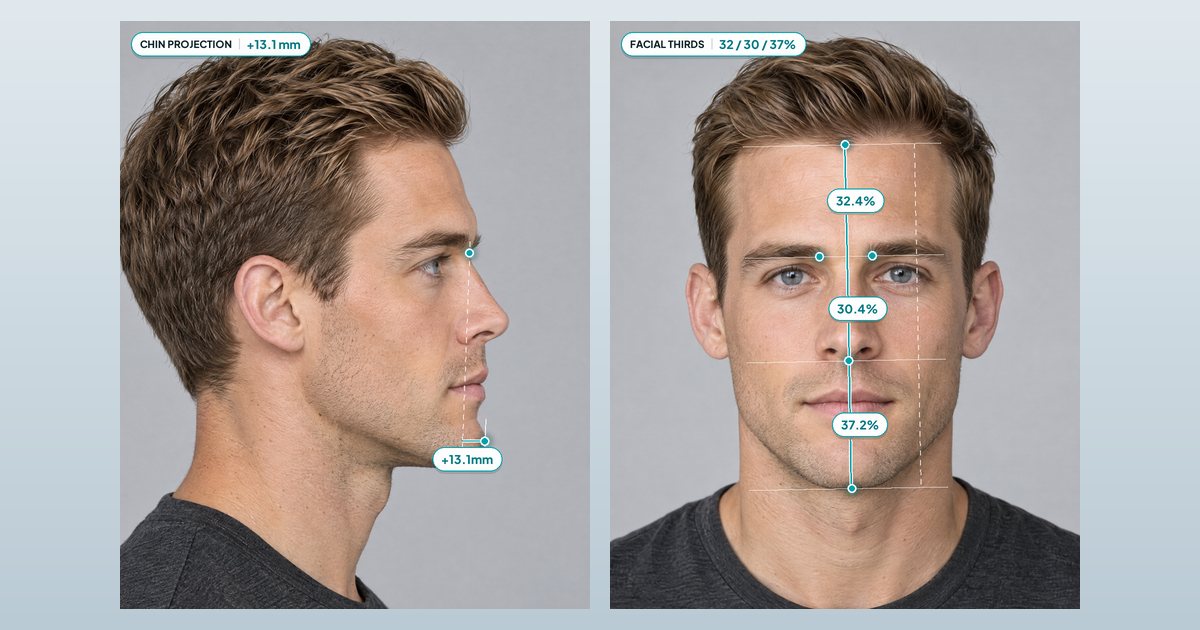
None of our three side photos was level. The first man’s head was 2.2 degrees down: +8.9 mm as shot, +13.1 leveled. The second was 3.2 degrees up: +14.9 as shot, +8.9 leveled. The third you’ve met. On his raw photo, the most set-back chin of the three would have passed as inside our ideal range.
Leveling undoes a tilted head, and nothing else. A slightly open mouth swings the jaw down and back, and by our own rough geometry 3 degrees of opening pulls the chin back about 4 to 5 mm. A neck craned forward or pulled into the collar changes the soft tissue under the chin. Turning your face toward the camera matters far less. A 20-degree turn shrinks the reading by only about 6%.
Our report levels every side photo before measuring, and tells you when your head was tilted 6 degrees or more.
Normal chin projection, and how far back counts as recessed
The orthodontist Reed Holdaway’s profile norm puts the chin about 2 mm in front of the nasal-root line, with a normal range from about 11 mm behind it to 15 mm in front.1 By these norms, a chin between the line and about 11 mm behind it is set back but normal. Only past that does it count as recessed.
Those millimeters are converted from Holdaway’s soft-tissue facial angle, so they’re approximate.1 Real groups land either side of the norm. Polish 17- to 19-year-olds averaged about 3 mm behind the line,1 and 120 young people in a standardized photo study about 2.5 mm in front of it.3
Surgeons call this line the zero meridian.4 Our report calls the gap to it Chin Position Relative to the Frankfort Plane, shortened to Chin projection on the images here. If another app showed you a number called recession relative to the Frankfort plane, it’s this same gap. Just check which way that app counts plus and minus.
Our ideal range is +1.5 to +15 mm, for men and women of every heritage. It leans forward of the textbook norm, so don’t take Great as a near miss. A chin 2 mm behind the line still scores 9.4 out of 10.
| Chin position on a leveled photo | What it means | Our report (score out of 10) |
|---|---|---|
| +15 to about +21.5 mm | Ahead of the clinical normal range | Great (8.7 at +20 mm); lower beyond |
| +1.5 to +15 mm | Our ideal range; Holdaway’s norm (about +2 mm) sits at its back edge | Ideal (10) |
| Just under +1.5 to -5 mm | Common, inside the normal range | Great (9.9 at 0 mm, 8.0 at -4.9 mm) |
| -5 to -8.3 mm | Still inside the normal range | Good (6.2 at -8 mm) |
| -8.3 to -11.7 mm | Near the back edge of the normal range | Fair (5.0 at -10 mm) |
| Beyond -11.7 mm | Behind the clinical normal range | Focus area (3.8 at -12 mm) |
If yours lands in the last row, that’s less common, and worth a second look before you decide anything. Retake the photo if your head was tilted, then take the bite photo in step 7. The ways to make a recessed chin look stronger work at any number.
The opposite of a recessed chin is a prominent one. It sits more than about 15 mm in front of the line, past the front edge of the normal range.1 Our report still scores +20 mm Great. In rating studies, though, a chin pushed too far forward was liked less than one set slightly back.10
How to tell if your chin is recessed from a side photo
Take a level side profile photo, draw the line from your ear to your eye socket, drop a line from your nasal root square to it, and see where the front of your chin lands. By orthodontic norms, anywhere from about 11 mm behind that line to 15 mm in front is normal.1 Our report scores 1.5 to 15 mm in front as Ideal. Only past about 11.7 mm behind does it call a chin a Focus area.
- Ask a friend to stand about 1.5 m (5 feet) away, or prop your phone at face height and use the timer. Rear camera, 2x zoom, fully side-on, whole head in frame, ear included.
- Look straight ahead at a mark on the wall at eye height. Back teeth lightly together, lips relaxed, no smile, hair behind your ear. Don’t tuck or lift your chin. Stand the way you normally do, and let step 4 take out whatever tilt is left.
- On the photo, find the small flap of skin in front of your ear hole and put one dot in the notch just above it. Put another on the lowest point of the bony rim under your eye (feel for it first). The line through the two dots is a photo version of the Frankfort plane, your head’s own horizontal.
- Rotate the photo with your editor’s straighten tool until that line is level. The angle you needed is your head tilt. If it was more than about 6 degrees, retake the photo, because a tucked or craned neck also changes the soft tissue under the chin.
- Draw a vertical line down from the deepest point between your brow and nose (the nasal root). The grid most editors show while you straighten gives you one to follow. Measure the horizontal gap from it to the most forward point of your chin. In front is plus, behind is minus. Any unit works, even millimeters with a ruler held to the zoomed screen, as long as you use the same one in step 6. If your chin touches the line or sits in front, you can stop there, because that almost always scores Great or Ideal.
- Turn your gap into real millimeters. Measure the height from your nasal root down to the level of your chin point (the same point as in step 5), in the same unit. Each 1% of that height is roughly 1 mm, because our report assumes a 190 mm hairline-to-chin height, which puts this span at 104 to 110 mm on the example faces. So a gap of 3 on a height of 60 is 5%, about 5 mm. Check your number against the table above.
- Do it on two more photos and average them; a few millimeters of spread is normal. Then take one more side photo with your back teeth together and your lips pulled apart so your front teeth show. If your upper front teeth sit well in front of the lower ones, your jaw position may be part of what you see, and that’s a question for a dentist or orthodontist.
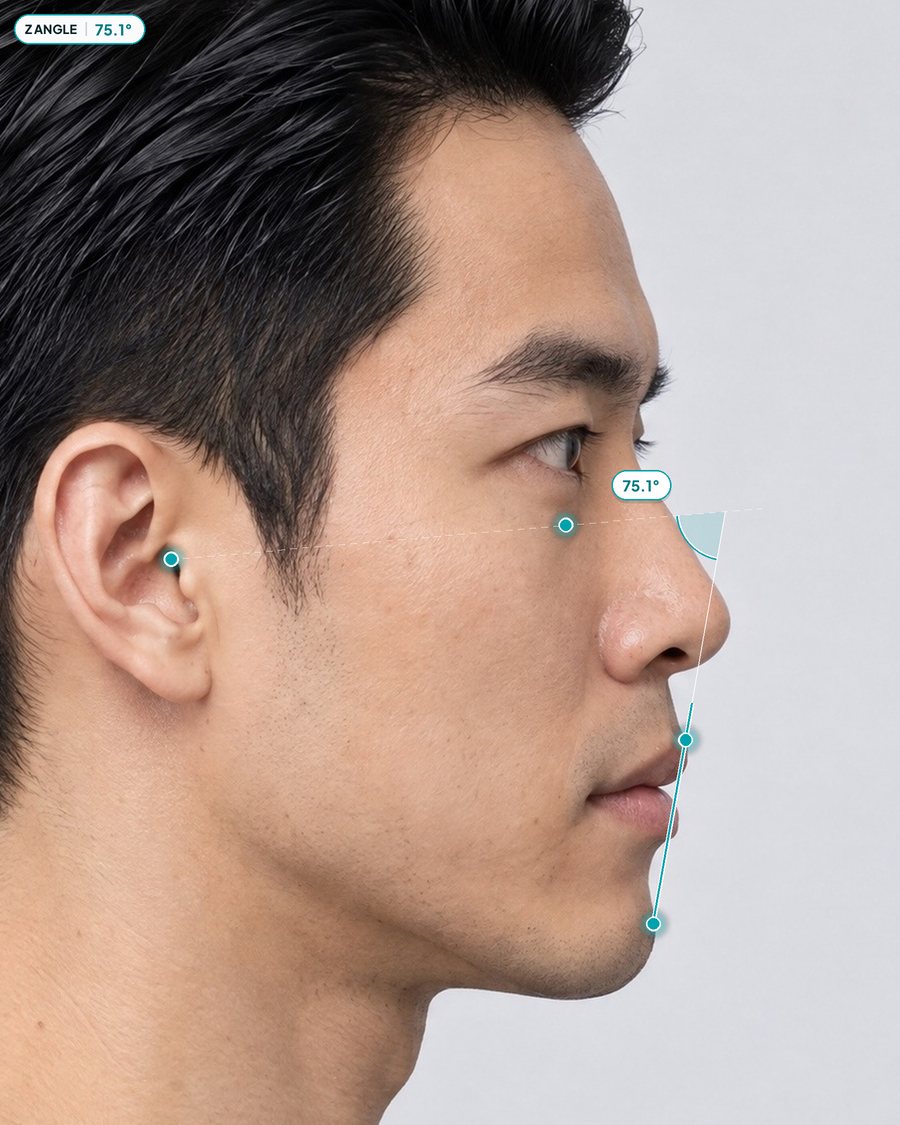
One limit covers this whole page. A photo measures the skin outline people see, and the bone underneath can sit differently. Photo and X-ray versions of the same facial angle agreed only loosely in 120 people (a correlation of 0.37, where 1 is a perfect match).3 A photo also can’t tell a small chin from a set-back jaw, and the bite photo is only a rough guide. Clinicians use an exam and, if needed, a side X-ray of the head called a cephalometric X-ray.7
Recessed chin vs weak chin vs recessed jaw
A recessed chin is the look in profile, with the chin sitting well back from the rest of the face. A recessed jaw is one cause, where the whole lower jaw (the mandible) sits back from the upper jaw. Weak chin is the everyday word for either, and for a chin that’s short from the front. Cleveland Clinic gives retrognathia, a set-back lower jaw, as the medical term for a receding chin, and keeps it apart from a small jaw (micrognathia).7
| Term | What it usually means | On a side photo |
|---|---|---|
| Recessed chin, receding chin or sunken chin | The front of the chin sits well back from the rest of the profile | Chin well behind the nasal-root line |
| Weak chin | Used loosely for a chin that is set back, short, or both, or a soft line under the chin | Set back, short from the front, or a blunt chin-neck angle |
| Small chin | The chin itself is small, with a normal jaw and bite | Set back or short, while the teeth meet normally |
| Recessed jaw or recessed lower jaw (retrognathia) | The whole lower jaw sits back from the upper jaw; the chin itself is often average size | Chin behind the line, sometimes with a steeper jaw line; on the bite photo, lower front teeth well behind the upper ones |
| Small jaw (micrognathia) | The lower jaw itself is small, so the chin looks small too | Looks much the same as a recessed jaw |
Our report has no single weak-chin number. It checks the two things people mean most often, forward position on the side photo and chin height on the front. Height is the chin-to-philtrum ratio, chin height against the groove above your lip, with an ideal of 2.15 to 2.45x for men and 2.1 to 2.4x for women. The third face reads 2.10x, just under his range. So on both checks he sits a little outside ideal, and both still score Great.
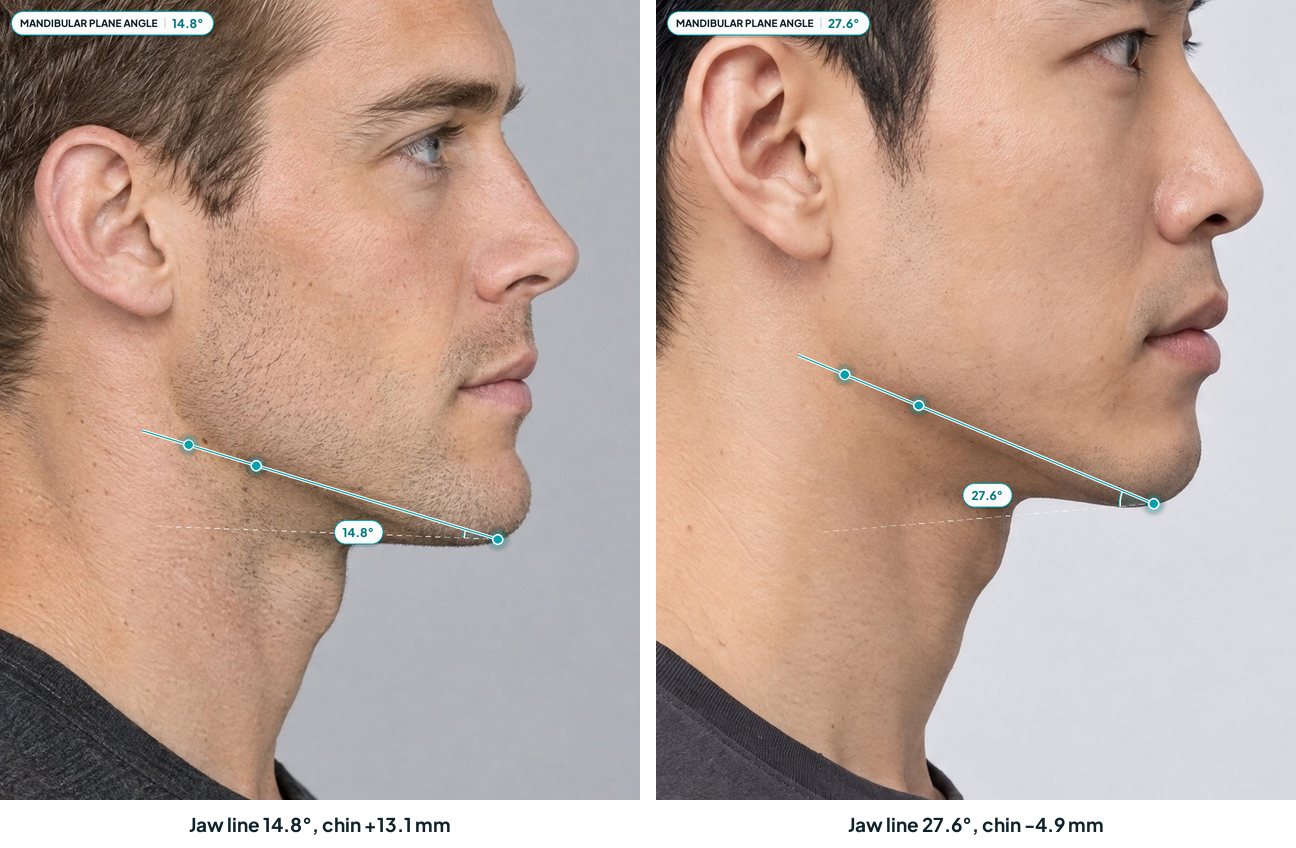
Three faces only illustrate the pattern. The report itself warns that jaw slope alone “cannot establish growth direction, bite pattern or jaw recession.” If your own jaw line looks steep, the gonial angle is the number to check next. It measures the jaw corner on the same side photo.
The bite is the better clue. A set-back lower jaw often comes with lower front teeth well behind the upper ones, which is why step 7 has you photograph it. Plenty of people call that an overbite, though dentists keep the word for upper teeth that overlap the lower ones too much.7
What causes a recessed chin
Mostly, you’re born with it. A set-back jaw sometimes runs in families or comes with a rare condition, and injury or childhood habits like thumb sucking account for some later cases.7 In adults, the soft tissue over the bone keeps changing, mostly with body weight.8 Under the chin, extra tissue shows in the chin-neck angle, which our report measures separately (more under posture below).
Posture gets blamed a lot online. Forward head posture and a set-back lower jaw do turn up together in studies, but the studies can’t show which causes which, and none shows that fixing posture moves the chin.12
Does a recessed chin affect attractiveness?
Less than people fear. A 2012 study had patients, clinicians and laypeople rate one idealized profile with the chin moved in 2 mm steps. Up to 4 mm either way was “essentially unnoticeable”, and raters only started to want a change beyond 10 mm back or 6 mm forward.9
A 2013 study of 130 raters found chins pushed forward less attractive than chins set back. The top-ranked profile had its chin 4 mm behind the study’s reference line, with the chin on the line a close second, and men and women ranked the images the same way.10 Both studies moved the chin of one idealized profile against a true vertical line (through the base of the nose in the 2012 study). Their millimeters tell you how much change people notice; they don’t map onto our line.
That third man, the one whose tilted photo flattered him, has the best overall score of the three (7.12, against 7.04 and 6.68). His facial convexity and lower-lip position are both Ideal, so his chin sits in balance with his nose and lips. The most forward chin, +13.1 mm, gives the first face a Fair Z angle, because it sits far ahead of his lips.
| Other side-photo numbers that change how a chin looks | What it adds | Our ideal range (men / women) | Our example faces |
|---|---|---|---|
| Z angle | Chin-to-upper-lip line against the ear-to-eye-socket line; head tilt can’t change it | 78 to 82 / 76 to 80° | 89.6 (Fair), 76.5 (Great), 75.1 (Great) |
| Lower lip to E-line | Where the lower lip sits against the nose-tip-to-chin line (plus = behind it); a set-back chin moves the line back | 1.1 to 4.4 / 0.4 to 3.7 mm | +5.2 (Great), -4.3 (Focus area; lip ahead of the line, chin Ideal), +1.1 mm (Ideal on his range, 0.1 to 3.4) |
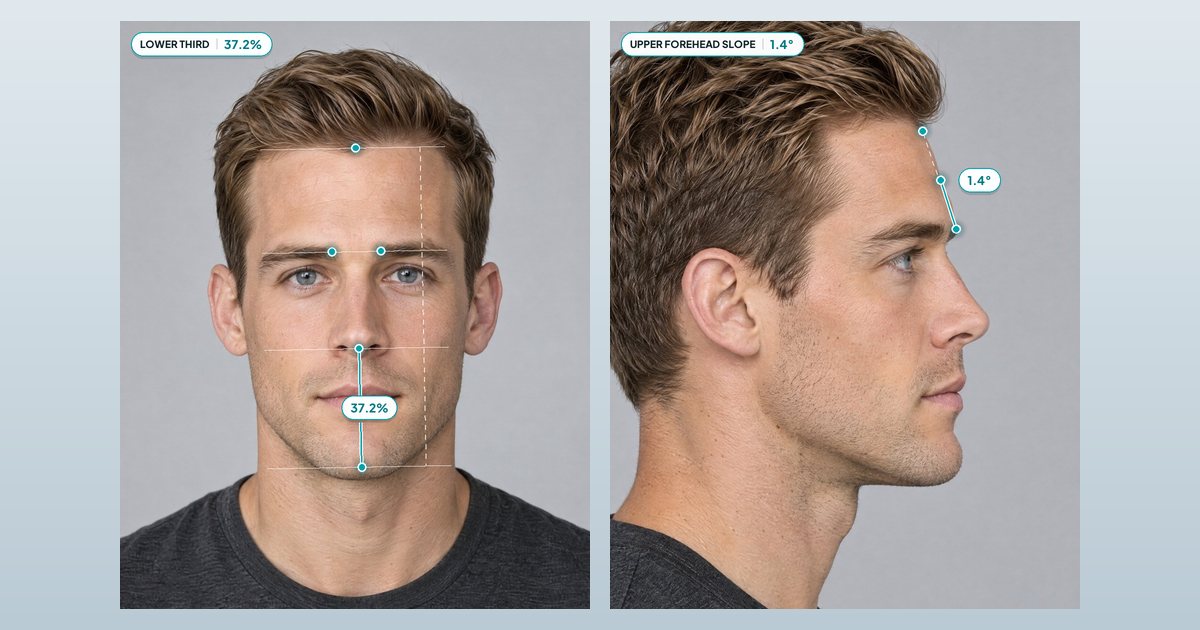
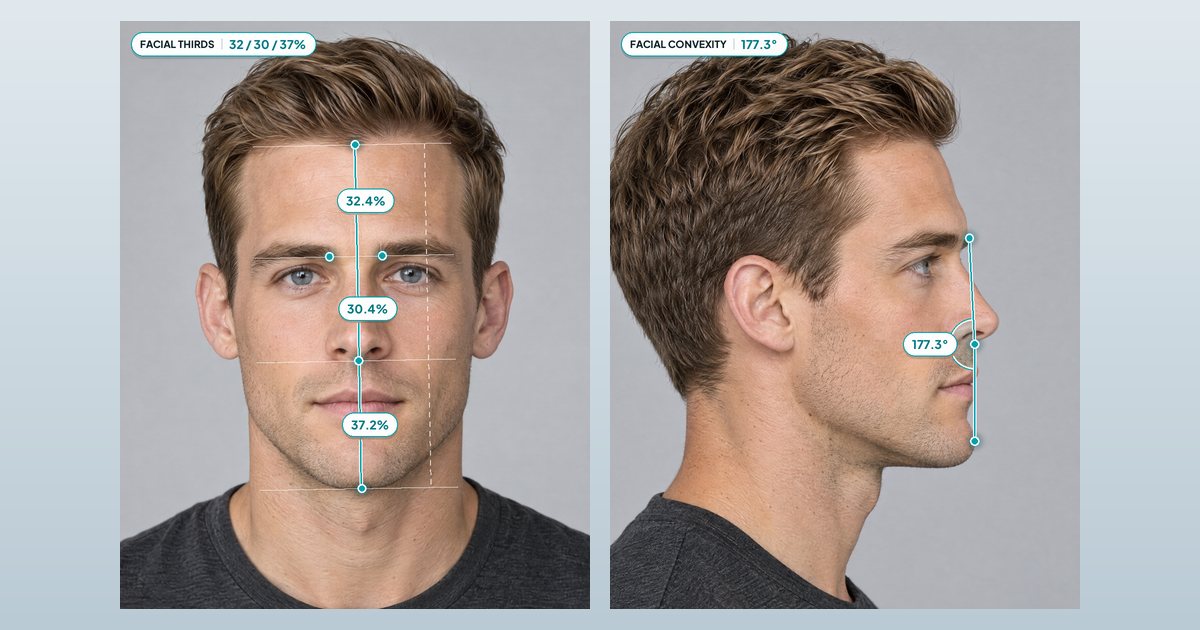
| Facial convexity | Brow, nose base and chin in one angle | 170 to 175 / 168 to 173° | 177.3 (Great), 172.6 (Ideal), 175.7 (Ideal on his range, 171 to 176) |
| Chin-neck angle | Where fat under the chin, posture and a beard neckline show | 94 to 106°, both | 122.4 (Focus area), 114.0 (Good), 113.3 (Good) |
One number never decides how a face looks, and a chin is always seen against the nose and lips around it. That’s also why no single ratio decides a harmony score. It works the other way too: a set-back chin changes how big your nose reads in profile.
If your chin sits a few millimeters behind the line and your lips sit near the E-line, there is nothing to fix.
Can you fix a recessed chin?
As an adult, you can’t move the bone of a recessed chin without a clinic. You can change how it looks.
Clinics have two routes, and age decides which. In children and teens with a mildly set-back jaw, braces and other orthodontic treatment can guide the jaws while they grow. Once growth stops, usually between 14 and 18, jaw surgery is how a clinic moves the jaw bone,7 and surgeons can also change the chin itself. Those are questions for a clinician. If you’re still growing and your bite photo shows your upper teeth well ahead, mention it at your next dental check-up.
Ignore anything that promises to fix a recessed chin naturally with exercises. No trial shows that jaw exercises or tongue posture (mewing) do it. In one randomized trial of 58 adults, the training group chewed gum three times a day for six months and the others didn’t train. Bite force went up. Jaw shape didn’t change.11
If a set-back jaw comes with loud snoring, jaw pain or trouble chewing or swallowing, see a doctor or dentist. It can go with sleep apnea and jaw-joint (TMJ) problems.7
How to make a recessed chin look stronger
If you change one thing, change the photo. It costs nothing, and on our example faces head tilt alone moved the reading by up to 8.9 mm. Whatever you try after that, check it the same way each time, with a leveled side photo from the same spot and in the same light, next to the first one.
In photos
Stand at least 1.5 m (5 feet) from the camera and zoom in. From the front, a phone at about 30 cm makes the nose look about 30% wider than at 1.5 m,13 and the chin, further from the lens, looks smaller next to it. In profile the bigger error is head angle. Keep the lens at face height and your chin level, never tucked. Five degrees of tuck costs about 9 mm.
For everyday photos, push your forehead slightly toward the camera so the jaw edge separates from the neck (a photographer’s trick, not something we’ve measured). Lifting your chin for a report photo won’t change your chin reading, because the report levels it first. It does change the chin-neck angle, so stand the way you normally do.
Posture and the angle under your chin
The angle under your chin, or chin-neck angle, is the turn between the line under your chin and the front of your neck in profile, and our report’s ideal for it is 94 to 106 degrees for men and women alike. A more open angle reads softer. None of the three example faces sits inside that range: the man in the sample report reads 122.4. It’s a strict range. A few degrees over it is no cause for worry. The report’s own note on it adds that posture moves it (“Lifting the chin can change the photographed contour”).
Stand with your head stacked over your shoulders and your neck long, never pushed forward or sunk into your collar. Two quick side photos, one each way, show the difference under your chin. If you’re an adult carrying extra weight, losing some through ordinary diet and exercise tends to thin the soft tissue under the chin too. In a large study of Caucasian adults, BMI was the factor most linked to how thick the soft tissue over the face is.8 If you’re still growing, leave weight targets out of it. The angle alone can’t tell posture from fat, though, so an open chin-neck angle doesn’t mean you need to lose weight.
A beard for a weak or recessed chin
A beard changes how much jaw size shows. In one study of face images with the lower face and jaw made larger or smaller, a bigger jaw made clean-shaven faces look more masculine but made little difference with a beard. Clean-shaven faces with small jaws got the lowest attractiveness ratings and bearded faces with smaller jaws the highest.14 The study tested jaw size and never looked at a set-back chin in profile.
Our report suggests a beard step for all three example faces, the man in the sample report included, because of those open chin-neck angles. Grow a short, even beard for three to four weeks. Then have the neckline set just under the jaw, with the throat kept clean, and compare side photos before and after. We’d add one styling touch, untested. Keep the chin point a little longer than the cheeks so the outline carries forward; a short boxed beard or heavy stubble draws that line better than a long beard.
A beard doesn’t move your chin. When it hides the chin, our report estimates the point and marks those measurements “est”.
Recessed chin in women
Your chin range is the same as a man’s, +1.5 to +15 mm, and the research we found mostly backs that. In the standardized photo study above, the angle version of our line came out about the same in young men and women (90.8 against 91.5 degrees, with only 28 men).3 In CT scans of 419 adults, the bony chin’s own bump was about the same size too, though older studies found a more prominent male chin. The clear difference was width from the front, about 23 mm in women against 28 in men.5 One Turkish study put women’s soft-tissue chins 1.6 mm further back.6 Any gap is a millimeter or two, whatever the forums say.
What shifts for women is the face around the chin. Our female ranges let the lower lip sit about 0.7 mm closer to the nose-to-chin line. They also expect a shorter lower third, about 30 to 33% of face height against about 34 to 37% for men. So a chin that looks short to you from the front may sit right inside your range.
The photo and posture tips above work the same for you. Stylists add a little highlighter on the chin point and soft contour just under the jaw edge to make the chin look further forward; we haven’t measured that. Hair that ends just below the jaw, or is pulled back, keeps the line under the chin clear, and a leveled side photo before and after shows whether it works on your face.
Questions people ask
Is my chin recessed?
A leveled side photo is the simplest check. Turn it until your ear notch and the lower rim of your eye socket sit level, then drop a line from your nasal root to see where the front of your chin lands. Our ideal range is 1.5 to 15 mm in front. A few millimeters behind is common, and only beyond about 11 mm behind is outside the orthodontic normal range. On a photo you haven't leveled, with the line drawn straight down, each degree of tuck costs about 1.9 mm.
What is a weak chin?
It's an everyday name, not a diagnosis, for a chin that looks small or set back. On a photo it can mean a chin that sits behind the nasal-root line in profile, a chin that's short from the front next to the groove above the lip, or a soft line under the chin. Doctors separate a lower jaw set back from the upper jaw (retrognathia) from a jaw that is small (micrognathia).
How do you fix a recessed or weak chin without surgery?
You can't move the bone as an adult, but you can change how your chin looks. In children and teens with a mild case, orthodontics can guide jaw growth; after growth stops, usually between 14 and 18, only surgery moves the bone. Head tilt moved the reading by up to 8.9 mm on our example faces, so start with the photo. Then shape the line under the chin with posture, a short beard with its neckline just under the jaw for men, or contour under the jaw edge for women.
Does a beard help a weak chin?
It changes how the chin looks, though the bone stays where it is. In one study of face images with the jaw made larger or smaller, clean-shaven faces with small jaws got the lowest attractiveness ratings and bearded faces with smaller jaws the highest. Our report suggests a short, even beard with the neckline just under the jaw and the throat clean. A slightly longer chin point is our own untested touch. When a beard hides the chin, our report estimates the point and marks it "est".
Do chin exercises or mewing fix a recessed chin?
No trial shows that either moves an adult chin forward, so there's no proven way to fix a recessed chin naturally. In one randomized trial of 58 adults, the group that chewed gum three times a day for six months gained bite force but showed no change in jaw shape. What does change the look straight away is how you stand for the photo, head level and neck long, with your back teeth together.
Is a recessed chin the same as a recessed jaw?
Often, yes. Cleveland Clinic uses retrognathia, a lower jaw that sits back from the upper jaw, as the medical term for a receding chin, and the chin itself is usually average-sized. A small jaw (micrognathia) can give the same look in profile. If your upper front teeth sit well ahead of the lower ones with your back teeth together, the jaw may be part of it. A dentist or orthodontist checks with an exam and, if needed, a side X-ray.
What is normal chin projection for women?
About the same as for men. Our report uses one ideal range for both, 1.5 to 15 mm in front of the nasal-root line. In a photo study, the angle version of that line came out about the same in young men and women, and in CT scans of 419 adults the bony chin's bump was about the same size, though older studies found a more prominent male chin. Women's chins were mainly narrower, about 23 mm against 28. One Turkish study put women's soft-tissue chins 1.6 mm further back.
What is recession relative to the Frankfort plane?
It's a name some face-rating apps use for the gap between your chin and a line dropped from your nasal root, square to the ear-to-eye-socket line (the Frankfort plane). Our report calls it Chin Position Relative to the Frankfort Plane, and plus means the chin sits in front of the line. Our ideal range is +1.5 to +15 mm, and a chin a few millimeters behind still scores Great.
Sources
-
Loster JE, Williams S, Wieczorek A, Loster BW. The Polish face in profile: a cephalometric baseline study. Head Face Med. 2015;11:5. doi:10.1186/s13005-015-0065-x. Full text on PMC ↩↩↩↩↩↩
-
Gonca M, Beser Gul B, Kantemur Z. Which intracranial plane can be used instead of the true horizontal plane? Eur Oral Res. 2025;59(3):210-216. doi:10.26650/eor.20251501479. Full text on PMC ↩
-
Gupta S, Tandon P, Singh GP, Shastri D. Comparative assessment of cephalometric with its analogous photographic variables. Natl J Maxillofac Surg. 2022;13(1):99-107. doi:10.4103/njms.NJMS_267_20. Full text on PMC ↩↩↩
-
Denize ES, McDonald F, Sherriff M, Naini FB. Facial profile parameters and their relative influence on bilabial prominence and the perceptions of facial profile attractiveness: a novel approach. Korean J Orthod. 2014;44(4):184-194. doi:10.4041/kjod.2014.44.4.184. Full text on KoreaMed Synapse ↩
-
Sella Tunis T, Hershkovitz I, May H, Vardimon AD, Sarig R, Shpack N. Variation in chin and mandibular symphysis size and shape in males and females: a CT-based study. Int J Environ Res Public Health. 2020;17(12):4249. doi:10.3390/ijerph17124249. Full text on PMC ↩
-
Celebi AA, Tan E, Gelgor IE, Colak T, Ayyildiz E. Comparison of soft tissue cephalometric norms between Turkish and European-American adults. ScientificWorldJournal. 2013;2013:806203. doi:10.1155/2013/806203. Full text on PMC ↩
-
Cleveland Clinic. Retrognathia: causes & treatment. Cleveland Clinic Health Library. Medically reviewed 2025-01-16. Page on Cleveland Clinic ↩↩↩↩↩↩
-
De Greef S, Vandermeulen D, Claes P, Suetens P, Willems G. The influence of sex, age and body mass index on facial soft tissue depths. Forensic Sci Med Pathol. 2009;5(2):60-65. doi:10.1007/s12024-009-9085-9. Abstract on PubMed ↩↩
-
Naini FB, Donaldson AN, McDonald F, Cobourne MT. Assessing the influence of chin prominence on perceived attractiveness in the orthognathic patient, clinician and layperson. Int J Oral Maxillofac Surg. 2012;41(7):839-846. doi:10.1016/j.ijom.2012.01.012. Abstract on PubMed ↩
-
Modarai F, Donaldson JC, Naini FB. The influence of lower lip position on the perceived attractiveness of chin prominence. Angle Orthod. 2013;83(5):795-800. doi:10.2319/122912-974.1. Full text on PMC ↩↩
-
Jung HJ, Hwangbo NK, Park Y, Ahn HJ. Effects of gum chewing training on occlusal force, masseter muscle thickness and mandibular shape: a randomised controlled clinical trial. J Oral Rehabil. 2024;51(12):2529-2536. doi:10.1111/joor.13830. Abstract on PubMed ↩
-
Dipalma G, Inchingolo AD, Pezzolla C, et al. Head and cervical posture in sagittal skeletal malocclusions: insights from a systematic review. J Clin Med. 2025;14(8):2626. doi:10.3390/jcm14082626. Full text on PMC ↩
-
Ward B, Ward M, Fried O, Paskhover B. Nasal distortion in short-distance photographs: the selfie effect. JAMA Facial Plast Surg. 2018;20(4):333-335. doi:10.1001/jamafacial.2018.0009. Full text on PMC ↩
-
Dixson BJW, Lee AJ, Sherlock JM, Talamas SN. Beneath the beard: do facial morphometrics influence the strength of judgments of men’s beardedness? Evol Hum Behav. 2017;38(2):164-174. doi:10.1016/j.evolhumbehav.2016.08.004. Record on the University of Glasgow repository ↩
Spotted a mistake? Email support@faceratinglab.com and we will fix it. First published .