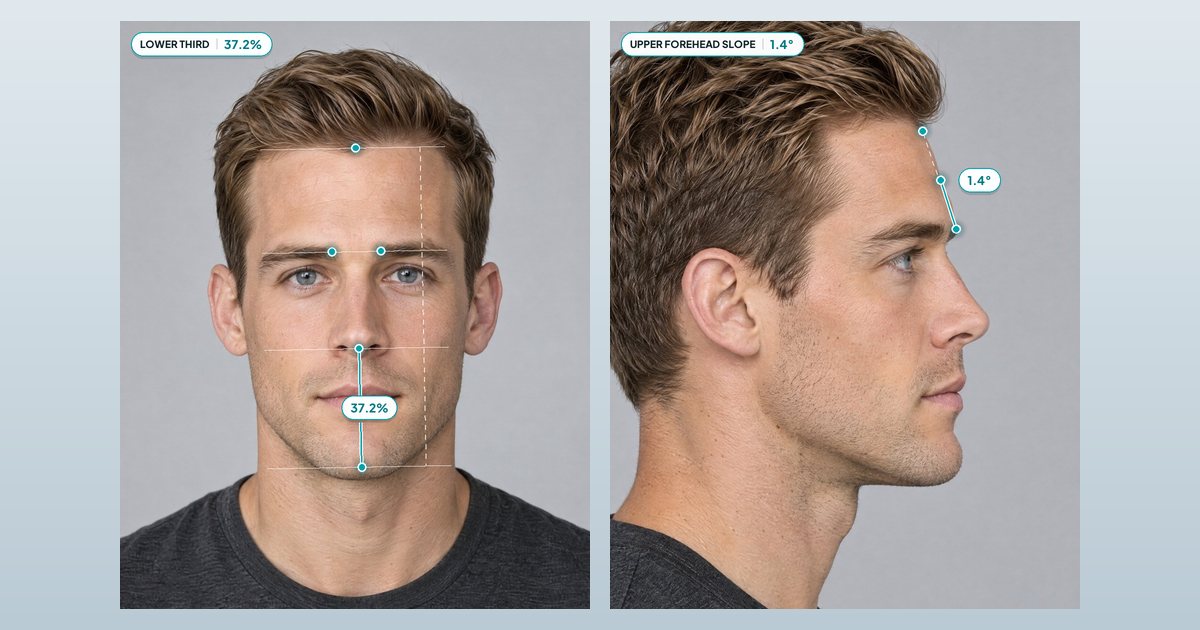
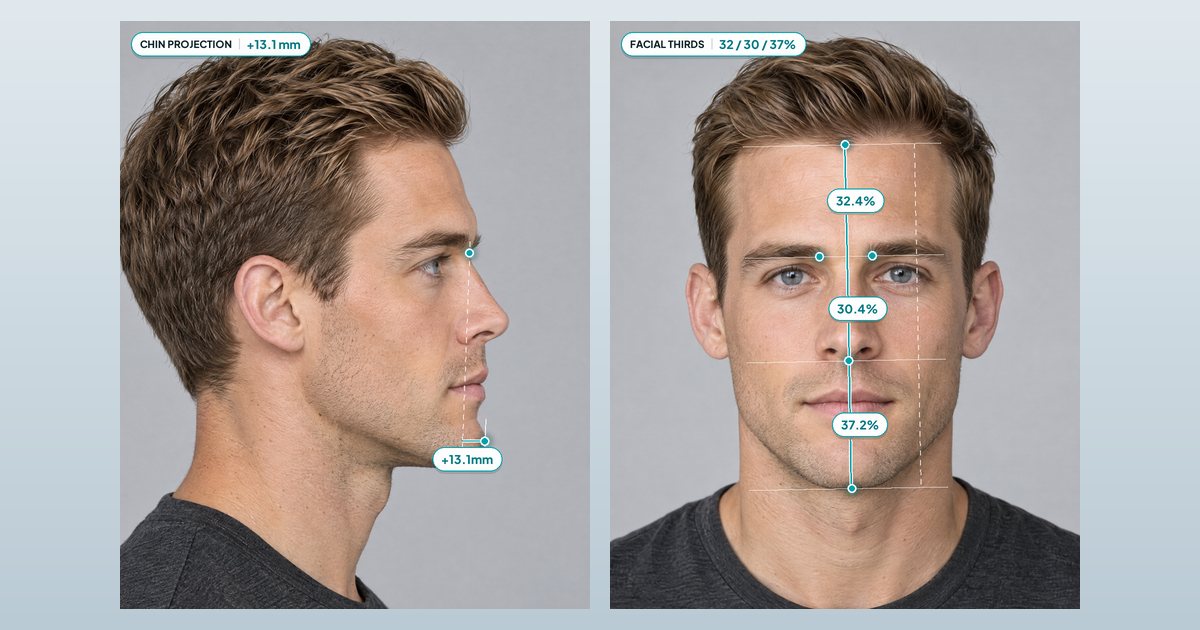
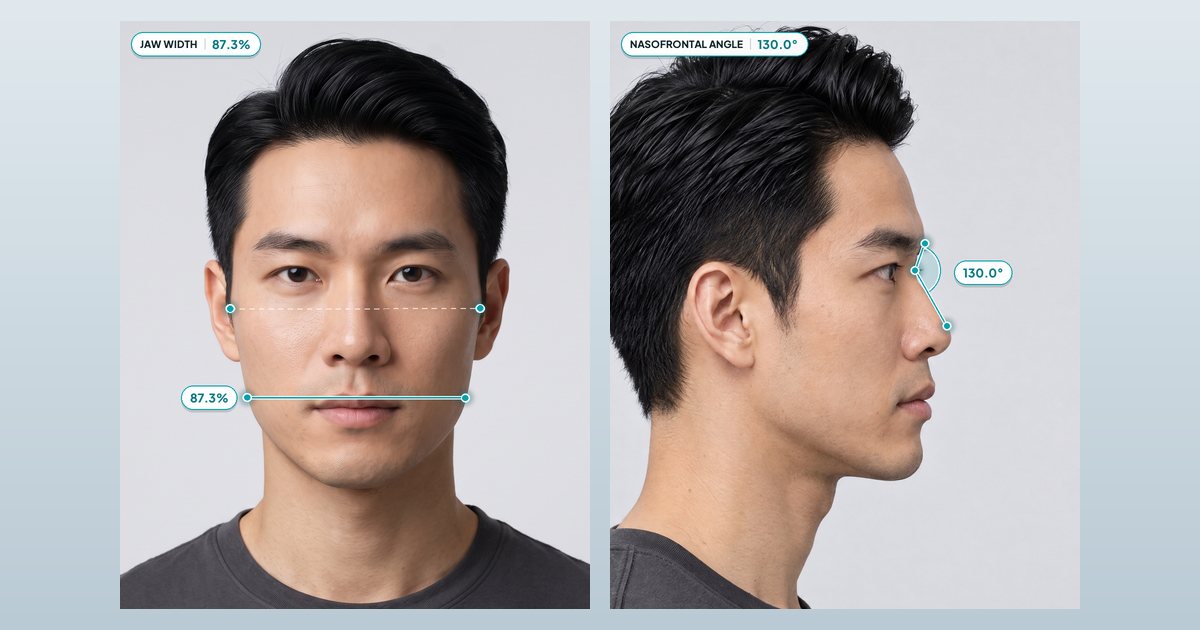
Gonial angle: normal vs ideal, and how to measure yours
The gonial angle is the corner of your jaw seen from the side, where the edge under your ear turns toward your chin. Adult X-ray studies average about 120 to 130 degrees. On a side photo, our ideal range is 115 to 121 for men and 118 to 124 for women, so 120 is inside the range for both.
The short version
- Our report's score is forgiving: half marks come only 8.4 degrees outside your ideal range, so a man at 125 still scores Great (8.2) and a woman at 130 still scores Good (6.8).
- You can measure yours from one side photo with two lines, ear notch down the back of the jaw and chin bottom back along the underside. On our sample photo this lands exactly on the engine's 115.3 degrees.
- Numbers from different methods do not compare: on one photo our two lines read 115.3, three dots 121.3 and lines along the jaw edges about 131.
- Gum-chewing training did not change jaw shape in a 6-month trial. Body fat, posture and the camera can change how your jaw corner reads in a photo, and so can the way a beard, hair or makeup frames it.
- It counts for less than the internet suggests: on our sample face, moving the gonial angle from Ideal (115.3 degrees) to Fair (130) would change the overall score from 7.04 to 7.00.
Online you’ll see men’s jaws put at a 90-degree gonial angle, or men told to aim for 100 to 120, with anything more open called soft or feminine. Neither holds up. For men and women alike, adult X-ray averages sit 30 to 40 degrees above 90.12 And the most open of the three jaws our engine measured for this guide, 123.8 degrees, looks as clean and defined as the other two.
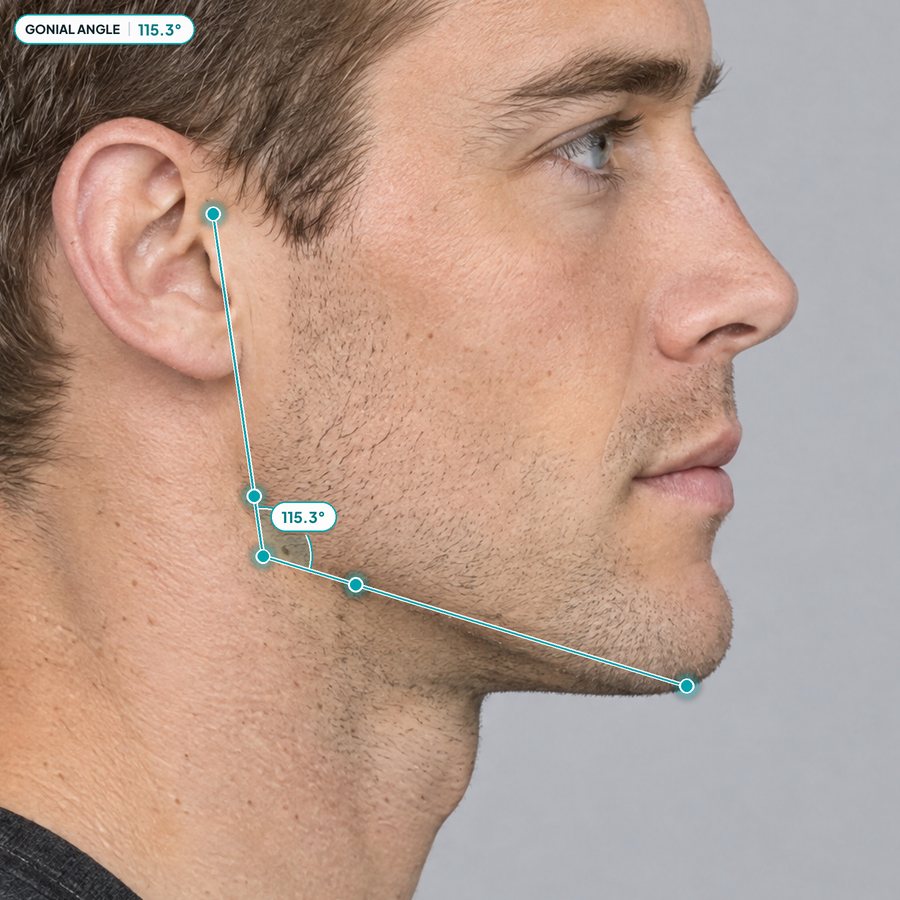
Most of the confusion comes from mixing up two numbers: what is normal on an X-ray, and what scores as ideal on a photo. The method matters just as much. Draw the lines differently on the photo above and the same jaw reads anywhere from 115.3 to about 131. Further down you’ll get your own number from one side photo, and see how little it moves a whole face.
What is the gonial angle, or mandibular angle?
The gonial angle, also called the mandibular angle, is the angle between the ramus, the upright part of your jaw under the ear, and the lower border of the jaw. The corner point is called gonion.1 You’ll also see it called the jaw angle, and sometimes the angle of the mandible or gonion angle. Same corner. The mandibular plane angle is a different one, the slope of the jaw line, and we put the two side by side further down.
Clinics measure the bone on X-rays. On side photos, studies use skin points instead: the tragus at the ear, the jaw corner and the bottom of the chin.3 So a photo reads the skin over the bone, which is why body fat and a beard can move it.
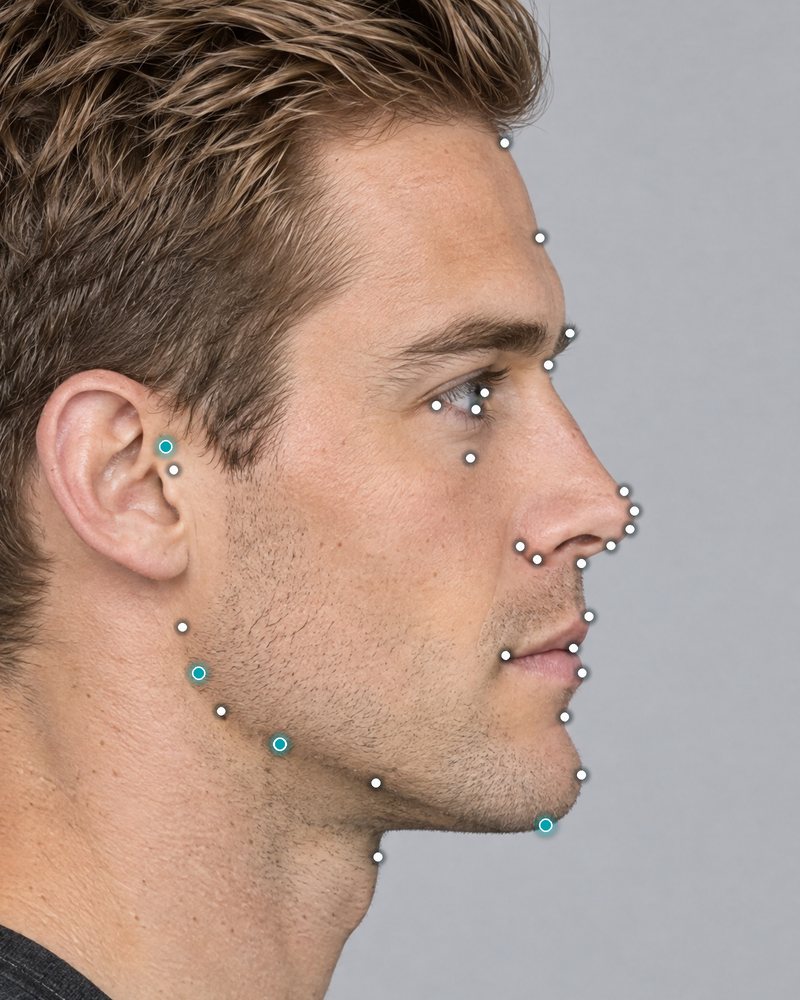
Our engine uses four points on the side photo: the ear notch, one point on each edge of the jaw a short way from the corner, and the bottom of the chin. One line runs through the first two points, a second through the last two, and the angle is read where they cross.
We built it that way on purpose. A rounded jaw corner is one of the hardest points to place on a soft outline, so the engine never depends on one exact corner dot. How our measurements work has more on how the points are placed.
Normal vs ideal gonial angle for men and women
Normal is what adult jaws average on X-rays, about 120 to 130 degrees. Ideal is the range our engine scores best on a side photo: 115 to 121 degrees for men and 118 to 124 for women.
Start with normal. In a study of 220 Australian adults, men averaged 123.1 degrees on X-rays and women 125.7, with a spread (standard deviation) of about 7 to 8 degrees.1 A second group of 448 adults aged 18 to 30 read a little higher on side X-rays of the head: 126.1 for men and 128.2 for women, with a spread of about 7.2 That’s no surprise. Both groups came from orthodontic clinics, but nearly half of the second had a long-face pattern,2 which goes with a more open angle.8 With spreads that wide, an X-ray reading of 115 or 135 still falls inside the normal adult range in both studies.
What people find attractive rests on thinner evidence. The only direct surveys we found were run online by one research group, on photos of celebrities and laypeople, and the women’s survey used only white faces. Raters preferred about 130 degrees on men’s profiles and 125.5 on women’s.45
| Men | Women | |
|---|---|---|
| Our ideal range on a photo | 115 to 121° | 118 to 124° |
| Our ideal range, East Asian heritage | 117 to 123° | 120 to 126° |
| Typical adult X-ray average | about 120 to 130° (126.1° in 207 men)2 | about 120 to 130° (128.2° in 241 women)2 |
| Preferred in online surveys | about 130°4 | 125.5°5 |
Nobody has settled on one ideal gonial angle. Our ranges come from facial-proportion research and reward a slightly sharper corner than the average jaw. That puts our men’s range a little below the two X-ray averages for men above, 123.1 and 126.1, and below the 130 that survey raters picked.
That gap is less odd than it looks. The table mixes bone on X-rays with skin on photos, and our two lines read lower than the other common ways of drawing the angle. Some of the gap is just the ruler. On an X-ray, a reading in the mid-120s is ordinary. On a photo, 120 sits inside every ideal range we use, for men and women.
Your report picks your range from the sex and the optional heritage you choose at upload. It never guesses either from your photo, and no range counts as better than another.
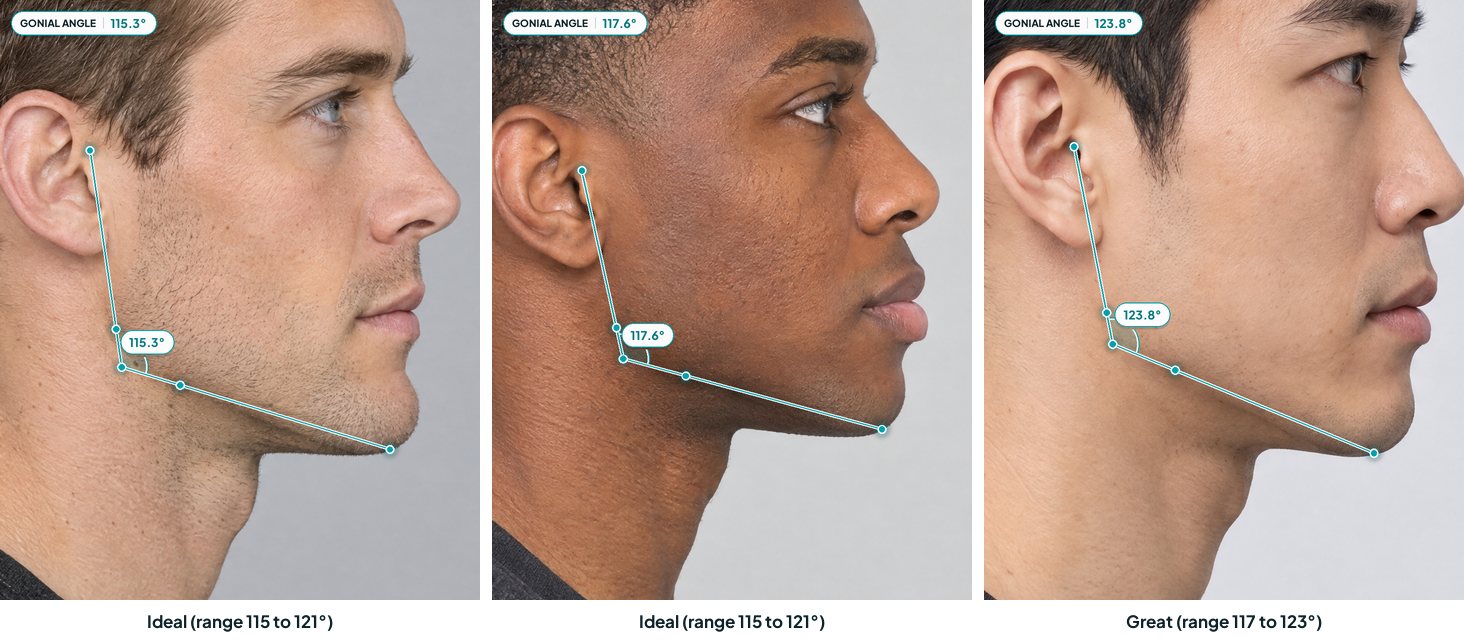
Look at them side by side. The 8.5 degrees between the first and third jaw is easy to measure and hard to see.
Our women’s ranges sit 3 degrees higher than the men’s. The bone studies are split on whether that gap is real. Where it showed up, women averaged about 2 to 3 degrees more open,12 and a 3D shape study of 100 adults also describes women’s jaw angle as larger.7 Several others, one of them 431 Norwegian adults, found no significant difference.6108 Size is the clearer split: men tend to have a taller ramus and a wider jaw.7 The angle alone can’t tell a male jaw from a female one.
Is a 90, 150 or 180 degree gonial angle normal?
No. Adult X-ray averages run about 120 to 130 degrees, with a spread of about 7 to 8.12 That puts 90 more than 30 degrees below them and 150 about 20 to 30 above, about three times the usual spread or more. At 180 the two jaw lines would form one straight line, with no corner at all. On a side photo, numbers like these almost always mean a misplaced point or a head that wasn’t fully side-on.
| Angle | What it means |
|---|---|
| 90° | Below every adult average we found. Even square-looking jaws read well above it: the most closed of our three faces measures 115.3. |
| 150° | Far above the adult averages. Tooth loss and a long-face pattern are the known reasons an angle runs high,68 but on a photo, check your points first. |
| 180° | A straight line from ear to chin. No jaw measures this. |
Our engine treats readings under 105 or over 145 as misplaced points, not as unusual jaws. For anything from 105 to 135, the score table further down shows where your number lands.
Why one jaw can measure 115 or 131 degrees
The number depends on which points and lines you use, and on whether you measure bone or skin. Every method has to decide where a rounded corner is, and each decides differently.
On the same photo of the same man, our two-line construction reads 115.3 degrees. A three-dot angle, with dots on the ear notch, the jaw corner and the bottom of the chin, reads 121.3. Lines fitted along the jaw edges read about 131. On all three of our faces, the three-dot shortcut came out 2.8 to 6.0 degrees higher than the two lines.
X-rays disagree too. The same 448 adults read 127.2 degrees on side X-rays of the head and 130.1 on panoramic X-rays, a gap of about 3 degrees that held up statistically.2
Photos can get close to X-rays, with care. When researchers found the jaw corner by touch, marked it with tape and used a fixed camera setup, side photos of 38 children averaged 124.8 degrees against 124.3 on X-ray, using the three-dot method on both.3 That is agreement on average for a group, not person by person. A casual selfie likely adds a few degrees of error on top.
A number from a dentist’s X-ray or a line someone drew over a selfie only means something against a range built the same way.
Nodding matters less than you might expect. In a true profile it turns both lines together, so the angle between them barely moves. Canthal tilt is different: a raised chin can flatten it. Two things do throw the gonial angle off. Turning toward the camera, because the photo stops being a profile. And tucking your chin, which bunches skin under the jaw and bends the lower line.
How to measure your gonial angle from a side photo
You need one true side-profile photo, a protractor app and about 10 minutes. No app? The one-line sum under the steps does the same job.
- Set up the shot. Ask a friend, or prop the phone up and use the rear camera with a timer. Stand about 1.5 m (5 feet) away, use the 2x lens if you have one, and keep the lens at jaw height.
- Turn fully side-on: you should not see your far eye or far eyebrow. Relax your face, keep your chin level and your teeth lightly together, tuck your hair behind the ear and skip high collars and scarves.
- Open the photo in a protractor app or any editor that shows pixel positions, and zoom in on the jaw. Mark the ear notch, the small notch just above the flap (the tragus) at the front of your ear canal.
- Mark a point on the back edge of your jaw about a quarter of the way from the corner up toward your ear. Then mark a point on the underside of your jaw about a quarter of the way from the corner toward your chin. Follow the jaw’s own edge, not the shadow on your neck below it.
- Mark the bottom of your chin, the lowest point of its outline.
- Draw line 1 from the ear notch through the back-of-jaw point, and line 2 from the chin bottom back through the under-jaw point. Extend both until they cross. That crossing is your jaw corner, and a protractor app reads the angle there. Your two lines should look like the ones on our example faces.
- Check the result. Under 105 or over 145 usually means a misplaced point or a head that was not fully side-on, so mark the points again or retake the photo. Our engine treats readings like that as misplaced points too.
- Compare your number with your ideal range: 115 to 121 for men and 118 to 124 for women, 2 degrees higher for East Asian heritage. Up to about 4 degrees outside still scores Great, and the table below has the rest.
The gonial angle calculator, in one line: 90 + lean + slope. The lean is how far line 1 tips forward from vertical, arctan(forward shift / drop). The slope is how far line 2 falls from level, arctan(drop / run). Count the lean as a minus number if line 1 tips backward as it goes down, and the slope as a minus number if line 2 rises toward the chin. Turn a phone calculator sideways and arctan is the tan⁻¹ key, sometimes behind 2nd or INV. Keep it in degrees.
Here it is on the face in the first figure, using the uncropped photo (the figure is cropped, so pixel counts on your screen will differ). From the ear notch down to the back-of-jaw point, line 1 moves 27.7 pixels forward over 190.0 pixels down. That is a lean of 8.3 degrees. Line 2 drops 68.1 pixels over 222.7 pixels on its way to the chin, a slope of 17.0 degrees. Then 90 + 8.3 + 17.0 = 115.3, exactly the engine’s value. He is the face in our sample report, so you can open it and see the same 115.3 drawn there.
Only the sum is stable. Tip your chin up a little and the lean grows while the slope shrinks by the same amount. Tip it down and the reverse happens. Your lean and slope won’t match ours, and they don’t need to.
High or low gonial angle, and what your number means
A high gonial angle is a more open jaw corner: the back edge and the lower edge of the jaw meet at a wider turn, and the corner tends to read softer. A low one is more closed and reads sharper and squarer. Online, a high one gets called an obtuse gonial angle and a low one acute. Every adult average in the studies we checked is well over 90 degrees, though, so nearly every jaw is obtuse, the square-looking ones included. In our report, high means above your ideal range and low means below it, and both lose points the same way.
Find your number in the left column. Scores are out of 10.
| Angle | Men (range 115 to 121°) | Women (range 118 to 124°) |
|---|---|---|
| 105° | 3.9, Focus area | 2.3, Focus area |
| 110° | 7.5, Good | 5.3, Fair |
| 115° | 10, Ideal | 8.9, Great |
| 120° | 10, Ideal | 10, Ideal |
| 125° | 8.2, Great | 9.8, Great |
| 130° | 4.6, Fair | 6.8, Good |
| 135° | 1.9, Focus area | 3.3, Focus area |
For East Asian heritage the ranges run 2 degrees higher, so the same scores land at 107, 112, 117 and so on up to 137.
The score falls gently. Half marks come only 8.4 degrees outside the range, so a man reading 124 or 125 still scores Great and 126 to 128 scores Good. If that’s you, this isn’t the number to worry about.
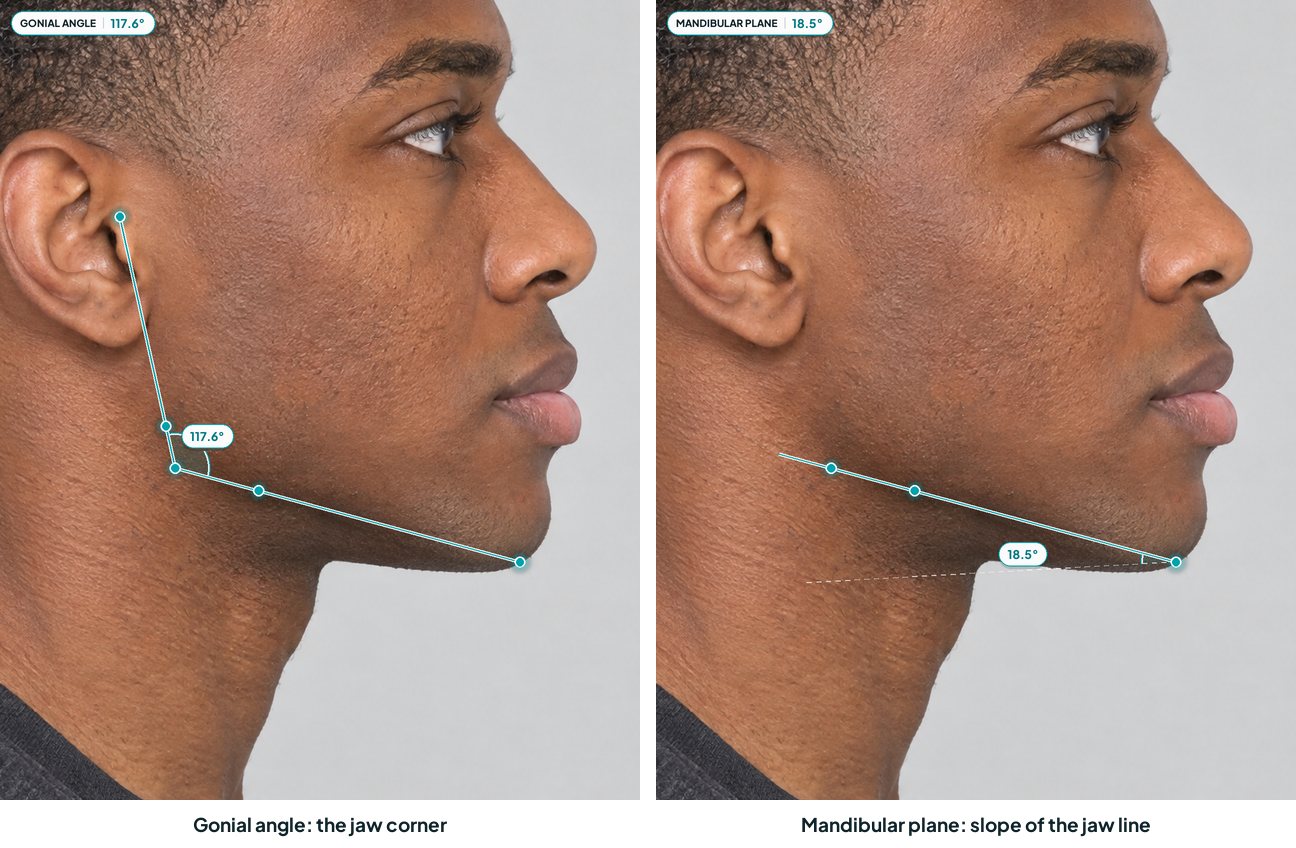
These two get mixed up all the time, and the jargon doesn’t help. When an orthodontist calls a face “high angle”, they usually mean the slope on the right, not the corner on the left, though the two tend to travel together.8 This man’s slope, 18.5 degrees, sits inside the ideal range of 15 to 22 for men (16 to 23 for women).
Gonial angle numbers you see online, checked
Most of the dramatic numbers fall apart against what real jaws measure.
| What you see online | What the measurements say |
|---|---|
| Men are about 90 degrees, women about 110. | Adult samples average about 120 to 130 for both sexes.12 Our engine treats any reading under 105 as misplaced points. |
| A man should be 100 to 120. | Its top end sits below the average man: men averaged 123.1 and 126.1 on X-rays in two studies.12 Its bottom end sits far below every average we found, and on our scale 105 already scores 3.9, a focus area. Our men’s ideal is 115 to 121. |
| Over 120 is soft or feminine on a man. | Survey raters preferred about 130 for men.4 In our report 125 scores Great for a man. |
| Men and women have very different angles. | A few degrees at most: where a gap showed up, women averaged about 2 to 3 degrees more open.12 Other studies found no significant difference.6108 |
| Chewing gum or jaw exercises lower it. | In a 6-month trial of 58 adults, those randomly assigned to chew gum three times a day bit harder, with no change in jaw shape or jaw muscle thickness.9 We found no trial of other jaw exercises. |
| Tongue posture reshapes an adult jaw. | We found no trial in adults that has tested it. |
If a number online sounds dramatic, ask what it was measured on and how. Most of the time nobody says.
Can you change your gonial angle?
Not the bone angle, once you’re an adult. How sharp the corner looks in photos, yes, and much of that is up to you.
The bone angle, and how it changes with age
The angle closes while you grow, then changes only slowly in adults who keep their teeth.106 Tooth loss is the main known reason it opens.6 People with no teeth measured about 6 degrees more open in one study.10 Age on its own counts for little. In 431 adults it accounted for only 8 to 16% of the differences between people,6 and studies disagree on whether it opens the angle at all. One sample with all their teeth found it larger after 40 than under 30,1 while a 3D study found no age effect on jaw shape.7
Short of surgery or losing teeth, nothing has been shown to change the adult bone angle. What you can change is how the corner reads.
How to make your gonial angle look sharper or softer
We have no before-and-after numbers for any of these, so take them as ways to show the jaw you already have.
If you carry some extra weight, body fat likely matters most. In a large study of white European adults, body mass index was the main factor behind soft-tissue thickness over the face.11 Lose fat through ordinary diet and exercise and the lower border of your jaw can show more, while the bone stays exactly where it was.
Then look under your chin. On the sample face, the jaw corner is Ideal at 115.3, yet his top focus area on the side photo is the chin-to-neck angle: 122.4 degrees against an ideal of 94 to 106. If your jaw looks soft in profile, check the line under your chin before you blame the corner. Posture and body fat both show up in that line. In photos, stand tall with your head over your shoulders and your chin level, neither pushed forward nor tucked.
A beard can draw a sharper corner than the bone has. In one study, a bigger jaw made clean-shaven men look more masculine but barely mattered once they had a beard.12 Keep the neckline about two fingers above the Adam’s apple and the edge tidy along the jaw corner. Our report measures through stubble.
Women start with a range 3 degrees more open, so a softer corner often sits inside it already. If yours reads above it, tuck your hair behind the ear in photos to show the corner, and if you wear makeup, a soft contour shade just under the jaw edge sharpens the line.
Below your range the corner already reads square, and if you’d like it softer in photos, the advice flips. Hair that falls forward at jaw level, such as layers or soft waves, softens the corner, and a contour shade on the corner itself, blended forward, rounds it off. A beard kept a little fuller at the chin and closer at the corners does the same. Men have more room here anyway: a man still scores Good down to about 108.
Last, the camera. The self-check setup, about 1.5 m away with the lens at jaw height, also shows your jaw best in everyday photos. Hold the phone close and low and the area under your jaw looks bigger. Side light that leaves a shadow under the jaw edge makes the edge easier to see.
How much it counts in a whole face
Very little on its own. It is 1 of 33 profile measurements in your Harmony score, and the profile counts for about 40% of Harmony. On the sample face, moving the angle from 115.3 (Ideal) all the way to 130 (Fair) would change his overall score from 7.04 to 7.00. Four hundredths of a point, for a number people argue about this much.
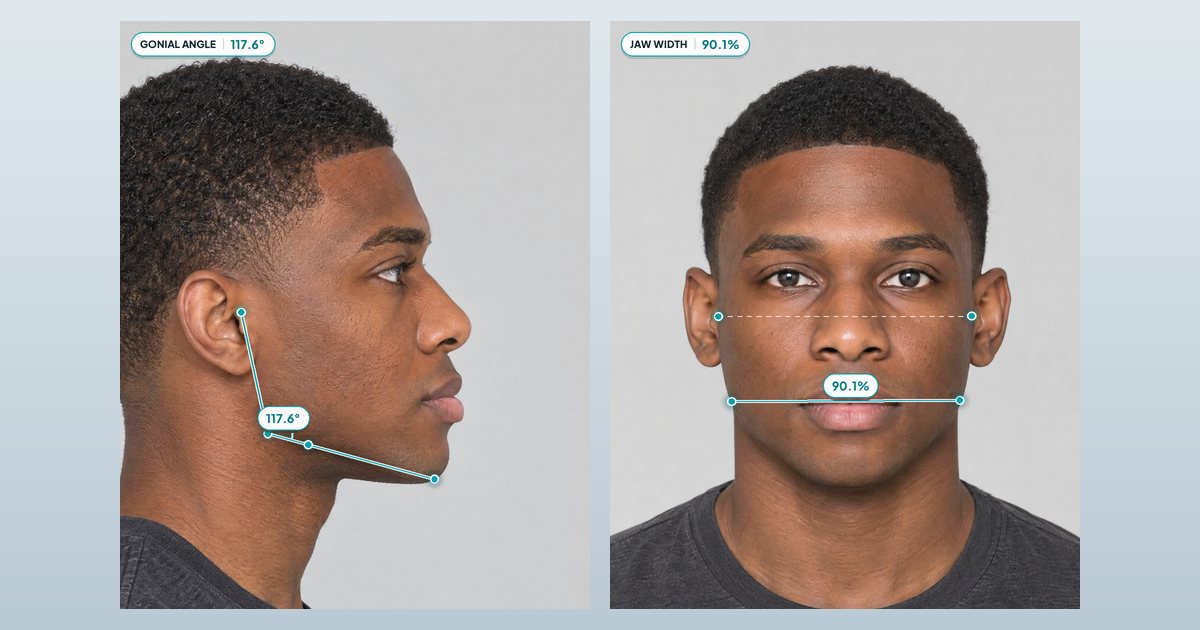
Your report looks at more of the jaw than this one angle. Jaw definition is rated from the photos as part of the Angularity score. Jaw width comes from the front photo: 89.1% of cheekbone width on the sample face (the 115.3 jaw) and 90.1% on the 117.6-degree man in the header image, both Ideal.
Your jaw corner is one number out of 65+, and no single one decides how attractive you are.
Measure yours with the two lines above, or let our engine draw them on your own side photo, next to the rest of your jaw.
Questions people ask
What is a normal gonial angle?
On X-rays, adult averages sit at about 120 to 130 degrees. In 220 Australian adults from orthodontic clinics, men averaged 123.1 and women 125.7, with a spread of about 7 to 8 degrees, so an X-ray reading of 115 or 135 still falls inside the normal adult range. A side photo is measured differently, and each way of drawing the lines gives its own number. On a photo, our ideal range is 115 to 121 degrees for men and 118 to 124 for women.
Is 120 a good gonial angle?
Yes. 120 degrees sits inside every ideal range our engine uses on a side photo: 115 to 121 for men and 118 to 124 for women, and 117 to 123 and 120 to 126 for East Asian heritage. If your 120 came from an X-ray instead, it's at the more closed end of the usual adult average of about 120 to 130. Either way it's a common value and nothing to fix.
Is 125 degrees a high gonial angle?
Only a little, and only against our ideal range. For a man, 125 is 4 degrees above the 115 to 121 range and still scores 8.2 out of 10, which is Great. For a woman it is 1 degree above 118 to 124 and scores 9.8. If your 125 came from an X-ray, it is an ordinary adult value. In the only survey we found on men's profiles, raters preferred about 130 degrees.
Do men and women have different gonial angles?
Slightly, and not consistently. Some studies find women's angles about 2 to 3 degrees more open, while others, including one of 431 adults, find no significant difference. Jaw size differs more clearly: men tend to have a taller ramus and a wider jaw. Our ideal ranges put women 3 degrees higher, at 118 to 124 degrees against 115 to 121 for men.
Does the gonial angle change with age?
Not much once you're grown, as long as you keep your teeth. The angle closes while you grow. After that, tooth loss is the main known reason it opens, and in one study of 431 adults, age on its own accounted for only 8 to 16% of the differences between people. One sample found it larger after 40 than under 30, while a 3D study of 100 adults found no age effect on jaw shape.
Is a 90 degree gonial angle possible?
Not in any normal adult sample we found. Adult studies average about 120 to 130 degrees, and 90 would sit more than 30 degrees below those averages, about four times the usual spread or more. A jaw that looks square is still well above 90: the most closed of our three example faces measures 115.3. Our engine treats any reading under 105 degrees as misplaced points on the photo rather than an unusual jaw.
Is a 150 degree gonial angle normal?
No. Adult X-ray averages sit at about 120 to 130 degrees with a spread of about 7 to 8, so 150 is about three times that spread or more above them. On a side photo, a reading that high almost always means a misplaced point or a head turned toward the camera, and our engine treats anything over 145 degrees as misplaced points. On an X-ray, tooth loss and a long-face pattern are the known reasons an angle runs high.
Can a beard change your gonial angle?
Not the bone, but it changes how the jaw corner looks. A well-shaped beard can draw a sharper or softer corner than the bone has, and in one study jaw size barely affected how masculine bearded faces looked. Our report measures through stubble. If a thick beard hides the jaw edge, the value is marked estimated and never becomes a strength or a focus area.
Sources
-
Leversha J, McKeough G, Myrteza A, et al. Age and gender correlation of gonial angle, ramus height and bigonial width in dentate subjects in a dental school in Far North Queensland. J Clin Exp Dent. 2016;8(1):e49-e54. doi:10.4317/jced.52683. Full text on PMC ↩↩↩↩↩↩↩↩↩
-
Tashkandi NE, Alnaqa NH, Al-Saif NM, Allam E. Accuracy of gonial angle measurements using panoramic imaging versus lateral cephalograms in adults with different mandibular divergence patterns. J Multidiscip Healthc. 2024;17:1923-1929. doi:10.2147/JMDH.S463688. Full text on PMC ↩↩↩↩↩↩↩↩↩↩↩
-
Sesqui N, Rizal MF, Suharsini M. Differences in linear and angular measurement of the lower facial third in lateral cephalometry and lateral photometry: a comparative study. Saudi Dent J. 2024;36(11):1438-1441. doi:10.1016/j.sdentj.2024.08.010. Full text on PMC ↩↩
-
Mommaerts MY. The ideal male jaw angle: an Internet survey. J Craniomaxillofac Surg. 2016;44(4):381-391. doi:10.1016/j.jcms.2015.12.012. Abstract on PubMed ↩↩↩
-
Mommaerts MY, Cleymaet R. The ideal shape of the female jaw angle: an online survey. J Craniomaxillofac Surg. 2023;51(10):597-602. doi:10.1016/j.jcms.2023.08.009. Abstract on PubMed ↩↩
-
Ohm E, Silness J. Size of the mandibular jaw angle related to age, tooth retention and gender. J Oral Rehabil. 1999;26(11):883-891. doi:10.1046/j.1365-2842.1999.00464.x. Abstract on PubMed ↩↩↩↩↩↩
-
Chalazoniti A, Lattanzi W, Halazonetis DJ. Shape variation and sex differences of the adult human mandible evaluated by geometric morphometrics. Sci Rep. 2024;14(1):8546. doi:10.1038/s41598-024-57617-7. Full text on PMC ↩↩↩
-
Mangla R, Singh N, Dua V, Padmanabhan P, Khanna M. Evaluation of mandibular morphology in different facial types. Contemp Clin Dent. 2011;2(3):200-206. doi:10.4103/0976-237X.86458. Full text on PMC ↩↩↩↩↩
-
Jung HJ, Hwangbo NK, Park Y, Ahn HJ. Effects of gum chewing training on occlusal force, masseter muscle thickness and mandibular shape: a randomised controlled clinical trial. J Oral Rehabil. 2024;51(12):2529-2536. doi:10.1111/joor.13830. Abstract on PubMed ↩
-
Upadhyay RB, Upadhyay J, Agrawal P, Rao NN. Analysis of gonial angle in relation to age, gender, and dentition status by radiological and anthropometric methods. J Forensic Dent Sci. 2012;4(1):29-33. doi:10.4103/0975-1475.99160. Full text on PMC ↩↩↩↩
-
De Greef S, Vandermeulen D, Claes P, Suetens P, Willems G. The influence of sex, age and body mass index on facial soft tissue depths. Forensic Sci Med Pathol. 2009;5(2):60-65. doi:10.1007/s12024-009-9085-9. Abstract on PubMed ↩
-
Dixson BJW, Lee AJ, Sherlock JM, Talamas SN. Beneath the beard: do facial morphometrics influence the strength of judgments of men’s beardedness? Evol Hum Behav. 2017;38(2):164-174. doi:10.1016/j.evolhumbehav.2016.08.004. Record on the University of Glasgow repository ↩
Spotted a mistake? Email support@faceratinglab.com and we will fix it. First published .