How to glow up: measure first, change two things, then re-check
To glow up, work on what habits can change on a face: skin, brows, hair, how rested you look, a beard neckline for men, and body fat through ordinary diet and exercise if you're an adult carrying extra weight. For women and men alike, pick the two with the most room on your face, give them 8 to 12 weeks, then re-check with the same photo setup.
The short version
- Measure first, then pick two changes. On all three of our example men, the report's plan landed on brow length and the jaw-to-neck angle; for women it works with brows and hair.
- Habits change the soft parts of a face (skin, hair, brows, beard, under-eyes and face fat) and how you hold your head; they don't change bone or cartilage, so eye tilt, jaw angle, cheekbone height and nose shape stay put, whatever face yoga or gua sha promises.
- Each change runs on its own clock: sleep, grooming and your photo setup show within days, skin color from more fruit and vegetables took about six weeks in a small study, and a leaner face, for adults carrying extra weight, takes months of ordinary diet and exercise, not a week.
- Daily sunscreen is one of the best-tested skin habits: in a 4.5-year trial of 903 adults, the people who used it every day showed no detectable increase in skin aging.
- Check progress with the exact same photo setup: a phone 30 cm (1 foot) away makes the nose look about 30% wider relative to the face, and in our re-scans of identical photos most front lines repeated exactly while every side line moved, the jaw-to-neck angle by 2.9 degrees.
Most advice on how to glow up hands you 30 tips at once. Two will do, as long as you pick them after you measure. Here’s how to get a glow up in six steps:
- Take day-0 photos, front and side, in one spot, at one distance, in one light.
- Check the four things that point to changes you control: brow length, face length (it guides your haircut), your jaw-to-neck angle, and skin.
- Pick the two with the most room to change.
- Work on only those two for 8 to 12 weeks.
- Cover the basics either way: daily sunscreen, a gentle cleanser and a moisturizer, and normal sleep.
- Re-take the photos the same way and lay them next to the first ones.
None of it touches bone. It doesn’t need to.
The feature you like least is where most people start. Unless it’s your skin, brows or hair, that’s usually the wrong place, and our own reports show why: the lowest scores on a face mostly follow bone, cartilage and teeth. Our report measures 66 lines and ends with a short plan of changes you control. Across three of our example reports, just 1 of the 17 lowest scores made it into that plan.
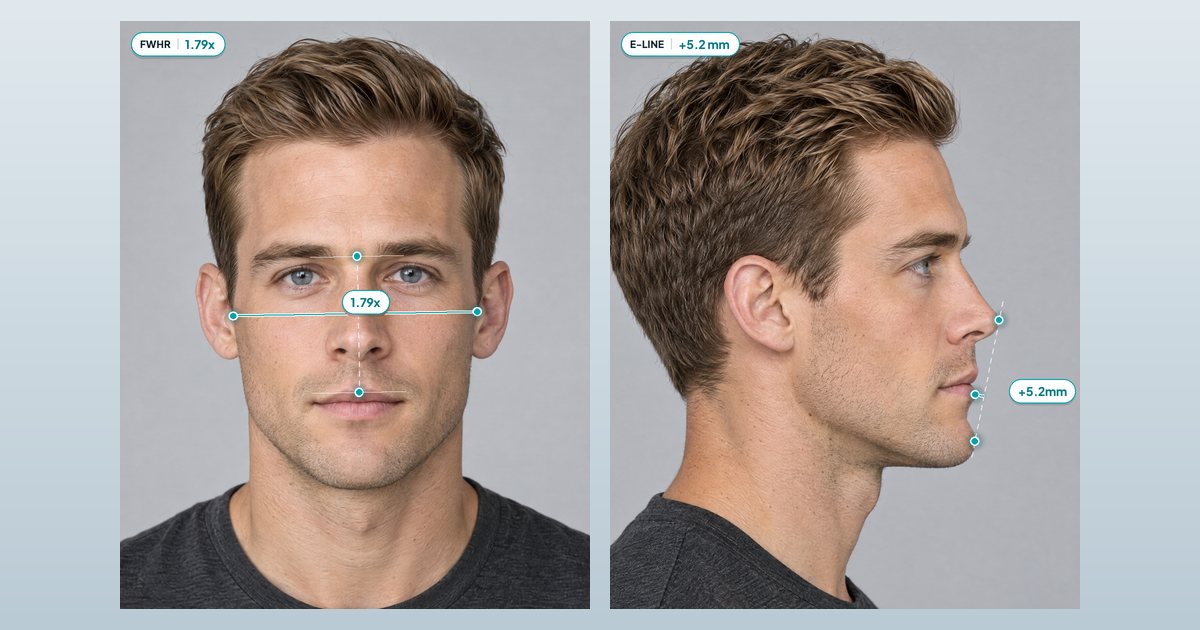
One of our example men shows the trap. He has a face width to height ratio of 1.72x: his cheekbone width against the height from brows to upper lip. That is one of his lowest scores, well under his ideal range of 1.93 to 1.97. Bone sets most of that number, so his plan leaves it alone. His brow length is 0.61, short of the range of 0.69 to 0.76 but close enough to score Good, and it is step 1 of his plan, because how he grooms his brows changes it.
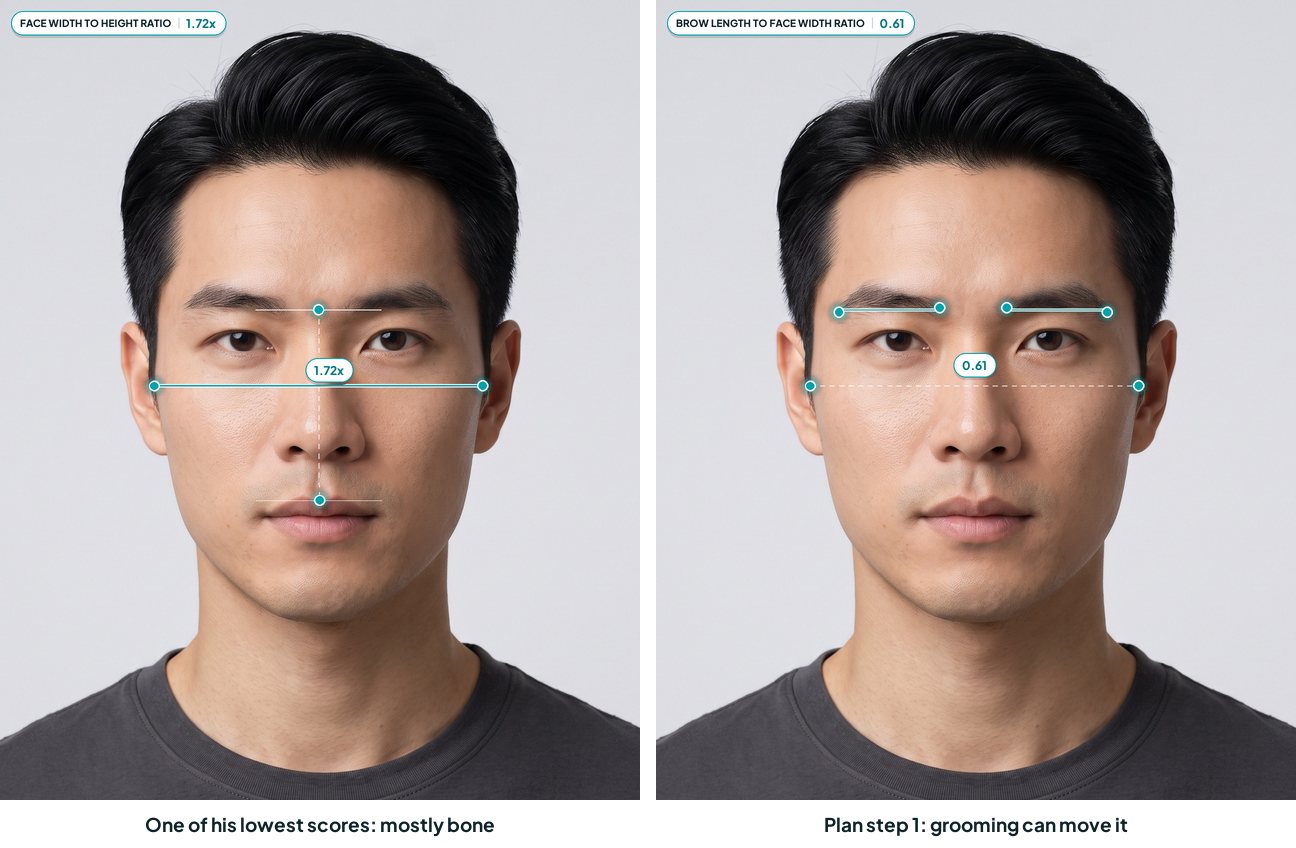
What a glow up can change, and what it can’t
A glow up is a visible change for the better in how you look, for women and men alike, usually built over months and shown off as a before-and-after. Habits and grooming change the soft parts of a face: skin, hair, brows, beard, under-eyes, the fat under your chin and in your cheeks, and how you hold your head. They change the photo too. They don’t change your bone structure, cartilage or teeth, so your eye tilt, jaw angle, cheekbone height, nose shape and lip position in profile stay put. You can work on every one of the soft parts at home, without a procedure.
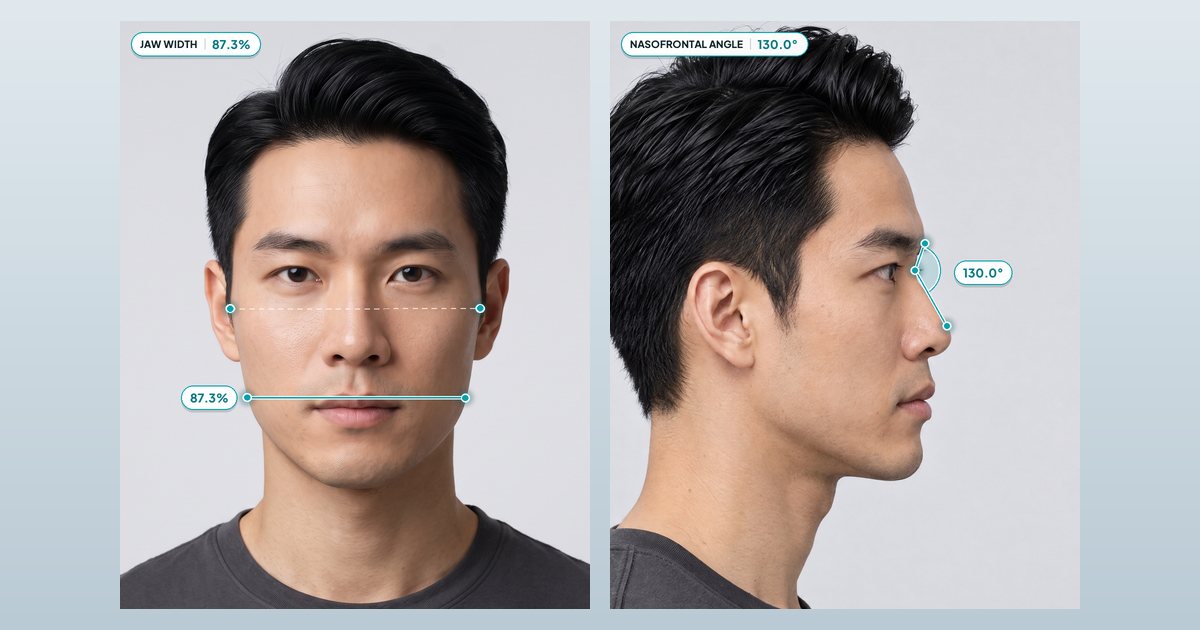
Our reports split a face the same way. Of the 66 lines we draw, only 5 can ever become a step in the plan: face length, forehead height and brow length for everyone, and for men the jaw-to-neck angle and jaw width, which a beard can change. Most of the rest follow bone, cartilage and teeth, which is why Harmony, the score built from all 66, is mostly out of reach of habits. What you can change shows up instead in what the report rates by eye: skin, under-eyes, hair, brows, how defined the area under your chin looks and how lean your cheeks are.
The soft parts can still do a lot. In two 2016 studies, makeup applied by professionals explained a quarter to a third of the differences in attractiveness ratings, while who the person was explained a little under half, and faces rated less attractive without makeup tended to gain more.1 Both studies used only women and makeup, so treat that as a hint. It’s still the logic behind picking the changes with the most room.
If a tip promises to move bone, skip it.
How to glow up your face, starting from a phone photo
Start with a baseline you can trust. Brows and face length take a photo and a ruler; the jaw-to-neck angle and skin you mostly judge by eye.
- Take your day-0 photos. Rear camera or a friend, about 1.5 m (5 feet) away and zoomed in, lens at eye height. Chin level, neutral face, lips closed, soft window light, no filter, hair off your forehead, plus a true side photo with your neck in view. The full photo checklist covers the rest.
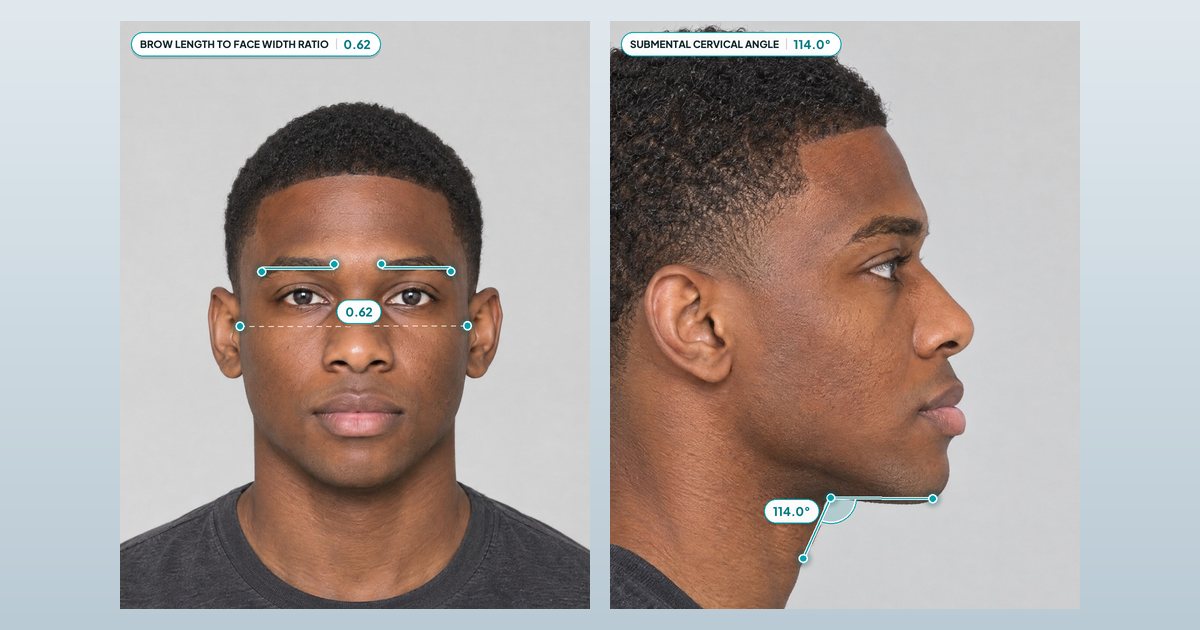
- Brow length, front photo. Mark the inner end and the tail of each brow, add the two horizontal spans, and divide by your cheekbone width, measured across the widest points just in front of your ears (the right half of the first figure shows where the points go). Any photo editor that shows pixel positions works, or a ruler on the zoomed-in photo; the units cancel out. The man in our sample report measures (196 + 193) / 633.5 px = 0.61. Our range is 0.69 to 0.76 for men and 0.65 to 0.72 for women. Below it can mean over-trimmed or over-plucked tails, sparse tails, or brows that are naturally short for a broad face.
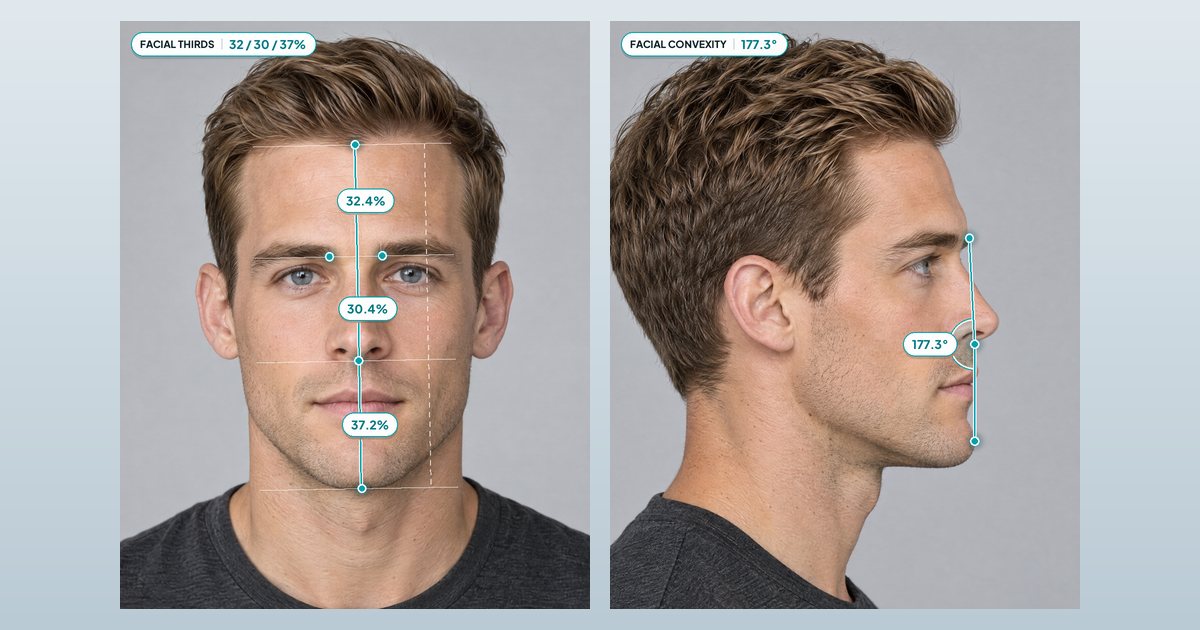
- Face length, front photo. Measure from your hairline, where dense hair starts, to the bottom of your chin, and divide by the same cheekbone width (the hair figure further down draws both lines). His: 892 / 633.5 = 1.41. Our range is 1.34 to 1.37 for men and 1.32 to 1.35 for women, and it shifts slightly with heritage. Above it, test less height on top; below it, more. If your hairline is receding, use the same point in both photos and compare only with yourself.
- Jaw-to-neck angle, side photo. Look at the corner where the underside of your chin meets your neck. Our range is 94 to 106 degrees for men and women, and our three example faces measure 113.3 to 122.4. It shifts with head position, so first check that your chin is level, not pushed forward. For a rough number, draw a line along the underside of your chin and one down the front of your neck, and read the angle with a protractor app. If that’s fiddly, keep the side photo as your baseline and judge the corner by eye.
- Skin and under-eyes, by eye. In daylight, with no filter, look at how even your skin tone and texture are, and at any shadows under your eyes. A report rates these instead of drawing them.
- Pick two. Keep the checks that came out outside their range, plus skin if it clearly needs the work; if that leaves more than two, go in the order of the tips below. Those are your changes for the next 8 to 12 weeks. If nothing came out of range and your skin is fine, there’s nothing to fix: keep the basics, and if you’d like a project, pick one you’d enjoy, such as a new haircut. For women, the plan works with brows and hair, so pick from those two plus skin.
Our report’s plan runs the same check with stricter rules. It skips any line it marks as estimated or low confidence and allows one change per area, so men get at most three steps and women two. On all three example faces it landed on brow length and the jaw-to-neck angle, plus a hair step for the sample man, and 6 of those 7 steps were lines the report already rates Good. It calls each one “a styling suggestion, not a proven way to raise a score.”
Glow up tips, in the order to try them
Most lists of ways to glow up give every tip the same weight. Ours doesn’t. Brows go first because anyone can start this week and they re-measure cleanly. The jaw-to-neck angle goes second: it is slower, and the hardest line to read. Women’s plans have no jaw step, so for women the order is brows, hair, then skin.
Brows
Brow length measured 0.61, 0.62 and 0.61 on our three faces, all a little short of the men’s range. If you trim, pluck or wax them, the step is mostly this: leave the tails alone and brush the hairs into place. If you use brow makeup, a light fill within your natural outline is plenty. Already above the range? Tidy only the stray hairs. If you’ve never trimmed or plucked them, the number may just be your natural length; as our report puts it, “a number outside the reference range does not mean they need reshaping.” Our handsome-face guide draws the same line on three faces and shows how far each tail falls short.
The jaw-to-neck angle
The report calls the jaw-to-neck angle the submental cervical angle, and it is blunt about its ranges: “comparisons, not universal beauty rules or targets everyone should match.” A few degrees over 106 is no cause for worry.
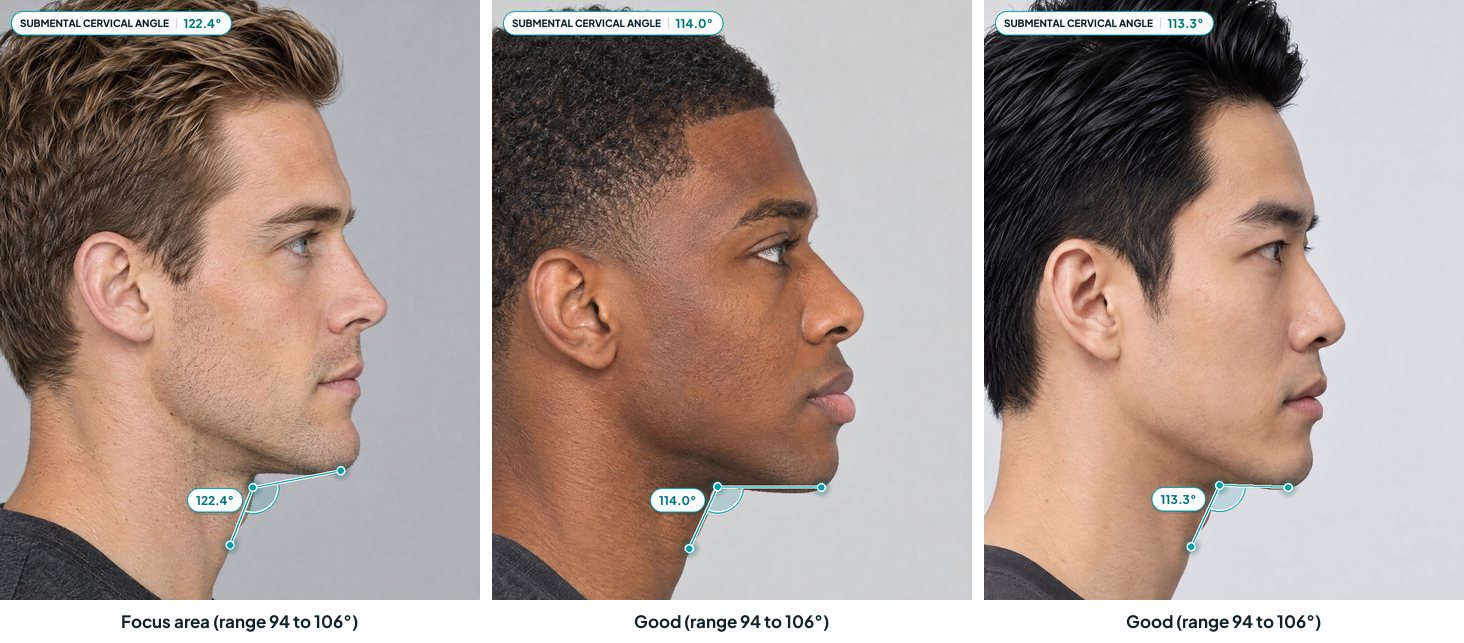
Here’s the catch. Posture, fat under the chin, skin, muscle and bone all change this angle, and the angle alone can’t say which one is at work. Even lifting your chin a little changes it in a photo. Check head position first: chin level, head stacked over your shoulders.
An open angle doesn’t mean you need to lose weight. The most open of the three, 122.4°, came with an under-chin definition rating of 8 out of 10; the most closed, 113.3°, came with a 7.
All three plans suggest the same step for men: “grow a short, even beard for three to four weeks, then have the neckline set just under the jaw with the throat kept clean.” For most men that’s about two fingers above the Adam’s apple. It changes what people see at the corner, though our points follow the skin under stubble, so the number may not move at all.
In a large rating study, heavy stubble (about 10 days of growth) beat both a full, untrimmed beard (4 weeks or more) and clean-shaven. Full beards did better when raters had seen few of them, but heavy stubble stayed at or near the top.5 Keep it trimmed short once it has grown, or skip the step if you can’t grow an even beard yet. Our gonial angle guide shows where to set the neckline.
For women, the plan never suggests a jaw step. If your jaw-to-neck angle reads open, check posture first, then try what our report suggests for women: hair that ends just below the jaw, or is pulled back, and soft contour under the cheekbones. Compare both in a side photo before you decide.
Body fat is the other thing that shapes this corner, and the slowest. If you’re an adult carrying extra weight, the honest route is ordinary diet and exercise. A 2018 review found that leaner faces get higher attractiveness and health ratings across studies, up to a point, and that people can guess body weight from a face fairly well: face fat follows body fat.2 In one study of 101 men, rated face fat predicted attractiveness more strongly than any other trait tested; for 80 women, it counted for less than femininity.3 There’s no good evidence you can slim your face alone with targeted exercises.4
If you’re a teenager and still growing, leave weight targets out of your glow up and talk to a parent or your doctor first.
Hair
Hair on top isn’t part of face length, which stops at the hairline. It changes the outline people see around your face.
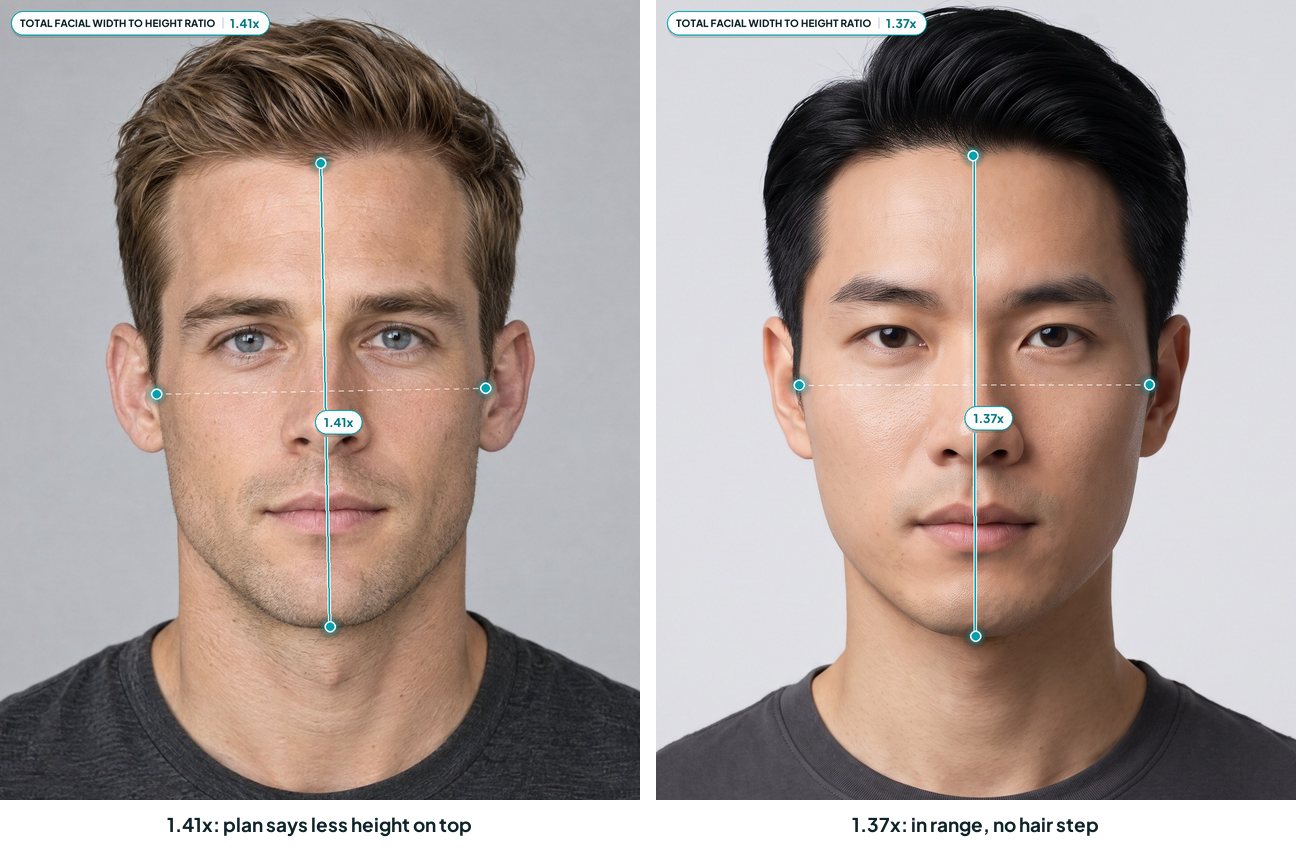
The man on the left, from our sample report, gets “less height at the top and a little more volume at the sides.” The man on the right wears his hair high too, but at 1.37x he gets no hair step. Same kind of haircut, different advice, because the face under it differs.
Below the range, the advice flips to more height on top. A fringe changes how long your face looks in person, but pull it back for measuring photos so the hairline point stays the same in your before and after. The plan’s practical line is worth copying too: take a comparison photo with the new styling before you commit to a cut.
Skin and sleep
Daily sunscreen has the strongest trial behind it of any skin habit here. In a 4.5-year trial of 903 adults under 55 in Australia, the daily group showed no detectable increase in skin aging and 24% less aging than people who used it when they chose.6 Aging was graded on silicone casts taken from the backs of the hands, not by rating faces.7 It prevents. It doesn’t reverse.
Beyond that, a gentle cleanser and a moisturizer are enough. When our report does flag skin, its tips stay that plain. For the lines from the sample man’s nose to the corners of his mouth (nasolabial folds, rated 7 out of 10), it suggests “daily moisturizer and SPF” for skin texture, and soft, front-facing light to soften their shadow in photos. For under-eye shadows, it suggests a morning eye cream with caffeine, a cold rinse and daily SPF. If breakouts don’t settle with a gentle routine, a pharmacist or doctor can help.
Sleep works faster than any cream. In a Swedish study, two nights of about 4 hours in bed made 25 adults look a little less attractive and less healthy to 122 strangers, who were also less keen to spend time with them.8 The effect was small, and the study didn’t test whether sleeping more than normal helps.
Food is slower, though it’s the closest thing research has to a literal glow. In a small six-week study of mostly light-skinned students, eating more fruit and vegetables went with slightly warmer, more yellow skin, measured across the body; about 3 extra portions a day was estimated to give a visible gain. No link showed at three weeks.9
Our three example faces were rated 9 to 10 on most skin items, so skin costs them almost nothing. If yours is already clear, a 10-step routine has nothing left to fix.
Makeup is optional. The 2016 studies above show it can change ratings a lot, so wear the same makeup, or none, in your before and after photos. Brow pencil can even move where the report sees a brow end.
Posture, smile, glasses, clothes
Posture is the one change in this group with a study behind it: open, expansive postures got more “yes” responses in speed dating and in an online dating test.10 That was the whole body rather than the face. It costs nothing, and you can practice it before anything else has changed.
Smiles and glasses never reach a scan, because measuring photos are taken with lips closed and glasses off. In person they count, so wear frames you like and keep up plain brushing and flossing. Clothes, nails and body hair count in person too; for the scan, just keep a high collar out of your side photo.
How to glow up in a week, or over the summer
Overnight, only your grooming and your photo setup can change. In a week you can add normal sleep; in a month, a man can add a short beard. Everything else takes longer:
| Change | When it can show | What the evidence says |
|---|---|---|
| Sleep back to normal after short nights | Within days | Two short nights made faces look slightly less attractive; recovery wasn’t timed8 |
| Photo distance, light and angle | The same day | A phone at 30 cm (1 foot) makes the nose look about 30% wider relative to the face11 |
| Brow strays, haircut test, beard trim | The same day | Nothing to wait for |
| A short, even beard with a set neckline | 3 to 4 weeks | The plan’s own timing |
| Skin tone from about 3 more portions of fruit and vegetables a day | About 6 weeks | One small study9 |
| Brow tails growing back | Weeks to months | No reliable number |
| A leaner-looking face, for adults carrying extra weight | 1 to 2 months to be noticed, 1.5 to 4 months to be rated more attractive | About 3.5 to 4 kg (8 to 9 lb) noticed, 6.3 to 8.2 kg (14 to 18 lb) rated more attractive, in one study of edited face photos12 |
| Daily sunscreen | Years | Prevention: no detectable increase in skin aging over 4.5 years6 |
| Eye tilt, jaw angle, cheekbone height, nose, lip position in profile | Not with habits | Set by bone, cartilage and teeth |
The weight times assume the pace the CDC calls gradual and steady: 1 to 2 lb (0.5 to 1 kg) a week.13
To glow up over the summer, start from how long your break is. With about six weeks, like a UK summer holiday, plan on sleep, grooming, a beard for men and the first change in skin tone. With ten weeks or more, closer to a US summer break, an adult carrying extra weight also has time for a first visible change in face fat. Whatever the length, take your day-0 photos in week one.
That’s where the 8 to 12 weeks comes from: it’s the shortest window in which the slower changes have a chance to show. The way to have a glow up that lasts is to keep it small: two changes you can keep up for months, not ten you’ll drop in a week.
Glow up myths worth skipping
You’ll meet these on most glow up lists.
Face yoga, face exercises or gua sha will sculpt your jaw. Two reviews ten years apart found no randomized trial of face exercises. The 2014 one called the evidence insufficient,14 and a 2024 review of seven small studies was more upbeat about signs of aging but couldn’t pin any effect to one area, such as a double chin.4 A 2018 pilot had 16 women finish, no control group, and the program’s founder as a co-author.15 All three were about looking younger, not jaw shape. Gua sha and face rollers sell the same sculpting promise, so the same verdict applies: unproven.
Drink 2 to 3 liters of water a day for glowing skin. A review of six studies found weak evidence of, at most, a slight rise in skin hydration, mainly in people who drank little to begin with.16
Lose 10 lb in a week with a cleanse. Ten pounds in a week is five times the top of the pace the CDC calls gradual and steady, and it notes that people who lose weight at that pace are more likely to keep it off.13 Skip the cleanse.
Thinner is always better. In one study reported in that 2018 review, attractiveness peaked inside the normal weight range, and in several studies the best fit was a curve, so a face can also read as too thin.2
Beta-carotene pills keep your skin young. In the sunscreen trial, beta-carotene supplements had no overall effect on skin aging.6 The color change in the diet study came from food.9 We don’t recommend supplements.
How to tell if your glow up worked
Take the after photos exactly like the day-0 ones, after 8 to 12 weeks, and compare the two changes you chose. A different setup can change your face in a photo more than your habits did.
The camera is why. A phone about 30 cm away makes the nose look about 30% wider, relative to the face, than a photo from far away; at 1.5 m the effect is essentially gone.11 Different photos of the same person can even vary in attractiveness more than different people do.17
Use the setup from your day-0 photos, down to the spot and the light. The one people forget: a high collar in the side photo can stop the jaw-to-neck angle from being measured at all.
We tested how steady our own lines are. When we scanned two test people’s identical photos three times each, 26 of 33 front lines came back identical for one person and 29 of 33 for the other. Not one side line did. Most side angles moved by a few degrees, up to about 7, and one forehead line jumped by far more on a single scan. Brow length never moved. The jaw-to-neck angle moved 2.9° (113.55°, 113.31° and 110.64°), enough to drop the beard step from one plan, because the score sat close to the plan’s cut-off. Our attractiveness test guide shows how much scores move between scans.
Identical photos are the best case. A new spot, distance or light adds its own wobble on top, and we haven’t measured how much. Trust a change in a front line more than one on the side, as long as your setup matched, and treat a few degrees on the side as noise.
Only some changes show up as a number. Brow length is the one most likely to move, since every tail you let grow back adds to it. A new haircut or beard neckline may not move a number at all, so judge those by eye, with the two photos next to each other. Skin and under-eyes are rated in a report, not drawn. See how the points are placed if you want to check a line yourself.
Don’t chase points either. Scores can move with photo conditions, and they don’t prove that a change made you more attractive. Compare yourself with your own day-0 photo, never with other people’s filtered glow ups. If worrying about your looks is taking over your day, talk to someone you trust, like a friend, a parent or your doctor.
Your next step is the easy one: take your day-0 photos today, before you change anything.
Questions people ask
What is a glow up?
Glow up, or glow-up, is slang for looking visibly better than you did before, often with more confidence to match. It's usually shown as a before-and-after, by women and men alike. What changes is the soft part of a face, such as skin, hair, brows, beard, under-eyes, face fat and posture, plus the photo itself. Bone, like your jaw angle, doesn't change with habits.
Can you glow up in a week?
Partly. A week is enough for sleep, grooming (tidying brow strays, a haircut, a beard trim) and a better photo setup, but not for skin color, face fat or bone. In one study, two short nights made faces look a little less attractive and less healthy to strangers, so getting back to normal sleep should undo that. Skin color from eating more fruit and vegetables showed at about six weeks and not at three. Take your day-0 photo before the haircut, not after.
How do I glow up as a guy?
Measure first: on all three of our example men, the plan picked brow length and the jaw-to-neck angle, but yours may differ. If your brows come in under 0.69 of cheekbone width and you trim them, stop trimming the tails. If you have no beard yet and your jaw-to-neck angle is over 106 degrees, grow a short, even beard for three to four weeks, then set the neckline just under the jaw. Heavy stubble (about 10 days) beat both untrimmed full beards and clean-shaven in one large study.
How do I glow up as a girl?
Start with brows and hair, the two areas our report's plan uses for women. Keep your brow tails: our range is 0.65 to 0.72 of cheekbone width, and short brows can mean over-plucked or sparse tails, or just a naturally short brow. Measure your face length, hairline to chin divided by cheekbone width: above 1.35, try less height on top; below 1.32, a little more. For the jaw-to-neck angle, our report suggests hair that ends just below the jaw, or pulled back. Add daily sunscreen and normal sleep.
How do I have a summer glow up?
In week one, take day-0 photos and pick your two changes; at the end of the break, re-check with the same setup. A six-week break fits sleep, grooming, a beard for men (3 to 4 weeks) and the first change in skin tone from more fruit and vegetables. Ten weeks or more leaves time for a first visible change in face fat if you're an adult carrying extra weight, through ordinary diet and exercise. Wear sunscreen every day throughout.
How can I glow up my face naturally at home?
Every change in this guide can be done at home: daily sunscreen, a gentle cleanser and a moisturizer, normal sleep, letting your brow tails grow, a tidy beard neckline, a haircut test, and body fat through ordinary diet and exercise if you're an adult carrying extra weight. Skip face exercises and tools that promise to sculpt your jaw. A 2014 systematic review found no controlled trials of face exercises, and a 2024 review still found no randomized ones.
How do I glow up for school?
Start your brows early: if they're short, stop trimming or plucking the tails as early as you can, since regrowth takes weeks to months. Get the haircut a week or two before, and sleep normally in the last week. For skin tone from more fruit and vegetables, start at least six weeks out; in a small study it took about that long to show. Keep it to two changes, skip diets and cleanses, and compare yourself with your own day-0 photo, not anyone else's.
How do I glow up after a breakup?
The same way as any glow up, but for yourself: pick one or two changes you enjoy and can keep, rather than a total makeover. In one study, two short nights showed in people's faces, so getting back to normal sleep is one of the quickest changes you can make; a haircut or a new beard shape works the same day. Skip crash diets and cleanses. If it all feels heavy, tell a friend or someone you trust, or see your doctor.
Sources
-
Jones AL, Kramer RSS. Facial cosmetics and attractiveness: comparing the effect sizes of professionally-applied cosmetics and identity. PLoS One. 2016;11(10):e0164218. doi:10.1371/journal.pone.0164218. Full text on PMC ↩
-
de Jager S, Coetzee N, Coetzee V. Facial adiposity, attractiveness, and health: a review. Front Psychol. 2018;9:2562. doi:10.3389/fpsyg.2018.02562. Full text on PMC ↩↩
-
Foo YZ, Simmons LW, Rhodes G. Predictors of facial attractiveness and health in humans. Sci Rep. 2017;7:39731. doi:10.1038/srep39731. Full text on PMC ↩
-
de Manincor EO, Borges AFM, Leão LO, et al. Facial exercises for rejuvenation: a systematic review. Rev CEFAC. 2024;26(6). doi:10.1590/1982-0216/20242664824. Full text on SciELO ↩↩
-
Janif ZJ, Brooks RC, Dixson BJ. Negative frequency-dependent preferences and variation in male facial hair. Biol Lett. 2014;10(4):20130958. doi:10.1098/rsbl.2013.0958. Full text on PMC ↩
-
Hughes MCB, Williams GM, Baker P, Green AC. Sunscreen and prevention of skin aging: a randomized trial. Ann Intern Med. 2013;158(11):781-790. doi:10.7326/0003-4819-158-11-201306040-00002. Abstract on PubMed ↩↩↩
-
QIMR Berghofer Medical Research Institute. World-first study proves daily sunscreen prevents skin ageing. Press release, 2013-06-04. qimrb.edu.au ↩
-
Sundelin T, Lekander M, Sorjonen K, Axelsson J. Negative effects of restricted sleep on facial appearance and social appeal. R Soc Open Sci. 2017;4(5):160918. doi:10.1098/rsos.160918. Full text on PMC ↩↩
-
Whitehead RD, Re D, Xiao D, Ozakinci G, Perrett DI. You are what you eat: within-subject increases in fruit and vegetable consumption confer beneficial skin-color changes. PLoS One. 2012;7(3):e32988. doi:10.1371/journal.pone.0032988. Full text on PMC ↩↩↩
-
Vacharkulksemsuk T, Reit E, Khambatta P, Eastwick PW, Finkel EJ, Carney DR. Dominant, open nonverbal displays are attractive at zero-acquaintance. Proc Natl Acad Sci U S A. 2016;113(15):4009-4014. doi:10.1073/pnas.1508932113. Full text on PMC ↩
-
Ward B, Ward M, Fried O, Paskhover B. Nasal distortion in short-distance photographs: the selfie effect. JAMA Facial Plast Surg. 2018;20(4):333-335. doi:10.1001/jamafacial.2018.0009. Full text on PMC ↩↩
-
University of Toronto News. Losing weight can make you more attractive, experts say, but there’s a catch. 2015-12-03. Press release on: Re DE, Rule NO. Heavy matters: the relationship between just noticeable differences in perceptions of facial adiposity and facial attractiveness. Soc Psychol Personal Sci. 2016;7:69-76. doi:10.1177/1948550615599829. University of Toronto News ↩
-
Centers for Disease Control and Prevention. Steps for losing weight. 2025-01-17. cdc.gov ↩↩
-
Van Borsel J, De Vos MC, Bastiaansen K, Welvaert J, Lambert J. The effectiveness of facial exercises for facial rejuvenation: a systematic review. Aesthet Surg J. 2014;34(1):22-27. doi:10.1177/1090820X13514583. Abstract on PubMed ↩
-
Alam M, Walter AJ, Geisler A, et al. Association of facial exercise with the appearance of aging. JAMA Dermatol. 2018;154(3):365-367. doi:10.1001/jamadermatol.2017.5142. Full text on PMC ↩
-
Akdeniz M, Tomova-Simitchieva T, Dobos G, Blume-Peytavi U, Kottner J. Does dietary fluid intake affect skin hydration in healthy humans? A systematic literature review. Skin Res Technol. 2018;24(3):459-465. doi:10.1111/srt.12454. Abstract on PubMed ↩
-
Jenkins R, White D, Van Montfort X, Burton AM. Variability in photos of the same face. Cognition. 2011;121(3):313-323. doi:10.1016/j.cognition.2011.08.001. Abstract at University of Glasgow ↩
Spotted a mistake? Email support@faceratinglab.com and we will fix it.