High cheekbones: how to tell if yours are high, low or flat
High cheekbones sit close to eye level, so your face is widest just under your eyes, not down by your nostrils. Three level lines on one front photo show where yours sit.
The short version
- You can check for high cheekbones on one front photo: draw level lines through your pupils, your upper lip and the widest part of your cheeks, then divide the lip-to-cheek height by the lip-to-pupil height.
- Our ideal starts at 83% on that test (84% for women), and it's a high bar. The three men we measured read 64.1%, 67.3% and 71.4%, and all three still score Good overall, because cheekbone height barely moves the score.
- High, wide and prominent are separate traits. On our three faces, too few to prove anything, the highest-set cheekbones got the lowest prominence rating, and the widest face sat no higher than the others.
- Two older studies of men's faces link prominent cheekbones with attractiveness, and when a 2018 test set cheekbones against the jaw, brows, eyes and face height, they counted the least of the five. In our scoring, what counts is how they look: two ratings for it make up a third of the Angularity pillar, more than the jaw.
- Cheekbones look defined when the cheek below them is lean but not hollow: losing excess body fat, a clean beard line, hair kept off the cheeks and well-placed contour all help. Stop short of gaunt, since faces that look underweight are rated less healthy and less attractive.
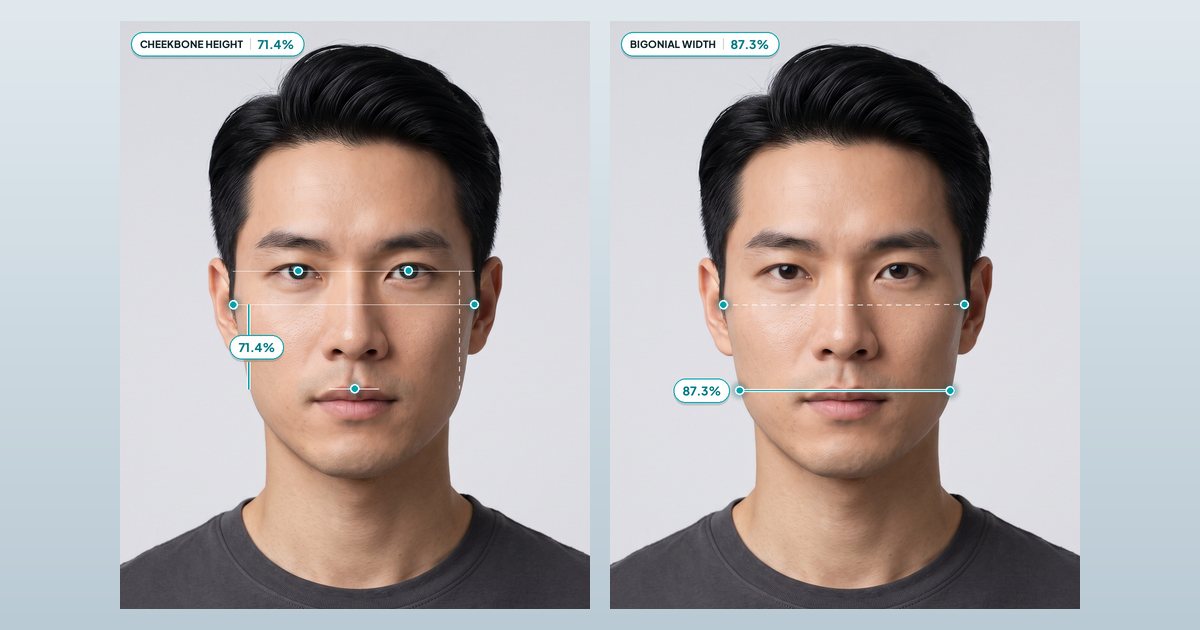
On a front photo, our ideal range for high cheekbones puts the widest part of your face close to the level of your lower eyelids: 83 to 100% of the way up from your upper lip to your pupils for men, and from 84% for women. None of the three men we measured for this page gets there. They read 64.1%, 67.3% and 71.4%. All three still score Good overall.
Height is only half of what people mean, though. The man with the highest cheekbones of our three, at 71.4%, got the lowest Cheekbone Prominence rating: 6 out of 10, against 7 for the other two. Three faces prove nothing, but they show the split. In our view, when people praise someone’s cheekbones, they are usually looking at the shadow under the bone, not at where it sits.
Here are the three lines on the man from our sample report.
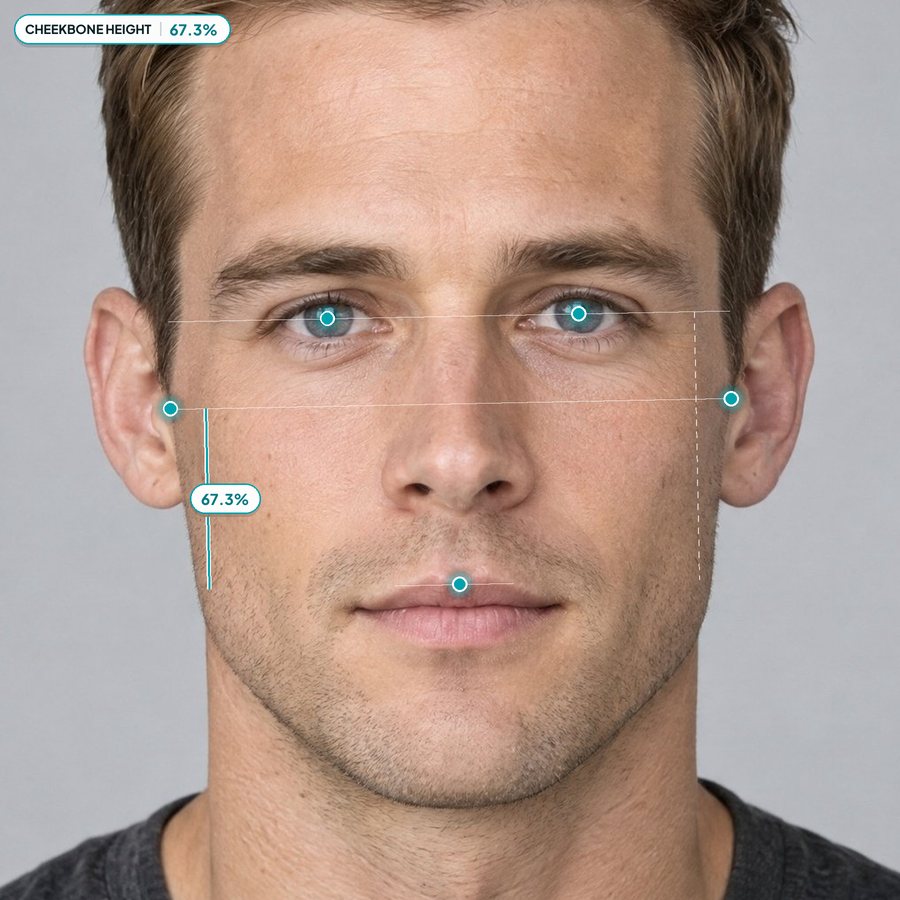
In our scoring, height barely counts: it is 1 of 33 front measurements and never makes your list of strengths or focus areas. How your cheekbones look is another matter. Two ratings for it make up a third of the Angularity pillar, more than the jaw gets. That part depends a lot on the cheek under the bone. Some of it you can change. Three checks tell height and definition apart: your fingers, three lines on a photo, and the shadow.
How to tell if you have high cheekbones
Feel for the bone, then find where your face is widest on a straight front photo. Widest just under your eyes means high. Widest down by your nostrils means low. All three faces on this page sit in between.
Your cheekbones are the two zygomatic bones, one under each eye, forming the lower outer rim of the eye socket. “The cheekbone” can mean two different spots. Your finger finds the front of the bone, below the outer corner of the eye, where highlighter goes. Our engine measures the sides of the face, where the skin outline is widest.
The finger test
Put a fingertip just in front of each ear and slide it forward along the bony ridge toward your nose until it becomes the cheekbone. Notice where it stands out most. On most people that peak sits roughly halfway down from the outer corner of the eye to the level of the nostrils. Clearly closer to the eye corner means yours sit high; closer to the nostrils, lower. The finger tells you where the bone is. It can’t give you a number.
The three-line photo test
This one matches our engine step for step, so you can set your result next to ours.
- Have a friend take a front photo, or prop the phone at eye level and use the timer, from about 1.5 m (5 feet) away and zoomed in. Keep your chin level and your face neutral, with lips closed, hair off your cheeks and soft light from the front.
- Draw a level line through the centers of both pupils. Your phone’s photo markup tool works, or print the photo.
- Draw a level line through the top of your upper lip at the center, the dip of the Cupid’s bow.
- Find the level where your face is widest between your eyes and the bottom of your nose, at the skin edge. Ignore ears and hair. Draw a level line there. If the outline looks equally wide over a band, take the middle of the band.
- Measure from the lip line up to the cheek line (B) and from the lip line up to the pupil line (A). Cheekbone height is B divided by A, times 100. Any unit works because it’s a ratio: zoom the photo to fill the screen and hold a ruler to it, or use millimeters on the printout.
On the face in the first figure, B is 204 pixels and A is 303, so 204 divided by 303 gives 67.3%, against 83% where the ideal range for men starts (84% for women). At 100% the cheek line sits on the pupil line. If yours lands in the 60s or low 70s, you’re where all three faces on this page sit. Each of them still rates Good.
Our engine runs the same steps with its own points. It checks 12 level rows between the pupils and the nose and keeps the widest one (how the points are placed). Because it only searches from the pupils down, it never reads above 100%. If you get more, your cheek line is above your pupils. Redraw it between your eyes and the bottom of your nose.
Don’t trust this number to the last point. Our engine flags cheekbone height as low confidence on all three faces here. It is the least certain ratio we take from the front, because the widest part of a cheek is a long, gentle curve and the chosen row can slide by several points. Tipping your chin up lowers it too. Compare only photos taken the same way.
The shadow test for defined or flat cheekbones
Stand at a mirror with light coming from slightly above you. A soft shadow running from under the cheekbone toward the corner of your mouth is what people read as defined. Switch to flat front light, such as a phone flash, and it fades.
Keep the top light and turn your head a little to one side to check for flat. A prominent cheekbone catches a highlight along its top, with the shadow below it. A flat one lights evenly from under the eye to the jaw, with little of either. In profile, the front of the cheek runs in a nearly straight line from the lower eyelid toward the corner of the mouth. Flat means the bone projects little, which is a different thing from low. A fuller cheek gives the same even look, so the mirror can’t always tell a flat bone from a well-padded one.
Both are rules of thumb. Your report judges these from your photos as two ratings: Cheek Leanness & Ogee Curve for the shadow, and Cheekbone Prominence for how far the bone stands out. The ogee is the S-shaped curve from the cheekbone into the cheek below.
Why your cheekbones look different in photos
Cheekbones show up as light and outline, which is exactly what a camera bends. Check any photo of yours for these five before you trust it.
| What changes | What it does | Fix |
|---|---|---|
| Chin tipped up | Drops the widest part of the cheeks against the eyes and lowers your number | Lens at eye level, chin level |
| Close selfie, about 30 cm | Makes the nose about 30% wider against the cheekbones than at 1.5 m, in a geometric model1 | Stand 1.5 m away and zoom in |
| Light from straight above vs flash | Top light deepens the shadow under the bone; flat front light hides it | Even front light for the number, the same light every time for the shadow |
| Smiling | Lifts the cheeks, moving the widest point and the shadow | Neutral face, lips closed |
| Contour makeup or a filter | Adds shadow that isn’t bone | Bare face, no filter |
When celebrities are praised for their high cheekbones, look at the light first. Studio and red-carpet photos often use top light and contour. Both deepen the shadow under the bone. Professional makeup also shifts ratings more than the self-applied kind.2 The full checklist for a fair photo is in our attractiveness test guide.
What high vs low cheekbones look like, and where three faces land
Low cheekbones peak closer to the upper lip, so the fullest part of the cheek sits lower and the face is widest nearer the mouth. On the photo test, anything under 50% is low by any reading. High ones sit close to the lower eyelids, with the cheek sloping in below them. Our three faces fall between the two. Here is what each reading scores:
| Your number (men’s ranges; women’s are 1 point higher) | Where it sits | Score out of 10 |
|---|---|---|
| 83 to 100% | High: inside our ideal range | 10 |
| 73 to 82% | Just under high: up to 10 points under the range | About 5 to 10 |
| 71.4% | In between (right-hand face) | 4.2 |
| 67.3% | In between (middle face, the sample) | 2.5 |
| 64.1% | In between (left-hand face) | 1.6 |
| 50 to 63% | In between, lower than our three faces | Under 1.5 |
| Under 50% | Low: nearer your lip than your eyes | Close to 0 |
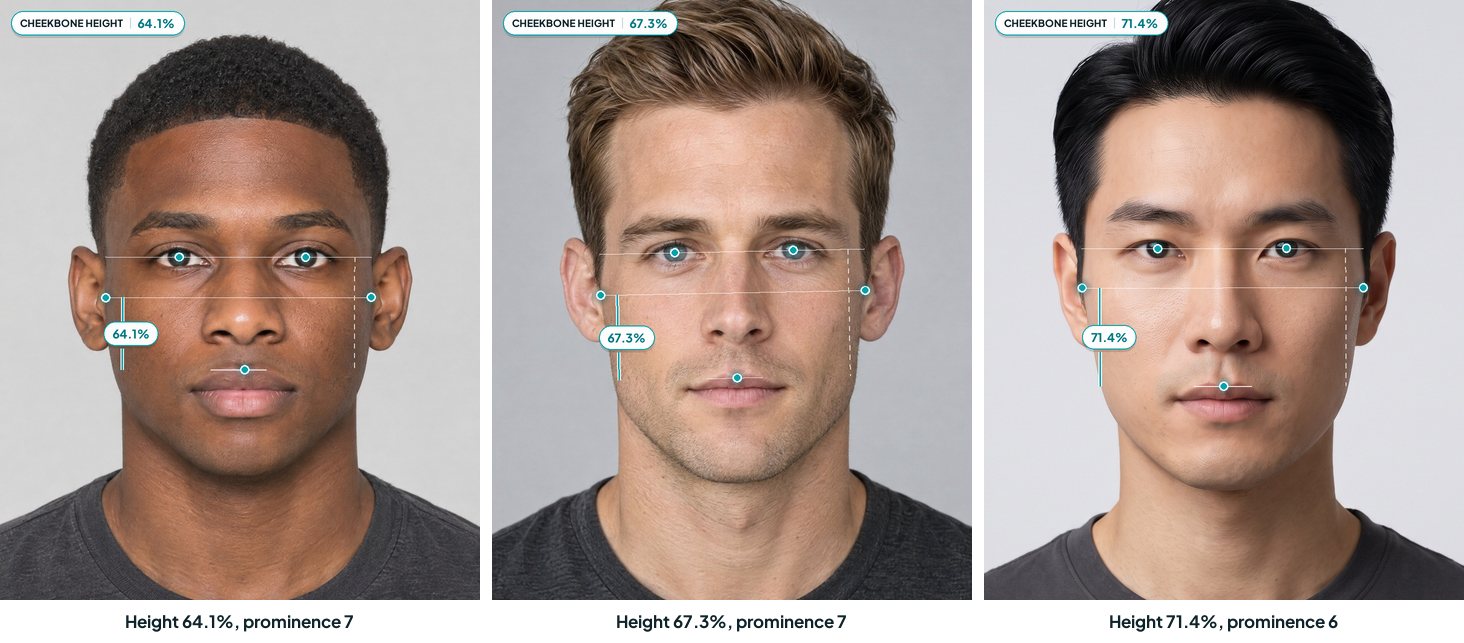
On these faces the widest part of the cheeks sits about 2 cm below pupil level. Reaching 83% would take it about 8 to 11 mm higher (both estimated). That’s a high bar.
How high your cheekbones sit doesn’t vary much between people. Of 67 patients photographed at an ear, nose and throat practice in a 2015 study, 86% had the most prominent point of the cheek within 3 mm of the average, on a typical-sized face.3 That study used a different point and an angled photo, so its 3 mm and our 8 to 11 mm don’t line up. But if most faces sit that close together, a range starting at 83% asks for something uncommon. Landing under it is no mark against your face.
High vs prominent vs wide cheekbones
Online, high, prominent, defined and big cheekbones all get praised as if they were one thing. Your report scores them separately, because they come apart:
| Word | What it describes | How your report reads it |
|---|---|---|
| High or low | Where the widest part of the face sits between the eyes and the lip | Cheekbone height, a front-photo ratio |
| Prominent or defined | How far the bone stands out, forward and to the sides: a highlight on top, a shadow below | Cheekbone Prominence, a 0 to 10 rating from the photos |
| Flat | Little forward projection: little highlight or shadow, and a flat-looking cheek from the side | Also Cheekbone Prominence (the side-photo lines don’t measure it) |
| Wide, narrow or big | The width across the face at the cheekbones | Cheekbone width, the base of six ratios, face width to height among them |
| Hollow | Missing soft tissue below the bone, seen as a deep dip under the cheekbone | Cheek Leanness & Ogee Curve, a rating from the photos |
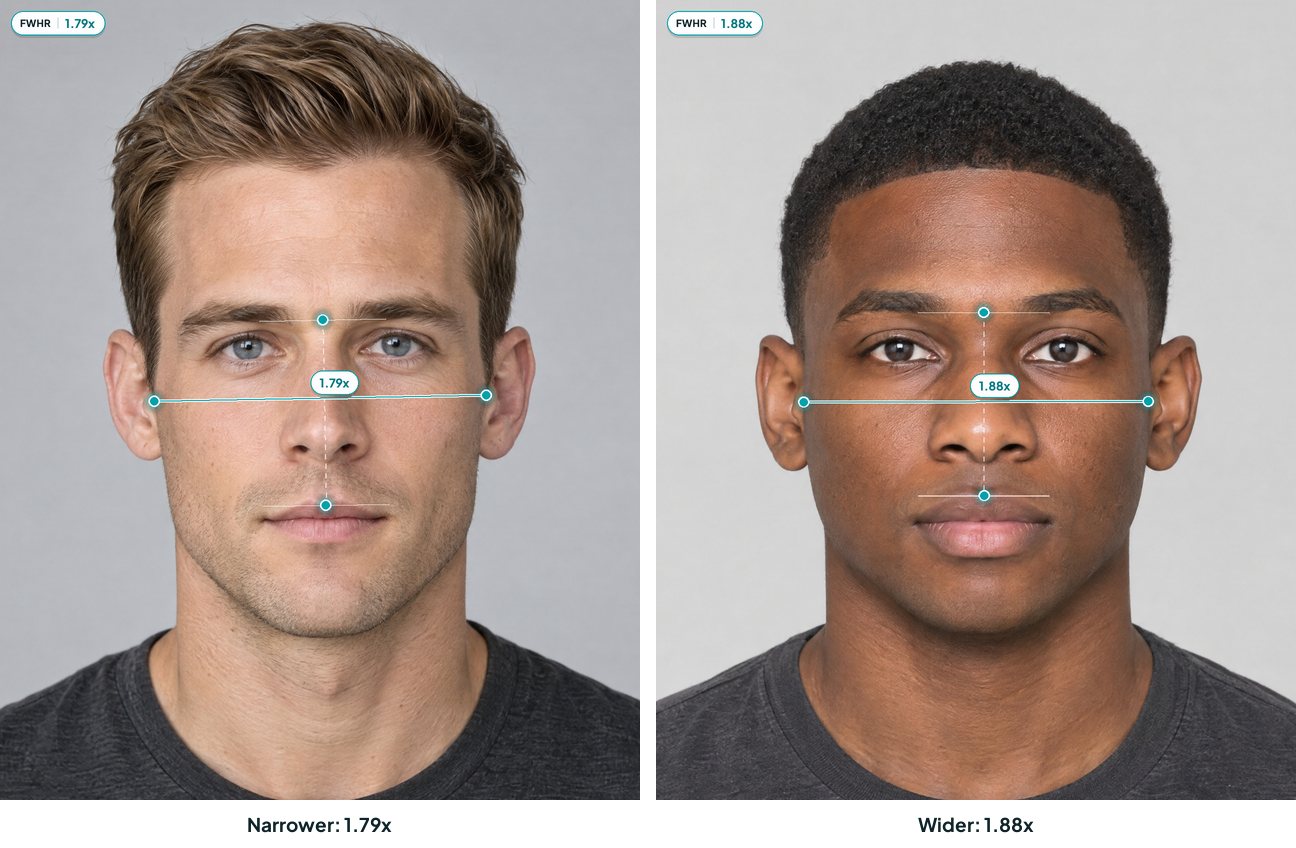
Width and height don’t move together. The 64.1% man on the right is the wider of the two for his face length: about 140 mm across the cheekbones against about 135 mm for the sample face (both estimated). His cheekbones sit no higher: 64.1% against 67.3%, a gap inside this measurement’s noise.
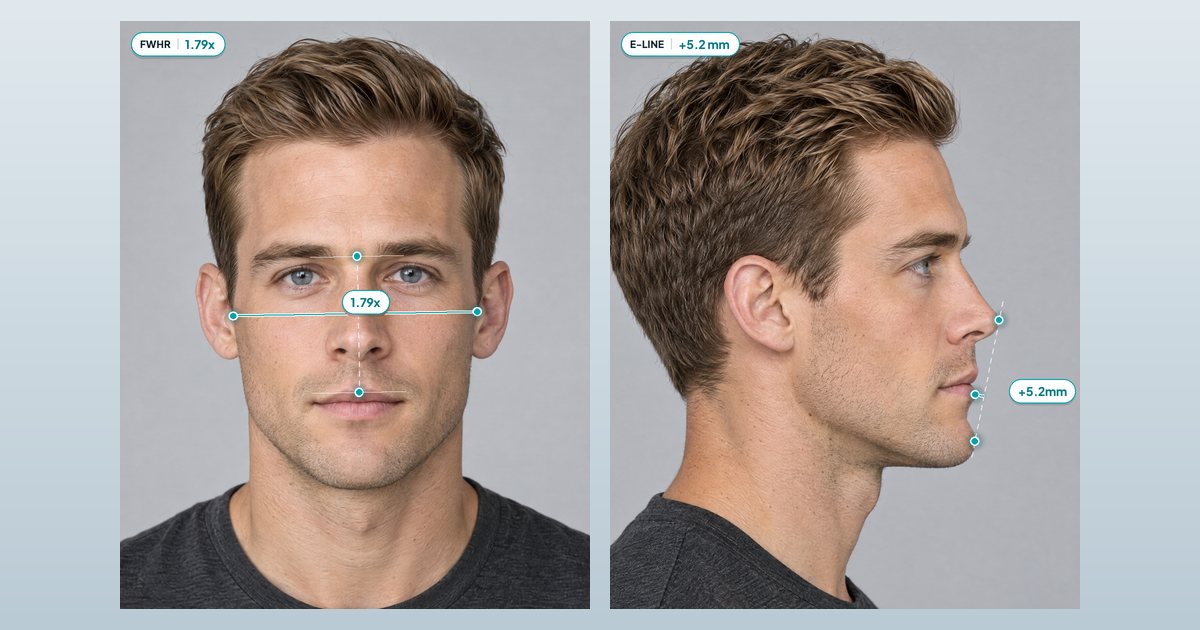
Narrow cheekbones show up in face width to height, the ratio drawn above. A ratio under the range means cheekbones that are narrow for the face’s height, a tall midface, or both. Both faces sit under it, the left by 0.17 and the right by 0.08. Neither looks narrow.
Defined cheekbones vs hollow cheeks
Cheekbones look defined when the cheek below them is lean enough to show a soft shadow. The goal is defined, not hollow or sunken.
Cheekbone Prominence carries 17% of the Angularity pillar and Cheek Leanness & Ogee Curve 16%, against 27.6% for the jaw. All three of our faces score 7 for leanness. Only prominence splits them, and it marks down the man with the highest-set cheekbones.
Face fat follows body fat. Across studies, people guess how heavy someone is for their height from a face alone fairly well, with a correlation of 0.71. Cheek fat is also linked to belly fat.4
More hollow is not better. Faces that look underweight and faces that look overweight both score lower on health and attractiveness.4 The fullest cheeks scored lowest with every group of raters in a 3D test on one woman’s face. Orthodontists also marked down the most hollowed version and rated it the oldest of seven, while lay raters picked the fullest version as the oldest.5
If you check one thing in the mirror, make it the cheek under the bone.
Can a round face have high cheekbones?
Yes. Part of a face’s roundness comes from soft tissue: in one study, young women with a higher BMI had a wider, rounder face outline relative to their eyes and lips.6 A jaw close to cheekbone width rounds it too. Cheekbone height varies little from person to person,3 so a round face usually has its cheekbones at about the same height as anyone else’s. They just show less. The three-line test still finds your widest level.
Why cheekbones look flatter with age
The cheekbone itself changes less with age than the upper jaw beside it. Below the eye, the upper jaw loses bone, the lower outer rim of the eye socket (partly formed by the cheekbone) recedes, and the soft tissue over the mid-cheek shifts too.7 So your cheeks can look flatter. Where their peak sits seems to hold steady: in one study of people aged 16 to 69, its height didn’t change with age.3
Are high cheekbones attractive?
Less than most pages claim. Prominent cheekbones went with higher attractiveness ratings in two older studies of men’s faces, always alongside other features. A 2018 experiment leaned slightly the other way. We found no study that tests how high cheekbones sit.
The study everyone quotes is Cunningham’s, from 1990. Women rated photos of men. Higher ratings went with prominent cheekbones, a large chin, large eyes, a big smile and high-status clothing. There was a ceiling: the most mature-looking faces weren’t rated the most attractive.8 Scheib’s team found the same direction in 1999: a masculinity score built from cheekbone prominence and a longer lower face went with attractiveness, even when women saw only half of each face.9
A 2018 study put cheekbones up against four other features, on men’s and women’s faces. Researchers changed the cheekbones, jaw, brows, eye size and face height of composite faces. Then 922 people, most of them white and many of them US students, ranked the results. Cheekbones counted the least of the five, with an importance score of 18.4 against 19.5 to 21.3 for the others. Slightly less prominent cheekbones were preferred on both sexes, a small effect the authors called unexpected for women’s faces. They note the change was subtle, though raters did see the less prominent version as more masculine.10
In your report, cheekbone height is one small part of the Harmony pillar. You see its value, score and label, but because it’s low confidence it never makes your list of strengths or focus areas (how the report picks them). The sample face shows how little it weighs. It scores 2.5 out of 10 there, labeled Focus area. The whole face still gets 7.0, Good. How defined your cheekbones look counts for more, through the two ratings in Angularity. The Masculinity or Femininity pillar, named for your sex in your report, is led by the jaw and brow ridge and has no cheekbone rating.
One number never decides how attractive someone is, and in our scoring this one hardly registers.
High cheekbones in women and men
Women and men carry their cheekbones at about the same height,3 and our ideal ranges for the two differ by only 1 point. What differs is how full the cheek is around the bone, and how much our ranges expect the face to narrow above and below it.
Women’s cheeks are fuller below the eyes, out toward the cheekbones, while men’s faces project more down the middle, from the brow ridge to the chin. That comes from 3D scans of 342 white Italian adults, so it may not hold everywhere.11 In the mirror, defined cheekbones tend to look rounder and softer on women. On men they tend to show as a sharper edge, with a clearer shadow below it.
| Measurement | Men | Women | Sample face |
|---|---|---|---|
| Cheekbone height | 83 to 100% | 84 to 101% | 67.3% |
| Temples, % of cheekbone width | 86.5 to 92.5% | 80.5 to 86.5% | 85.7% |
| Jaw corners, % of cheekbone width | 87.5 to 91.5% | 84 to 88% | 89.1% |
| Face width to height | 1.96 to 2.00 | 1.94 to 1.98 | 1.79 |
The analysis asks for your heritage. A different answer nudges a few width ranges; the cheekbone height range never moves.
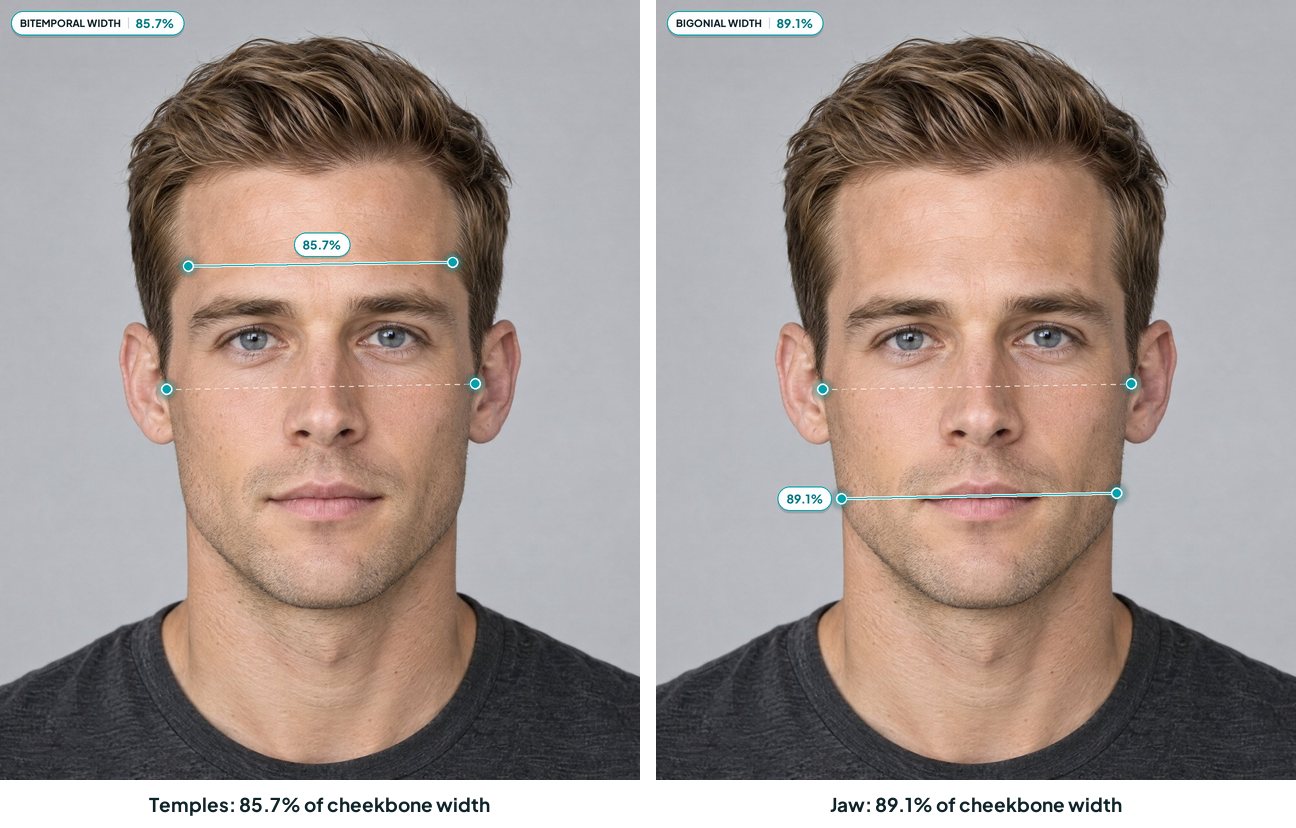
Our ideal ranges expect a feminine face to narrow more on each side of the cheekbones, with the temples 6 points lower and the jaw corners 3.5 points lower, which leaves the cheekbones more clearly the widest line of the face. Real faces don’t always follow it: one 3D study found relatively wider temples in women.11
Pages that tie high cheekbones to diamond or oval faces are describing this taper: a face that narrows above and below the cheekbones. A heart face narrows mainly below them.
Which sex has more prominent cheekbones is disputed. One study counts cheekbone prominence as a masculine cue,9 while another built its feminine faces with more prominent cheekbones.10 Two studies, two answers, so we won’t pick a side, and your report doesn’t need to: it rates cheekbones in Angularity whatever your sex.
How to get higher-looking cheekbones
You can’t raise the bone, but you can change how much of it shows. Here are the levers, in order of how much they change, in our judgment:
- Body fat, through ordinary diet and exercise. It’s the biggest lever if you carry extra weight, because cheek fat tracks body fat.4 Stop well short of hollow.5
- Makeup, if you wear it. For high cheekbone makeup, placement matters more than the products. Shade along the underside of the bone from in front of the ear toward the corner of the mouth, stopping about under the outer corner of the eye. Highlight the top of the bone and blend blush from the apples up toward the temples. If your cheek line reads low on the photo test, keep the shade short and set it a little higher.
- Beard, for men. Set your cheek line low enough that the hollow under the cheekbone stays bare skin. A beard that climbs into it fills the shadow in. Go shorter on the cheeks, and a little fuller along the jaw if your jaw reads narrow.
- Hair and glasses. Hair that hangs over the cheeks hides them, so pull it back or have it cut to fall behind or below the cheekbone. Glasses can hide them too, so pick frames whose lower edge sits clear of the cheekbones. If your face width to height reads under the range, volume at the sides at cheekbone level makes the midface look wider; if it reads over, height on top makes the face look longer. The measured ratio stays the same, since our engine ignores hair.
- Photos. For a flattering shot, use light from slightly above and to one side, with the camera at eye level and back from your face (see the table above).1 Save even front light for measuring.
Face exercises and face yoga have no good evidence behind them. A 2014 review of face exercises for an aging face found nine studies, none with a control group or randomization, and called the evidence insufficient.12 We found no study of mewing for cheekbones, and no evidence that an exercise, massage or face gadget can reshape adult bone.
Check yours first, with the three-line test above or a scan, so you know whether your cheekbones read low, narrow or soft, and which of these tips is worth your time.
You can read the full report on the sample face first.
Questions people ask
What are high cheekbones?
High cheekbones are cheekbones that make your face widest close to eye level, near the lower eyelids, so the cheek slopes in below them. The cheekbone is the zygomatic bone. With low cheekbones, the face is widest nearer the nostrils. On a front photo, our ideal range puts the widest part of the face 83 to 100% of the way from the upper lip to the pupils for men, and 84 to 101% for women.
Are high cheekbones attractive?
Somewhat, but less than most pages claim. In two older studies of men's faces, prominent cheekbones went with higher attractiveness ratings. They measured how far cheekbones stand out, not how high they sit, and we found no study that tests height. A 2018 experiment that changed cheekbones, jaw, brows, eye size and face height together found cheekbones counted the least of the five, and slightly less prominent ones were preferred. In our scoring, how defined they look counts for far more than how high they sit.
What ethnicity has high cheekbones?
We found no good evidence that any ethnicity has higher-set cheekbones as a group. One small study that measured cheekbone height across groups found no difference between white and Hispanic patients, and its authors say it can't speak for other groups. Our cheekbone height range is the same for every heritage option; heritage shifts only a few width ranges, and only slightly. Width and how much cheekbones stand out vary from face to face in every group.
Are high cheekbones masculine or feminine?
Both. In one study that measured it, men and women had cheekbones at about the same height, and our ideal ranges for the two differ by just 1 point. In two older studies of men's faces, prominent cheekbones went with attractiveness, and studies disagree on which sex has more prominent ones. In one 3D study, women's cheeks were fuller below the eyes than men's, so defined cheekbones tend to read softer on women and sharper on men.
Can losing weight give you high cheekbones?
It can make them show, but it can't move them. Cheek fat tracks body fat, so losing excess weight through ordinary diet and exercise can sharpen the line under the bone. Stop well short of hollow: faces that look underweight are rated less healthy and less attractive, and in one small test orthodontists rated very hollow cheeks the oldest-looking. We know of no single body-fat number where cheekbones appear; it differs from face to face.
Do face exercises or mewing give you higher cheekbones?
No. Exercises can't move adult bone, and a systematic review of face exercises for an aging face found nine studies, none with a control group or randomization, and called the evidence insufficient. We found no study that tested mewing for cheekbones. What does change how they look is body fat, hair, the line of a beard, makeup and light, so those are a better use of your time.
Are low cheekbones attractive?
Yes. No study we know of ties cheekbone height itself to attractiveness; the research that exists is about how far cheekbones stand out. In our scoring, cheekbone height is 1 of 33 front measurements and is marked low confidence. The face in our sample report reads 2.5 out of 10 on it and still scores 7.0, Good, overall. A lean cheek under the bone does more for how your cheekbones look than their height does.
Sources
-
Ward B, Ward M, Fried O, Paskhover B. Nasal distortion in short-distance photographs: the selfie effect. JAMA Facial Plast Surg. 2018;20(4):333-335. doi:10.1001/jamafacial.2018.0009. Full text on PMC ↩↩
-
Jones AL, Kramer RS. Facial cosmetics and attractiveness: comparing the effect sizes of professionally-applied cosmetics and identity. PLoS One. 2016;11(10):e0164218. doi:10.1371/journal.pone.0164218. Full text on PMC ↩
-
Kaptein YE, Kaptein JS, Markarian A. Vertical localization of the malar prominence. Plast Reconstr Surg Glob Open. 2015;3(6):e411. doi:10.1097/GOX.0000000000000383. Full text on PMC ↩↩↩↩
-
de Jager S, Coetzee N, Coetzee V. Facial adiposity, attractiveness, and health: a review. Front Psychol. 2018;9:2562. doi:10.3389/fpsyg.2018.02562. Full text on PMC ↩↩↩
-
Feng J, Yu H, Yin Y, Yan Y, Wang Z, Bai D, Han X. Esthetic evaluation of facial cheek volume: a study using 3D stereophotogrammetry. Angle Orthod. 2019;89(1):129-137. doi:10.2319/020418-97.1. Full text on PMC ↩↩
-
Mayer C, Windhager S, Schaefer K, Mitteroecker P. BMI and WHR are reflected in female facial shape and texture: a geometric morphometric image analysis. PLoS One. 2017;12(1):e0169336. doi:10.1371/journal.pone.0169336. Full text on PMC ↩
-
Mendelson B, Wong CH. Changes in the facial skeleton with aging: implications and clinical applications in facial rejuvenation. Aesthetic Plast Surg. 2012;36(4):753-760. doi:10.1007/s00266-012-9904-3. Full text on PMC ↩
-
Cunningham MR, Barbee AP, Pike CL. What do women want? Facialmetric assessment of multiple motives in the perception of male facial physical attractiveness. J Pers Soc Psychol. 1990;59(1):61-72. doi:10.1037/0022-3514.59.1.61. Abstract on PubMed ↩
-
Scheib JE, Gangestad SW, Thornhill R. Facial attractiveness, symmetry and cues of good genes. Proc Biol Sci. 1999;266(1431):1913-1917. doi:10.1098/rspb.1999.0866. Article on PMC ↩↩
-
Mogilski JK, Welling LLM. The relative contribution of jawbone and cheekbone prominence, eyebrow thickness, eye size, and face length to evaluations of facial masculinity and attractiveness: a conjoint data-driven approach. Front Psychol. 2018;9:2428. doi:10.3389/fpsyg.2018.02428. Full text on PMC ↩↩
-
Solazzo R, Gibelli DM, Alderighi A, Dolci C, Sforza C, Cappella A. How sex shapes facial morphology in adults: a 3D geometric morphometric study. Diagnostics (Basel). 2026;16(5):712. doi:10.3390/diagnostics16050712. Full text on PMC ↩↩
-
Van Borsel J, De Vos MC, Bastiaansen K, Welvaert J, Lambert J. The effectiveness of facial exercises for facial rejuvenation: a systematic review. Aesthet Surg J. 2014;34(1):22-27. doi:10.1177/1090820X13514583. Abstract on PubMed ↩
Spotted a mistake? Email support@faceratinglab.com and we will fix it.