Eye shapes: every type on one chart, and how to find yours
Most charts pick six to eight eye shapes from these 10: almond, round, hooded, monolid, upturned, downturned, deep-set, protruding, close-set and wide-set. Each name describes one trait you can check on a photo, and almond is simply the name for an eye near the average.
The short version
- One label can hide very different eyes: a chart would call all three of our example men almond, yet one has nearly level corners (+2.7 degrees) and another's rise steeply (+8.1). No chart or study we found sets a number where one chart shape turns into the next.
- An average adult eye opening is about 3 times wider than it is tall. Our default ideal range runs from 3.0 to 3.5 for men and 2.8 to 3.3 for women, and lower numbers read rounder.
- To find yours, check five things in order: the lid crease, roundness, corner tilt and spacing on a level front photo, then depth on a side photo.
- We found no study that sorts people into the chart shapes and counts them, so 'almond is the most common' has no data behind it, however often you read it.
- Tape changes your lids only while it's on, and nothing we found shows that eye exercises work. Brows, glasses, lashes, makeup and a level, front-lit photo change how your eyes read, so choose them by trait, not by label.
Behind the drawings, the eye shapes on any chart track just five traits: the lid crease, how round the opening is, the corner tilt, the spacing and the depth. That’s why one pair of eyes often collects two or three names: hooded and almond, say, or round, upturned and wide-set.
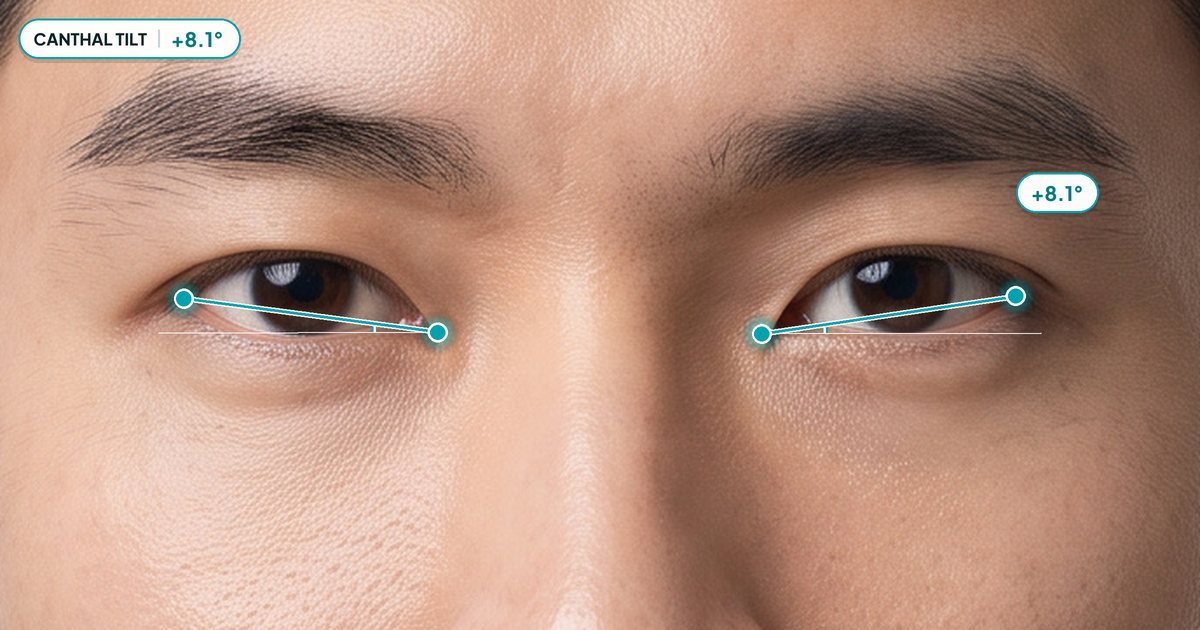
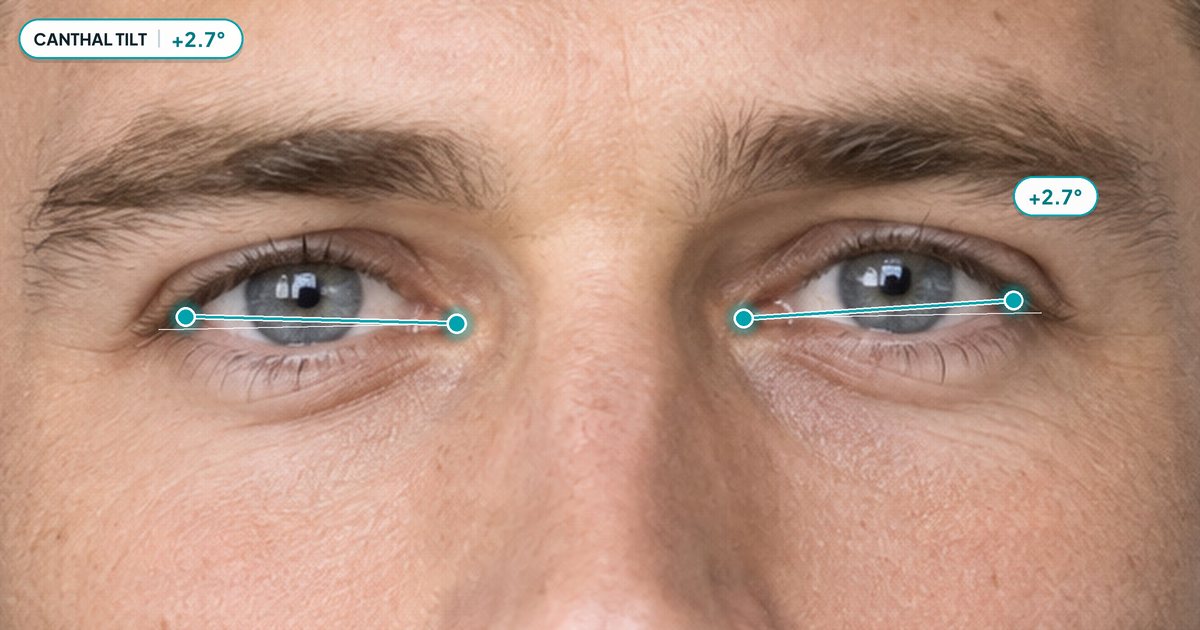
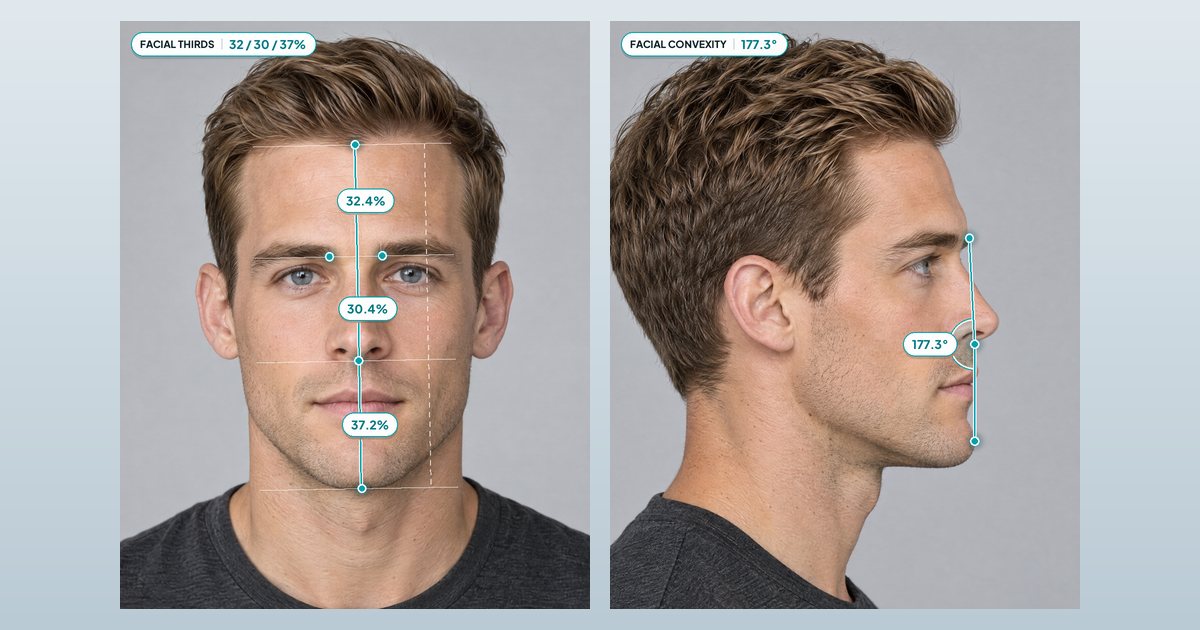
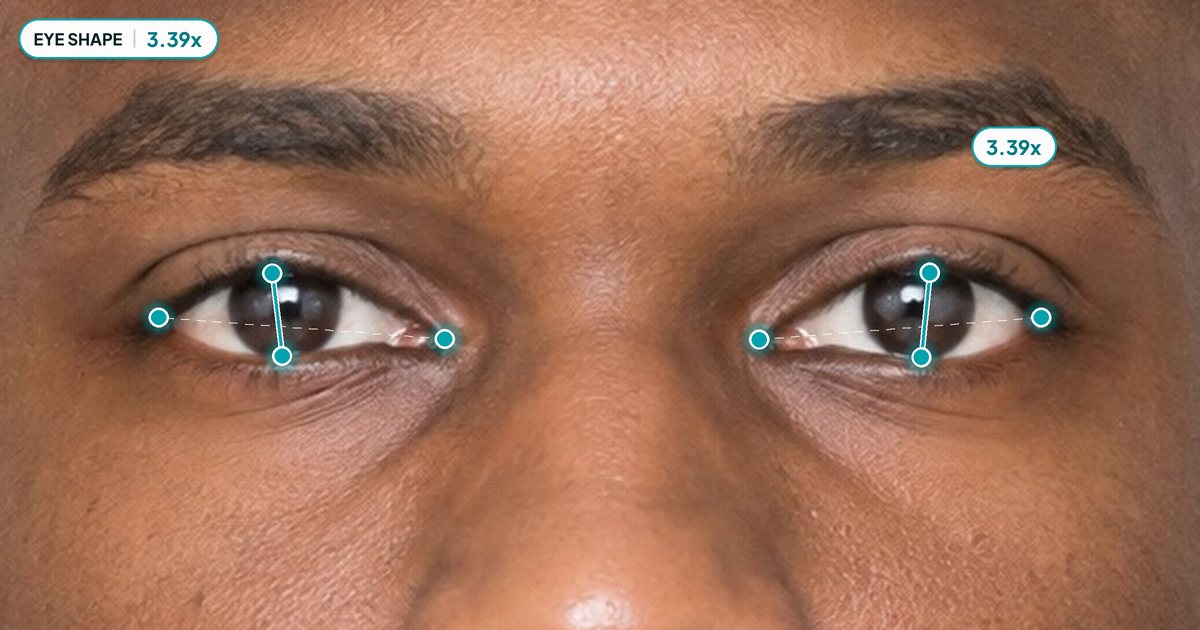
Most charts would call all three pairs of eyes in the next figure almond. Measured with the ratio our report calls eye shape (width divided by height), all three sit inside their ideal range, at 3.00, 3.27 and 3.39. Past that they split. The outer corners rise anywhere from +2.7 to +8.1 degrees, and the gap between the eyes runs from 0.95 to 1.13 eye widths, as our report measures it. Same word, three different pairs of eyes. The man in the middle is the one in our sample report.
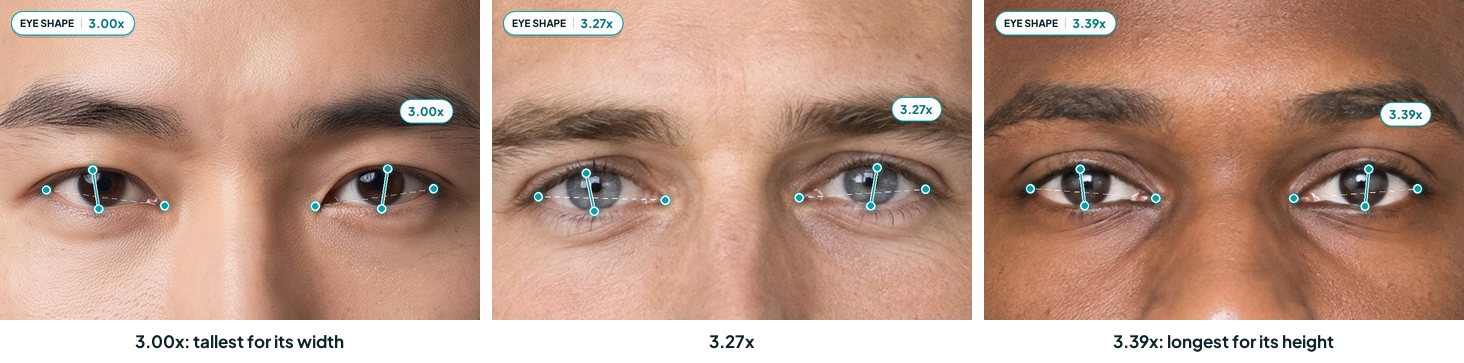
Doctors don’t sort eyes into shapes. They measure the opening’s width and height, its slant and the spacing, judge depth and lid folds by eye, and usually only give a trait a name when it sits far from the average.1
So none of the chart names is a flaw, and none is a diagnosis. The chart below gives the trait behind each name and how our report handles it, so you can check your own eyes instead of squinting at drawings.
Eye shape chart of all 10 types, with what each one measures
Between them, the charts we read use 10 names for the different eye types. Six describe the opening and the lid above it (almond, round, upturned, downturned, hooded and monolid), and four describe where the eyes sit in the face (close-set, wide-set, deep-set and protruding). Read each row with your eyes looking straight ahead and your face relaxed.
| Shape (trait) | What you see | Our report |
|---|---|---|
| Almond (middle of every scale) | About 3 times wider than tall,2 corners tilting slightly up, no white above or below the iris | Eye shape 3.0 to 3.5 for men, 2.8 to 3.3 for women |
| Round (roundness) | An opening tall for its width, white often visible above or below the iris | Eye shape well below your range; White below the iris (rating) |
| Upturned (tilt) | Outer corner visibly higher than the inner corner | Canthal tilt of about +6° or more |
| Downturned (tilt) | Outer corner below the inner corner, or a hood or low brow tail pulling the outer third down | Canthal tilt below 0° (about 0° reads level); Eyelid hooding (rating) |
| Hooded (lid) | A fold of skin from under the brow rests on or near the lashes | Eyelid hooding and Upper Eyelid Exposure ratings, out of 10 |
| Monolid (lid) | No visible crease across the lid3 | Upper Eyelid Exposure (rating) |
| Close-set (spacing) | Gap between the inner corners noticeably less than one eye’s width | One Eye Apart clearly below your range |
| Wide-set (spacing) | Gap between the inner corners clearly wider than one eye, by about a third or more | One Eye Apart well above your range, at about 1.2 or more. Just above it is common: the range sits below the average gap. |
| Deep-set (depth) | Eye sits further back in the face than usual, not just under a heavy brow;1 lid often in shadow | Not rated: your own side-photo check (step 5). Eye Protrusion (rating) covers the opposite end. |
| Protruding or prominent (depth) | Eye sits forward; more lid shows, often with white below the iris | Eye Protrusion and White below the iris (ratings) |
The ranges in the last column are where our engine scores best, not borders between shapes, and the tilt and wide-set cut-offs are our own rules of thumb. Where almond turns round, or where a lid becomes hooded, is a judgment call, so any chart, ours included, can only tell you which way your eyes lean.
You’ll read on page after page that almond is the most common eye shape. We found no study that has counted. Almond is just the name charts give an opening near the average, with corners that tilt slightly up, like the sample face’s +2.7 and the 3.39 face’s +4.4, so plenty of eyes can wear it.
Oval means the same thing on most charts.
Seven of the 33 front measurements in our report are about the eyes, more than any other part of the face, and each is drawn as a line on your photo. The lid is the exception: lid show and hooding are rated out of 10 instead of drawn, because the crease is too hard to place on a photo. How the points are placed shows where each line sits.
What eye shape do I have? Five checks on a front and side photo
Take a level front photo and a side photo, check five traits in order (lid, roundness, tilt, spacing, depth) and write down one word for each. That is the whole eye shape test. If you came here asking “what is my eye shape?”, those five words are the honest answer. A single label throws four of them away.
First, the photo. Ask a friend to use the rear camera, or prop the phone up and use the timer. Stand about 1.5 m (5 feet) away, zoom in and put the lens at eye height. Keep your chin level and your face and brows relaxed, with your eyes on the lens rather than the screen. Don’t smile or squint. Take glasses off and push hair off the brows. Take a side photo the same way.
A mirror is enough for the lid and tilt checks; roundness and spacing need a photo you can measure. Open it in an editor that shows the cursor position (Paint’s bottom bar on Windows, or Photopea’s Info panel). On a phone, lay a strip of paper on the zoomed-in screen, mark the eye’s height on it and count how many times it fits across the width.
- Lid. Look straight ahead and find the band of lid between your lashes and the crease. A clear band means an open lid: write open. A fold of skin resting on or near the lashes means hooded. No crease at all means monolid.3
- Roundness. Measure the width, corner to corner where the lids meet, and divide it by the height, from the upper to the lower lid edge straight through the pupil (the two lines on each eye in the first figure). Average both eyes. On the sample face, the right eye is 129.5 pixels wide and 39.5 tall, so 3.28; with the left at 3.26, the average is 3.27. Our default ideal range is 3.0 to 3.5 for men and 2.8 to 3.3 for women. An average adult opening sits at or just below the bottom of the men’s range.2 Inside your range, or close to it, write almond. Well below it, especially with white showing above or below the iris, write round. Well above it, write long: most charts don’t name it, and it only means the opening is low for its width.
- Tilt. Draw a line from the inner corner to the outer corner, where the lids meet (not the end of your liner or the hood fold). Compare it with a line parallel to the one between your pupils. Our rule of thumb: if the outer corner sits higher by roughly a tenth of the eye’s width (about +6 degrees), write upturned, like the +8.1 face below. Less rise than that, like the sample face’s +2.7, reads about level: write neutral. Lower at the outer corner means downturned. A hood or a low brow tail can make eyes look downturned even when the corners tilt up. The full method turns the line into degrees.
- Spacing. Divide the gap between your inner corners by the width of one eye; the paper strip works here too. Averages shift with the method and the group,28 so only a clear miss counts. Clearly under 1 reads close-set. For younger adults in one Australian photo study, the averages work out to about 1.2 measured this way,2 so we’d only write wide-set above about 1.3. Anything in between, write average. Your report’s number runs about 0.1 lower, because it measures each eye to the end of the lid fold: the sample face is 1.06 by ruler and 0.95 in his report.
- Depth. On the side photo, judge how far back the eye sits. Most eyes sit a little behind the brow bone. Eyes set well back compared with the whole face around them read deep-set. Check the cheek and nose bridge too, because a heavy brow alone can fake it. Eyes whose front sits well ahead of the cheek below, with more lid on show, read protruding, which some charts call prominent. Anything else is average depth, and this one stays a judgment call.
Head angle can fake three of the five answers. In a study of 12 women, tipping the chin 15 degrees up all but erased the tilt: the outer corner went from 2.55 mm above the inner one to 0.13 mm. Tipping it down hid lid, leaving 2.6 mm on show where a level head showed 3.8.4 Looking down narrows the opening too.5 And raised brows hide a hood, which is why the photo step asks for a relaxed face.
Even a careful photo flattens a curved eye. If a trait sits on the line between two words, take the photo again another day and keep the word that comes up both times. Our guide to a fair photo has the full checklist.
Here is how it adds up on the man in our sample report. Lid: a fold covers most of his upper lid, so hooded. Roundness: 3.27, so almond. Tilt: +2.7 degrees, up but not by much, so neutral. Spacing: 1.06 by ruler, so average. Depth: average on his side photo, and his report rates Eye Protrusion 9 out of 10, where 10 means no sign of it.
A makeup chart would call him a hooded almond and stop there. That label leaves out his tilt, the one eye trait his report lists as a focus area.
The five traits behind every eye shape, measured on three faces
Each of the five traits moves on its own. Among our three men, the roundest opening (3.00) comes with the steepest tilt (+8.1), while the sample face sits in the middle on roundness and lowest on tilt (+2.7). That’s why a single label so often feels wrong.
Round, almond or long openings
Round and almond are closer than the drawings suggest: a millimeter or two of opening apart. Take an eye 27 mm wide. With an opening 9 mm tall it reads 3.0, the bottom of the men’s range. Add 1 mm of height and it reads 2.7; add 2 mm and it reads 2.45, well on the way to round. Lose 1 mm instead and it reads about 3.4, the whole spread across our three men. Your two eyes won’t match either: the 3.39 face reads 3.45 on one side and 3.33 on the other. For scale, the average adult opening on a photo is 25.6 mm wide and 8.7 mm tall, in an Australian sample with an average age of 58.2
Missing your range by a little costs little. The score stays at 10 inside the range and only drops to 5 out of 10 at 0.55 outside it (2.45 for men), a bigger gap than the one between our roundest and longest eye.
Upturned and downturned corners
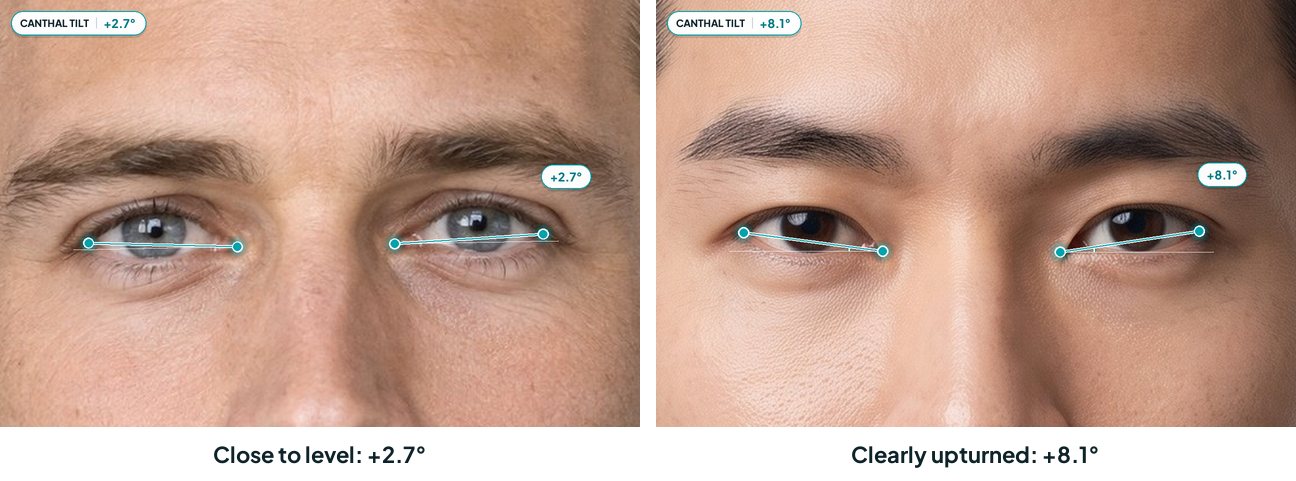
The whole difference between these two men is 2.6 mm at the outer corner, by our estimate. That’s close to what a 15-degree chin lift erased in the photo study above, which is why the check asks for a level lens. The canthal tilt guide has the tilt ranges by heritage, and the guide to downturned eyes covers level corners and eyes that only look downturned.
Hooded lids and monolids
A single eyelid, or monolid, is a normal lid build. The usual explanation is that the crease forms where fibers of the lid-lifting muscle reach the skin, and in a single lid that link is weak or sits low, with more fat in front.3
Genes play a large part. A genetic study asked 7,473 Chinese volunteers whether they had a double lid, and common gene variants explained 45% of the variation in the answers.6 We found no reliable count of how common single lids are. The estimates swing widely with the group studied and with whether a faint crease counts, so be wary of any page that gives you one neat percentage.
Hooding isn’t only age. Twin data put 61% of the variation in sagging lids down to genes. Men had higher odds, as did people with lighter skin or a higher BMI.7
Low brows that sit close over the eye make any lid look more hooded, which is why brows come back in the tips below. Hooding itself is a rating out of 10, and a coarse one. All three of our men got 8, although the sample face’s fold covers more of his lid than the 3.39 face’s does in the first figure. At this end of the scale, your own look in step 1 tells you more than the number.
How far apart the eyes sit
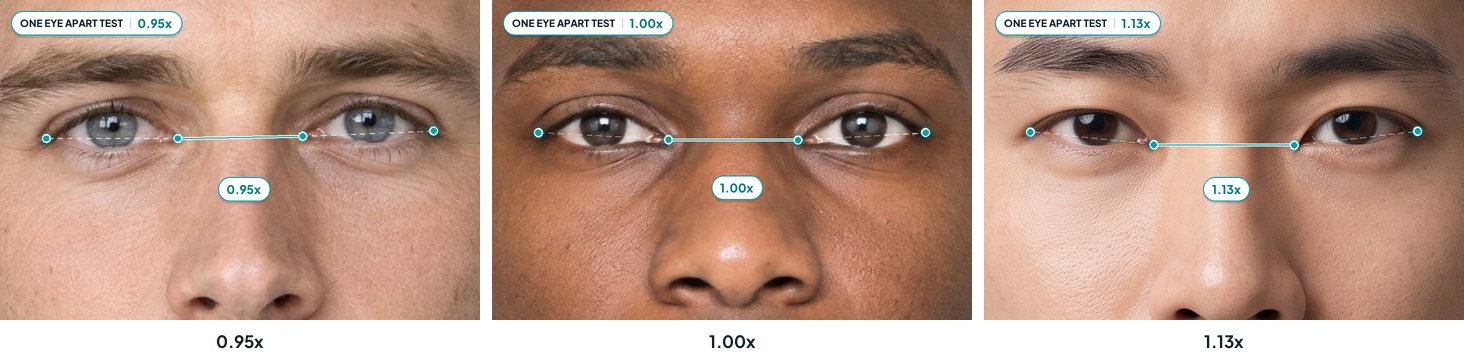
The old rule says eyes should sit one eye-width apart. It’s a drawing-class rule, and most real faces miss it: calipers on 168 young adults found it held for only 29% of the men and 25% of the women.8
Our ideal ranges are 0.95 to 1.00 for men and 0.98 to 1.03 for women. By ruler, corner to corner, the men’s band comes to about 1.05 to 1.1: close to the old rule, and below the roughly 1.2 we get from the younger Australian adults’ averages.2 So plenty of ordinary eyes read just above it. Landing outside the band makes spacing a focus area at most, never a flaw.
With East Asian heritage chosen at upload, both ranges move up 0.15, in line with wider average inner-corner gaps in East Asian samples.210 A gap that reads wide-set on a strict chart can sit inside your own ideal range.
The same idea gives the rule of fifths: a face about five eyes wide. Our three men measure 4.65 to 5.1 eye widths, close enough.
How deep the eyes sit
Depth is the hardest trait to pin down. Even in medicine, “deeply set eye” has no known objective measurement, so the call depends on whoever is looking.1 Our report rates how far an eye protrudes, out of 10, but has no deep-set rating, so deep-set stays your call from the side photo in step 5.
Eye shapes in women and men
Female and male eye shapes use the same names. The averages differ, and the studies don’t agree on how.
Australian measurements of 380 adults put men’s openings at 26.1 by 9.0 mm and women’s at 25.1 by 8.5 mm: bigger both ways in men, with almost the same shape.2 In Chinese young adults, measured on 3D scans that read rounder than photos, the shape did differ: the opening’s height came to about 46% of its length in women against 42 to 43% in men.10 So a rounder eye in women shows up in some groups and barely at all in others. Our ranges follow the rounder pattern.
Lid show differs more. Among celebrities on People magazine’s “most beautiful” and “sexiest” lists, the men showed 2.5 mm of lid between lashes and crease and the women 3.9 mm.9 The authors point to men’s heavier brow ridges and thicker brows. It’s a small celebrity sample, so read it as a direction: a lower, more hooded lid is normal in men.
| Measurement | Men | Women |
|---|---|---|
| Eye shape (width divided by height) | 3.0 to 3.5 | 2.8 to 3.3 |
| Canthal tilt | +6 to +7.7° | +6.8 to +8.5° |
| One Eye Apart | 0.95 to 1.00 | 0.98 to 1.03 |
| Eyebrow tilt | 6.5 to 11° | 10.5 to 15° |
Those are our defaults: ideal ranges differ by sex and heritage, and three of these four rows shift a little with the heritage you choose at upload. One difference the table doesn’t show: our women’s ideal puts the brow higher above the eye, 4 mm higher on a typical opening, by our estimate.
If every chart you’ve seen shows women in makeup, the names still work on men’s eyes. Expect your lid to read more hooded and your eyes deeper set than the drawings, partly because of the brow.
What is the most attractive eye shape?
No single shape wins.
A few traits show up more often in people picked as attractive, and which ones depends on who was picked. Italian researchers compared 126 men and women aged 18 to 30, picked at beauty contests, with 199 ordinary people of the same age. The contest picks had longer eye openings, inner corners closer together and a steeper upward slant.11 Korean pageant contestants had longer and much taller openings than ordinary young women, 11.5 against 9.1 mm tall on a 3D scan, with no measurable difference in slant.12 Both are small samples of contest picks, and one is women only, so read them as hints.
For men the evidence is thinner. In the Italian study the attractive men showed a similar pattern to the women.11 Large eyes and high brows are part of a “babyface” look that people read as warm and honest, but also as naive and less dominant.13 On a man, rounder isn’t automatically better.
On our three men, the eyes helped more than they hurt. The eye shape ratio made the strengths list on all three. The only eye measurement on any of their focus lists is the sample face’s canthal tilt (+2.7, Fair), and it moves his overall 7.04 by only about 0.05. One eye number never decides how attractive a face is.
How eye shape changes with age
Eye shape does change, but slowly and late. The upper lids hood, and the opening shortens while its corner line flattens.147
Researchers in Germany found the opening 2 mm shorter corner to corner (28.8 against 30.9 mm) in people averaging 77 than in people averaging 27, and by the study’s own angle the corner line was about 2 degrees flatter. The study had no one aged 35 to 60, but within its older group the differences showed mostly past 70.14 Lid skin hanging over the lashes showed up in 17.8% of 5,578 older Dutch adults.7 Of the clear risk factors in that study, body weight is the one you can change through ordinary diet and exercise. It’s a link in the data, with no promise attached.
No study we found shows that eye exercises, face yoga or taping change eye shape, so ignore the videos that promise it.
Lid shape comes from muscle attachments, fat, skin and bone,3 and tape or a tight hairstyle changes it only while it’s on. Only a medical procedure changes the crease or the corners for good. What you can change is how the area around them reads: brows, lashes, glasses, sleep and the photo itself.
One health note: a change that is new, quick or on one side only, such as one lid starting to droop or one eye starting to look more prominent, is worth showing a doctor. Shape names say nothing about how well you see.
Makeup, lashes, brows, glasses and photos for each eye shape
Pick a tip for each trait you found rather than for one label. If yours are hooded and downturned, use both tips.
One lab study put numbers on how much eye makeup changes perceived eye size: eyeliner or mascara made eyes look up to 6% larger and eye shadow about 5%, and liner added nothing once mascara was on.15 So for size, pick one of the two as your main tool. The rest is makeup-artist practice, not research.
- Hooded and deep-set: thin liner tight to the lashes, shadow taken slightly above the crease so it shows with your eyes open, and curled lashes. Keep lighter shades on the lid if your eyes sit deep.
- Monolid: liner thick enough to show with your eyes open, and shadow blended upward. Curl the lashes first, then use a lash primer.
- Round and protruding: lengthen with liner and longer lashes on the outer third, with matte mid-tones on the lid.
- Almond: the outline needs no help, so choose by your tilt and spacing instead.
- Downturned or upturned: for downturned, lift the liner and lashes at the outer third. For upturned, keep the lower outer lash line soft.
- Close-set or wide-set: for close-set, lighten the inner corner and push color outward. For wide-set, deepen the inner third.
No makeup? Your brows and glasses do most of the work. Stylists choose frames by trait: thin top rims for hooded or deep-set eyes, a thin or clear bridge for close-set eyes and a darker bridge for wide-set ones. Soft light from the front keeps deep-set eyes out of shadow in photos, and enough sleep keeps puffiness from hiding the lid.
For most men, brows are the main lever, because the brow’s lower edge frames how much lid shows. Trim only stray hairs under the brow, leave the tail’s length alone and brush the hairs up with a clear brow gel. On our three men, brow tilt runs from 6.5 to 10.5 degrees, all inside the men’s range of 6.5 to 11, so the trim is for hairs that hang over the lid, not for changing the angle.
To see these traits measured and rated on one face before you upload, open the sample report: he’s the man in the middle of the first figure.
Questions people ask
How many eye shapes are there?
Most eye shape charts list six to eight types, a few list all 10, and there is no official number, because doctors don't sort eyes into shapes. They name single traits (upslanted, downslanted, widely spaced, deeply set), mostly when one sits far from the average. The usual names are almond, round, hooded, monolid, upturned, downturned, deep-set and protruding, often plus close-set and wide-set. They all come down to five traits: roundness, tilt, lid, spacing and depth, which is why one pair of eyes often takes two or three names.
Is there an eye shape detector or test that works from a photo?
Yes, but check what it can read. A level front photo is enough to measure how round the opening is and how the corners tilt, plus the spacing. The lid crease is hard to place on a photo, and depth needs a side view, so a test that uses one front photo can't judge deep-set or protruding eyes well. Pick one that draws its lines on your photo, so you can check them. Ours draws the eye measurements on your front photo and rates your lids and eye protrusion.
What is the most common eye shape?
Nobody knows: we found no study that sorts people into chart shapes such as almond and round and counts them. Almond gets called the most common on many sites, with no source given. What is true is that the average measured eye, about 3 times wider than tall with a slight upward tilt, is what most charts call almond. Many eyes sit near that middle, which is why it sounds common.
What is the rarest eye shape?
We couldn't find any count of how rare each eye shape is. The least common eyes sit at the far end of one of the five scales: a clearly downturned corner line, say, or eyes set well forward or well back. Rarity also depends on the group. By our estimate from published study averages, a downturned corner line shows up in about 1 in 5 young adults in some groups and in fewer than 1 in 100 in others.
Is an oval eye shape the same as almond?
On the charts that mention oval, it usually means the same as almond: an opening near the middle of the width-to-height scale, with no white showing above or below the iris. A few charts use oval for an opening that is a little rounder at the ends. To check, divide your eye's width by its height through the pupil: most charts mean an answer near 3.
Can your eye shape change?
Slowly, mostly in older age. In one study, people averaging 77 had openings about 2 mm shorter corner to corner and corner lines about 2 degrees flatter than people averaging 27. Genes, male sex, lighter skin and a higher BMI raise the odds of sagging, hooded lids in older adults. Tape changes the lid only while it's on, and we found no evidence for eye exercises. In photos it changes easily: chin down hides lid and chin up shows more. A sudden or one-sided change is worth showing a doctor.
What lashes suit my eye shape?
Makeup artists choose by trait rather than by label. Hooded lids suit short, well-curled lashes that don't press on the fold. Round and downturned eyes suit longer lashes at the outer corner, which lengthen and lift. For monolids, curl first, then use a lash primer. Almond eyes take most styles, so let your tilt and spacing decide. In one lab study, mascara alone made eyes look up to 6% larger, and liner on top of it added nothing.
Sources
-
Hall BD, Graham JM Jr, Cassidy SB, Opitz JM. Elements of morphology: standard terminology for the periorbital region. Am J Med Genet A. 2009;149A(1):29-39. doi:10.1002/ajmg.a.32597. Definitions in the Human Phenotype Ontology ↩↩↩
-
Rana K, Beecher MB, Caltabiano C, et al. Normal periocular anthropometric measurements in an Australian population. Int Ophthalmol. 2023;43(8):2695-2701. doi:10.1007/s10792-023-02669-3. Full text on PMC ↩↩↩↩↩↩↩↩
-
Kiranantawat K, Suhk JH, Nguyen AH. The Asian eyelid: relevant anatomy. Semin Plast Surg. 2015;29(3):158-164. doi:10.1055/s-0035-1556852. Full text on PMC ↩↩↩↩
-
Vaca EE, Bricker JT, Mioton LM, Fagien S, Alghoul MS. The influence of sagittal head tilt on periorbital appearance: implications for clinical photography and the evaluation of postoperative results. Aesthet Surg J Open Forum. 2022;4:ojab043. doi:10.1093/asjof/ojab043. Full text on PMC ↩
-
Read SA, Collins MJ, Carney LG, Iskander DR. The morphology of the palpebral fissure in different directions of vertical gaze. Optom Vis Sci. 2006;83(10):715-722. doi:10.1097/01.opx.0000236811.78177.97. Abstract on PubMed ↩
-
Wang P, Sun X, Miao Q, et al. Novel genetic associations with five aesthetic facial traits: a genome-wide association study in the Chinese population. Front Genet. 2022;13:967684. doi:10.3389/fgene.2022.967684. Full text on PMC ↩
-
Jacobs LC, Liu F, Bleyen I, et al. Intrinsic and extrinsic risk factors for sagging eyelids. JAMA Dermatol. 2014;150(8):836-843. doi:10.1001/jamadermatol.2014.27. Abstract on PubMed ↩↩↩
-
Al-Sebaei MO. The validity of three neo-classical facial canons in young adults originating from the Arabian Peninsula. Head Face Med. 2015;11:4. doi:10.1186/s13005-015-0064-y. Full text on PMC ↩↩
-
Evans JA, Shaheen MS, Clark TJE, Shriver EM. Aesthetic eyelid measurements of “beautiful people”: gender differences and application for thyroid eye disease patients. Plast Reconstr Surg Glob Open. 2021;9(7):e3666. doi:10.1097/GOX.0000000000003666. Full text on PMC ↩
-
Jayaratne YSN, Deutsch CK, Zwahlen RA. Normative findings for periocular anthropometric measurements among Chinese young adults in Hong Kong. Biomed Res Int. 2013;2013:821428. doi:10.1155/2013/821428. Full text on PMC ↩↩
-
Sforza C, Dolci C, Grandi G, Tartaglia GM, Laino A, Ferrario VF. Comparison of soft-tissue orbital morphometry in attractive and normal Italian subjects. Angle Orthod. 2015;85(1):127-133. doi:10.2319/012814-75.1. Full text on PMC ↩↩
-
Kim YC, Kwon JG, Kim SC, et al. Comparison of periorbital anthropometry between beauty pageant contestants and ordinary young women with Korean ethnicity: a three-dimensional photogrammetric analysis. Aesthetic Plast Surg. 2018;42(2):479-490. doi:10.1007/s00266-017-1040-7. Abstract on PubMed ↩
-
Zebrowitz LA, Montepare JM. Social psychological face perception: why appearance matters. Soc Personal Psychol Compass. 2008;2(3):1497. doi:10.1111/j.1751-9004.2008.00109.x. Full text on PMC ↩
-
Liu J, Rokohl AC, Liu H, et al. Age-related changes of the periocular morphology: a two- and three-dimensional anthropometry study in Caucasians. Graefes Arch Clin Exp Ophthalmol. 2023;261(1):213-222. doi:10.1007/s00417-022-05746-y. Full text on PMC ↩↩
-
Matsushita S, Morikawa K, Yamanami H. Measurement of eye size illusion caused by eyeliner, mascara, and eye shadow. J Cosmet Sci. 2015;66(3):161-174. Synopsis on the journal’s site ↩
Spotted a mistake? Email support@faceratinglab.com and we will fix it.