Canthal tilt: positive vs negative, and how to measure yours
Canthal tilt is the angle of the line from the inner corner of your eye to the outer corner: positive when the outer corner sits higher, negative when it sits lower. In most groups studied it is positive, and a negative tilt is less common.
The short version
- Study averages for canthal tilt run from about 0 to +9 degrees depending on who was measured, and "neutral" has no agreed cut-off.
- Our engine's ideal range is +6 to +7.7 degrees for men and +6.8 to +8.5 for women, set higher for some heritages (1.7 degrees higher for East Asian). Too steep scores lower as well.
- Head position moves the reading a lot. In one study a 15-degree chin-up pose nearly flattened a positive tilt, so measure on a level photo and average both eyes.
- No exercise, mewing or taping moves the outer corner for good, since a tendon anchored to bone holds it in place, but brow tails, liner, frames and camera height all change how lifted your eyes look.
- A more positive tilt tends to rate a little higher in Western studies, but steeper does not keep winning. On the +2.7 face from our sample report, moving it from Fair to Ideal would lift the overall score only from 7.04 to about 7.09 out of 10.
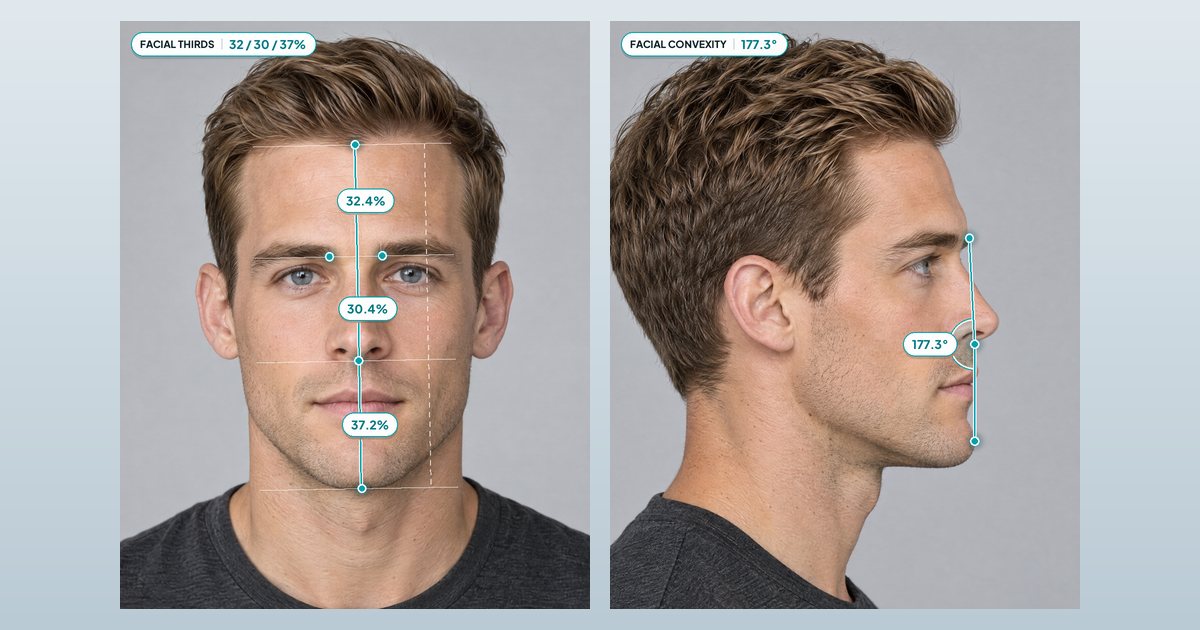
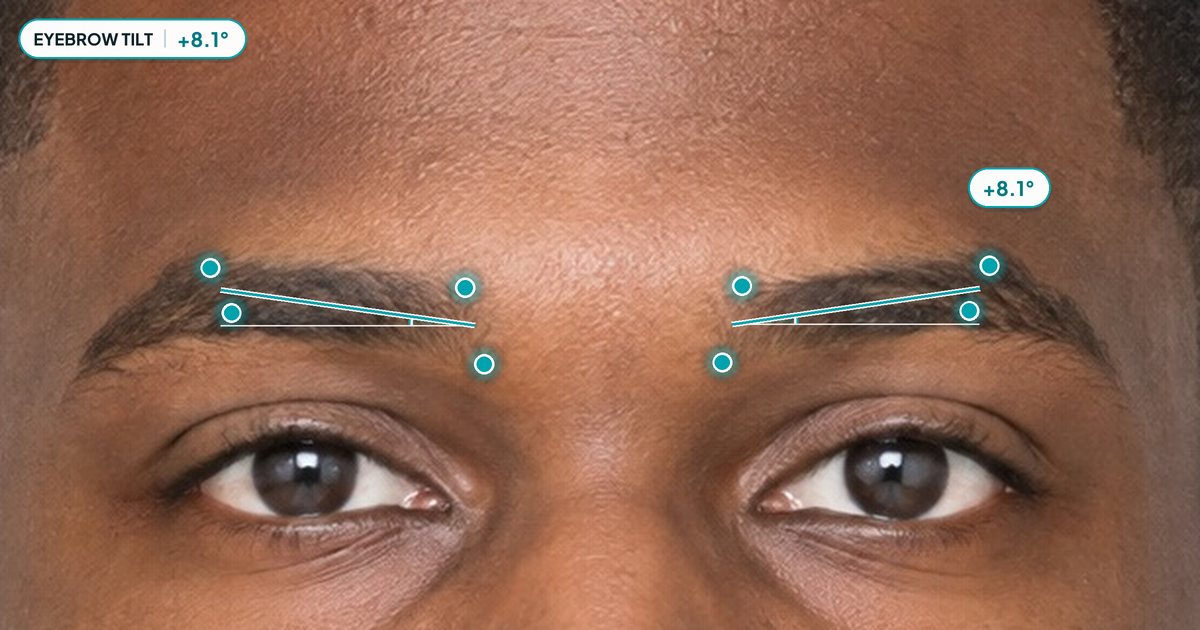
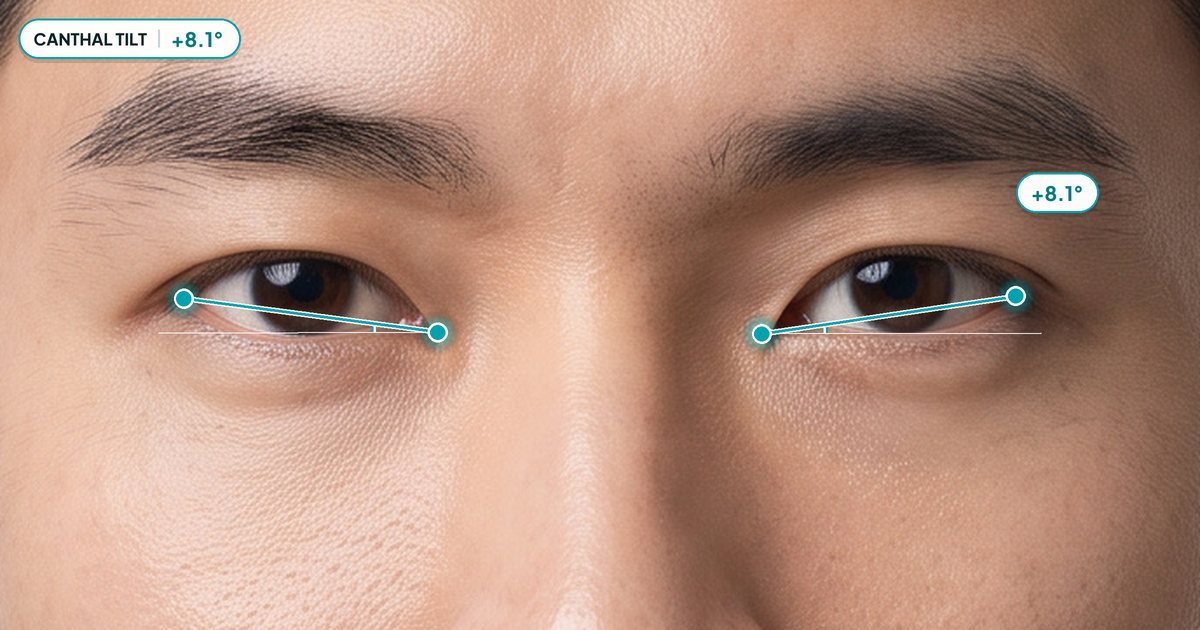
We measured canthal tilt on three faces for this guide and got +2.7, +4.4 and +8.1 degrees. All three are positive. Two of them still sit below the ideal range our engine scores against, and that says more about the range than about the eyes.
Online, a negative canthal tilt, or even a low positive one, gets treated as a flaw. Check the photo before you check the eyes. A raised chin alone can make an ordinary positive tilt look flat.4
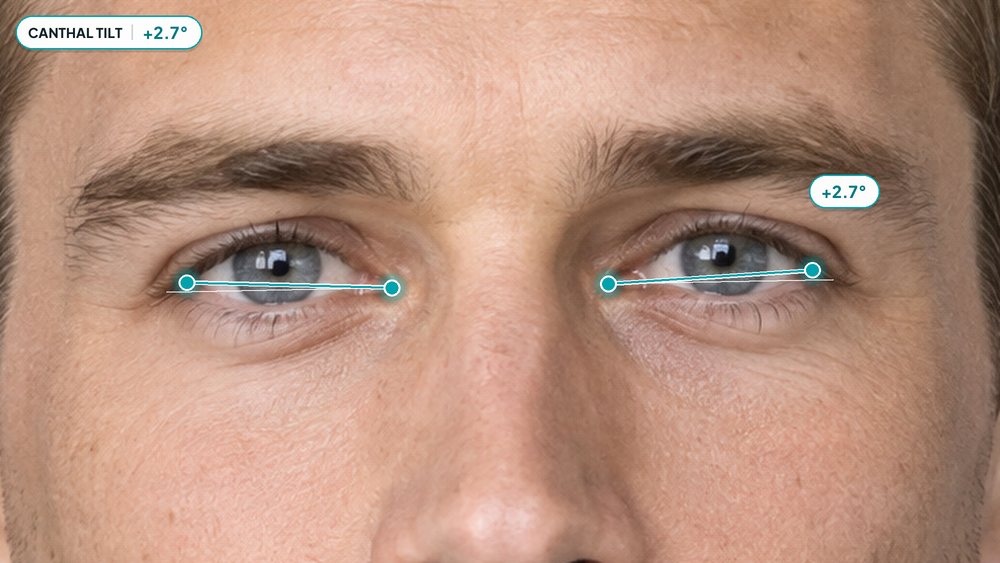
The distances involved are tiny. On an eye about 27 to 30 mm wide, each degree of tilt lifts the outer corner by about half a millimeter. The whole 5.4-degree gap between our lowest and highest face comes to about 2.5 mm of corner height. A lot of worry online is about a couple of millimeters.
The self-check below gets you your own number from one phone photo in about five minutes. The last section shows what that number is worth on a whole face. Usually less than you have been told.
What is canthal tilt and how is it measured?
Canthal tilt is the angle of the line from your inner eye corner to your outer one, measured against a level line. It comes with a sign: plus when the outer corner is higher, minus when it is lower.15 Doctors call the inner corner the medial canthus and the outer corner the lateral canthus, which is why our report lists this measurement as lateral canthal tilt. Plain words from here on.
The level line is the part most explanations skip. Studies usually use a line through both inner corners, or true horizontal with the head held in its natural position.15 Our engine first levels the photo so the line between your pupils is horizontal, then measures each corner line against that. The edge of the photo plays no part.
The outer corner is where the upper and lower lids meet at the side. The inner corner is where they meet beside your nose, at the tip of the eye opening, and not on the small pink mound of tissue there. Both points come from a mesh of 478 face points. How the points are placed and the lines drawn has the full method.
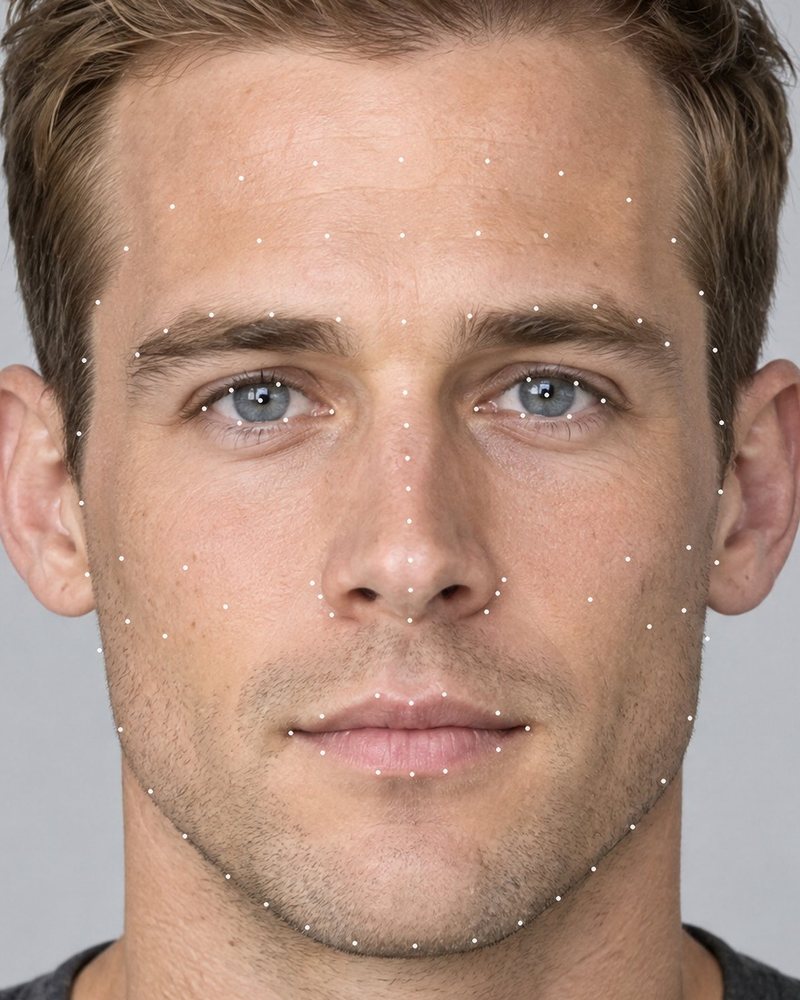
Each eye is measured on its own, then the two are averaged. That last step does real work. Tilt your head a degree to one side and one eye reads a degree steeper while the other reads a degree flatter, so the average cancels the error.
Positive, neutral and negative canthal tilt
A positive canthal tilt means the outer corner sits higher than the inner corner, and a negative canthal tilt means it sits lower. Everyone agrees on those two, and they are roughly what makeup guides call upturned and downturned eyes.
A neutral canthal tilt means the two corners sit about level, within a degree or two. It is the slippery one: online shorthand with no agreed cut-off and no medical version. Doctors call eyes upslanting or downslanting only when the slant is well outside the usual spread, more than two standard deviations from the average.3 Even then the word describes a shape, not a diagnosis.
Two more terms you’ll meet. “Fox eyes” means a clearly upward tilt. “Hunter eyes” is online shorthand for a positive tilt with low, straight brows and little visible upper lid. Neither is a research term, and neither label comes with a number our engine could score.
How common is a negative canthal tilt?
In most groups studied, not very. In the South Indian and Korean studies below, averages sat 5 to 9 degrees above level, and only the older adults in a German study averaged close to level. The numbers you see online disagree because they mix up two questions: what is typical, and what is ideal.
| What the number is | Value | Basis |
|---|---|---|
| Study average, South Indian adults aged 18 to 26 | men +5.1°, women +6.1° | Measured on 200 people1 |
| Study average, Koreans (ages not given; includes children and teens) | men +8.5°, women +8.8° | Measured on 996 people2 |
| Study average, Caucasian adults in Germany | about +2° around age 27, about 0° around age 77 | 141 people, our conversion of the study’s angles9 |
| “Downslanting” in medicine | More than 2 standard deviations below the average | Clinical terminology3 |
| Our three example faces | +2.7°, +4.4°, +8.1° | Engine, both eyes averaged |
Typical is what people actually measure. The South Indian women were about a degree steeper than the men; the Koreans showed no real gap between the sexes and sat about 3 degrees steeper than the South Indian group.12 In both studies most people sat within 2 to 3 degrees of their group’s average, so a reading at or below level was uncommon.
The German study measured photos against a different reference line, so don’t compare decimals across studies.9 The point holds without them. There is no single normal number, and whether your tilt counts as flat depends on who you compare yourself with.
Ideal is the target our engine scores against. It comes from facial-proportion research, separate from the studies above. Because it sits above the South Indian and German averages, plenty of ordinary eyes fall below it, two of our three faces included. Ideal ranges differ by sex and heritage (women’s sit 0.8 degrees higher in every set), and your report uses yours.
| Heritage chosen at upload | Men | Women |
|---|---|---|
| White, Black or South Asian | +6 to +7.7° | +6.8 to +8.5° |
| East Asian | +7.7 to +9.4° | +8.5 to +10.2° |
| Mixed, Latino, Middle Eastern, other or not stated | +6.2 to +7.9° | +7.0 to +8.7° |
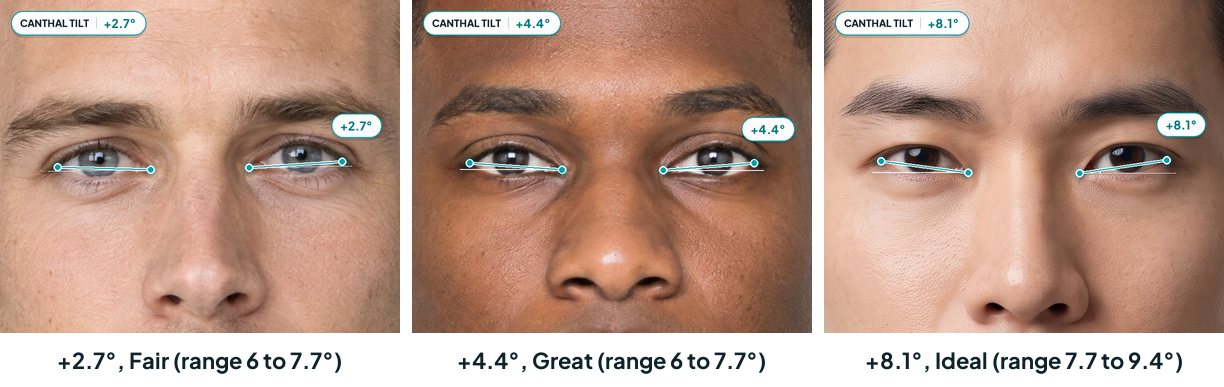
The scoring is gentle close to the range. The +4.4 face sits 1.6 degrees under his range and still scores 8.2 out of 10 (Great); the +2.7 face sits 3.3 degrees under and scores 5.4 (Fair). No cliff.
Being under the ideal range is not the same as tilting down. A reading of +2.7 is below 6 to 7.7, and it is still clearly positive.
How to measure your canthal tilt from one photo
You need one level front photo and two points per eye.
- Have a friend take the photo about 1.5 m (5 feet) away, with the lens level with your eyes and zoomed to 2x or 3x so your face fills most of the frame. On your own, prop the phone up, use the rear camera and set the self-timer.
- Look straight into the lens with your chin level, neither raised nor tucked. Keep a relaxed, neutral face, hair off your eyes and no glasses.
- Open the photo on a computer in an editor that shows the cursor position, such as Paint on Windows (bottom bar) or GIMP or Photopea (pointer or Info panel), and zoom in on one eye. A protractor app on your phone works too.
- Mark the inner corner, where the upper and lower lids meet beside the nose (not the pink tissue), and the outer corner, where the lids meet at the side (not the end of your liner or lashes).
- Note the position of both corners. Most editors count y downward, so the rise is the inner corner’s y minus the outer corner’s y, and a positive result means the outer corner is higher. The run is the horizontal distance between the corners. Tilt in degrees = arctan(rise / run), or about 57 x rise / run.
- Repeat for the other eye and average the two.
- If the two eyes differ by more than about 3 degrees, check your points again, then trust the average or retake the photo.
- Compare your average with the study averages and ideal ranges in the tables above, and with the score words further down.
Here is that check done on the +2.7 face from the first figure, using the full-size original photo before any leveling. The figure on this page is cropped and resized, so pixel counts on your screen will differ, but the angles come out the same. On his right eye (the one on the left of the photo), the outer corner sits 3.4 pixels higher than the inner corner over a run of 129.5 pixels. That works out to +1.5 degrees. On his left eye it sits 8.6 pixels higher over 129 pixels, which is +3.8 degrees. Average the two and you get +2.7, the same value the engine prints.
The 2.3-degree gap between his eyes is head roll at work, and the average throws it away. Once the photo is leveled, his eyes differ by 0.1 degrees, and our other two faces by 0.3 and 0.6.
One limit: a photo measures the photo. Compare only photos taken the same way, and trust a careful level shot over a quick selfie. If that careful shot still reads 0 or below, that is your eye shape, and the last section shows how little it moves a whole-face score.
Why your canthal tilt looks different in selfies
Tipping your chin up 15 degrees can change how far the outer corner sits above the inner one by about as much as the whole gap between our lowest and highest face. Tipping it down changes it nearly as much, and a phone held well below or above your eyes does the same.
One study measured this directly. Researchers photographed 12 women with the head level and tipped 15 degrees down and up, five of them at in-between angles too.4 Then they measured how far the outer corner sat above the inner one. With the head level it was 2.55 mm. At 15 degrees chin down it grew to 4.39 mm. At 15 degrees chin up it shrank to 0.13 mm, close to flat.
The camera does the same thing. A phone held below your eyes sees your face as if your chin were raised, so the tilt reads lower. A phone held above sees it as if your chin were tucked, so it reads higher. That part is geometry rather than a study finding: your outer eye corner sits further back in your head than the inner one, so any view from above or below shifts the two corners by different amounts.
So if a selfie reads negative, don’t believe it yet. Retake it with the phone at eye height and your chin level, then measure again.
Which is better, positive or negative canthal tilt?
In Western studies a more positive canthal tilt tends to rate a little higher, but steeper does not keep winning.568 A level or downward tilt is simply the less common shape.
The strongest case for a positive canthal tilt comes from Italy. Adults picked at beauty contests, men and women, had steeper eye slants than ordinary people of a similar age.5 A 2024 review of 18 studies also lists an upward line between the eye corners among the features of attractive eyes in Caucasian women.6
The other side has evidence too. Korean beauty pageant contestants were no steeper than ordinary young women, even though their eye openings were wider and taller and the gap between their inner corners was smaller.7 And when researchers raised the outer corner of one edited face, 2,081 raters scored it less attractive and less trustworthy, and more dominant and threatening.8
You may also see a claim that 93% of people prefer a positive tilt. It comes from a 2007 study of Photoshop-edited female faces that accentuated medial canthal tilt, a feature at the inner corner. In forced choices, the edited faces won 93% of the time.11 That is 93% of choices, not of people, and it is not a direct test of the corner-to-corner line, even though the authors think the two are linked.
The idea that attractive men should have a neutral or negative tilt and women a positive one has little support. In the Italian study, the attractive men had steeper slants too.5 The clearest hint the other way comes from the edited-face study, where raters of both sexes saw the raised outer corner as less masculine, and women raters also saw it as less feminine.8
One caution covers all of this. None of these studies says how many rating points a degree of tilt is worth, and most rated only women’s faces, so the evidence on men is thin. Tilt never travels alone either. Brow line, lid crease and how much of the iris shows turn up in the same studies.6
Our scoring does put a number on each degree, and too steep loses points just as too flat does. On the +6 to +7.7 men’s range, +12 degrees scores 4.0, exactly what +1.7 scores, and a score of 5 out of 10 comes 3.6 degrees outside the range on either side.
| Score word (or better) | Men (range +6 to +7.7°) | Women (range +6.8 to +8.5°) |
|---|---|---|
| Ideal | +6 to +7.7° | +6.8 to +8.5° |
| Great | +4.2 to +9.5° | +5.0 to +10.3° |
| Good | +3.0 to +10.7° | +3.8 to +11.5° |
| Fair | +1.7 to +12.0° | +2.5 to +12.8° |
| Focus area | below +1.7° or above +12.0° | below +2.5° or above +12.8° |
These bands use the White, Black or South Asian ranges. For another range, shift every band by the same amount: up 1.7 degrees for East Asian, or 0.2 for mixed, other or not stated.
Our view: canthal tilt gets more attention online than the research supports. If yours reads mildly positive, you’re in the most common group. If it reads lower, it is one angle on a face full of them.
Can you change your canthal tilt?
No exercise, tape or tongue posture will turn a negative canthal tilt positive for good. The outer corner is held by the lateral canthal tendon, a tough band of tissue anchored to bone on the outer rim of the eye socket.10 Only surgery, such as canthoplasty, can move where it is anchored. How lifted your eyes look is a different question, and that one you can change.
Older adults tend to have a slightly flatter tilt, and the difference shows late, mainly in people over 70 in the German study.9
| Claim | Verdict | Why |
|---|---|---|
| Eye exercises or “hunter eyes training” lift the corner | No evidence | We found no study testing it |
| Mewing changes your tilt | No evidence | We found no study showing a change |
| Taping or tight ponytails lift it | Only while applied | They stretch soft tissue for a while, but the tendon’s anchor stays put, so the corner returns when released |
| Your tilt never changes | Partly true | It is slightly flatter in older adults9 |
| Brows, liner and lashes change it | They change the look, not the angle | Makeup can change how slanted eyes look,5 but the measured points sit on the lids |
Ignore anyone selling a routine that claims to move the corner. A tendon fixed to bone does not respond to training.
How to make your canthal tilt look more positive
To make a canthal tilt look more positive, lift the lines around the corners: the brow tail, a liner wing, the outer lashes and the top edge of your glasses. The corners themselves stay put.
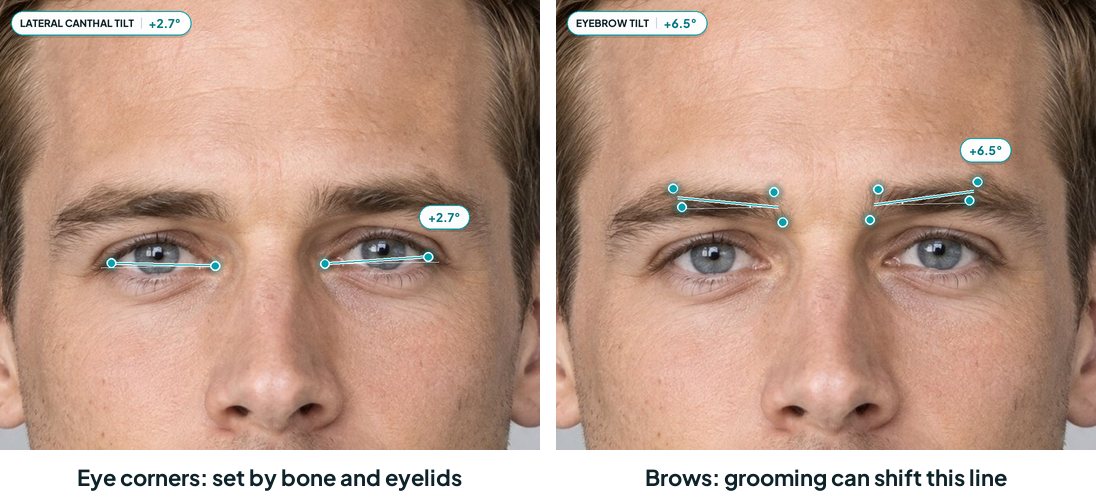
Tweezers can’t reach his eye corners, but they can reach his brows. The ideal range for brow tilt is 6.5 to 11 degrees for men and 10.5 to 15 for women, so at +6.5 he sits on the bottom edge. Our engine measures that line from the inner brow to the arch, so the tail is not part of his number, but a tail that droops still pulls the outer eye area down. An upward brow line also appears among the attractive-eye features in women in the 2024 review.6
If you change one thing, make it the brow tail. Keep it from drooping below the level of the brow head, tidy the strays under the outer third and leave the arch alone. For men that means tidy and trim, nothing more; women who fill their brows can lift the tail slightly with a pencil.
Liner and lashes do the same job lower down. Angle a wing up toward the brow tail, keep heavy liner off the outer lower lash line, which drags the corner down visually, and put the mascara on the outer lashes.
A frame’s top line works at a distance. Browline or upswept shapes that rise slightly at the outer edge carry the eye up; frames that droop at the sides or sit low on your nose do the opposite.
Puffy lower lids make any tilt look tired; more sleep and a cool compress in the morning help with the day-to-day kind.
For photos you post (not the one you measure), hold the camera at eye level or slightly above. Chin down exaggerates tilt. In the head-tilt study, raters preferred the chin-down eye photos, up to 15 degrees, except for eyes with lower-lid bags, which looked best level.4 Those were close crops of single eyes, all from young women, so in a full-face photo keep it to a touch.
Your measured number won’t budge. That’s fine.
How much canthal tilt matters in a whole face
Very little, in our scoring. Canthal tilt is 1 of 33 front measurements that feed the Harmony pillar, our facial harmony score, each given equal weight, with a slight lean toward the weakest ones.
Take the +2.7 face, the one in our sample report. Moving its canthal tilt from Fair (5.39) all the way to Ideal would lift Harmony from 5.92 to 6.08, and the overall score from 7.04 to about 7.09 out of 10. Five hundredths of a point. The other direction is just as small. If the same face read 0 degrees, a level eye line, its score would slip to about 7.00.
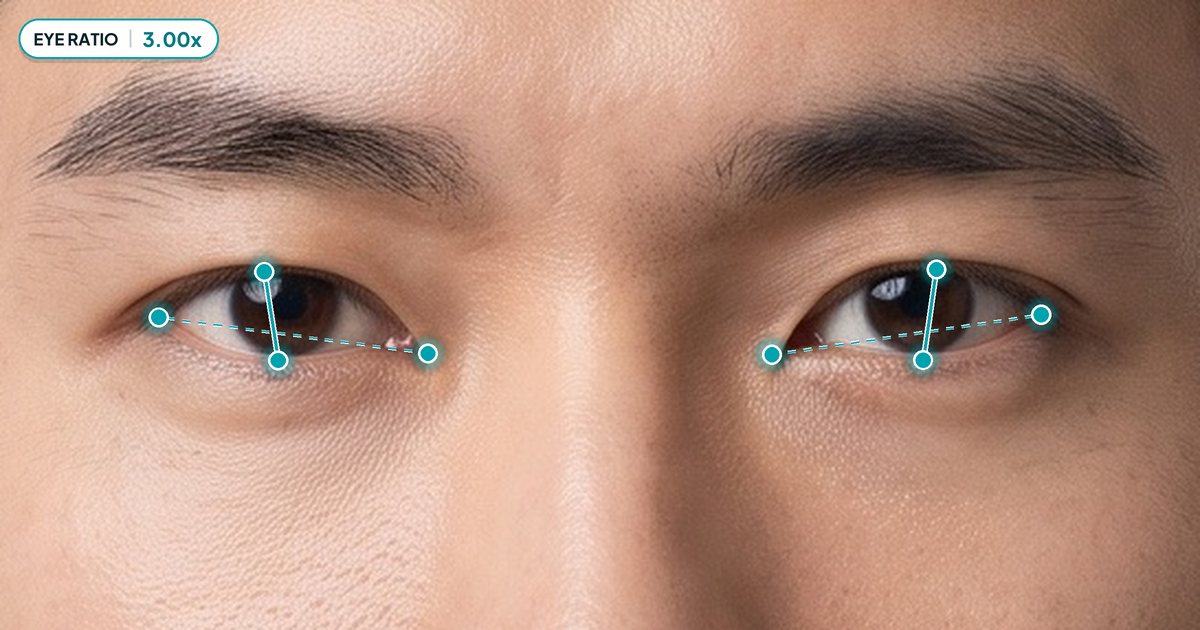
The rest of that face’s eye area is strong. Eye shape (3.27x), which compares the eye’s width with its height and often gets confused with tilt, is Ideal, and so are the one-eye spacing test (0.95x) and eyebrow tilt (+6.5). Canthal tilt is the only eye measurement below Good. The sample report shows all 66 measurements on this face if you want to see where it sits among them. No single number decides how attractive a face is, this one included.
If you want your own number, take a level photo and run the check above. Or get it drawn on your own photo as part of 65+ measurements, in about a minute.
Questions people ask
Is negative canthal tilt bad?
No. It is less common than a positive tilt, and some Western studies rated a more upward tilt a little better, but it is one eye feature among many. Doctors call a slant far below the usual average "downslanting", which describes a shape, not a diagnosis. If an eye corner has dropped recently, show it to a doctor; a lifelong tilt is just how your eyes are built. On the +2.7 face from our sample report, a 0-degree reading would move the overall score from 7.04 to about 7.00.
What causes negative canthal tilt?
Mostly anatomy. The outer eye corner is held by a tendon anchored to the bone of the eye socket, and where it sits varies between people and between populations. Older adults tend to have a slightly flatter tilt. In photos, a raised chin or a phone held below eye level can make a positive tilt read flat or negative.
Can you fix a negative canthal tilt or get a positive one?
Not with exercises, mewing or taping. None of them moves the outer corner for good, and we found no study showing otherwise. Start by retaking the photo with the phone at eye height and your chin level, since a low camera can make a positive tilt read negative. Then work on how the eye area reads: brow tails, liner, lashes and frames.
What is a good canthal tilt?
For our engine, +6 to +7.7 degrees for men and +6.8 to +8.5 for women, with ranges about 1.7 degrees higher for East Asian heritage and 0.2 higher for mixed, other or unstated heritage. The score falls off gently on both sides, so a very steep tilt scores lower too. That target sits above many study averages, which run from about 0 to +9 degrees depending on who was measured (close to 0 only in a group of older adults), so a reading of +3 or +4 is ordinary.
Does canthal tilt change with age?
A little, and late. In 141 Caucasian adults the tilt was about 2 degrees flatter at around 77 than at around 27, with the outer corner sitting lower and slightly further inward in the older group, and the difference showed mainly in people over 70. A Korean study found slant peaks in childhood and the teens, then eases off slowly.
Do men and women have different canthal tilts?
Slightly, in some groups. Young South Indian women averaged +6.1 degrees and men +5.1, while a study of 996 Koreans found no difference between the sexes (+8.8 for women, +8.5 for men). Our engine's ideal ranges sit 0.8 degrees higher for women in every set: +6.8 to +8.5 degrees for White, Black or South Asian heritage, against +6 to +7.7 for men.
Why is my canthal tilt different on each eye?
Most likely because your head was slightly rolled in the photo. A small sideways head tilt raises one eye's angle and lowers the other's by the same amount, which is why you average the two. On the unleveled photo of the +2.7 face from our sample report, the readings were +1.5 and +3.8 degrees, averaging +2.7. After leveling, our three example faces differed by only 0.1 to 0.6 degrees between eyes. If yours differ by more than about 3 degrees, recheck your points or retake the photo.
Sources
-
Vasanthakumar P, Kumar P, Rao M. Anthropometric analysis of palpebral fissure dimensions and its position in South Indian ethnic adults. Oman Med J. 2013;28(1):26-32. doi:10.5001/omj.2013.06. Full text on PMC ↩↩↩↩
-
Choi SS, Park DH. Anthropometric analysis of slant of palpebral fissure in Koreans. J Korean Cleft Palate-Craniofac Assoc. 2002;3(2):185-189. Abstract ↩↩
-
Hall BD, Graham JM Jr, Cassidy SB, Opitz JM. Elements of morphology: standard terminology for the periorbital region. Am J Med Genet A. 2009;149A(1):29-39. doi:10.1002/ajmg.a.32597. Abstract on PubMed ↩↩
-
Vaca EE, Bricker JT, Mioton LM, Fagien S, Alghoul MS. The influence of sagittal head tilt on periorbital appearance: implications for clinical photography and the evaluation of postoperative results. Aesthet Surg J Open Forum. 2022;4:ojab043. doi:10.1093/asjof/ojab043. Full text on PMC ↩↩↩
-
Sforza C, Dolci C, Grandi G, Tartaglia GM, Laino A, Ferrario VF. Comparison of soft-tissue orbital morphometry in attractive and normal Italian subjects. Angle Orthod. 2015;85(1):127-133. doi:10.2319/012814-75.1. Full text on PMC ↩↩↩↩↩↩
-
Zanchetta-Balint E, Hersant B, Hanan L, Meningaud JP. A biological approach to periorbital aesthetics in Caucasian females: a review of the literature. Aesthet Surg J. 2024;44(8):NP540-NP550. doi:10.1093/asj/sjae097. Abstract on PubMed ↩↩↩↩
-
Kim YC, Kwon JG, Kim SC, et al. Comparison of periorbital anthropometry between beauty pageant contestants and ordinary young women with Korean ethnicity: a three-dimensional photogrammetric analysis. Aesthetic Plast Surg. 2018;42(2):479-490. doi:10.1007/s00266-017-1040-7. Abstract on PubMed ↩
-
Kempa J, Kasielska-Trojan A, Gabryszewski M, et al. Understanding the impact of eyebrow and lateral canthal height on the perception of character traits: a rating-based analysis of 2081 participants. J Plast Reconstr Aesthet Surg. 2025;104:417-425. doi:10.1016/j.bjps.2025.03.040. Abstract on PubMed ↩↩↩
-
Liu J, Rokohl AC, Liu H, et al. Age-related changes of the periocular morphology: a two- and three-dimensional anthropometry study in Caucasians. Graefes Arch Clin Exp Ophthalmol. 2023;261(1):213-222. doi:10.1007/s00417-022-05746-y. Full text on PMC ↩↩↩↩
-
Wong AS, Chong K, Yen MT, et al. Canthoplasty. EyeWiki, American Academy of Ophthalmology. Updated 2026-09-04. Read on EyeWiki ↩
-
Bashour M, Geist C. Is medial canthal tilt a powerful cue for facial attractiveness? Ophthalmic Plast Reconstr Surg. 2007;23(1):52-56. doi:10.1097/IOP.0b013e31802dd7dc. Abstract on PubMed ↩
Spotted a mistake? Email support@faceratinglab.com and we will fix it. First published .