Types of noses: 12 nose shapes and the measurements behind them
Most charts name about a dozen types of noses: straight, Greek, Roman, hooked, scooped, upturned, snub, button, bulbous, fleshy, wide and flat. Every name on that list describes the bridge line in profile, the tip (where it points and how round it is) or the nose's width from the front, and you can check all three on two photos.
The short version
- Most noses fit more than one name. By the cut-offs in our chart, all four of our example men have straight bridges and round tips, and three of them also have wide bases and tips that turn up more than the men's range expects.
- The same names fit men and women, but our ranges expect a woman's tip to turn up about 9 degrees more than a man's: +20.5 to +30.5 degrees against +11.5 to +21.5.
- The chin changes how big a nose reads: by our two nose-to-chin angles, all four of our example men's noses read less prominent than the ranges expect, so if yours looks big in profile, check your chin first.
- The old rule that your nose should be as wide as the gap between your eyes usually doesn't hold: in one study the nose was wider in 92% of men and 56% of women, and our report's range is 1.04 to 1.16 times the gap for men and 0.94 to 1.06 for women.
- In one geometric model, a phone held 30 cm from your face makes your nose look about 30% wider relative to your cheekbones, so judge your nose type from a photo taken about 1.5 m away with the lens at eye level.
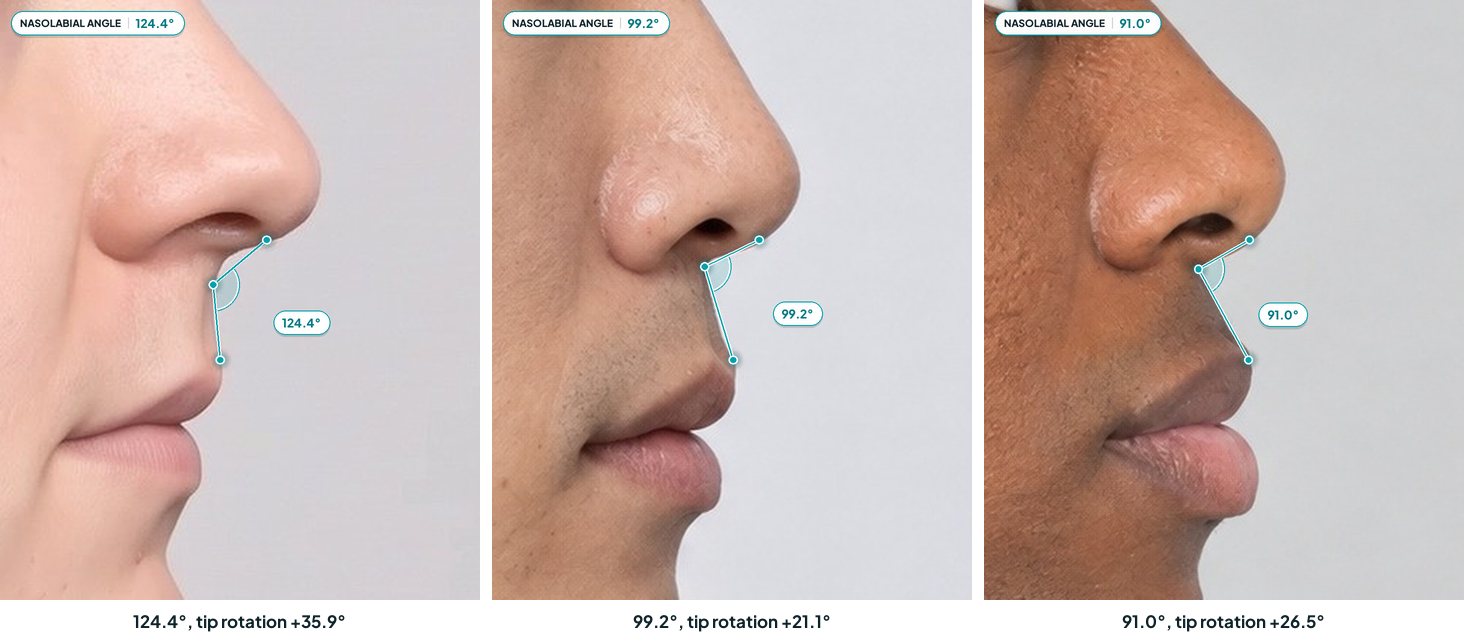
The usual test for an upturned nose, the nose-to-lip angle, can mistake a lip for a nose. On the three men below it measures 124.4, 99.2 and 91.0 degrees, which would make the man on the right the least upturned. Measure the tip on its own and he isn’t. His tip points up more than the middle man’s (+26.5 against +21.1 degrees), but his upper lip leans forward about 26 degrees from upright, against 12, and a forward lip closes the angle. The man on the left, from our sample report, reads upturned on both tests.
The usual list of types of noses is shakier still. The “14 nose types” many charts borrow trace back to one 2011 survey of pictures, more than a fifth of them artworks.1 So our chart below ties each of the 12 common names to what decides it. The self-check then shows you how to read your own with two photos and a card edge.
A chart of nose shape names and what decides each one
These 12 types of noses cover nearly every name you’ll meet on a chart. Each comes down to one to three things you can check, and wherever our report has a number, the last column gives the point where the name starts to fit, for men and women.
| Type | What you see | It fits when |
|---|---|---|
| Straight | The bridge runs in a straight line from the dip between the eyes to the tip | The outline stays on a straight line drawn along the bridge |
| Greek (classic straight) | A straight bridge that flows out of the forehead with almost no dip | Straight, with a root angle of 128° or more for men (more open for women) |
| Roman (convex; “bumpy” for a smaller hump) | The bridge curves or bumps outward, and the tip keeps its usual upward tilt | Outline in front of the line, tip rotation inside the range (men +11.5 to +21.5°, women +20.5 to +30.5°) |
| Hooked (hawk) | An outward curve and a tip that sits lower, toward level or pointing down | Outline in front of the line, tip rotation under +11.5° (men) or +20.5° (women), nose-to-lip angle often under 97° (men) or 101° (women) |
| Scooped (concave, ski-slope) | The bridge dips in the middle and the tip turns up | Outline dips behind the line, tip rotation above the range |
| Upturned (celestial, retroussé) | The tip points up, and more nostril shows in profile | Tip rotation over +21.5° and nose-to-lip angle over 114° (men), or over +30.5° and 118° (women) |
| Snub (often called a short nose) | Upturned, with a tip that doesn’t reach far forward | Upturned, with a nasal projection (the tip’s reach for its length) under 0.58 (men) or 0.55 (women) |
| Button | Small, with a soft round tip and a slight upturn | Tip angle over 138.5° (men) or 136.5° (women), modest reach, slight upturn |
| Bulbous (round tip) | A wide, round, less defined tip | Tip angle above the range and a lower Nose tip fullness rating |
| Fleshy (thick-skinned) | Larger overall, with a soft tip and a full bridge | Lower Nose tip fullness and Nose bridge fullness ratings, with any bridge line |
| Wide (broad) | The base looks wide next to the eyes | Nose base over 1.16 (men) or 1.06 (women) times the gap between the inner eye corners (front photo) |
| Flat (low bridge) | A low, broad bridge that sits close to the face in profile | A bridge clearly broad for its base (front) and a clearly short tip reach (side), with no single cut-off |
The numbers are the edges of the ideal ranges our report scores against. They are aesthetic targets. They are also tight: all four of our men sit outside several of them, so a value just past an edge only leans that way. The further past it sits, the better the name fits. The ranges also shift a little with the heritage you choose at upload.
Three more names don’t need a row. Narrow is the other end of width: a base under 1.04 times the eye gap for men, or 0.94 for women. Pointed is the other end of the tip: a tip angle under 128.5 degrees for men or 126.5 for women. Crooked means the nose sits off-center. Lay a card edge on a straight-on front photo, from the midpoint between your brows to the dip in your upper lip: a centered bridge and tip sit on it. Saddle, deviated and broken noses come from injury, illness or the nose’s inner structure, so they are medical questions and stay off this chart.
Most noses fit more than one row. All four of our example men have straight bridges and tips rounder than the men’s range allows. Three of them also have wide bases and tips that turn up past the men’s range. The man in our sample report reads straight, upturned, round-tipped and wide at once. All four fall a little short on tip reach and bridge taper too, so on paper they lean flat. If the chart hands you several names, you’re in the same spot as every man on this page.
Some charts label noses by ancestry. This one doesn’t. A low bridge, a broad base or a round tip describes what you can see and measure, on anyone.
How the bridge line sorts straight, Greek, Roman, hooked and scooped noses
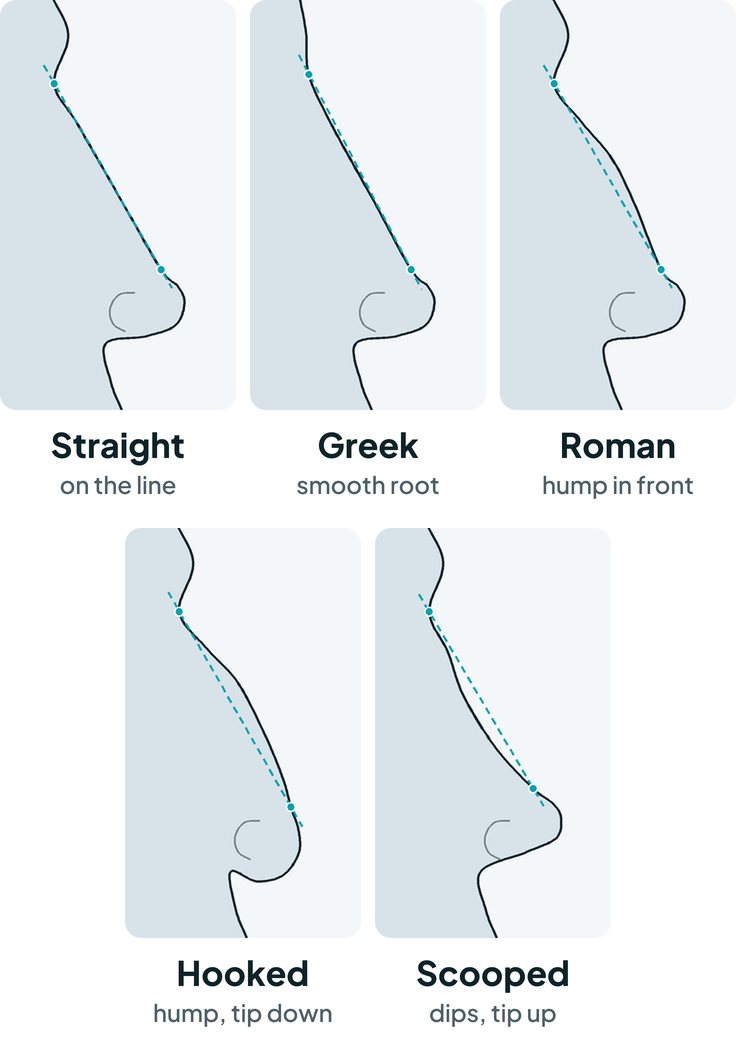
Five of the 12 names are sorted in profile by one straight line along the bridge, plus the dip where the bridge meets the brow and the way the tip points. If the outline sits on the line, the bridge is straight. In front of it is a hump. Behind it is a scoop.
Our report fits a straight line to the upper part of the bridge, marks where it reaches the height of the root, and draws a dashed line from there to the tip, as part of its nasal projection drawing. It doesn’t score a hump.
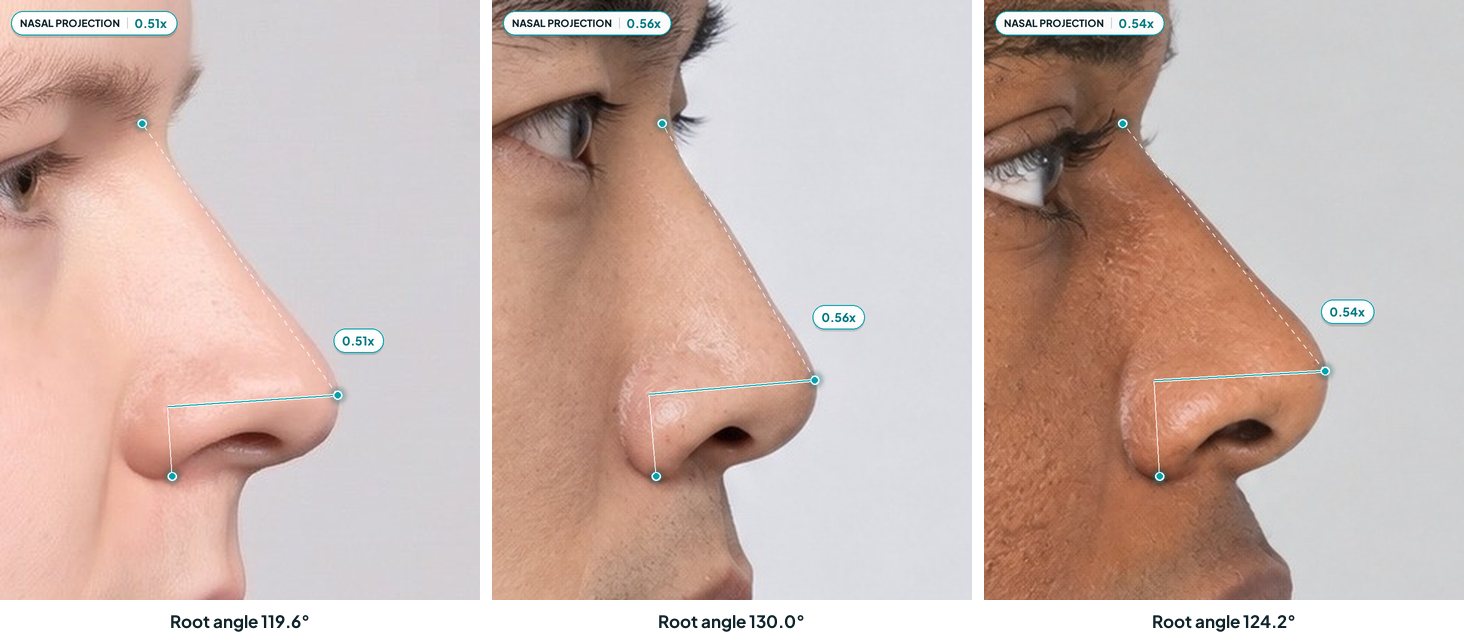
A Greek nose is a straight nose with a smooth root: the forehead flows into the bridge with almost no dip. Our root angle, called Nasofrontal angle in the report, runs from the forehead between the brows to the deepest point between the eyes, then down to just above the tip. For men the range is 116 to 128 degrees. The range our report uses for women is far more open, 139 to 151: it expects a woman’s forehead to run into her nose with much less of a dip. The middle man above, at 130.0, just clears the men’s 128 mark, so he leans Greek. The deepest dip in our set, 115.0, belongs to a man not drawn here. A forward brow ridge can deepen the dip too, since both the brow and the bridge move this angle.
Roman and hooked noses both sit in front of the line. The tip tells them apart. Aquiline gets used for both. A Roman tip keeps the usual tilt, with tip rotation inside the range. A hooked tip sits lower: tip rotation under the range, toward level or pointing down, and the nose-to-lip angle often under the range too. The same test works for a bumpy nose, a smaller, local hump on an otherwise straight bridge. A scooped (ski-slope) nose is the reverse.
The one direct test we found doesn’t back the belief that a bump makes a man look more masculine. When 503 people each picked the most masculine of 12 versions of one man’s profile, none stood out: the top pick, a straight bridge, got 11% of the votes, close to the 1 in 12 that chance would give.3
Where the tip points and how round it is
The tip carries six names. Which way it points decides upturned, and snub adds a short reach. How round it is decides button, bulbous and pointed, and fleshy adds the soft tissue over the bridge.
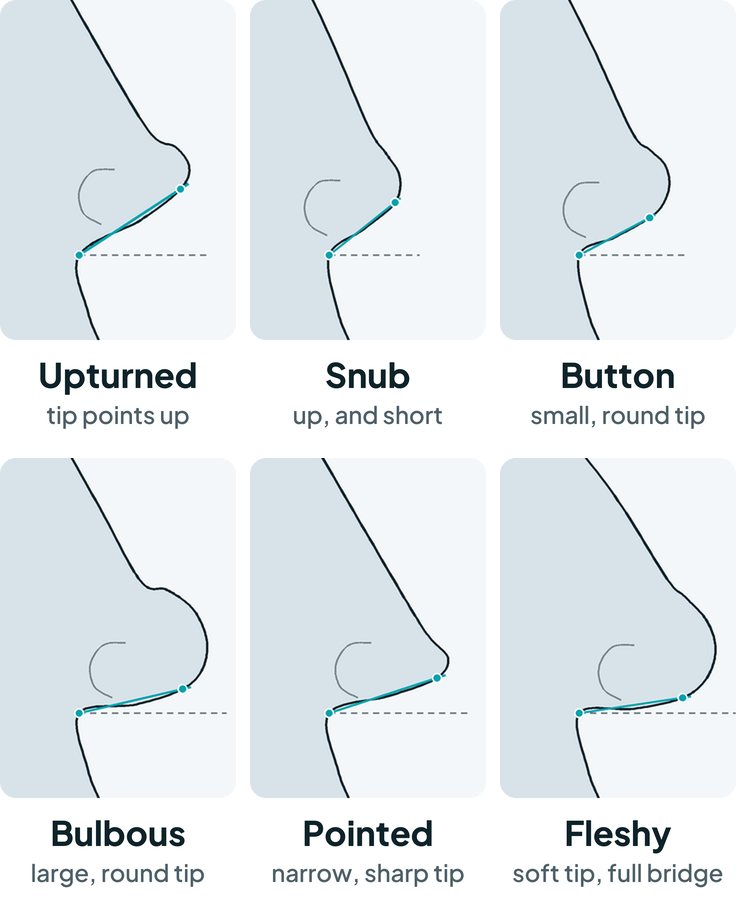
Upturned, snub and button noses
Two measurements read the direction. Tip rotation (Nose tip rotation angle in the report) is the tilt of the nose’s underside against a line from the ear to the lowest point of the eye socket. Head tilt doesn’t change it. Our report’s range is +11.5 to +21.5 degrees for men and +20.5 to +30.5 for women.
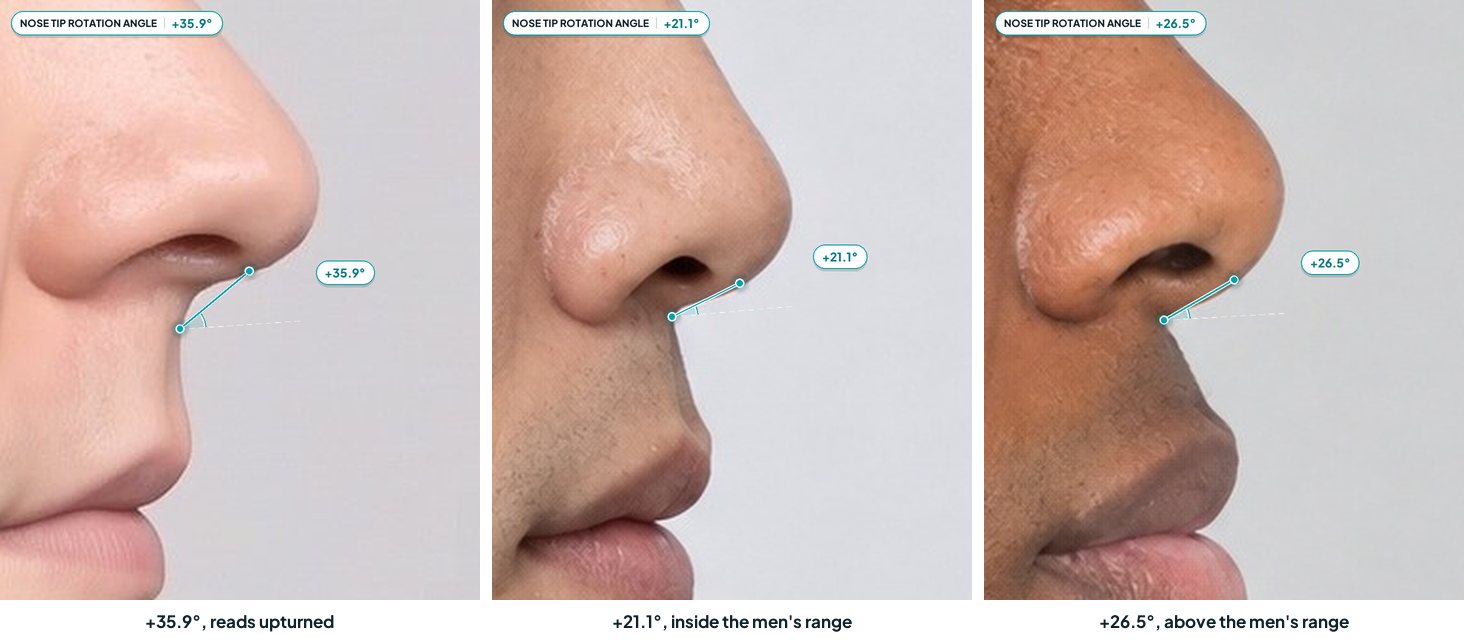
The nose-to-lip (nasolabial) angle runs from the underside of the nose to the front of the upper lip, with a range of 97 to 114 degrees for men and 101 to 118 for women.
Only the second test includes your lip, and on our four men the two drift apart (lip lean is how far the upper lip tilts forward from upright):
| Face | Nose-to-lip | Tip rotation | Lip lean |
|---|---|---|---|
| Our sample report (first drawing, left) | 124.4° | +35.9° | about 2° |
| Another example man (not drawn) | 113.2° | +33.4° | about 10° |
| First drawing, middle | 99.2° | +21.1° | about 12° |
| First drawing, right | 91.0° | +26.5° | about 26° |
So don’t call a nose hooked on the nose-to-lip angle alone. Check that it’s the tip dropping, not the lip leaning.
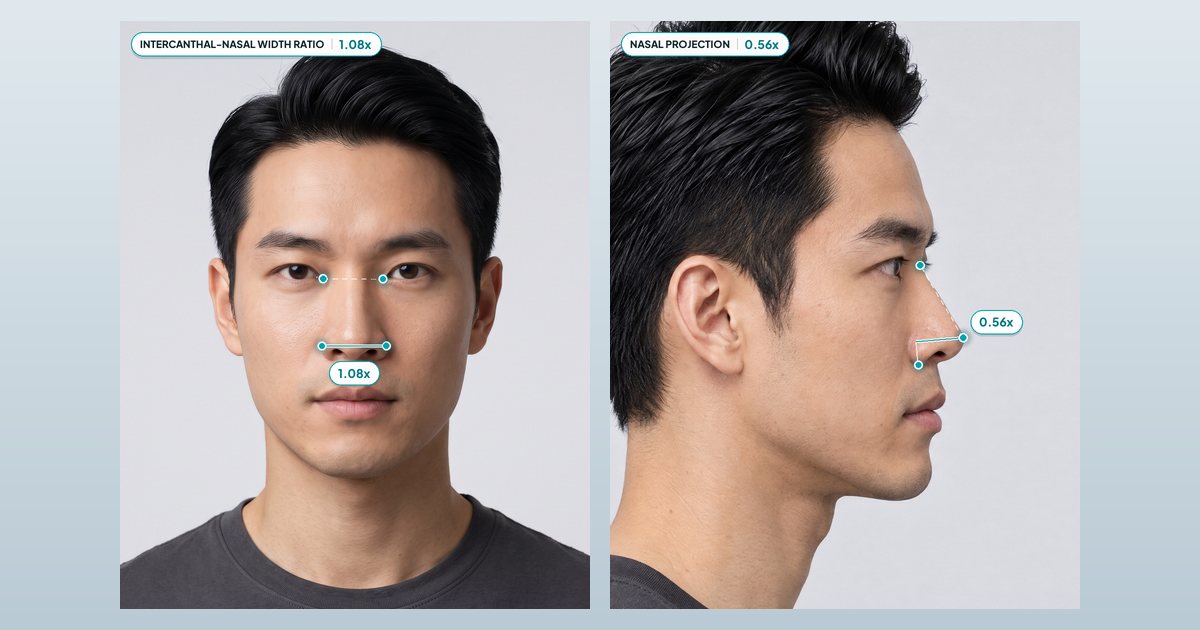
The man in our sample report, top row of the table, reads upturned on both tests, which is all celestial means. Snub is upturned with little forward reach: his nasal projection of 0.51 is the lowest of our four men, against a men’s range of 0.58 to 0.65. All four of our men sit under 0.58, though, so save snub for a nose that also looks short. That part you judge by eye: our report has no nose-length number. Button overlaps snub, but it’s the tip’s size and roundness that make a button.
None of these is a fault. An upturned tip also doesn’t always mean your nostrils show from the front: his nostril exposure rating is still 9 out of 10 (10 means no extra nostril shows).
Bulbous, fleshy and pointed tips
The tip angle (Nasal tip angle in the report) is taken at the tip itself, between a point just above it and one just below. Lower is sharper and more defined. Higher is rounder, toward button and bulbous. Our ranges are 128.5 to 138.5 degrees for men and 126.5 to 136.5 for women.
Our men run from 139.3, the most defined, to 151.2, the roundest, so all four sit past the round end of the men’s range, one of them only just. Save bulbous for a tip that also looks wide from the front. The report’s visual Nose tip fullness rating agrees with the angles: 7 or 8 out of 10 on all four, where 10 means no extra fullness.
Bulbous and fleshy get mixed up all the time. Bulbous is a round, wide tip on an otherwise ordinary nose. Fleshy is a larger nose with more soft tissue over both the tip and the bridge, so it can sit on a straight, humped or scooped bridge.
How wide, narrow and flat noses are measured
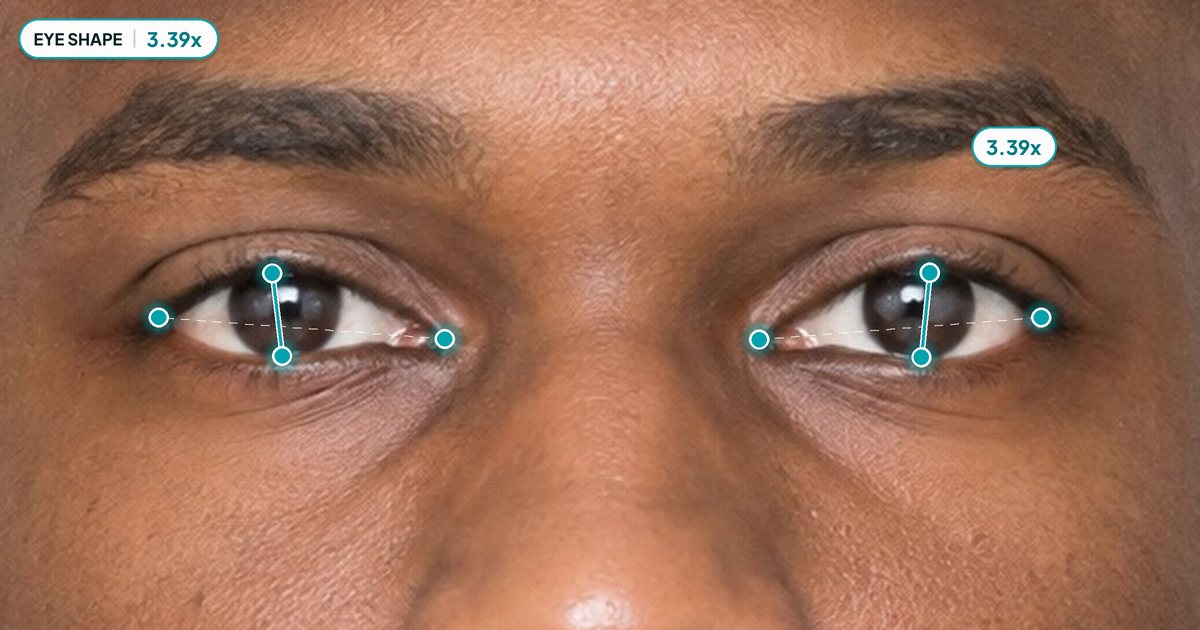
Width names compare the base of your nose, across the outer edges of the nostril wings, with the gap between your inner eye corners. The report calls this the Intercanthal-nasal width ratio, and so does the label on the photo at the top of this page. Its range is 1.04 to 1.16 times the gap for men and 0.94 to 1.06 for women. A narrower eye gap raises the number just as a wider nose does, so close-set eyes can make a nose read wide on this test.
The old rule says the two should match, at 1.0. It holds for a minority. Among 168 dental students chosen for healthy, pleasing faces, the two matched within 1 mm for about 1 in 15 men and 1 in 3 women. The nose was the wider of the two in 92% of men and 56% of women.4 So if your nose is a little wider than your eye gap, that’s the usual result, not a wide nose.
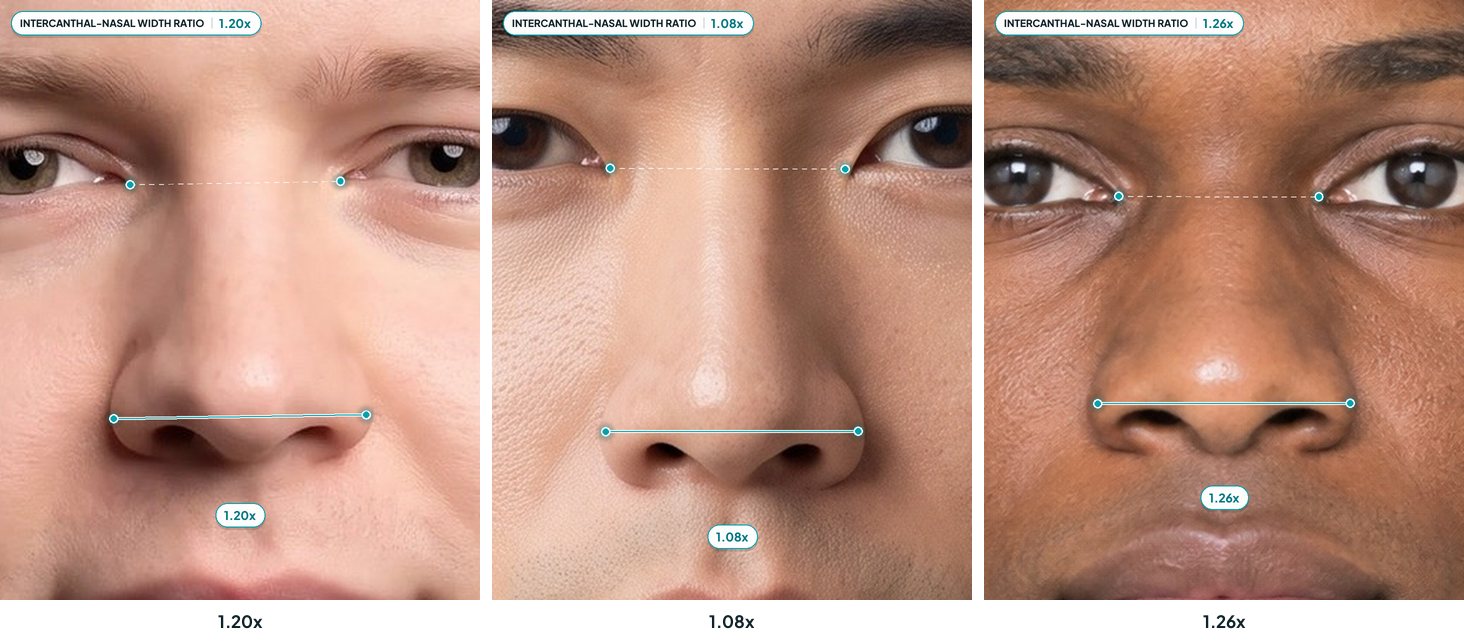
Flat gets lumped in with wide. It describes the bridge, though: low and broad, sitting close to the face in profile. Our report has no bridge-height number, so we read flatness from two others: the bridge-to-base taper on the front photo (Nose bridge to nose width in the report) and the tip’s reach on the side. Our four men’s bases are 1.94 to 2.01 times their bridge width, just under the men’s 2.06 to 2.14, and all four tips reach less than 0.58. That’s too close to call any of them flat.
Before you decide your nose is wide, check the photo. A 2018 geometric model of camera distance worked out that a phone held 30 cm from your face makes the nose look about 30% wider relative to the cheekbones, and that from 1.5 m the effect is gone.5 If your nose only looks wide in selfies, believe the photo from the self-check below.
Check your nose type in three steps
Two photos and a straight edge settle most of it.
- Side photo: have a friend take it with the rear camera from about 1.5 m (5 feet), lens at eye level, chin level, then zoom in on it. Hold a card edge on the screen so it touches your bridge just below the dip between your eyes and just above the tip. An outline that runs along the edge, or strays by a hair, is straight (Greek if your forehead flows into it with almost no dip). One that bulges past the edge has a bump: Roman, or hooked if step 2 shows a low tip. If it falls away behind the edge in the middle, it’s scooped.
- Same photo, with your phone’s markup pen. Find the lowest point of the bony rim under your eye with a fingertip, draw a line from your ear opening to it, and rotate the photo until that line is level. Then draw one line along the underside of your nose, from where it meets your lip to the tip, and one from that same point down the front of your upper lip. A protractor app reads both angles. An underside that climbs more than about 22 degrees above level on a man (a quarter of a right angle), or 30 on a woman (a third), turns up. Call it upturned only if the angle between the underside and the lip line also tops about 114 degrees (118 on a woman), and snub if the tip also sits close to your face. Under about 11 degrees (20 on a woman), with a bump from step 1, reads hooked.
- Front photo from the same distance, zoomed in until the gap between your inner eye corners spans about 3 cm on screen. Mark that gap on a paper edge held to the screen, then lay it across the outer edges of your nostril wings. For a man, a base from a little over 3 cm up to about 3.5 cm is inside our range. For a woman, it’s within about 2 mm of the gap either way. Clearly wider reads as wide.
Tip shape is the one reading that’s hard by eye: the tip angle hangs on points a few millimeters above and below the tip, which our report places on your outline. From the front, a round tip that looks wide reads bulbous, and a small round one with a slight upturn reads button.
How many types of noses are there, and which are most common or rare?
There is no official count. Researchers describe nasal shape with angles and ratios, and when they sort noses it’s by those numbers, such as width for length. In one study of 115 young adults sorted that way, about 3 in 4 noses were narrow for their length and just one was broad.2 The named types are a separate, looser system: the charts we read list anything from 8 to 18 of them.
The 2011 survey behind many charts sorted 1,793 pictures, 403 of them artworks, into 14 groups, and each group had a match in art. The groups came from one author, and the abstract gives no rules for them and no second sorter to check them. In that picture set the fleshy nose came first at 24.2%, the least common group made up 0.45%, and one shape turned up just once.1 Those figures describe a pile of pictures, not people. The rounded percentages copied from page to page (Greek 3%, snub about 5%) appear to come from the same set, though none of the pages we read cite the survey.
Nobody has properly counted rare nose shapes either: we found no study with clear criteria that names the rarest of the chart types. A nose far from the average on one measurement is less common, never worse.
Normal is a wide band. In one study of young adults, the spread (one standard deviation) was roughly 8 to 13 degrees for each nose angle, which puts about two-thirds of people within that distance of the average, either way.2
What determines your nose shape, from genes to age
Under its thin skin, a nose is part bone, part cartilage. Bone forms the root and the upper bridge, between the eyes. Cartilage forms the part that sticks out, from the lower bridge down to the tip.6 That’s why the chart reads the bridge and the tip separately, and why a fleshy nose, with more soft tissue over both, can sit on any bridge line.
About half the variation in how far noses stick out tracks common gene variants: 0.47 on a 0 to 1 scale, across about 6,000 people, the highest of the nose traits. Each variant in that study explained only about 1% of the variation in one part, such as bridge width or nostril-wing width.7
Nostril width also partly tracks the climate where your ancestors lived: wider where it was warm and humid, narrower where it was cold and dry.8 The authors call climate one part of a much longer story.
Female and male nose types
The same names apply to both. In a study of 2,637 people with 3D face scans, men’s noses were larger on average, with wider nostrils, a longer ridge and a tip that sticks out further.8 The angles differ much less. One 3D study of 859 people found no sex difference in the angles it measured,9 and a smaller one found the clearest gap at the root, about 9 degrees smoother in women.2
Our ideal ranges differ by sex and heritage. These are the default ones:
| Measurement | Men | Women |
|---|---|---|
| Tip rotation | +11.5 to +21.5° | +20.5 to +30.5° |
| Nose-to-lip angle | 97 to 114° | 101 to 118° |
| Root angle | 116 to 128° | 139 to 151° (a target set from reference faces, far more open than the men’s) |
| Nose base ÷ inner-eye gap | 1.04 to 1.16 | 0.94 to 1.06 |
A tip at +25 degrees sits inside the women’s range and above the men’s.
How noses change with age
Noses are bigger in each older age group, from childhood right into old age.9 When 48 adults were scanned about 12 years apart, their noses were about 1.4 to 1.7 mm longer in profile.10 The authors suggest the tip droops as the tissue holding it up loosens, alongside changes in the bone around the nose, though they didn’t test why. Either way, noses change. The idea that yours is fixed after 16 to 18 is too strong.
Which nose shape is the most attractive?
No shape wins outright. In the same study of 503 people, the profile picked most often as the most attractive had a mildly scooped (ski-slope) bridge, and only about 1 in 5 people chose it. The one rated least attractive, and oldest, was a hump version that also had the most open angles at the root and the lip, so the hump may not be what raters disliked.3 It was one grayscale face edited 12 ways and rated mostly by women: a hint, not a verdict on Roman noses.
Nobody agrees on the ideal nose-to-lip angle either. In one 3D study, raters preferred 80 to 90 degrees on women and about 90 on men.11 That’s at or below the 90 to 120 degrees historically given as ideal, and well under the 101 to 118 our own report uses for women. Ignore anyone who gives you one perfect angle, us included.
Our scoring is forgiving here. A nose-to-lip angle 10 degrees outside the range still scores about 8.8 out of 10. Tip rotation is stricter, about 3.7 out of 10 at 14 degrees past the edge, but it never makes a focus list. The nose carries 10 of 99 weight points in the Masculinity or Femininity pillar and about 8% of the Features pillar, and its 15 measurements count in Harmony like the other 50. No single nose number decides your overall score, let alone how attractive you are.
The chin changes how big a nose reads. Two of our profile angles run from the nose to the chin, and by both, all four of our men’s noses read less prominent than the ranges expect. A chin further forward makes the same nose read smaller, and a chin that sits further back makes it read bigger. If your nose looks big in profile, look at your chin first, then at the rest of your face.
How to contour and style different nose shapes
What you can change is how a nose reads, in photos and in person.
Contour is the only tip here with a test behind it, and an indirect one. When a professional artist did the makeup, and said afterwards he had contoured, the noses of 32 women looked smaller. Everyday makeup that 44 women put on themselves made no measurable difference.12 The effect held in blurred versions of the photos, which fits soft shade seen from across a room, so blend until no edge shows. The type-by-type tips below are styling practice. Nobody has tested them one by one.
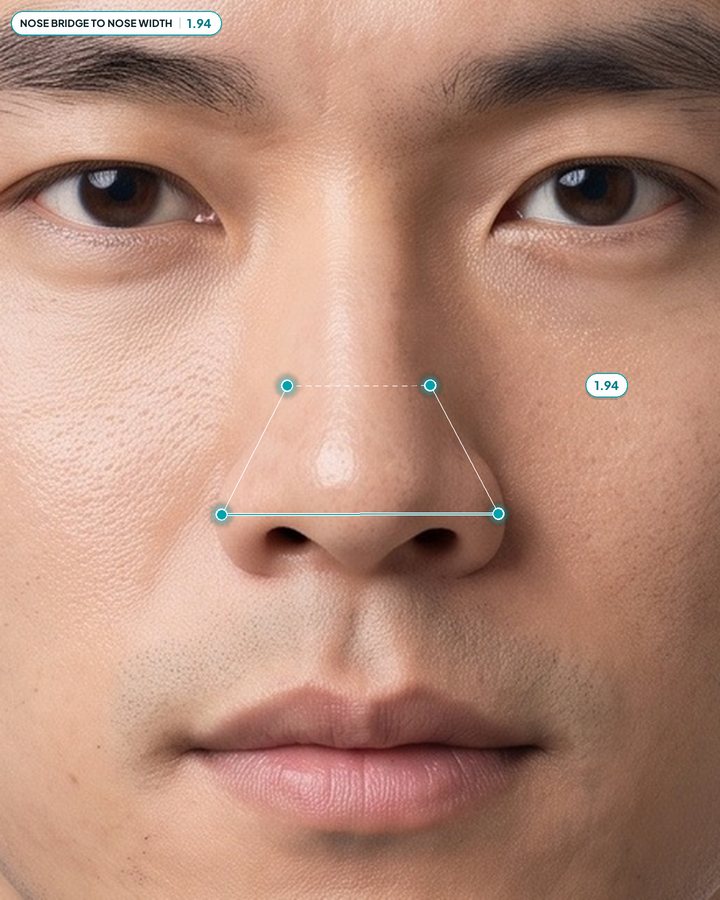
Treat those two slanted lines as your contour map, then adjust by type:
- Straight or Greek: contour is optional. If you use it, a soft shade down the sides is plenty.
- Roman, hooked or bumpy: glasses do more here than makeup. A frame bridge that sits on or just under the bump, with a strong top line, breaks up the profile, and on any bigger nose, frames at least as wide as your face keep it from looking bigger by contrast. Keep highlight off the bump. For men, a fuller beard at the chin balances a nose that projects.
- Scooped: a thin highlight down the dip reads straighter in photos, and frames with adjustable pads sit level on a dipped bridge.
- Upturned, snub or button: keep the camera at eye level or a little above, so less of the nostrils shows. A higher-set or keyhole glasses bridge makes a short nose look longer, and soft shade just under the tip, with the highlight stopping above it, plays down the upturn.
- Bulbous or fleshy: step back and zoom in a little, since close cameras enlarge the tip. Shade both sides of the tip with a small dot of highlight on its center, and choose frames with some thickness.
- Wide or flat: two thin shade lines just inside the slanted ones, running straighter than the flare at the base, with a slim highlight strip down the bridge, make the base read narrower. A slight three-quarter turn does the same in photos, and adjustable nose pads stop frames sliding down a low bridge.
- Narrow or pointed: a natural gap between the brows keeps the bridge from looking pinched. Keep side shade very light or skip it, add a soft highlight across the tip, and pick a slimmer frame bridge.
If you do one thing today, have a friend retake your side photo from 1.5 m at eye level, then run the three steps.
Questions people ask
How many types of noses are there?
There is no official number. Researchers measure noses with angles and ratios, and when they do sort them it's by those numbers, such as width for length, not by names like Roman or button. The popular list of 14 traces back to one 2011 survey in which a single researcher sorted 1,793 pictures, with no sorting rules given in the abstract. Our chart uses 12 names, each tied to the bridge line, the tip or the nose's width from the front, and most noses fit more than one.
What is the most common nose shape?
Nobody has counted the chart names reliably. In the 2011 survey behind many charts, the fleshy nose was the most common at 24.2% of 1,793 pictures. But one person did the sorting, more than a fifth of the pictures were artworks and the abstract gives no sorting rules, so the figure describes that picture set, not people in general. Sorted by width for length instead, about 3 in 4 noses in one study of 115 young adults were narrow for their length.
What is the rarest nose shape?
Nobody knows for sure. No study with clear criteria has counted the rarest of the chart names. In the 2011 picture survey behind the popular list of 14, the least common group made up 0.45% of the pictures and one shape appeared only once in 1,793, but the abstract doesn't say how the groups were defined. A nose far from the average on one measurement is less common, never worse.
What is a celestial nose?
Celestial is another name for an upturned (retroussé) nose: the tip points up, so more nostril shows in profile. Two angles measure it. On a man, a tip rotation above +21.5 degrees and a nose-to-lip angle above 114 read upturned; for a woman the edges are higher, at +30.5 and 118. Check both, because a forward-leaning upper lip shrinks the nose-to-lip angle even when the tip points up.
What is a fleshy nose?
A fleshy nose is a larger nose with more soft tissue over the tip and the bridge, so the tip looks soft and rounded and the bridge full, whatever its line. Our report rates this as Nose tip fullness and Nose bridge fullness, each from 0 to 10, where lower means fuller (10 means no extra fullness). The fleshy nose topped the 2011 picture survey at 24.2% of the pictures. For contour, blend shade on both sides of the tip and keep a small highlight on its center.
Are female and male nose types different?
The same names apply to both, but men's noses are larger on average, with wider nostrils, a longer ridge and a tip that projects further. The angles differ less: one large 3D study found no sex difference in the nose angles it measured, while a smaller one found the root about 9 degrees smoother in women. Our ranges expect a woman's tip to turn up more (+20.5 to +30.5 degrees against +11.5 to +21.5) and her base narrower for her eye gap (0.94 to 1.06 against 1.04 to 1.16).
Which nose shape is the most attractive?
No single shape wins. In a test with 503 raters, the most-picked male profile for attractiveness had a mildly scooped (ski-slope) bridge, and only about 1 in 5 chose it. Nobody agrees on the ideal nose-to-lip angle either: in one 3D study, raters preferred 80 to 90 degrees on women, at or below the 90 to 120 degrees historically given as ideal. Whatever the type, the chin and the rest of the face change how big a nose reads.
How do you contour different nose shapes?
Shade softly down both sides of the nose, from the inner brows to the nostril wings, and blend until no edge shows. In one study, professional makeup that included contouring made noses look smaller, while everyday makeup did not. Then adjust by type, as styling practice: keep highlight off the bump of a Roman or hooked nose, add a little shade under an upturned tip, shade both sides of a bulbous tip, and use two thin lines with a narrow highlight strip on a wide base.
Sources
-
Tamir A. Numerical survey of the different shapes of the human nose. J Craniofac Surg. 2011;22(3):1104-1107. doi:10.1097/SCS.0b013e3182108eb3. Abstract on PubMed ↩↩
-
Uzun A, Ozdemir F. Morphometric analysis of nasal shapes and angles in young adults. Braz J Otorhinolaryngol. 2014;80(5):397-402. doi:10.1016/j.bjorl.2014.07.010. Full text on PMC ↩↩↩
-
Nuyen B, Kandathil CK, Saltychev M, Most SP. Social perception of the nasal dorsal contour in male rhinoplasty. JAMA Facial Plast Surg. 2019;21(5):419-425. doi:10.1001/jamafacial.2019.0321. Full text on PMC ↩↩
-
Al-Sebaei MO. The validity of three neo-classical facial canons in young adults originating from the Arabian Peninsula. Head Face Med. 2015;11:4. doi:10.1186/s13005-015-0064-y. Full text on PMC ↩
-
Ward B, Ward M, Fried O, Paskhover B. Nasal distortion in short-distance photographs: the selfie effect. JAMA Facial Plast Surg. 2018;20(4):333-335. doi:10.1001/jamafacial.2018.0009. Full text on PMC ↩
-
Betts JG, Young KA, Wise JA, et al. Anatomy and Physiology 2e. Section 22.1: Organs and structures of the respiratory system. OpenStax, Rice University; 2022. Open textbook on OpenStax ↩
-
Adhikari K, Fuentes-Guajardo M, Quinto-Sanchez M, et al. A genome-wide association scan implicates DCHS2, RUNX2, GLI3, PAX1 and EDAR in human facial variation. Nat Commun. 2016;7:11616. doi:10.1038/ncomms11616. Full text on PMC ↩
-
Zaidi AA, Mattern BC, Claes P, McEvoy B, Hughes C, Shriver MD. Investigating the case of human nose shape and climate adaptation. PLoS Genet. 2017;13(3):e1006616. doi:10.1371/journal.pgen.1006616. Full text in PLOS Genetics ↩↩
-
Sforza C, Grandi G, De Menezes M, Tartaglia GM, Ferrario VF. Age- and sex-related changes in the normal human external nose. Forensic Sci Int. 2011;204(1-3):205.e1-9. doi:10.1016/j.forsciint.2010.07.027. Abstract on PubMed ↩↩
-
Kim Y, Park JH, Park M, et al. Differences in nasal shapes and the degree of changes over a decade or more: a paired analysis. Clin Exp Otorhinolaryngol. 2024;17(1):56-63. doi:10.21053/ceo.2023.01137. Full text on PMC ↩
-
El-Habbash S, Bakshi A, Khambay BS. Aesthetic preferences of the nasolabial angle: a three-dimensional (3D) study. JPRAS Open. 2025;46:238-249. doi:10.1016/j.jpra.2025.08.026. Full text on PMC ↩
-
Jones AL, Porcheron A, Russell R. Makeup changes the apparent size of facial features. Psychol Aesthet Creat Arts. 2018;12(3):359-368. doi:10.1037/aca0000152. Author manuscript on Swansea University’s repository ↩
Spotted a mistake? Email support@faceratinglab.com and we will fix it.