Face shapes: the 7 types, measured the same way, and what suits each
The usual chart names seven face shapes: oval, round, square, oblong, heart, diamond and triangle. For men and women alike, one length, two widths and the jaw edge separate them, and faces people call oval measure about 1.4 times as long as wide in the two groups we checked, not the 2x some charts claim.
The short version
- Nobody owns the list of face shapes. Seven is the usual chart, research papers use 3 to 9 labels, and one team that sorted faces by measured shape got 4.
- Ignore the 2x oval. Faces people call oval measured about 1.4 in the two groups we checked, and faces judges called round measured 1.1 to 1.2 in one small study, not 1 to 1.
- All four of our example men sit close to the border between two shapes, and three of them would change label with under 1 mm of movement at one measuring point, by our estimate.
- To place your own face, take a level photo from about 1.5 m with your hair back, draw four straight lines and run the numbers down the chart.
- What suits each shape is stylists' convention, and no shape needs changing, so shortlist from the tables and test a look in a photo before you commit.
You can tell the seven different face shapes apart with four straight lines on one photo: hairline to chin, cheekbones, temples, jaw. Add a look at how clear your jaw edge is, and don’t be surprised if you land between two.
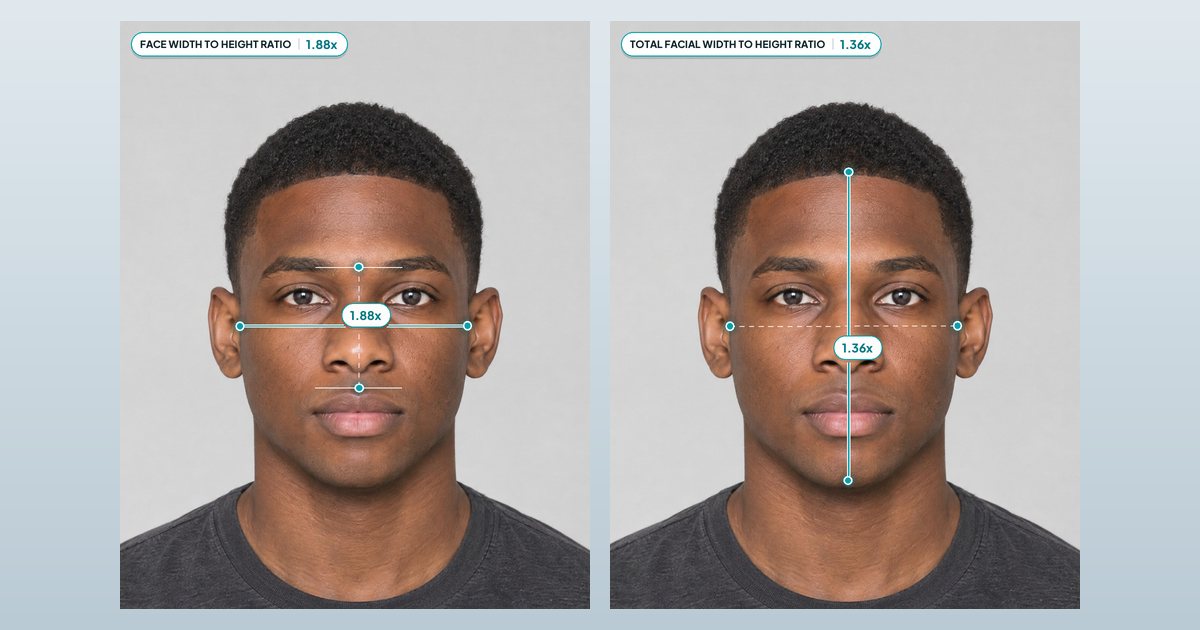
The internet says an oval face is 1.5 times as long as it is wide, or sometimes twice. Measured from hairline to chin over cheekbone width, our four example men run from 1.28 to 1.41, and two of the three studies we cite land about 1.3 to 1.4.42 None comes near 2.
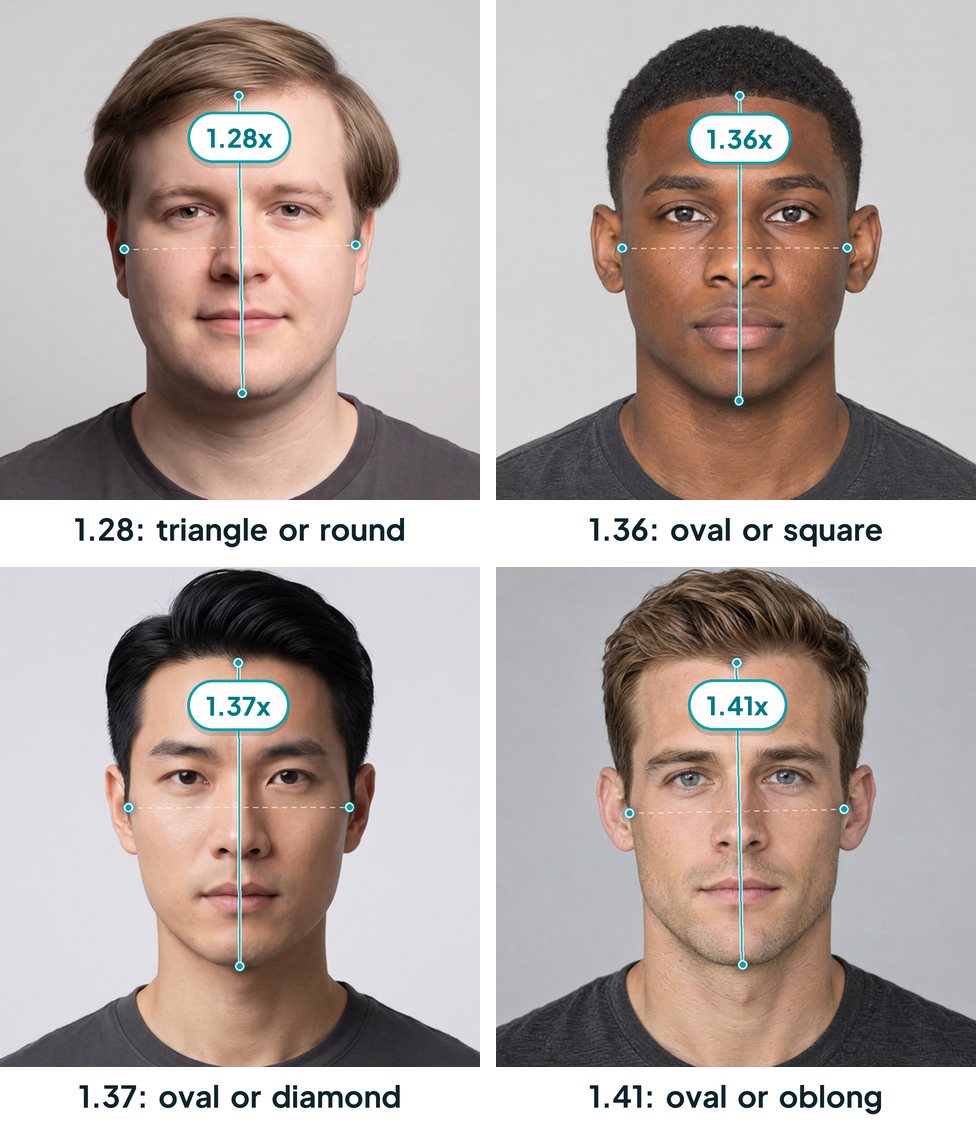
Not one of the four lands cleanly in one shape. Three come out oval under the rule we wrote for this page, and each of those three is under 0.5 mm from another name, by our estimate. If a chart has never quite fit you, that is why.
The 7 types of face shapes, in one chart
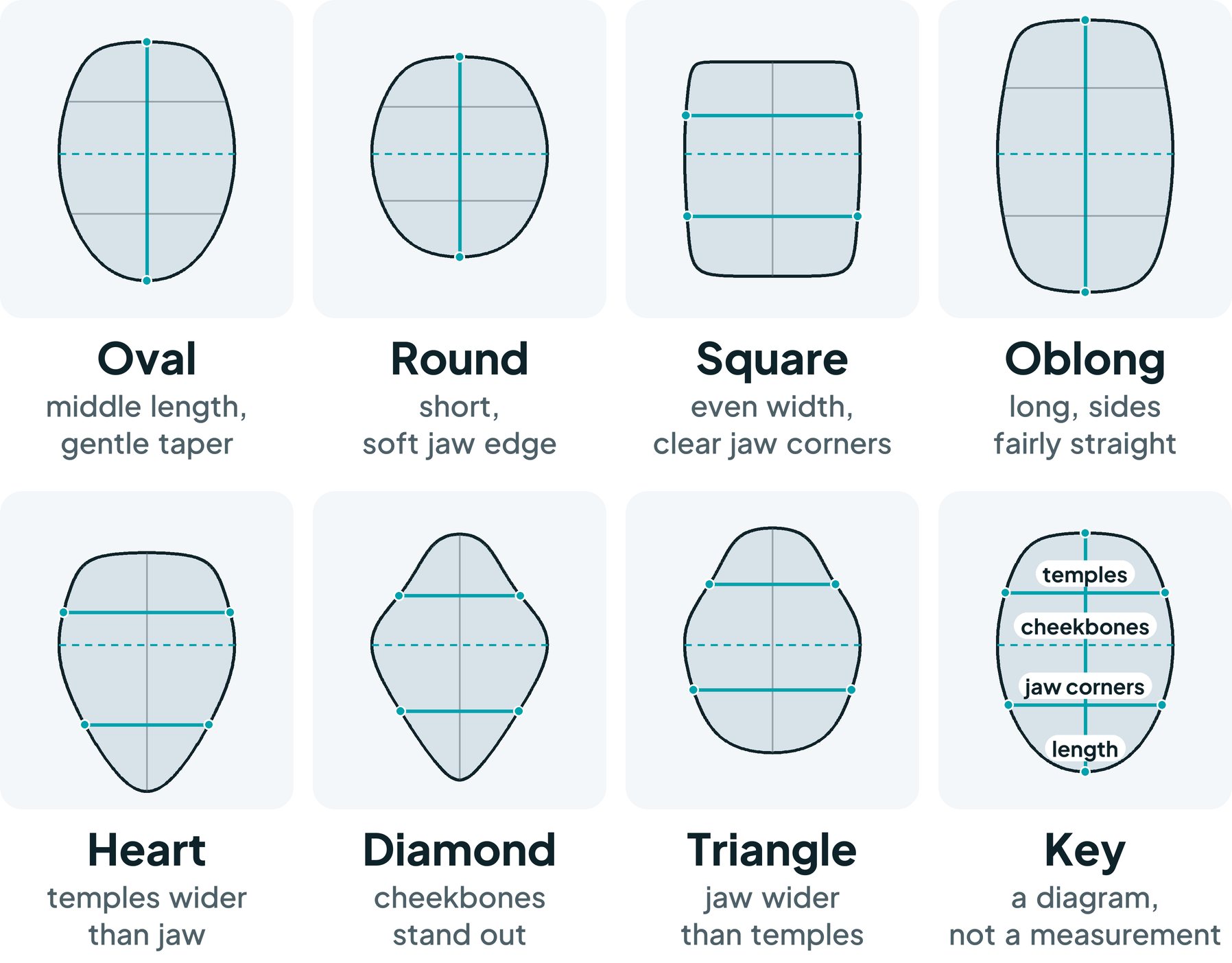
In words, here are the 7 types of face shapes, in the order to check them. To determine your face shape by eye, stand at a mirror with your hair back and stop at the first line that fits.
- Heart (heart-shaped or inverted triangle): temples clearly wider than your jaw, tapering to a narrower chin.
- Triangle (pear): jaw clearly wider than your temples.
- Diamond: cheekbones stand out, with temples and jaw both narrower.
- Oblong (long or rectangle): clearly long for its width, sides fairly straight.
- Round: short for its width, with a soft, curved jawline.
- Square: even width, clear jaw corners.
- Oval: none of these. Middle length, gentle taper.
Those looks overlap, so the table separates the different face shapes with numbers: length (hairline to chin ÷ cheekbones), temples (T) and jaw (J) as percentages of cheekbone width, plus one call by eye, how clear your jaw edge looks. Men and women use the same chart, and its numbers read men / women. Start at the top and stop at the first row that fits, because a face can pass more than one test. Oval is simply what’s left. Your own numbers come from the three-step photo check.
| Shape | Length | T and J | Jaw edge |
|---|---|---|---|
| Heart | Any | T at least 5 points over J | Either |
| Triangle | Any | J at least 5 points over T | Either |
| Diamond | Any | T under 86.5 / 80.5, J under 87.5 / 84 | Either |
| Oblong | Over 1.41 / 1.39 | Within 5 points | Either |
| Round | Under 1.30 / 1.28 | Within 5 points | Soft |
| Square, short | Under 1.30 / 1.28 | Within 5 points | Clear |
| Square, middle length | 1.30 to 1.41 / 1.28 to 1.39 | T 89.5+ / 83.5+, J 89.5+ / 86+ | Clear |
| Oval | 1.30 to 1.41 / 1.28 to 1.39 | Within 5 points | Either |
Jaw edge means how clear your jawline looks, and it’s a call by eye. Clear means you can see a corner below the ear and a shadow where the jaw meets the neck. Soft means the cheek curves into the chin and neck with no visible corner.
If you only check one thing, check length. Two lines and a ruler tell you short, middle or long, which on this chart is most of the split between round, oval and oblong.
How to tell your face shape in three steps
The mirror list under the chart gets you close. If two lines fit, go further. To measure your face shape with numbers, you need one level front photo and four straight lines, no tape.
- Prop your phone at eye level with the timer on, or ask a friend to shoot with the rear camera, from about 1.5 m (5 feet), zoomed to 2x. Chin level, face relaxed, hair tied or pushed back so your hairline and temples show. Use a clean-shaven photo if you have one. Skip the close selfie.
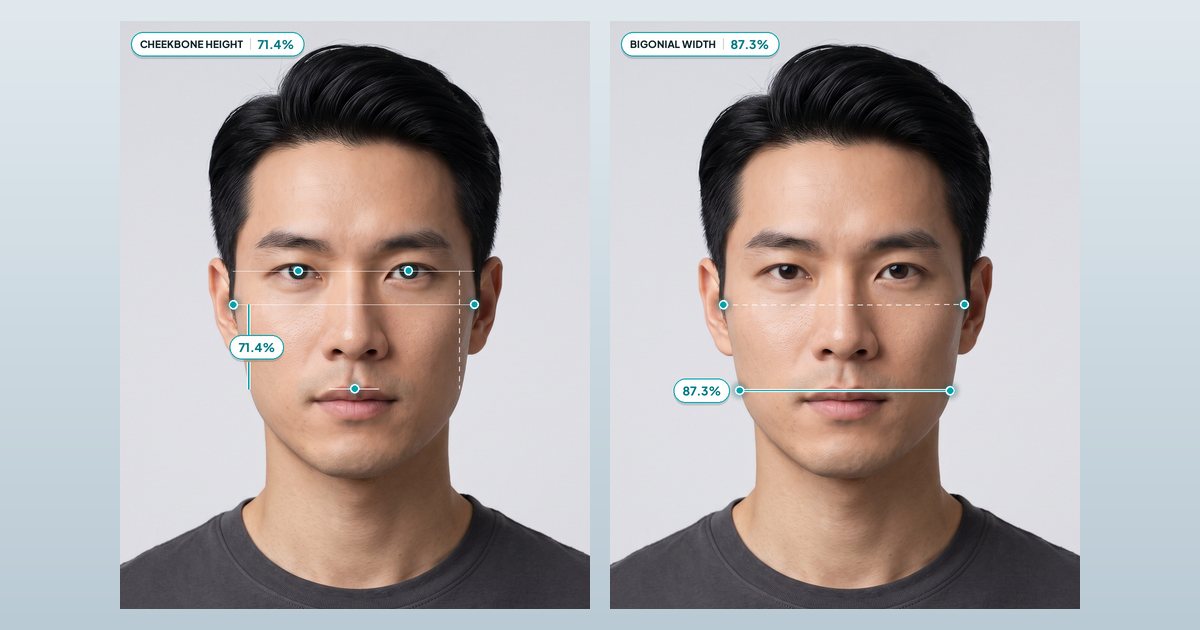
- Crop the photo so your head fills the screen, then open it in your phone’s markup tool, or print it as large as you can. Draw four straight lines (the Key panel in the chart above shows all four together):
- Length: hairline to bottom of chin.
- Cheekbones: the widest part of the cheeks, skin edge to skin edge.
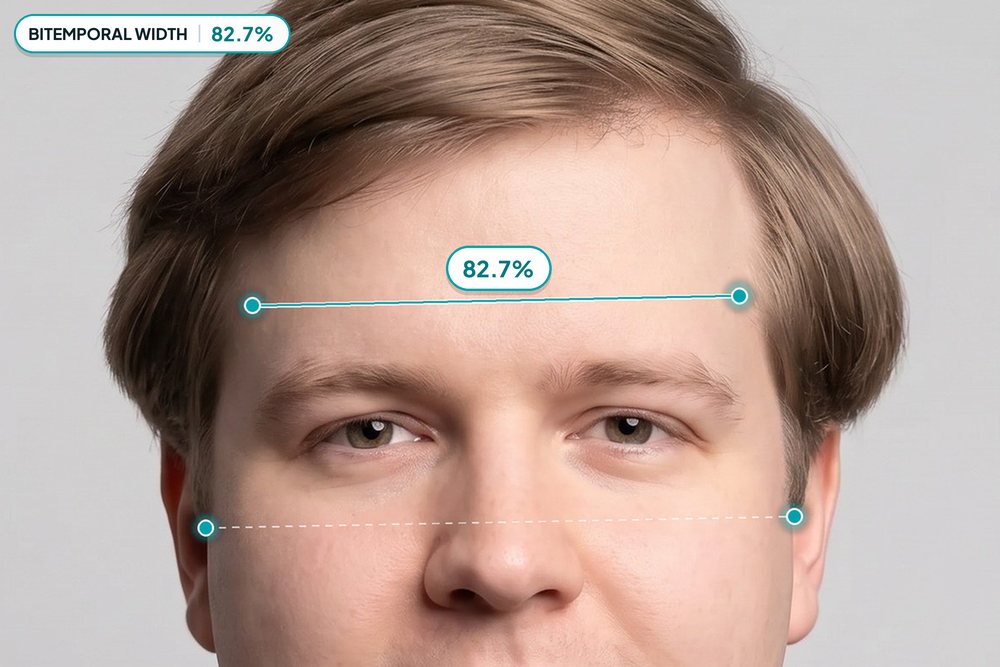
- Temples: where forehead skin meets hair, a little above your brow peak.
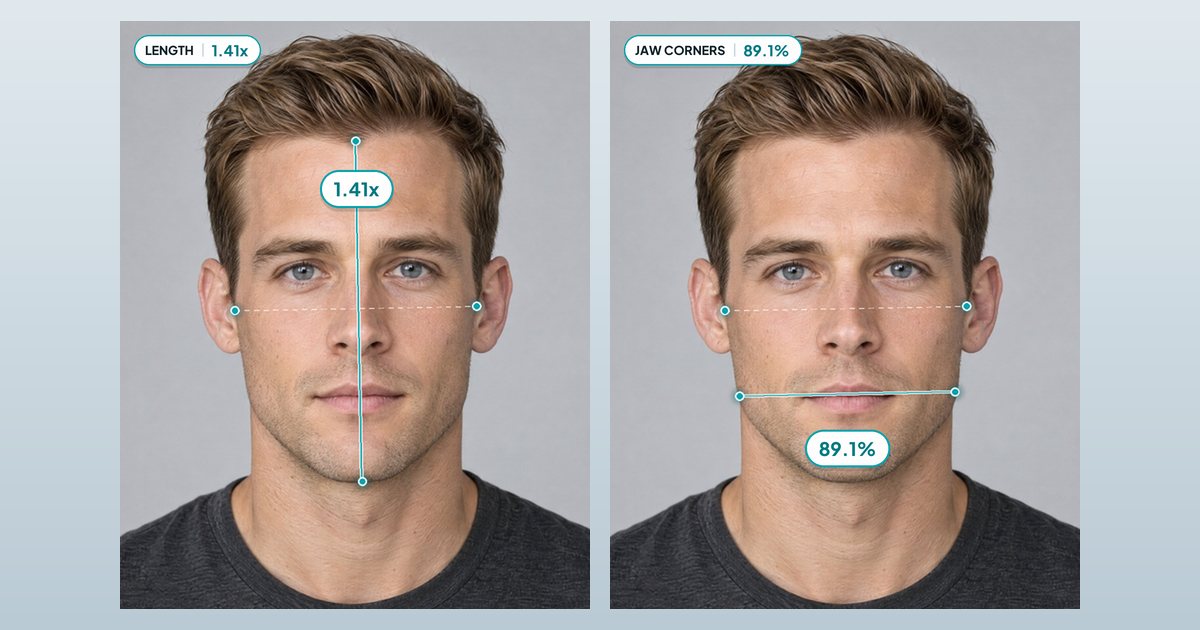
- Jaw corners: where the back edge of your jaw meets its lower border, about level with the mouth in the picture below.
- Hold a ruler to the screen or the print, keep the zoom the same, and measure in any unit. Divide length by cheekbones, then divide temples and jaw by cheekbones and multiply by 100. Run your numbers down the chart from the top and stop at the first row that fits. If you are within 0.02 of a length cut-off or 3 points of a width cut-off, read the other row too: you sit between two shapes. That margin is our own, about 3 to 4 mm on an adult face.
An example: length 8.2, cheekbones 6.0, temples 5.2 and jaw 5.3 give 1.37, 86.7 and 88.3. For a man that lands on oval, and both widths sit within 3 points of the diamond and square rows. For a woman, the same numbers land on square with a clear jaw edge and oval with a soft one.
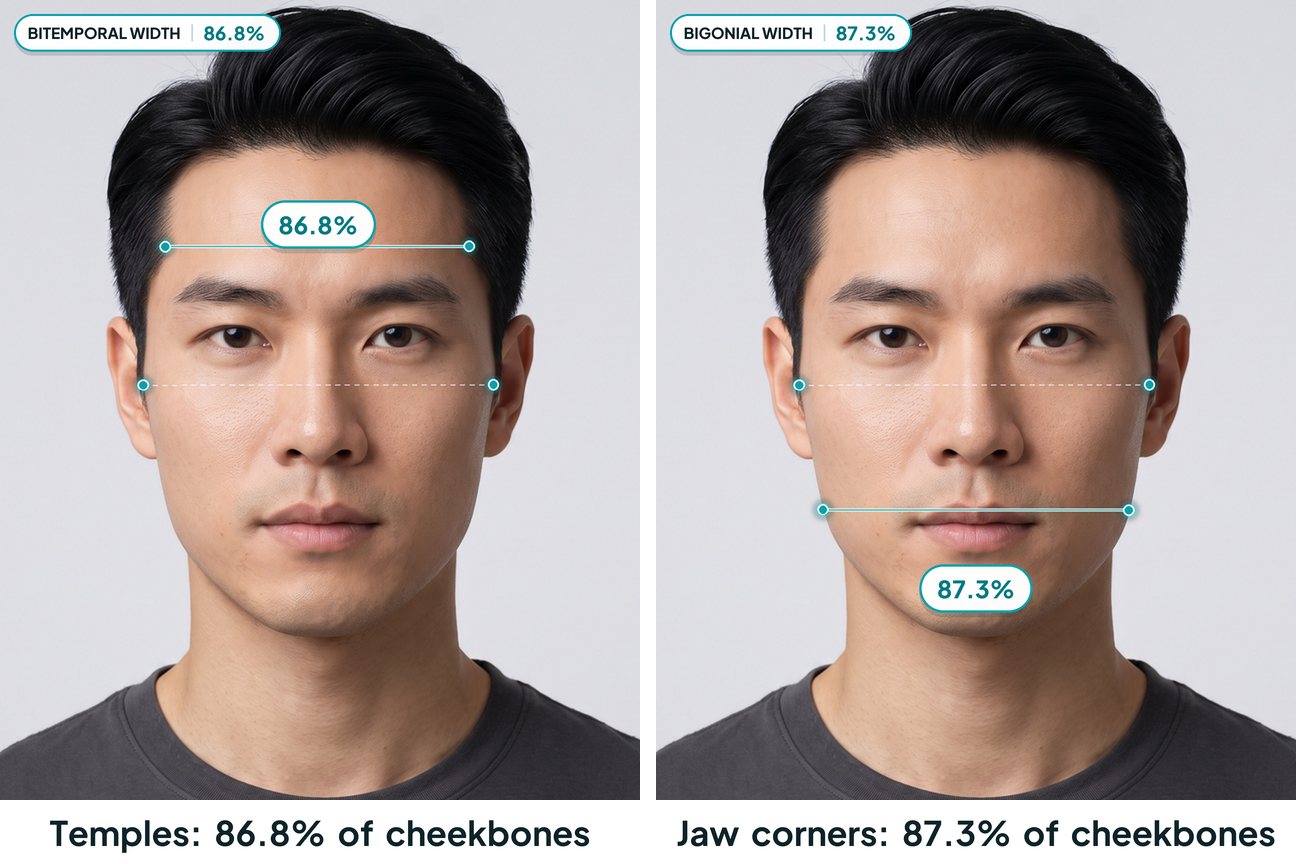
Why no tape? It follows the curve of the face, so tape numbers and ours won’t match. Some guides even get the jaw by doubling the curve from ear to chin, which isn’t a straight width at all.
Our report prints these same numbers on your photo, not a shape name, so you read the name off the chart. Two labels to look for. Your length is the Total facial width to height ratio, printed as height over width, so it’s the same number as here. And a Jaw definition rating under 6 out of 10 counts as soft on this chart. The Face shape rating is something else. It scores how masculine or feminine the outline reads, not which of the seven you are. How our report places these marks is public, and you can read a full sample report first.
Can you have two face shapes? What decides it when you sit between
Yes, and in our view most faces do, because the labels overlap. Find your number closest to a cut-off, and you have the two shapes you sit between.
A formula only gets you so far. In a Korean study, one built from five measurements put 63.9% of 180 women back in the type a panel of 20 had given them by eye.4 Round did best, at 84.9%. Oval and square got under half. A UK PhD thesis on glasses, by K. Ramlagun, reports 90% for its three-shape formula, but on the same few faces it was built from.2
The thesis also started from faces chosen to fit. The researcher picked 15 as ovals, rounds or squares and showed them to 150 people, who described each in their own words. Four still got no clear verdict.2 If your face seems to fit two shapes, that is normal.
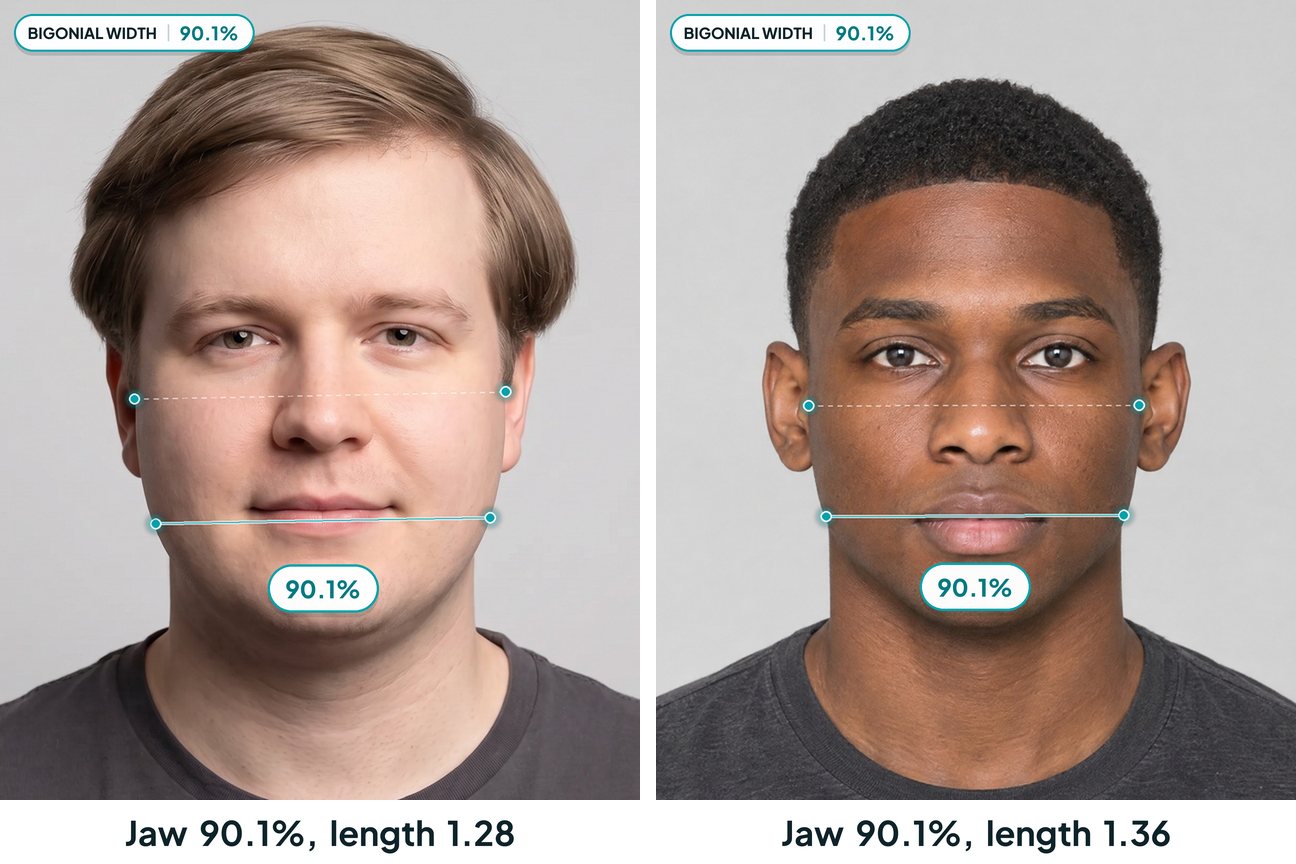
Now our four men, from the grid near the top of this page, top row then bottom row. The numbers are length, temples and jaw, and the millimeters are estimates.
| Man | Numbers | Our rule | Close to |
|---|---|---|---|
| First | 1.28, 82.7, 90.1 | Triangle | Round, with temples 2.34 points wider (about 3.5 mm) |
| Second | 1.36, 89.2, 90.1 | Oval | Square, with temples 0.32 points wider (about 0.4 mm) |
| Third | 1.37, 86.8, 87.3 | Oval | Diamond, with temples 0.31 points narrower (about 0.4 mm) |
| Fourth | 1.41, 85.7, 89.1 | Oval | Oblong, with length 0.002 longer (about 0.3 mm) |
Look at the millimeters. That 0.4 mm is about half the thickness of a bank card, and your thumb on a phone screen isn’t that steady. We set those cut-offs ourselves, so which side of one a face lands on is partly chance. Trust the numbers over the name. The first man is the one in our sample report, where you can check his numbers, and we’d expect most people to call him round by eye.
Oval or oblong
Length decides, at 1.41 (women 1.39). Our fourth man is about 0.3 mm under it: comb his hair back differently and he could be oblong. The Korean study won’t back a length cut-off here. Its oblong women (1.39) came out shorter than its egg-shaped ones, the paper’s word for oval (1.41), though not significantly.4
Round or square
Length usually separates them, but the ranges meet near 1.3. In the glasses thesis, faces judges agreed were round measured 1.1 to 1.2 and those they agreed were square 1.3 to 1.5, while round web photos averaged 1.3.2 Near that point the jaw edge decides, by eye. Our jaw slope angle won’t settle it.
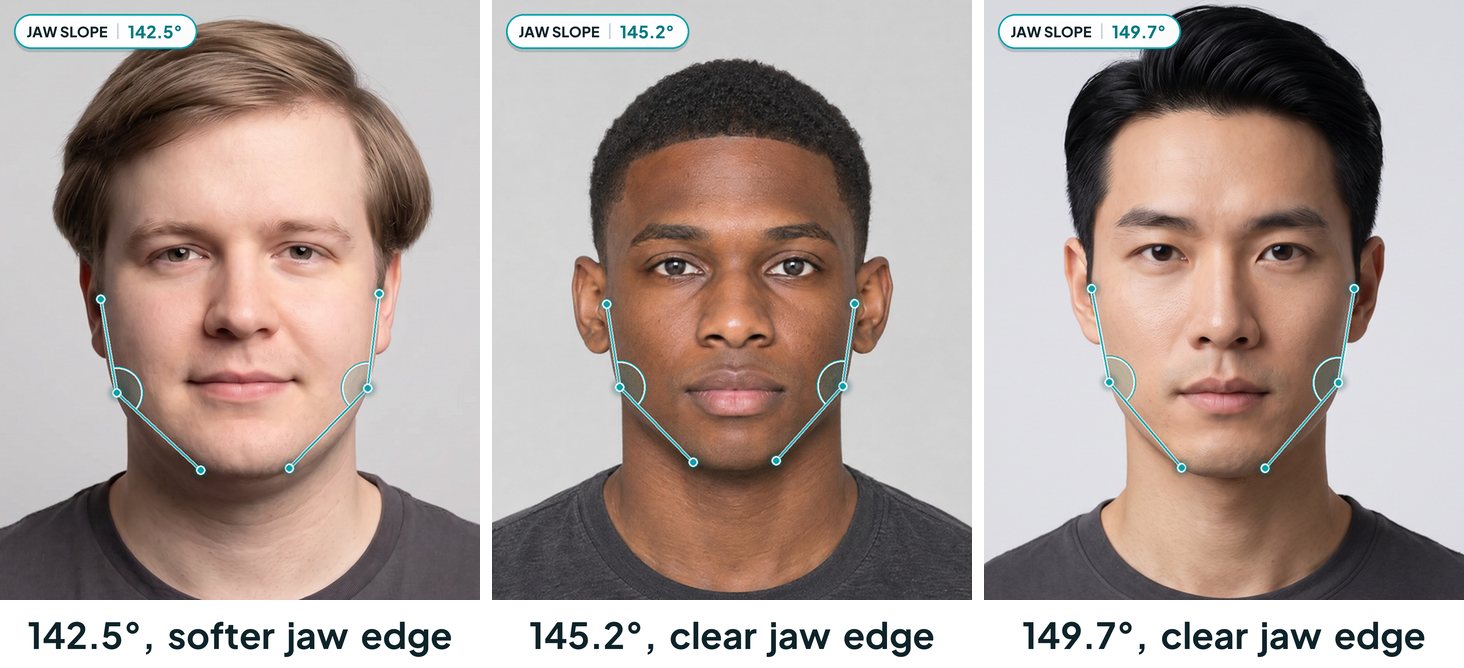
The sharpest corner by the numbers, 142.5 degrees, belongs to the softest-looking jaw. The more open corners have the clearer edges. The angle measures the turn in the outline, not how crisp the edge looks, so near 1.3 your eye is the better judge.
The glasses thesis does try an angle ratio for round, at the side of the jaw over the chin, but neither angle differed significantly across its 15 faces.2 We found nothing that ties our jaw slope, or the gonial angle people quote from the side, to one of these seven shapes. On this chart the jaw edge does one job: it says whether a face can be square.
Oval or square
Your widths and jaw edge decide. Both widths in the top half of their ranges plus a clear jaw edge make it square. Otherwise it’s oval. The glasses thesis points the same way without settling it. Oval and square faces had the same length to width, and square faces were wider at the jaw among 114 web photos. Among the 15 faces photographed for the study that gap wasn’t significant, and the square group was all men.2
Heart, diamond or triangle
Subtract jaw from temples. A gap of 5 points or more either way gives heart or triangle. If the gap is smaller and both widths fall under their ranges, you have diamond, the same taper that makes high cheekbones stand out.
Hairstyles, beards, makeup and glasses for each face shape
Almost every tip below, for men and women alike, does one thing: it adds where your outline is narrow and takes away where it’s wide. These are stylists’ working rules, since we found no controlled study testing hairstyles or contouring by face shape.
| Shape | Men | Women |
|---|---|---|
| Oval | Choose by hair type, not by this chart: a textured crop, side part or quiff all work. Beard or no beard is your call. | Most cuts and lengths, from a pixie to long layers. Blush on the cheekbones. |
| Round | Quiff or pompadour with faded sides: 2 to 3 cm (about 1 in) more height on top. Short, even beard, a little longer at the chin. Full sides or a heavy fringe add width. | Long layers or a lob past the jaw, crown volume, sleek sides. Chin-length bobs add width. Blush angled up. |
| Square | Textured crop or side part with some height. Keep a short beard neat at the jaw corners, or leave the corners strong if you like them. A boxy, flat-sided cut shows the corners more. | Soft layers or curtain bangs (a fringe in the UK) around the jaw, side part. Blunt jaw-length bobs show the corners more. Soft shade at the jaw corners if you contour. |
| Oblong | Side part or textured fringe, less height on top, fuller sides. Fuller beard sides, kept short at the chin. A tall quiff or a long chin beard adds length. | Curtain bangs or a wavy lob, volume at cheek and jaw level. Long, straight, one-length cuts add length. Blush across the cheek. |
| Heart | Side part or low crop with less width on top. A full beard along the jaw. A wide, full top adds more up top. | Lob or chin-length bob with volume from chin to jaw, side-swept bangs. Height at the crown adds more up top. Blush low on the cheeks. Soft shade at the sides of the forehead if you contour. |
| Diamond | Textured fringe or a longer side-swept top, fuller at the temples. Stubble or a short full beard for fullness at the jaw corners. Tight-faded temples show the taper more. | Side-swept bangs, or a chin-length bob for volume at jaw level. Styles pulled tight at the temples show the taper more. Blush on the apples of the cheeks. Soft shade at the top of the forehead and the chin if you contour. |
| Triangle | Quiff or side-swept top, with volume at the temples and on top. Stubble or a short beard with neat sides. A wide, bushy beard adds more at the jaw. | Pixie or short layers with volume at the crown and temples, less at the jaw. Blush high on the cheekbones. Soft shade along the lower jaw if you contour. |
The round row’s 2 to 3 cm is bigger than it sounds. Our whole middle band of length is about 1.5 cm on a face 14 cm wide. Height on top won’t change your number, since the line starts at your hairline, but it moves the outline people see by more than that.
Makeup sits in the women’s column only because charts put it there, and it works the same on anyone who wears it.
You’ll read that oval is the best shape and everything else should be balanced toward it. The support is thin: 1,417 people in China picked oval first from plain sketches, 39.94% of them, then heart, with square last.7 And yes, the table above nudges every shape toward the middle, because that’s how stylists think. You can ignore it. No shape here needs changing, so if you like your jaw corners or your long face, keep them.
For glasses, the usual rule is contrast: angular frames on soft outlines, softer frames on angular ones.
| Shape | Glasses frames to try first |
|---|---|
| Oval | Match frame width to your cheekbones. |
| Round | Square or rectangular. |
| Square | Try both: round by the usual rule, square by the summary of the test below. |
| Oblong | Deep frames: aviator, square or rectangular. |
| Heart | Aviator or round, light along the lower rim. |
| Diamond | Cat-eye first, oval if you like it. |
| Triangle | Browline, or detail on the top half. |
That rule is only a convention. In 2020 two big UK optician chains told round-faced customers opposite things, one saying angular frames and the other rounder ones, and the UK’s optical bodies set no standard. The only test we found, in the glasses thesis, didn’t back it either. Round faces scored about the same in square and round frames, 3.14 and 3.05 out of 5 (our average of its male and female columns). On square faces the thesis contradicts itself, its figure and tables picking different winners, though its summary puts square frames first. Oval frames came last on all three face shapes tested, though the author points to that one frame’s long proportions and to fashion.2 Use the table to shortlist, then try them on.
Treat every cell as an experiment. Before you commit to a haircut, comb or pin your hair into roughly the new shape, photograph it in the same light as your usual look, and compare. Between two shapes, start with what both rows share. The man in our sample report sits between triangle and round: both rows want more on top, so he’d start there.
Is an oval face 1.5 or 2 times as long as it is wide?
Closer to 1.5 than to 2, and two of the three studies we cite come out lower than either: about 1.3 to 1.4 from hairline to chin over the cheekbones.42 The third runs higher, with 286 students in Malaysia averaging 1.50 to 1.62 across its groups. Its cheekbone widths run about 2 to 3 cm narrower than in the Korean and US surveys on this page, which pushes the ratio up, so we treat it as an outlier.6
Here is what each claim means on a face 19 cm (7.5 in) tall.
| Claim | Length ÷ width | Width |
|---|---|---|
| “Round: as wide as it is long” | 1.0 | 19 cm (7.5 in) |
| Our ideal range, men | 1.34 to 1.37 | 13.9 to 14.2 cm (about 5.5 in) |
| “Oval: about 1.5 times” | 1.5 | 12.7 cm (5.0 in) |
| “Oval: sometimes twice” | 2.0 | 9.5 cm (3.7 in) |
Twice has no measured support anywhere we looked. That 9.5 cm face is narrower than the narrowest published average cheekbone width we read, about 10.8 cm.6
The closest thing to a measured oval number comes from two small groups, and both land near 1.4. Faces judges clearly called oval in the glasses thesis measured about 1.4, and none passed 1.5.2 The Korean egg-shaped group averaged 1.41, which our women’s cut-off of 1.39 would call oblong.4 Across that study’s six types the average was 1.35, where our ideal range sits. So our range runs a little under the faces people call oval, and you could measure 1.40, sit just above it and still get called oval.
Our cut-off of 1.41 (women 1.39) is stricter than the thesis too. Its judges still called faces up to 1.5 oval, and its formula stops at 1.45.2 If you measure 1.45, call yourself oval or oblong. Both are fair.
If your face runs long, this cut-off matters less than it looks. Yes, a 1.5 would show as a focus area in our report. But length is 1 of 33 front measurements behind a facial harmony score, and one number doesn’t decide how attractive someone is: our example man at 1.41 sits outside the ideal range and still scores higher overall than another of our men who sits inside it.
The golden ratio, 1.618, is the other number you’ll meet. Ignore it here. Even with narrow widths pushing every ratio up, only 17.1% of those Malaysian students fell in the “golden” band of 1.6 to 1.699, and landing in it had no link with how people rated their own looks.6
Which part of your face is widest? Temples, cheekbones and jaw
On our four men it’s the cheekbones, with temples at 82.7 to 89.2% of that width and jaw at 87.3 to 90.1%, and our ideal ranges also sit under 100% in both sexes. The Korean study’s averages have the cheekbones widest in all six types too, even inverted triangle.4
Charts say the forehead is widest on a heart face and the jaw is widest on a triangle. Our men don’t work that way, so we define heart and triangle by temples against jaw. One catch: our forehead line sits at the temples, where hair starts, so a tape across the widest part of the forehead can come out wider.
On all four men, the jaw is also at least as wide as the temples, by 0.5 to 7.3 points. So the usual claim, “oval: forehead a little wider than the jaw”, doesn’t describe them. The Korean women labeled egg-shaped did fit that claim on average, about 2 points wider at the forehead, by our arithmetic.4 That makes it a fair tendency and a poor test: on our chart, a forehead no wider than your jaw doesn’t rule out oval, and three of these men land there without it.
Jaw width alone doesn’t settle a shape either. Both these jaws measure 90.1%. One man comes out triangle or round, the other oval or square.
Our report scores against the ranges below. It gives no score for being any of the seven. The length range does sit inside the oval and square rows, so a round or long face gets a lower mark on that one number.
| Our ideal range | Men | Women |
|---|---|---|
| Length (hairline to chin ÷ cheekbones) | 1.34 to 1.37 | 1.32 to 1.35 |
| Temples (% of cheekbones) | 86.5 to 92.5 | 80.5 to 86.5 |
| Jaw corners (% of cheekbones) | 87.5 to 91.5 | 84 to 88 |
Ideal ranges also shift a little with the heritage you pick at upload, and no set ranks above another. On these numbers only South Asian differs, with temples 3 points lower and length 0.01 lower. If that’s yours, use those for the diamond and square tests and move the length cut-offs down 0.01.
If you’re a woman, expect a bit more taper toward the jaw on average. A caliper survey of 3,997 US workers found women’s jaws 7.6 mm narrower than men’s after adjusting for body size, and cheekbones 6.0 mm narrower.3 Our ideal ranges run the same way at the jaw. That survey doesn’t back the 6-point gap in our temple range, since its narrowest forehead measure, taken at a different spot, differed by just 1.1 mm. Read that one as our scoring target.
How many face shapes are there, and which are most common?
There is no official number. Seven is the most common count in the guides we read, which run from 5 to 9. Research papers use anywhere from 3 to 9 labels, and one team that grouped faces by measured shape instead of by eye proposed 4.2451 We use seven because it’s the chart you’ll meet, and our numbers can pull those seven apart. So a chart with 5 shapes or 9 isn’t wrong, and neither is ours.
“Different face types” usually means this same chart, but in anatomy papers a face type can mean the facial index: top of the nose to chin over cheekbone width. That leaves out the forehead, so don’t compare its numbers with ours.2
People don’t agree by eye either. When 16 observers sorted the same 60 faces twice, using one forensic system, they often disagreed with each other and with their own first answer. Agreement scored 0.112 between people and 0.203 with themselves, on a scale where 1 is perfect and 0 is chance. Only round and oval drew real agreement.1
So if a friend says square and your stylist says oval, neither has to be careless.
Guides do no better. Two popular ones file the same stars under different shapes: Rihanna is oval in one and diamond in the other, Jennifer Aniston triangle and diamond, Demi Moore inverted triangle and square. That’s why you won’t find a celebrity list per shape here.
We found no reliable count of how common each shape is. Oval is the answer you’ll read, but in the two small counts we could check, round came first: 29.4% of Korean women and 31.4% of Brazilian adults, with oval at 11.7% and 26.7%.45 Diamond usually gets called the rarest, but none of the guides we read names a study or a count behind it, and the Brazilian count had triangular (0.5%) below diamond (4.5%). Heart was 1.0% there, but that count listed inverted triangle apart at 5.0%, and our chart puts the two together.5 In the Korean count, which had no triangle label, diamond did come smallest, at 10.0%.4 Both samples are local, with labels given by eye.
Can your face shape change? Hair, beard, weight and age
Yes, the outline you measure can. Once you’ve finished growing, your bones change only slowly, but hair, hairline, beard, weight, age and the camera all move that outline.
The hairline comes first, because the length measure starts there and it isn’t a bone point. On a face 19 cm tall and 14 cm wide, moving it 5 mm higher or lower changes length by 0.036, more than our whole ideal window of 0.03. A receding hairline makes the face measure longer, and hair styled over the hairline makes it measure shorter. If yours is receding, expect your length number to climb for that reason alone.
Hair at the temples does the same to the widths, which is why step 1 says to keep it back.
A beard adds width low down and changes the length, and under one our report has to estimate the chin and jaw marks. In rating studies, a beard raised how masculine and dominant men looked, and jaw size mattered far less once the beard was on.8 So a bearded photo tells you about the beard.
Heavier people tend to measure wider, with little extra length. Across those 3,997 workers, each extra 10 kg went with a jaw about 3.5 mm wider and cheekbones about 2 mm wider, but only 0.5 mm more length from nose bridge to chin.3 That compares different people, so it’s a tendency and not a forecast for you. Our cheekbone line follows the skin edge, so fuller cheeks count as width: on that 19 by 14 cm face, 4 mm of width moves length by 0.04. Body fat is the one you can change without a stylist, if you want to, through ordinary diet and exercise.
Age shows up small in that survey. Workers aged 45 and over measured about 2.1 mm longer from nose bridge to chin than those aged 18 to 29, and about 1 mm wider at the jaw and cheekbones.3 It stops at working age, and calipers don’t capture sagging along the jaw, so it can’t speak for later life.
The camera is the easiest one to rule out. Our FWHR guide explains why a close selfie makes the face measure narrower for its height, and it should do the same here, so use the 1.5 m photo.
Take the level photo and run the three steps today. Then change one thing and re-check. Our guide on how to glow up runs on the same measure, change, re-check loop.
Questions people ask
How many face shapes are there, and what are they?
There is no official number, but the usual chart has seven: oval, round, square, oblong, heart, diamond and triangle. Research papers use anywhere from 3 to 9 labels, and one team that grouped faces by measured shape instead of by eye proposed 4. We use seven because one length, two widths and the jaw edge can separate them, with rectangle sharing oblong's row and inverted triangle folded into heart.
What is my face shape, and how can I tell?
Take a level front photo from about 1.5 m with your hair back, then compare your hairline-to-chin length, temples and jaw with your cheekbone width, using straight lines. A length under about 1.30 is short, pointing to round or square, and over about 1.41 is long, pointing to oblong (women 1.28 and 1.39). A gap of 5 points or more between temples and jaw points to heart or triangle. If two chart rows fit, you sit between two shapes, which is normal.
Can you have two face shapes?
Yes, and we think that's the usual case, because the labels overlap. In one small study, 150 judges looked at 15 faces a researcher had picked as oval, round or square: 11 got a clear verdict and 4 didn't. Under our rule, all four of our example men sit close to the border between two shapes. Read both rows of the chart and start with the advice they share.
What is the most common face shape?
We found no reliable count, and none in a representative sample. Oval is the usual answer online, with no study or count named in the guides we read. In two small studies round came first, at 29.4% of Korean women and 31.4% of Brazilian adults, while oval was 11.7% and 26.7%. Both samples were local, so treat those numbers as a rough picture.
What is the rarest face shape?
No one knows for sure. Diamond is the usual answer, but none of the guides we read names a study or a count. In a count of 382 Brazilian adults, triangular (0.5%) came below diamond (4.5%), and heart was 1.0% with inverted triangle counted apart at 5.0%. In 180 Korean women, diamond was the smallest of six groups at 10.0%.
What is the most attractive face shape?
No shape wins for everyone, and we don't rank them. In a survey of 1,417 people in China, oval was the top pick at 39.94%, then heart, with square last, but those were plain sketches picked in one country. Our report gives no score for being any of the seven shapes: hairline-to-chin length is 1 of 33 front measurements, and one number never decides how attractive someone is.
What hairstyle suits my face shape?
The usual rule is to add where your outline is narrow and take away where it's wide. A short face tends to get more height on top and tighter sides, such as a quiff with faded sides or crown volume with sleek sides. A long face gets less height and fuller sides, often with bangs. These are stylists' working rules and we found no controlled study testing them, so pin or comb your hair into the new shape and compare photos before you commit to a cut.
What shape glasses suit my face?
The usual rule is contrast, with angular frames on round faces and round frames on square faces, but it's a convention, and the UK's optical bodies set no standard. In the one test we found, round faces scored about the same in square and round frames (3.14 and 3.05 out of 5), and oval frames came last on all three face shapes tested. Shortlist by shape, then try them on.
Sources
-
Valladares J, Lopez-Valdes DA, Farrera A. Technical note: reliability of Pöch’s facial shape classification system: a morphometric approach. Forensic Sci Int. 2025;369:112435. doi:10.1016/j.forsciint.2025.112435. Publisher’s page ↩↩
-
Ramlagun K. Aesthetics and spectacle wear: investigating perceived harmony between face shape and spectacle frame shape. PhD thesis, Anglia Ruskin University; 2024. doi:10.25411/aru.26977591.v1. Thesis on the university’s repository ↩↩↩↩↩↩↩↩↩↩↩↩↩
-
Zhuang Z, Landsittel D, Benson S, Roberge R, Shaffer R. Facial anthropometric differences among gender, ethnicity, and age groups. Ann Occup Hyg. 2010;54(4):391-402. doi:10.1093/annhyg/meq007. Full text on CDC Stacks ↩↩↩
-
Song MY, Park OL. A study on women’s face types classification and shape differences. Journal of Fashion Business. 2004;8(1):76-90. PDF on KoreaScience ↩↩↩↩↩↩↩↩↩↩
-
Nascimento EA, Carvalho MVD, Bento MIC, Almeida SM, Petraki GGP, Soriano EP. Study of facial types of Brazilian individuals. Brazilian Journal of Forensic Anthropology & Legal Medicine. 2021;3. PDF of the journal issue ↩↩↩
-
Alam MK, Mohd Noor NF, Basri R, Yew TF, Wen TH. Multiracial facial golden ratio and evaluation of facial appearance. PLoS One. 2015;10(11):e0142914. doi:10.1371/journal.pone.0142914. Full text on PMC ↩↩↩
-
Samizadeh S, Wu W. Ideals of facial beauty amongst the Chinese population: results from a large national survey. Aesthetic Plast Surg. 2018;42(6):1540-1550. doi:10.1007/s00266-018-1188-9. Full text on PMC ↩
-
Dixson BJW, Lee AJ, Sherlock JM, Talamas SN. Beneath the beard: do facial morphometrics influence the strength of judgments of men’s beardedness? Evol Hum Behav. 2017;38(2):164-174. doi:10.1016/j.evolhumbehav.2016.08.004. Author’s manuscript at the University of Glasgow ↩
Spotted a mistake? Email support@faceratinglab.com and we will fix it.