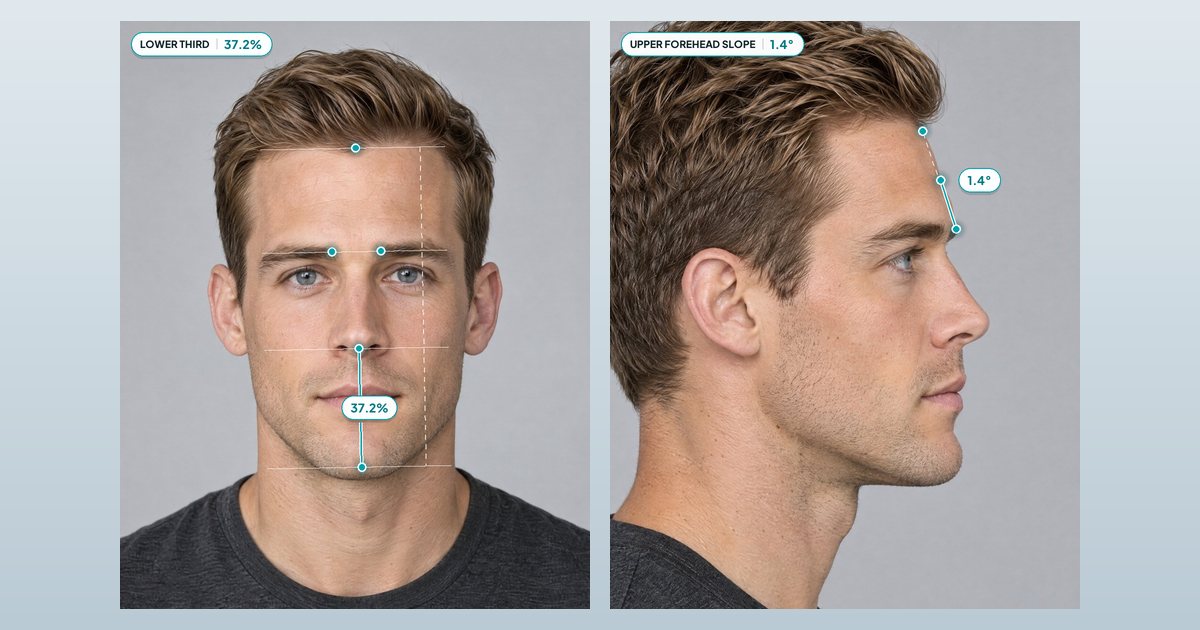
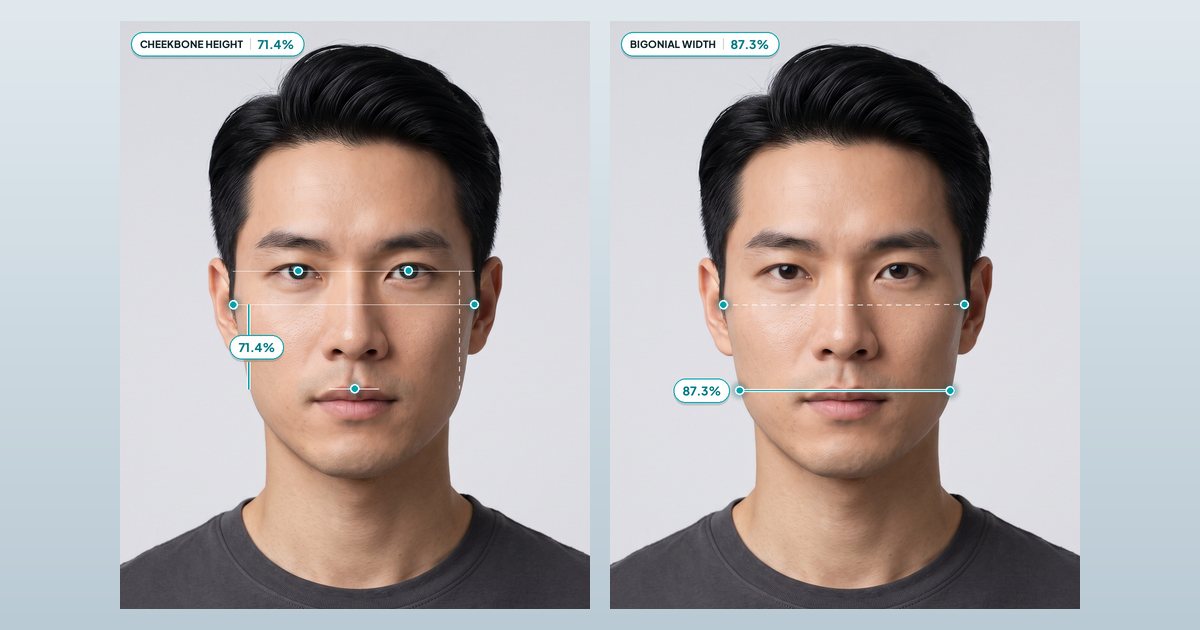
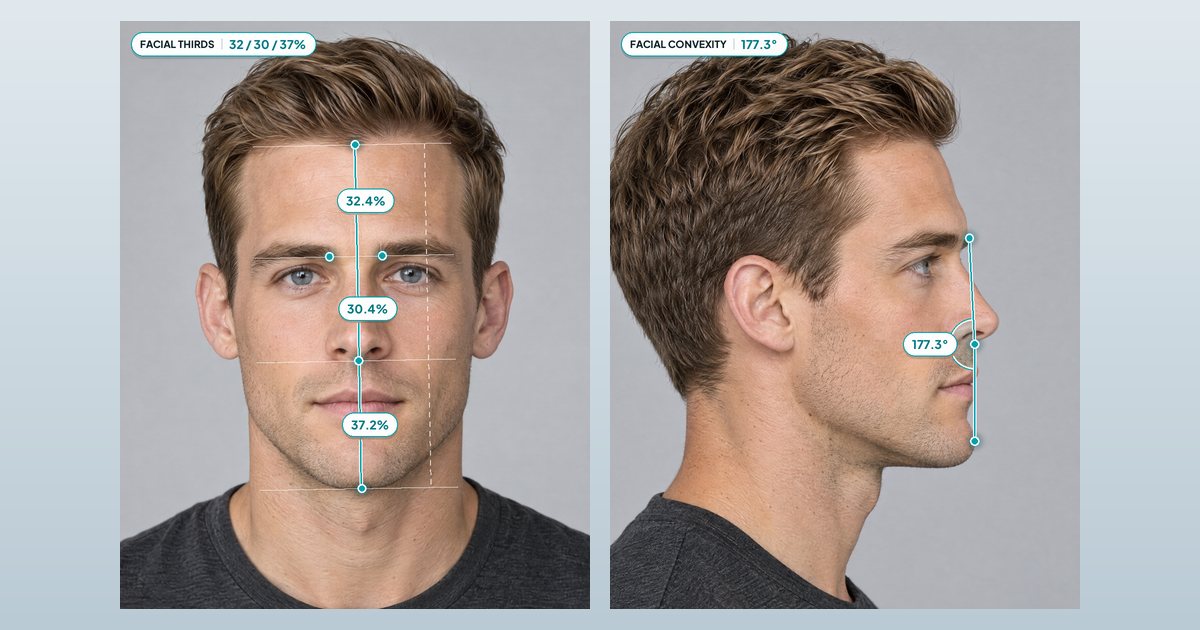
FWHR: what your face width to height ratio means and how to measure it
FWHR (facial width to height ratio) is your cheekbone width divided by the height from your brows to your upper lip. There's no agreed ideal, but our report scores men against 1.96 to 2.00 and women against 1.94 to 1.98, and in the big rating studies a higher ratio doesn't make a face look more attractive.
The short version
- Published FWHR averages run from about 1.7 to 2.2 because studies start the height at different points: about 1.7 to 1.9 from the brows, about 2.2 from the top of the eyelids.
- The total facial width to height ratio divides hairline-to-chin height by cheekbone width, so a higher total means a longer face for its width, and the two can disagree: one of our example men has a focus-area FWHR of 1.72 and an ideal total of 1.37.
- Our window is only 0.04 wide and cuts both ways: a man at 1.90 or 2.06 still scores Great, and at 1.76 or 2.20 the line becomes a focus area.
- Men and women barely differ on FWHR: pooled across 32 samples the gap was tiny, and in 17,607 passport photos women's ratios were higher than men's after age 48.
- In lab studies a higher ratio mostly makes a face look more threatening and, for men, more masculine, but large samples link it to neither adult testosterone nor personality.
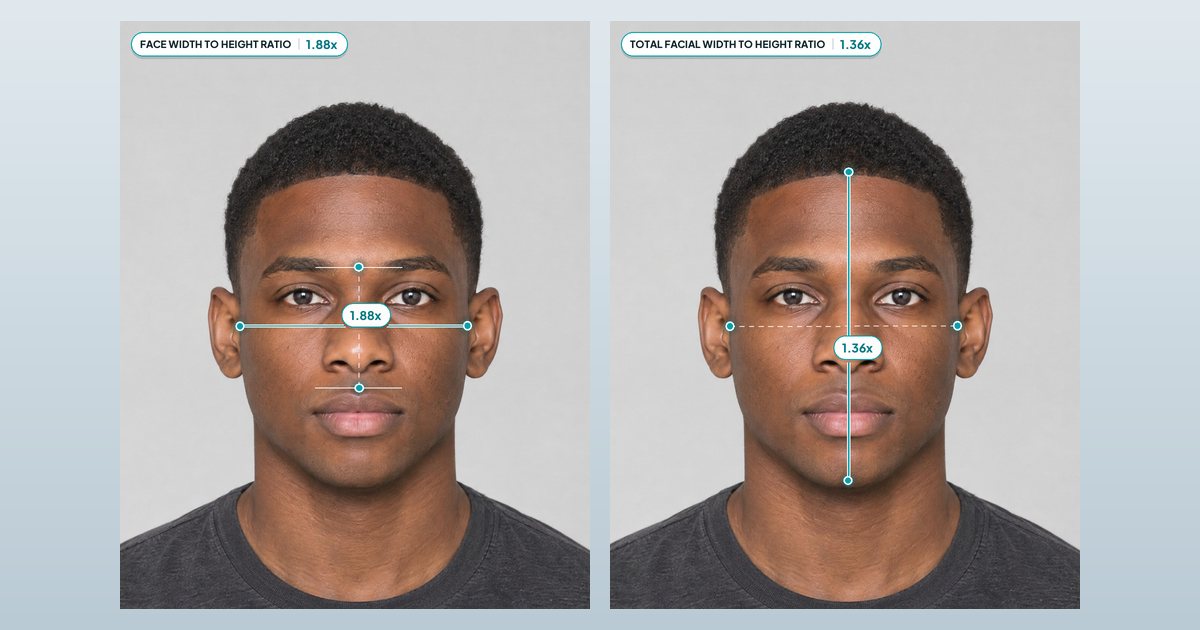
Two different measurements go by the name facial width to height ratio, and on the same face they can point opposite ways. FWHR proper measures the middle of your face, brows to upper lip. The total ratio runs from hairline to chin and, in our report, is divided the other way round. So a higher total means a longer face for its width.
Forums treat a high FWHR as the mark of a masculine, high-testosterone face. The research backs only a sliver of that: wider men’s faces do tend to be rated more masculine, but men and women barely differ on the ratio, and it doesn’t track adult testosterone.12 Our own scoring doesn’t reward a big number either: past 2.00, a man’s score on this line starts to fall.
Where you stand can move this number more than where you put the points. In one study, the same 23 men measured 1.70 when photographed close up with a 50 mm lens and 1.80 from further back with a 105 mm lens, with the head the same size in the frame.3 That lens swap moved them 0.1, more than the gap between men and women in most of the studies below.16
If you already have a number from a calculator, the next section tells you which of the two ratios it is, and the one after tells you whether it’s a good one.
FWHR vs total facial width to height ratio
Both ratios use the same width: the widest points of your cheeks, taken on the skin outline, roughly where your cheekbones sit.
| FWHR | Total facial width to height | |
|---|---|---|
| Width | Cheekbone (bizygomatic) width, skin edge to skin edge | The same |
| Height | Upper face height: lower edge of the brows to the top of the upper lip at its center | Full face height: hairline to the bottom of the chin |
| Calculation | Width ÷ height | Height ÷ width |
| Our men’s range | 1.96 to 2.00 | 1.34 to 1.37 |
| Our women’s range | 1.94 to 1.98 | 1.32 to 1.35 |
| A higher number means | Wider cheeks or a shorter central face | A longer or narrower face |
So a calculator number between about 1.6 and 2.3 is FWHR. One near 1.3 to 1.4 is the whole-face ratio, and one near 0.7 to 0.8 is the whole face flipped to width over height, where our men’s range reads about 0.73 to 0.75.
Here they are on the man in our set with the lowest FWHR.
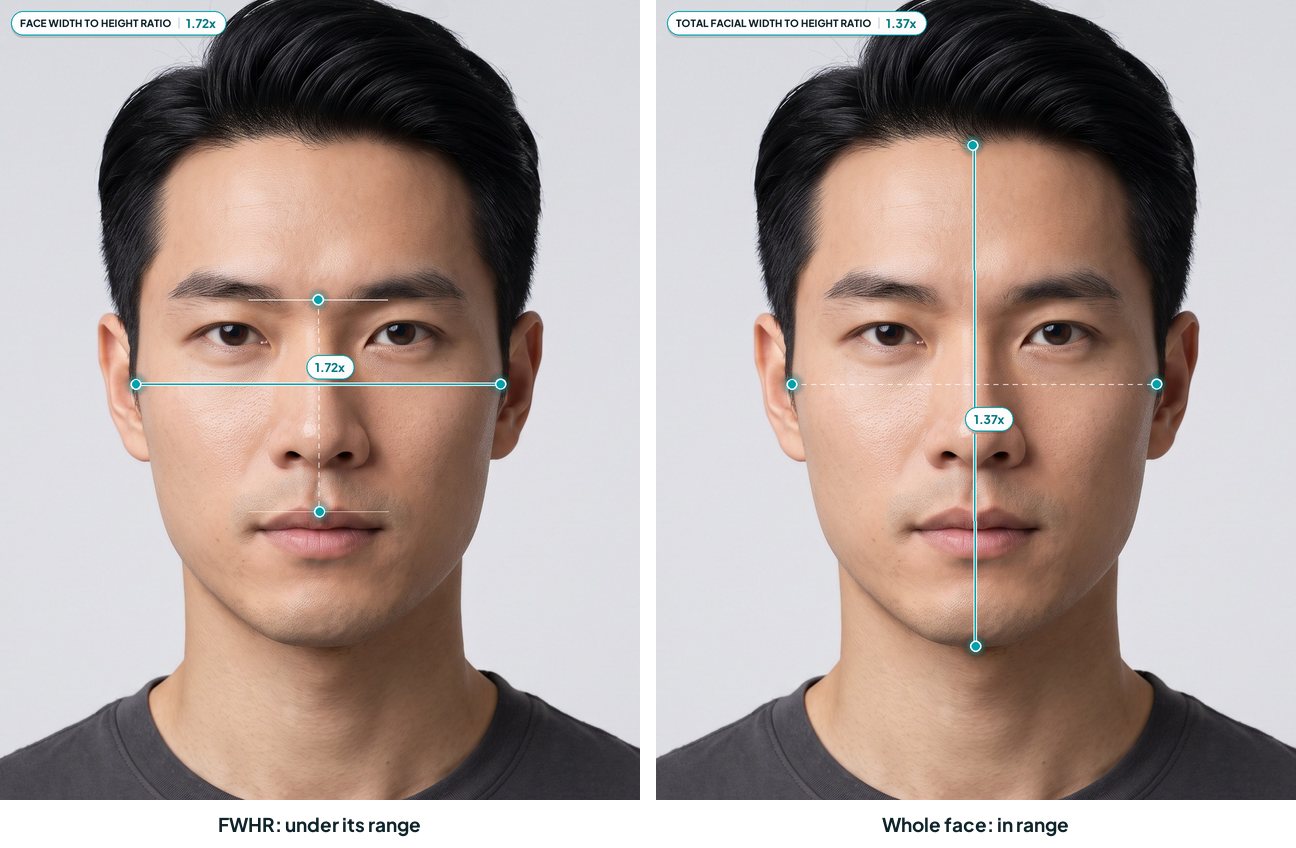
His cheeks aren’t why his FWHR is low. At 72.8% of his face height, his cheek width sits mid-pack among our four men, who run from 71.0 to 77.9%. The height is the difference: from brows to upper lip he measures 42.3% of his face height, where the other three measure 39.0 to 39.6%. Give him their 39% and his FWHR would read about 1.87.
So “my FWHR is low” and “my face is narrow” are different claims. FWHR is a width over a height, and the number alone won’t tell you which one is doing the work.
The man in our sample report is the mirror case.
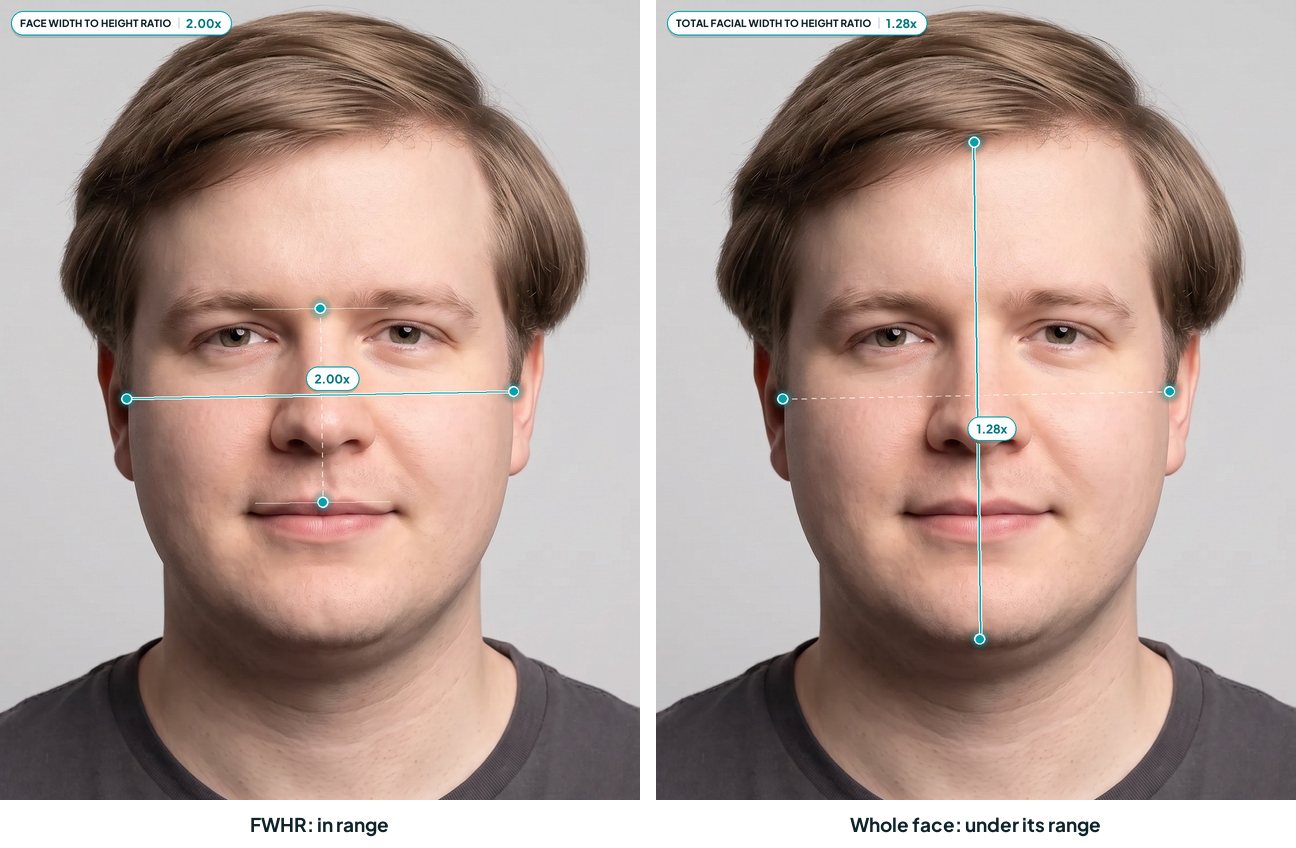
Here the width does the work. His cheeks span 77.9% of his face height, the widest of our four men. The width follows the skin outline, so fuller cheeks count. You can see both lines drawn on the sample report.
Research rarely uses this exact ratio, and the hairline is one reason. It recedes and it hides under hair: one large study couldn’t use a hairline-based measure for its older adults because some of the men’s hairlines had receded.4 If yours has receded, the whole-face number reads longer than your face is. FWHR doesn’t use the hairline at all. The chin can hide too, so under a full beard our report estimates the chin point.
Golden-ratio pages say this whole-face number should be 1.618. Our men’s range tops out at 1.37, a long way short, and our harmony guide tests the 1.618 claim.
One more width-for-height number gets mixed in: the midface ratio, pupil spacing over pupil-to-lip height. It’s a separate line in our report with its own range (0.97 to 1.00 for men, 1.04 to 1.07 for women), so keep it out of FWHR comparisons.
Ideal FWHR for men and women
Research has never settled on a best FWHR.15 Our report scores against a narrow window that shifts a little by sex and heritage:
| Ratio | Men | Women |
|---|---|---|
| FWHR | 1.96 to 2.00 | 1.94 to 1.98 |
| FWHR, East Asian heritage | 1.93 to 1.97 | 1.91 to 1.95 |
| Total (hairline to chin ÷ cheekbones) | 1.34 to 1.37 | 1.32 to 1.35 |
| Total, South Asian heritage | 1.33 to 1.36 | 1.31 to 1.34 |
Every other heritage you can pick on upload is scored on the first and third rows. We explain why we score FWHR at all after the research.
The FWHR window is only 0.04 wide, and going over it costs points the same way going under does. For a man, 1.90 and 2.06 both score 8.3 out of 10 on this line, and 1.76 and 2.20 both score 3.9, a focus area.
| FWHR (men) | What our report calls it |
|---|---|
| 1.96 to 2.00 | Ideal |
| 1.90 to 1.95, or 2.01 to 2.06 | Great |
| 1.84 to 1.89, or 2.07 to 2.12 | Good |
| 1.77 to 1.83, or 2.13 to 2.19 | Fair |
| 1.76 or under, or 2.20 or over | Focus area |
Women’s bands sit 0.02 lower, and East Asian heritage moves them 0.03 lower.
FWHR is also just one line out of 65+. Three of our four example men sit under their range, and all three have better overall scores than the one man inside his. A man at 1.85 still scores 6.6 on this line, which the report calls Good.
FWHR in men vs women
The two sexes barely differ. Our two ranges sit 0.02 apart, and research mostly finds a gap about as small,1 sometimes running backwards: in 17,607 passport photos, women’s ratios were the higher ones after age 48.6 The biggest study on this page found men ahead by 0.06 to 0.12, depending on the method,8 about what the lens swap in the opening did on its own.
Faces do differ by sex lower down. Measures that include the lower face separated men and women clearly in all four samples of one study, while FWHR didn’t.4 Much of the real difference between men’s and women’s faces sits there and in the profile, as our guide to what makes a face masculine shows. If you’re a woman and your ratio lands near or inside the men’s range, that’s ordinary. It says little about how feminine your face is.
Average FWHR, and why calculators give different numbers
The average depends on where the height starts. Studies that start at the brows average about 1.7 to 1.9, and one that starts at the top of the eyelids averages about 2.2.86 None of these is an ideal.
| Height measured from | Who | Men | Women |
|---|---|---|---|
| Midbrow to upper lip, by hand | 1,692 people8 | 1.83 | 1.73 |
| Midbrow to upper lip, by computer (same data set, looser photo rules) | 137,163 people8 | 1.87 | 1.81 |
| Brows to the peak of the upper lip | 904 students in China7 | 1.89 | 1.93 |
| Top of the eyelids to the upper lip | 17,607 passport photos6 | 2.18 | 2.19 |
The eyelids sit lower than the brows, so the height is shorter and the ratio bigger. If an app gave you 2.1 or more, check where it started the height: from the eyelids, 2.1 is a little under average.
Even the measurer matters. On the same photos of those 1,692 people, a computer read about 0.06 lower than the hand measure: 1.77 for men and 1.65 for women.8 The 137,163-person set let in smaller, lower-resolution photos, which may be why its computer averages run higher. Within any one study, about two-thirds of people sit within 0.14 to 0.18 of its average.86 Across methods, the averages run from 1.65 to 2.19, which is probably where the “1.6 to 2.2” you see quoted comes from.
The photo itself adds noise. Among Facebook photos measured by computer, two pictures of the same person gave only moderately similar numbers, and the highest-resolution pictures agreed best.8
Our report measures from the lower edge of the brows to the top of the upper lip, so compare your report number with our ranges and a study’s number with that study’s averages. A calculator that prints a bare number without showing where it put the points can’t tell you which of these scales you’re on.
How to measure your FWHR from a photo
One level front photo and any editor that shows pixel positions are enough to measure both ratios in a few minutes. You don’t need an FWHR calculator.
- Take a front photo with the rear camera from about 1.5 m (5 feet), zoomed to 2x so your face fills more of the frame, with the lens at eye level. Ask a friend, or prop the phone up and use the timer. A close selfie makes the face read narrower for its height and lowers the number.
- Keep your chin level and your face neutral: brows relaxed, mouth closed, no smile, eyes on the lens. Tuck your hair behind your ears so the edges of your cheeks show.
- Open the photo in that editor, or print it large, with your face at least 15 cm (6 inches) tall, and use a ruler. The units cancel out when you divide.
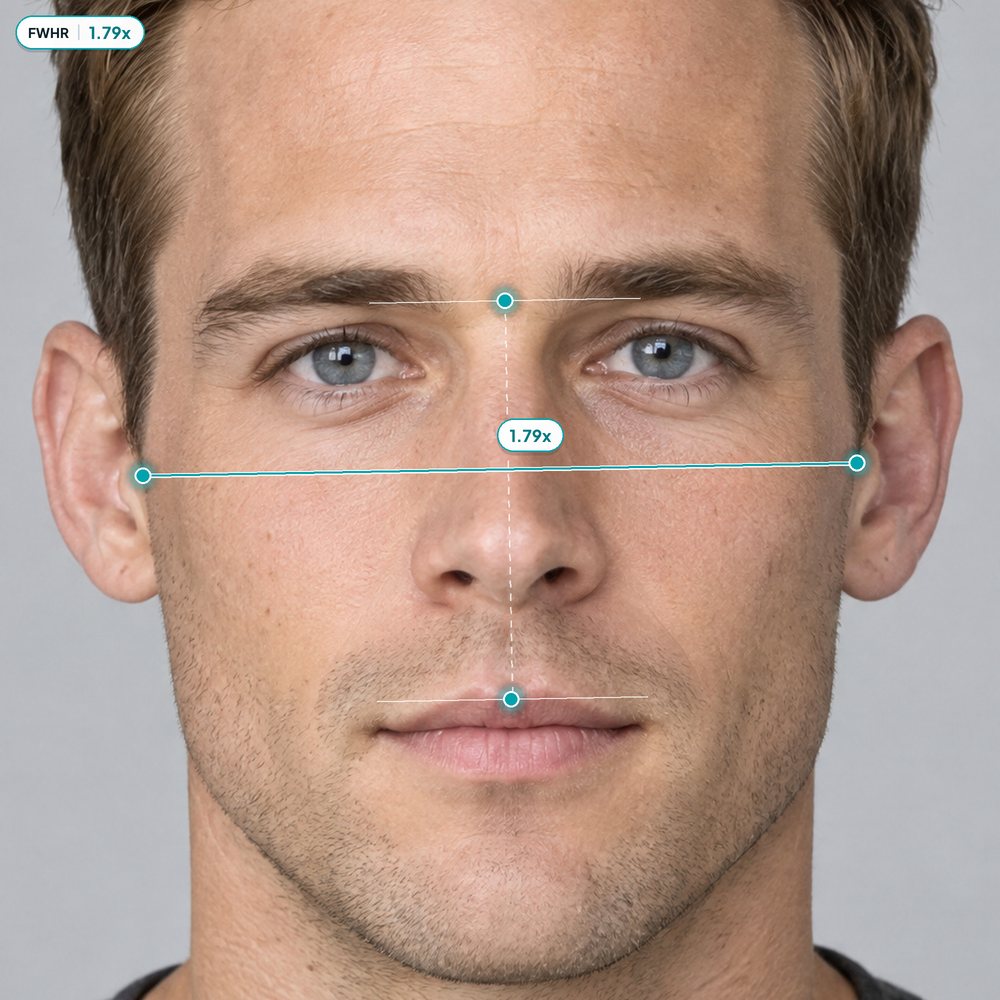
- Width: on each side, mark the widest point of your face at cheekbone level, usually a little below the eyes. Use the skin edge just in front of the ear, not hair or jaw. Measure straight across.
- Height: mark the lower edge of each eyebrow and take the level halfway between the two. Then mark the top of your upper lip at its center, the dip in the Cupid’s bow. Measure straight down between them.
- Divide width by height to get your FWHR. Our ideal is 1.96 to 2.00 for men and 1.94 to 1.98 for women, a little lower for East Asian heritage. For a man, anything from 1.90 to 2.06 still counts as Great.
- For the whole-face ratio, measure from the middle of your hairline, where dense hair starts, to the bottom of your chin. Divide by the same width: men 1.34 to 1.37, women 1.32 to 1.35. Then repeat everything on a second photo and average the two.
Be fussy in step 5. On a face about 19 cm from hairline to chin, 1 mm of brow-to-lip height moves FWHR by about 0.025, more than half the width of the 0.04 ideal window. That’s why step 7 asks for a second photo.
The steps follow how our analysis places the points, the four drawn on the 1.79 face in the first figure, so a hand measure uses the same scale as our ranges. Expect it to differ from our report by a few hundredths, more if a point slips.
Is a high FWHR attractive? What the research found
Not on average. A 2015 review that pooled the lab studies found that a higher ratio buys a tougher, more masculine first impression, mostly in men’s faces, and little else.1 A later study with 11,481 raters in 44 countries found even the tougher look unreliable for men’s faces: nothing in its main, preregistered test, and only a link with looking meaner and more aggressive in a follow-up on more faces.5
In a 2008 study, hockey players with wider faces spent more time in the penalty box: clearly in one university team of 21 players, more weakly across 112 professionals.9 Much of FWHR’s reputation rests on studies of that size. Here’s what happened when bigger ones checked the main claims.
| Claim | What larger studies found | Our read |
|---|---|---|
| “A wide face is more attractive” | In the 2015 review, higher-ratio faces were rated slightly less attractive (r = -.26), more so when women rated.1 In 44 countries, men’s FWHR didn’t predict it.5 | No bonus for wider |
| “It makes you look masculine and dominant, but less trustworthy” | In the 2015 review, rated more threatening (r = .46, untrustworthy included), more masculine (r = .35) and somewhat more dominant (r = .20), mostly in men’s faces.1 In the 44-country study, men’s ratio predicted none of 13 ratings in the main test, trust included, and only looking meaner and more aggressive in a follow-up.5 | A lab tendency at most |
| “It shows high testosterone” | No significant positive link with adult testosterone in 7 samples of men, 780 in all.2 One small re-analysis (ages 8 to 22) found a modest link after adjusting for age (r = .25).11 | Not a hormone test |
| “It predicts aggression or personality” | No meaningful link across 55 personality scales in 137,163 people.8 The link with men’s aggressive or selfish behavior was small (r = .16), and small studies may inflate it.1 | Weakly for aggression, not personality |
The r in the table runs from 0 (no link) to 1 (a perfect one). Around .2 is weak, around .5 moderate, and a minus sign means the link runs the other way.
One study does find an edge for wider faces. At speed-dating events, men with higher ratios were picked more often for a second date and rated more attractive for short-term, but not long-term, relationships.10 That’s one set of speed daters against the much larger studies in the table. If you want to look better, it’s the wrong number to chase.
Our own four men point the same way.
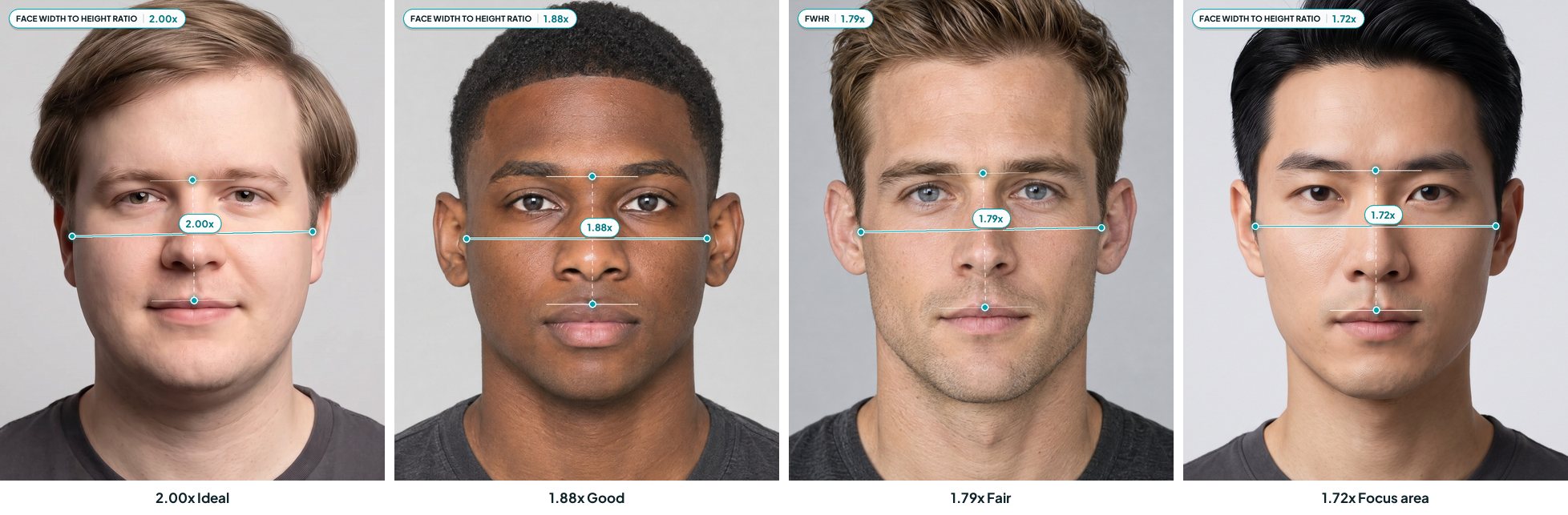
Each of those scores rests on dozens of other lines, so four men settle nothing. But forums sell a high FWHR as the masculine face, and the one man here inside his range, from our sample report, has the lowest Masculinity score of the four: 5.1 out of 10.
So why does our report score it at all? Because it’s a proportion, and Harmony scores how your proportions fit together: FWHR is 1 of 33 front-photo measurements there, alongside your eye spacing and the whole-face ratio. It feeds no other pillar. Your Masculinity or Femininity score comes from 10 visual ratings of your front and side photos, so FWHR isn’t one of its inputs. More on how that score is built.
Can you improve your FWHR?
No exercise or routine moves your cheekbones. What you can change is the number a photo gives you, and how wide your face looks, which is what other people actually see.
Start with a true reading, using the photo rules from the self-check, and keep your brows relaxed. Raise them and their lower edge lifts: on the man in the header photo, 3 mm more brow-to-lip height would take him from 1.88 (Good) to 1.81 (Fair). Plucking hair from under the brows lifts that edge the same way and lowers the reading. In both cases the face stays the same and only the number moves. Keep your chin level as well, because our engine levels the eyes but can’t undo a nod. The same rules apply to the photos you upload to us.
People who weigh more tend to have higher FWHRs: in all four samples of one study, a higher body mass index went with a higher ratio,4 most likely because fuller cheeks measure wider. So a high reading can just mean fuller cheeks, and nobody should put on weight to chase the number. FWHR also tends to be lower in older people, yet people measured 11 years apart kept fairly stable ratios.6
There’s no evidence that mewing or masseter training changes it, and the width is taken at the cheekbones, above where a bigger jaw muscle mostly adds width, near the jaw corners.
Hair does most of the work on how wide your face reads. Let the whole-face ratio, not FWHR, decide your cut.
If your whole-face number is under its range, your outline is broad and short, like the sample-report man’s 1.28. His plan says: “Style a little more height at the top and less volume at the sides. Take a comparison photo before committing to a cut.” Above the range, a longer face wants the reverse: a little more volume at the sides and less height on top (more in how to glow up). On the man at 1.72, the whole face sits at the top of its range and scores Ideal, so there’s nothing to fix. His low FWHR comes from a long brow-to-lip span, which is mostly bone, and his plan leaves it alone.
With a beard, fuller sides widen the lower outline and length at the chin lengthens it. For women, length and parting do the same job: a center part and length past the jaw draw a broad outline longer, while curtain bangs or volume at cheekbone level widen a long one. Contour can make the cheeks read narrower or wider.
Before any change, take a baseline photo. Then change one thing at a time and retake it the same way: same distance, same light, brows relaxed. Your ratios won’t move as long as your hairline and cheek edges stay visible, so judge the change on the side-by-side.
Questions people ask
What is FWHR?
FWHR, the facial width to height ratio, is the width of your face across the cheekbones divided by the height from your brows to your upper lip. Studies that measure it this way find adults average about 1.7 to 1.9. It's a different number from the whole-face ratio, which runs from hairline to chin and, in our report, divides height by width, so the two can disagree on the same face.
What is a good or ideal FWHR for men?
Research has no agreed ideal. On our report's scale, a man's FWHR scores Ideal from 1.96 to 2.00 and Great anywhere from 1.90 to 2.06. For women each number is 0.02 lower, and for East Asian heritage 0.03 lower. Higher isn't better: at 2.20 the line becomes a focus area. Studies that start the height at the brows average about 1.7 to 1.9, so a number there is ordinary on their scales, but don't compare it directly with ours.
What is the average FWHR?
Somewhere from about 1.7 to 2.2, depending on where the height is measured from. Measured by hand from the middle of the brows to the upper lip in 1,692 people, men averaged 1.83 and women 1.73. Measured from the top of the eyelids in 17,607 passport photos, both sexes averaged about 2.18. A lower start point shortens the height and raises the ratio, so compare your number only with averages measured the same way.
How do you calculate FWHR from a photo?
Take a level front photo from about 1.5 m with the lens at eye level, your face neutral and your hair off your cheeks. Measure the width across the widest points of your cheeks at the skin edge. Measure the height from the lower edge of your brows down to the top of your upper lip at its center. Divide width by height, and pixels work fine. Average two photos, and skip close selfies, which read lower.
Is a high FWHR attractive?
On average, no. A 2015 review of the lab studies found that faces with a higher ratio were rated slightly less attractive, and in other studies it pooled, more threatening and, for men, more masculine. With raters in 44 countries, men's FWHR did not reliably predict how attractive they looked, and women with higher ratios were rated slightly less attractive. One speed-dating study found higher-ratio men were picked more often for a second date and rated more attractive for short-term, but not long-term, relationships.
Is FWHR different for men and women?
Only slightly, and sometimes the other way round. A pooled analysis of 32 samples found a tiny gap. Among 17,607 Australian passport photos, men's ratios came out higher only between about 27 and 40, and women's were higher after 48. A study of Chinese students found women a little higher. Our own ranges for the two sexes sit 0.02 apart. Measures that include the lower face separate the sexes far more clearly.
Does FWHR say anything about testosterone or personality?
Very little in adults. Across 7 samples, 780 men in all, FWHR had no significant positive link with resting testosterone or with the rise in testosterone after competing. One small re-analysis of boys and young men aged 8 to 22 found a modest link once age was accounted for, so a role during puberty is still open. Personality fares no better: in 137,163 people, FWHR didn't meaningfully predict any of 55 scales of personality and behavior.
Can you increase your FWHR?
Not the bone. Your cheekbones are set, but the measured number moves with camera distance, head angle and raised brows, and it tends to be higher in people who weigh more, which is no reason to gain any. There's no evidence that mewing or jaw training changes it, and the width is taken at the cheekbones anyway. Hair and a beard change how wide your face looks, which is the part most people notice.
Sources
-
Geniole SN, Denson TF, Dixson BJ, Carré JM, McCormick CM. Evidence from meta-analyses of the facial width-to-height ratio as an evolved cue of threat. PLoS One. 2015;10(7):e0132726. doi:10.1371/journal.pone.0132726. Full text on PMC ↩↩↩↩↩↩↩↩
-
Bird BM, Cid Jofré VS, Geniole SN, Welker KM, Zilioli S, Maestripieri D, Arnocky S, Carré JM. Does the facial width-to-height ratio map onto variability in men’s testosterone concentrations? Evol Hum Behav. 2016;37(5):392-398. doi:10.1016/j.evolhumbehav.2016.03.004. Record on the University of Chile repository ↩↩
-
Třebický V, Fialová J, Kleisner K, Havlíček J. Focal length affects depicted shape and perception of facial images. PLoS One. 2016;11(2):e0149313. doi:10.1371/journal.pone.0149313. Full text on PMC ↩
-
Lefevre CE, Lewis GJ, Bates TC, Dzhelyova M, Coetzee V, Deary IJ, Perrett DI. No evidence for sexual dimorphism of facial width-to-height ratio in four large adult samples. Evol Hum Behav. 2012;33(6):623-627. doi:10.1016/j.evolhumbehav.2012.03.002. Accepted manuscript on the University of Pretoria repository ↩↩↩
-
Durkee PK, Ayers JD. Is facial width-to-height ratio reliably associated with social inferences? Evol Hum Behav. 2021;42(6):583-592. doi:10.1016/j.evolhumbehav.2021.06.003. Preprint on PsyArXiv ↩↩↩↩
-
Summersby S, Harris B, Denson TF, White D. Tracking sexual dimorphism of facial width-to-height ratio across the lifespan: implications for perceived aggressiveness. R Soc Open Sci. 2022;9(5):211500. doi:10.1098/rsos.211500. Full text on PMC ↩↩↩↩↩↩
-
Lv H, Wang T, Zhang J, Liu Z, Dong J, Xie H, Yang Y, Xue P, Che Y, Han P. Analysis of personality traits’ correlation to facial width-to-height ratio (fWHR) and mandibular line angle based on 16 personality factor in Chinese college students. PLoS One. 2022;17(12):e0278201. doi:10.1371/journal.pone.0278201. Full text on PMC ↩
-
Kosinski M. Facial width-to-height ratio does not predict self-reported behavioral tendencies. Psychol Sci. 2017;28(11):1675-1682. doi:10.1177/0956797617716929. Full text on arXiv ↩↩↩↩↩↩↩↩
-
Carré JM, McCormick CM. In your face: facial metrics predict aggressive behaviour in the laboratory and in varsity and professional hockey players. Proc Biol Sci. 2008;275(1651):2651-2656. doi:10.1098/rspb.2008.0873. Full text on PMC ↩
-
Valentine KA, Li NP, Penke L, Perrett DI. Judging a man by the width of his face: the role of facial ratios and dominance in mate choice at speed-dating events. Psychol Sci. 2014;25(3):806-811. doi:10.1177/0956797613511823. Abstract on PubMed ↩
-
Welker KM, Bird BM, Arnocky S. Commentary: Facial width-to-height ratio (fWHR) is not associated with adolescent testosterone levels. Front Psychol. 2016;7:1745. doi:10.3389/fpsyg.2016.01745. Full text on PMC ↩
Spotted a mistake? Email support@faceratinglab.com and we will fix it.