Masculine face: the features that make one, and how much is too much
A masculine face has a brow that juts forward over the top of the nose, a long lower face with a tall chin, and a wide jaw. People spot one easily, but more isn't always better: in a 2017 study, hypermasculine versions of men's faces rated near the bottom, with the very feminine ones.
The short version
- Men's faces are about 7% larger than women's, and the biggest shape differences sit in the brow, jaw, nose and cheeks.
- In our ranges the clearest men-vs-women gaps sit in the profile, the lower face and the neck. Face width to height ratio, the forum favorite, has men's and women's ranges just 0.02 apart.
- A side-by-side test exaggerates how much face shape matters: people picked the masculinized face as more masculine 86% of the time, but with real faces rated one at a time the effect was about a fifth as large.
- More masculine is not always more attractive. When 224 women rated men's faces at seven levels, ratings peaked on the masculine side of average and fell after that, and across 10 countries measured masculinity had no clear link with men's attractiveness.
- Bone-led ratings (jaw, brow ridge, face shape) carry 55 of the 99 points in our Masculinity score. In a study of 37 men photographed with and without beards, the beard moved masculinity ratings more than jaw shape did. Brows, hair, body fat and photo distance are the other levers you control.
Put two versions of one man’s face side by side, one with its shape pushed further in the male direction and one in the female direction, and people call the first more masculine about 86% of the time.1 Ask which one they like better and the answer changes. In the classic 1998 study, people who could slide a man’s face from feminine to masculine stopped on the soft side of average.2
So a masculine face is easy to spot, and it is not automatically the one people like. Try it on three faces our engine measured. Which man looks the most masculine to you?
If you picked the man on the left, our ratings agree: he has the deepest step and the highest Masculinity score of the three, 7.25 (he is also the face in the header). The man on the right has the softest step, still inside the range set for his heritage. He also has the best overall score, 7.12 to the left man’s 7.04.
The rest of this page is about that gap: which features make a face read male, and where more of them stops helping. There is a two-photo check for your own face halfway down.
What makes a face masculine
Masculine facial features are mostly a matter of size, plus four areas that change shape: a brow that juts forward under a flatter forehead, a bigger nose, a longer lower face with a taller chin, and a wider jaw with a sharper corner. A 2022 study that scanned 1,573 adults in 3D found men’s faces were 7.3% larger on average, with the biggest shape differences in the brow, jaw, nose and cheeks, where women’s sit fuller at the front.3 Much of the difference is thought to come from sex hormones during development, and some may simply come with men’s larger bodies.6
Masculine vs feminine face, feature by feature
| Feature | Reads more masculine | Reads more feminine | Our measurement: men / women |
|---|---|---|---|
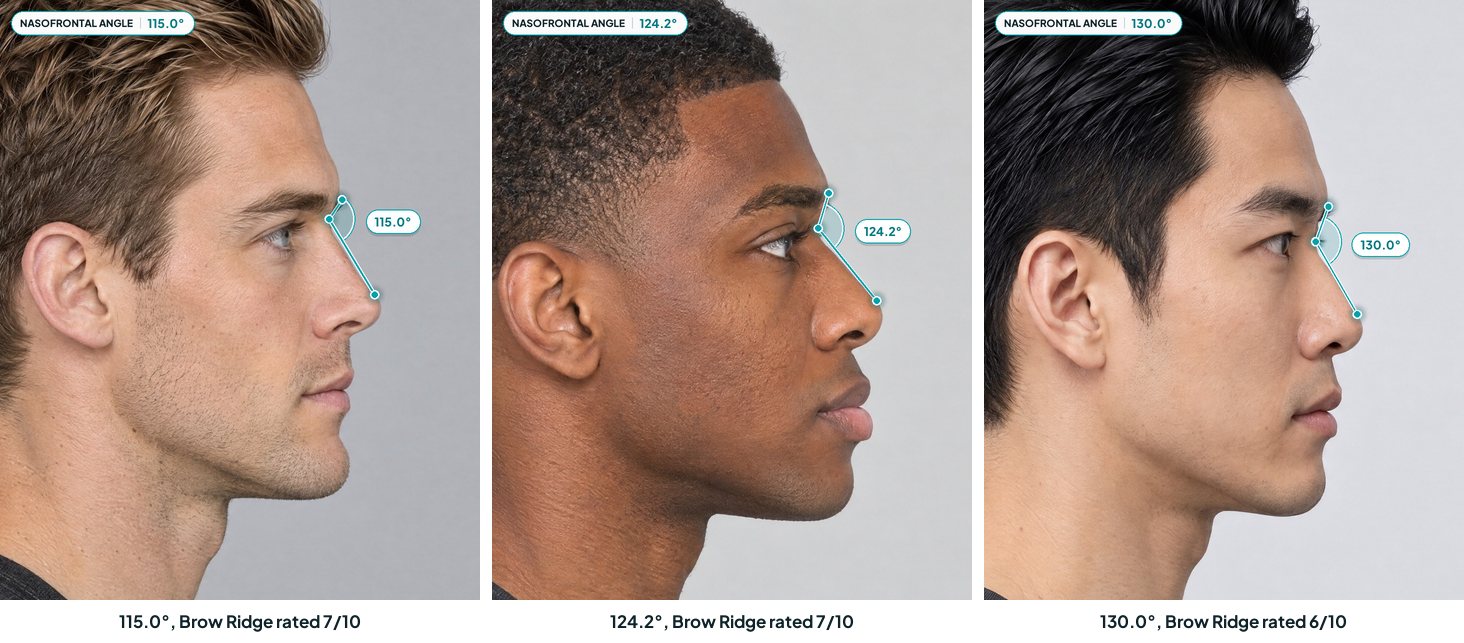
| Brow and forehead | Brow projects forward, forehead flatter above it | Smoother brow, more curved forehead | Brow-to-nose angle 116 to 128° / 139 to 151°; upper forehead slope 0 to 2° / 7 to 9° |
| Eyebrows | Thicker; lower and flatter in our ranges | Higher, more arched | Brow tilt 6.5 to 11° / 10.5 to 15° |
| Nose | Larger, base about 8% wider, tip less upturned | Smaller, tip more upturned | Nose tip rotation 11.5 to 21.5° / 20.5 to 30.5° |
| Mouth | Groove above the lip about 15% longer, lip height about the same; in our ranges, a wider mouth for the eye spacing | Shorter groove; a narrower mouth for the eye spacing | Mouth width vs pupil spacing 0.83 to 0.87 / 0.75 to 0.79 |
| Lower face and chin | Longer lower third, chin about 11% taller | Shorter lower face | Lower third 33.9 to 37% / 30 to 33.1% |
| Jaw | Wider, projects further out and down, sharper corner | Narrower, softer corner | Jaw width 87.5 to 91.5% / 84 to 88% of cheekbone width; jaw angle 115 to 121° / 118 to 124° |
| Neck | Wider | Narrower | Neck width 92 to 98% / 74 to 80% of jaw width |
| Face width for its height (FWHR) | Barely different | Barely different | 1.96 to 2.00 / 1.94 to 1.98 |
The percentages in the middle columns come from the 3D scans.3 Our ranges shift a little with heritage, so a value just outside one here can still sit inside your own.
People weigh the main features almost equally. A 2018 test changed five features at once and split 100 points of importance for how masculine a face looked between them: face length and brow thickness got about 21 each, the jaw 20, eye size 19 and cheekbones 18.4 The feature lists that lead with “men have smaller eyes” are leading with one of the two weakest cues, if only by two points.
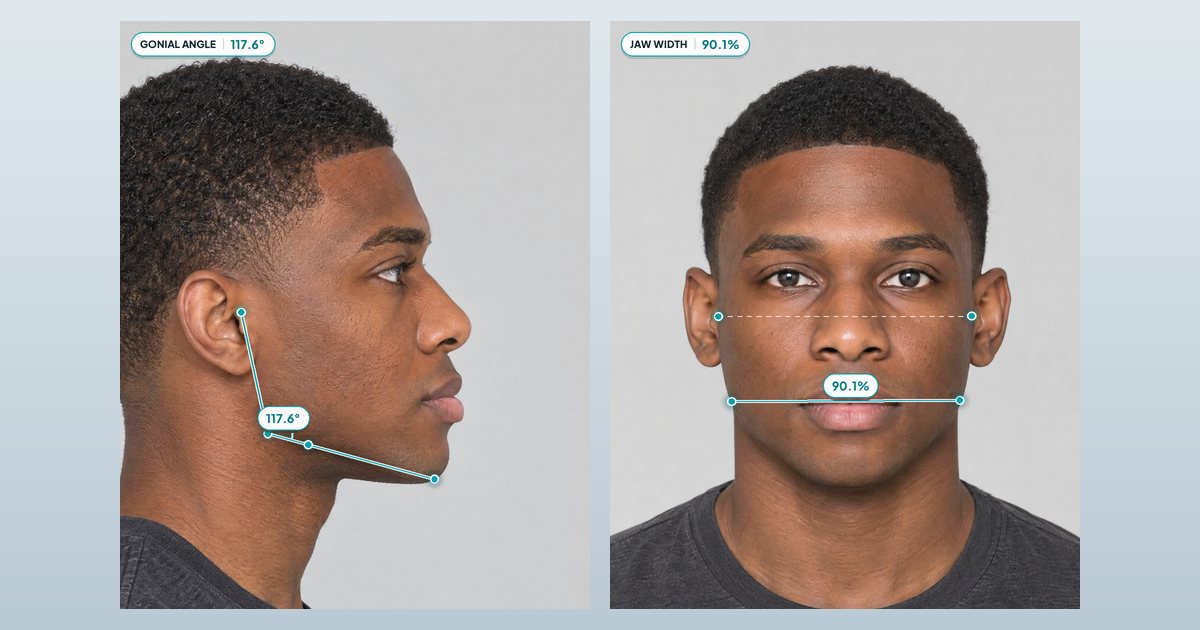
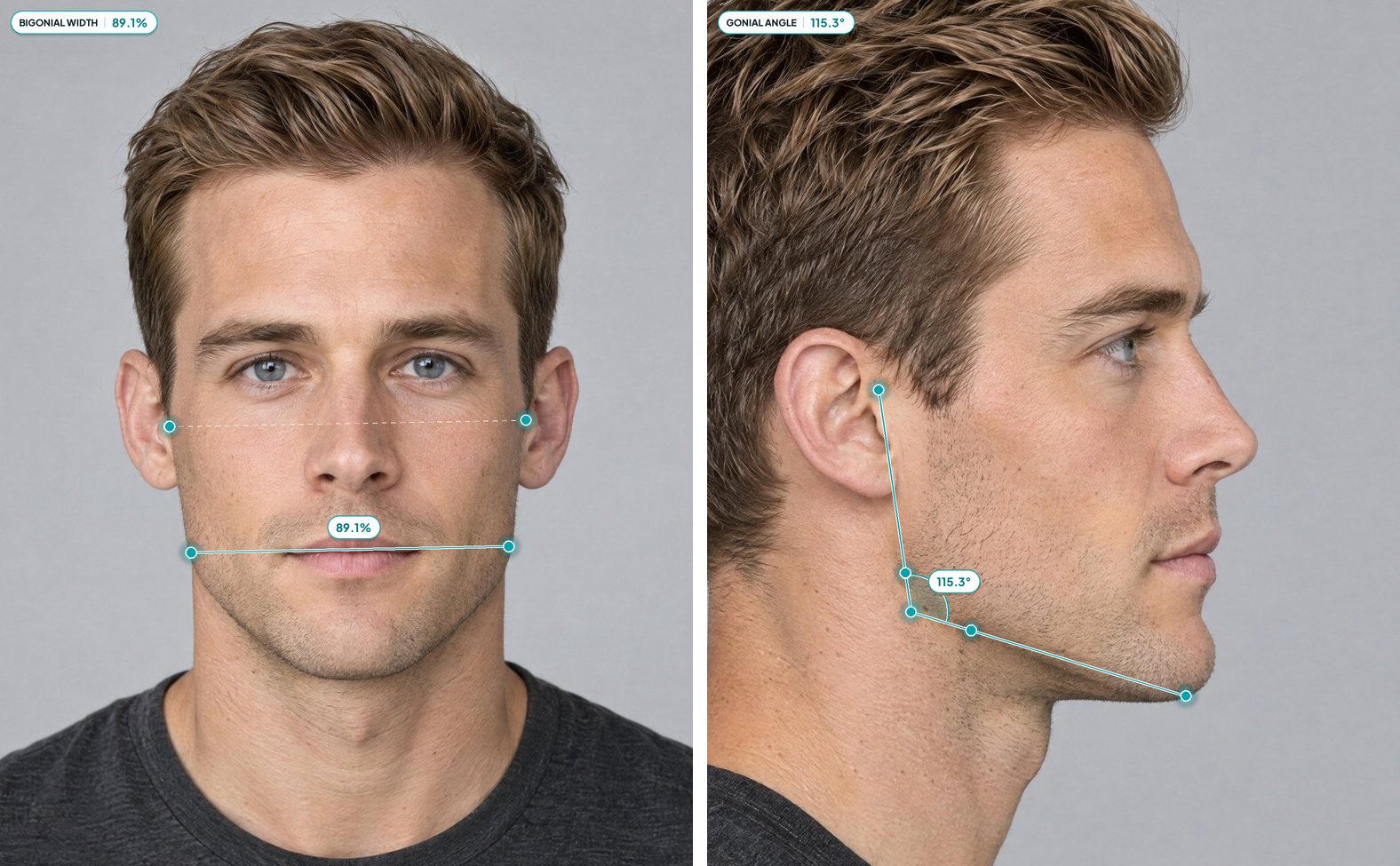
A masculine jaw comes down to two numbers. Jaw width (bigonial width) is taken straight across the jaw corners and compared with cheekbone width, not measured at the chin. The corner itself is the gonial angle, read in profile.
No single row makes a face male. A masculine nose is larger, with a tip that turns up less, yet our most masculine-rated man has a nose tip turned up 33.4 degrees, past the top of even the women’s range, and his Nose rating is still 7 of 10.
How far forward the chin sits isn’t on the list either. Our report scores it against one range for men and women alike, 1.5 to 15 mm in front of a line dropped from the top of the nose, so a chin set back from that line counts the same against a man as against a woman.
Some of those feature lists add the Adam’s apple, which our photos don’t measure. Neck width they do measure, and it is one of the widest men-vs-women gaps we score.
What is the most masculine face shape?
Face-shape charts usually call it square, but the outline matters less than three lines underneath it: a jaw that stays almost as wide as the cheekbones (87.5 to 91.5% in our men’s range), a long lower third (33.9 to 37% of face height) and a flat forehead above a forward brow (0 to 2 degrees of slope). The most masculine face shape has all three at once.
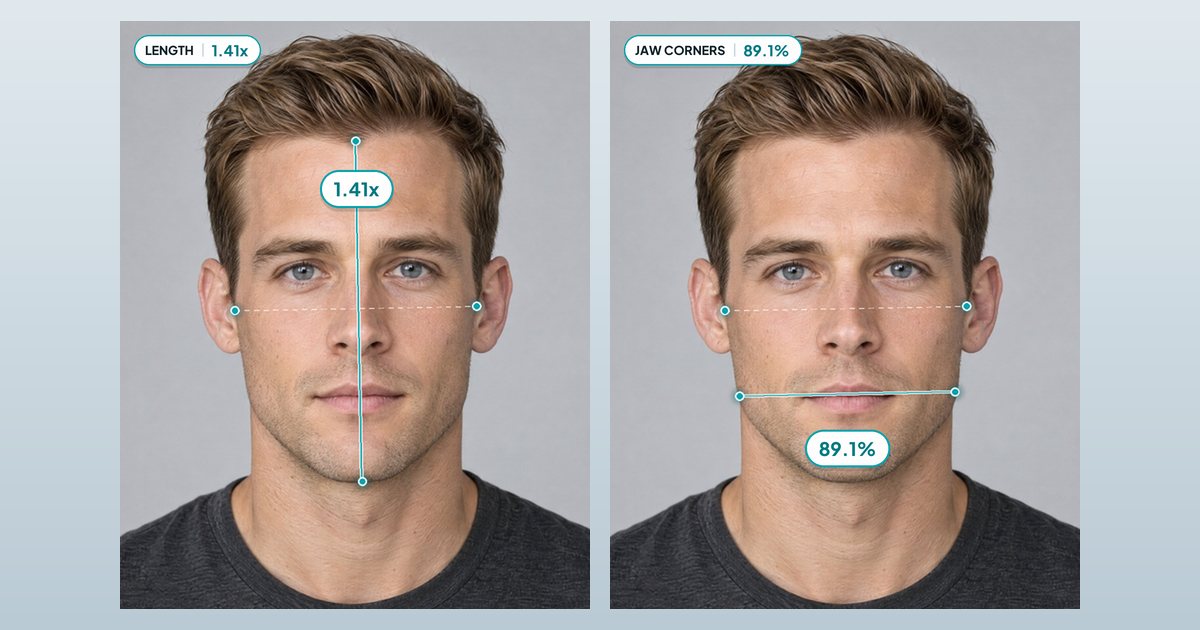
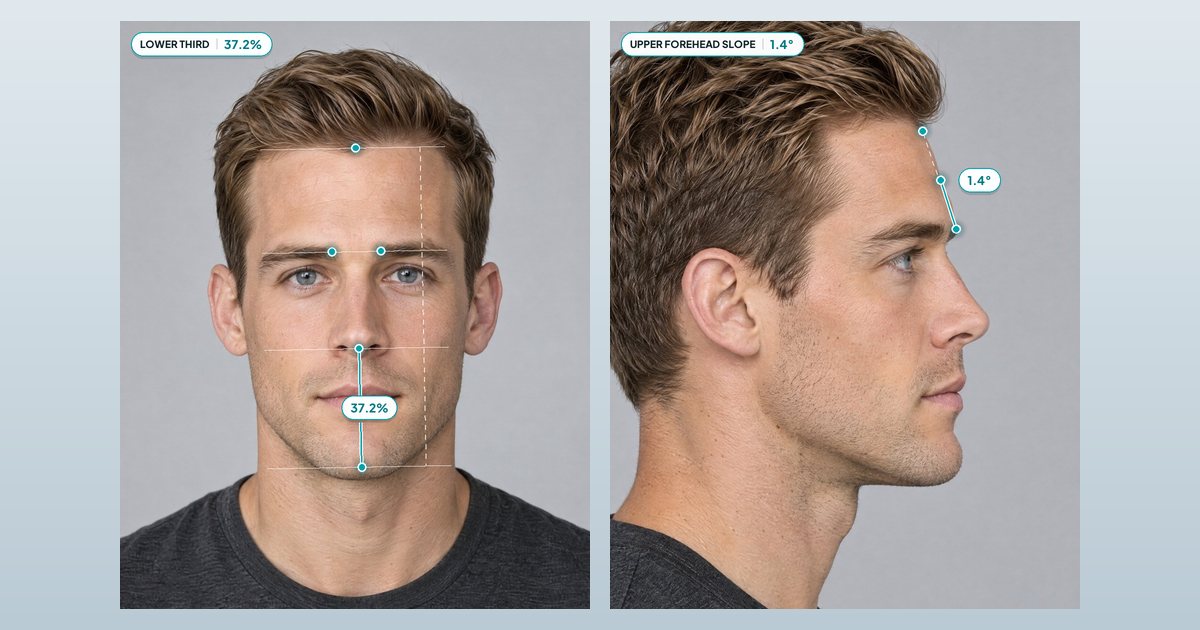
The face we rate most masculine of our three, the man from our sample report, has all three: a jaw at 89.1% of cheekbone width, a lower third of 37.2% and a forehead that curves just 1.4 degrees above the brow. Width alone doesn’t do it, because face width for its height barely separates men’s faces from women’s.5
What is facial dimorphism?
Facial dimorphism, or sexual dimorphism in the face, is the average difference between men’s and women’s faces; a dimorphic face shows it strongly. Our report builds it into its ranges: 50 of our 66 measurements have one range for men and another for women, and in 9 the two don’t even touch. Four of those 9 you can picture: the upper forehead slope, the brow-to-nose angle, the lower third and neck width.
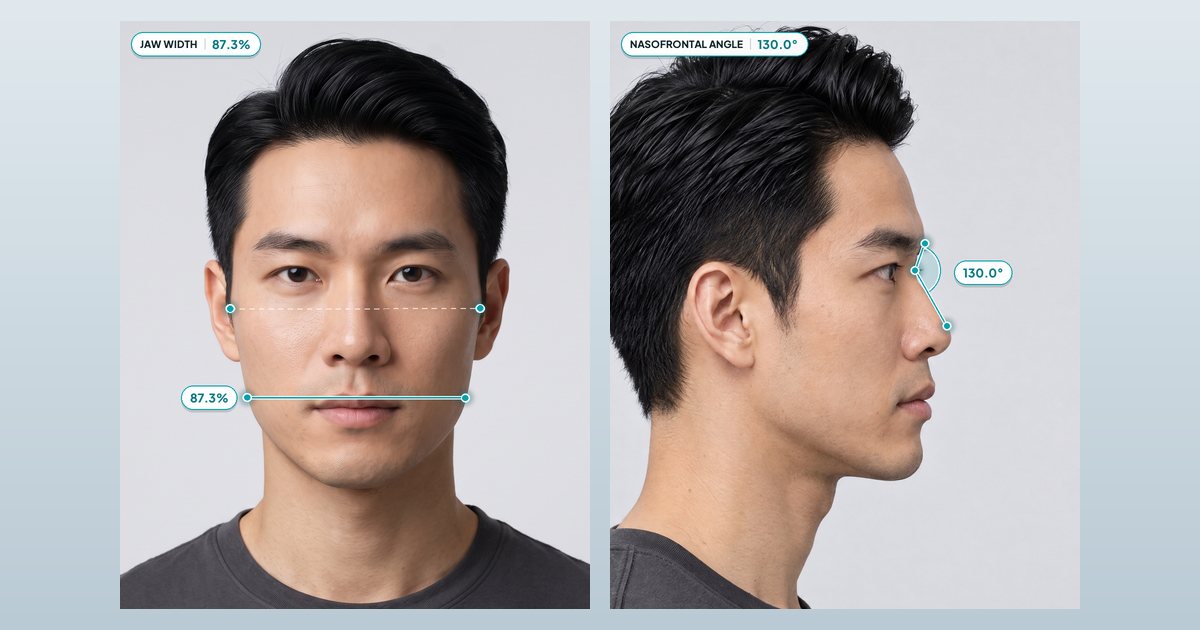
The biggest gaps sit in the profile, the lower face and the neck, and you have already seen three of them. The three profiles near the top show the brow-to-nose angle, where the men’s and women’s ranges sit 11 degrees apart. The header shows the lower third and the upper forehead slope. The famous marker, face width, barely moves.
To show how far apart the two sets sit, we scored the man from our sample report (left in the three-man pictures) on both.
| Line | His value | Score on the men’s range | Score on the women’s range |
|---|---|---|---|
| Lower third | 37.2% | 9.98 | 2.37 |
| Brow-to-nose angle | 115.0° | 9.87 | 1.10 |
| Upper forehead slope | 1.4° | 10.00 | 4.05 |
| Jaw width | 89.1% | 10.00 | 9.63 |
| FWHR | 1.79 | 4.78 | 5.36 |
Scores are out of 10, from the curves our report uses. Switch him to the women’s ranges and three lines collapse: the lower third, the brow-to-nose angle and the forehead slope. His jaw width barely notices, and his FWHR scores a little better as a woman’s.
Masculine, as people see it, isn’t quite the same as male. In a small 2015 study, the faces women called masculine were wider, with eyes set further apart, a broader nose, thinner lips and a bigger lower face. That pattern only partly matched the real difference between men’s and women’s faces, and bigger faces were rated more masculine too.6 Take size out of the 3D scans and sex explained only 6% of face shape.3 Much of what reads as masculine is a bigger face with a bigger lower half.
Why face width (FWHR) says little
Face width to height ratio is the number forums treat as the masculinity score, yet it barely differs between the sexes. Pooled across 10,853 people, the men-vs-women gap in FWHR was about a twentieth of the gap in face size from the 3D scans, compared on the same standardized scale.53 Studies measure it slightly differently from our cheekbones-over-brow-to-lip version, so don’t compare their numbers with ours.
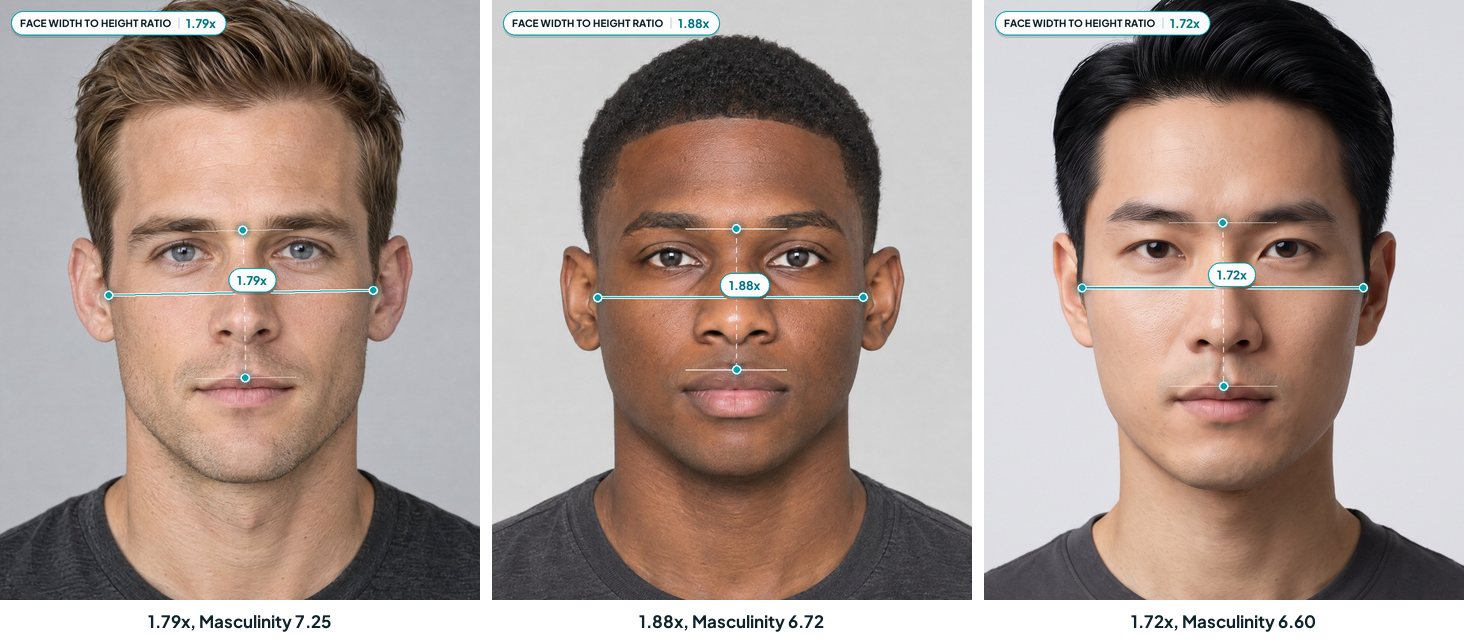
Three faces prove nothing, but if width were the masculinity number forums say it is, the middle man would top our Masculinity scores. He comes second. The man on the left has a lower ratio and comes first, mostly on his Jaw and Face Shape ratings (8 against 7 on each).
How masculine is my face? Check it with two photos
Four lines in the table can be measured from two phone photos. The brow-to-nose angle and the lower third have the widest gaps, so they tell you the most.
- Take a front and a side photo with the rear camera from about 1.5 m (5 feet); ask a friend or use the timer. A phone about 30 cm (1 foot) away makes the nose look about 30% wider relative to the face; from 1.5 m the difference all but disappears.7
- Keep your head level and your face neutral: mouth closed, jaw and brows relaxed (clenching widens the jaw, raised brows stretch the face), hair off your forehead so the hairline shows.
- Front photo, lower third (drawn in the header image): mark your hairline, the base of your nose and the bottom of your chin. Divide the nose-to-chin height by the hairline-to-chin height and multiply by 100. Men 33.9 to 37% (33.5 to 36.6 for East Asian heritage), women 30 to 33.1%. If your hairline sits high or has moved back, this number comes out low whatever your lower face looks like, so lean on the other three.
- Front photo, jaw width: measure across your jaw corners, which sit about level with your mouth (as in the jaw image above), and across the widest part of your face, at the cheekbones just in front of your ears. Divide jaw by cheekbones and multiply by 100. Men 87.5 to 91.5%, women 84 to 88%.
- Front photo, brow tilt: draw a line from the inner end of each brow to the top of its arch, read its angle against level with a protractor app, and average the two sides. Men 6.5 to 11 degrees, women 10.5 to 15.
- Side photo, brow-to-nose angle (as in the three profiles at the top): put dots on the most forward point of your brow between the eyebrows, the deepest point at the top of your nose and just above the nose tip, then measure the angle at the middle dot. Men 116 to 128 degrees (120.2 to 132.2 for East Asian heritage), women 139 to 151.
Then read the four together. Three or four in one column is a clear read. A mix is normal. A value where the ranges overlap (jaw width of 87.5 to 88%, brow tilt of 10.5 to 11 degrees) counts for both, and one in the gap between them (a brow-to-nose angle around 135 degrees, say) reads in between. And these are ideal ranges, not averages, so landing just past one is common.
If you’re a man and most of yours land in the women’s column, your face reads on the softer side, and that isn’t a verdict: remember the man on the right in the opening pictures. The same goes for a woman whose lines land in the men’s column; her report still scores her against the women’s ranges.
Expect a phone photo to be off by a degree or two, or a percentage point, so treat a value at a range edge as a tie. The Masculinity score itself is 10 visual ratings of the whole face, which no ruler gives you. Our report places the points for you and draws every line on your photo, so you can check where each point goes.
Are masculine faces more attractive?
Up to a point. In the study with the widest spread, the most masculine versions were rated below more moderate ones, and in real faces, how masculine a man’s face measured had no clear link with how attractive he was rated.
In the 1998 study from the opening, raters in the UK and Japan preferred feminized male faces to average or masculinized ones. Masculinizing a face made it look more dominant but also colder and less honest.2 Some later studies with similar morphs found a mild pull the other way.11
A 2017 study went wider: 224 women rated men’s faces at seven levels, from very feminine to hypermasculine. Ratings climbed, then fell. Both ends were rated lowest. The favorite sat on the masculine side of average, well short of the extreme. The authors note their scale ran further toward masculine, which may have pushed that peak up.8
Real, unedited faces tell a flatter story, for spotting masculinity as well as liking it. When the 2023 team behind the opening’s 86% had people rate real faces one at a time, face shape moved masculinity judgments about a fifth as much.1 A 2024 study measured 1,550 faces from 10 countries, each rated by people from the same country. A more masculine face shape made no clear difference to men’s ratings. Faces close to their population’s average shape did better in both sexes.9
Taste shifts with place, too. Across 12 populations, women in only 3 clearly preferred the masculinized face. The rest leaned neutral or feminine, or it depended on the kind of relationship. Every group linked masculine faces with aggression.10
Face width gets the same reading. Pooled across studies, wider faces were judged more threatening, more masculine, a little more dominant and somewhat less attractive, especially by women.5 Width feeds the impression of masculinity, then, even though it barely separates men’s faces from women’s.
The popular story that women’s tastes swing toward masculine faces around ovulation didn’t hold up in the largest test of it. In 584 women tested weekly, preferences didn’t track hormone levels, though on average they mildly preferred the masculinized faces.11
Most of this research used computer-morphed faces rated by White, Western volunteers, so treat the exact numbers as rough. The 10-country study used real faces and raters from each country; the 12-population study kept the morphs but went far beyond the West.
Our read: a face on the masculine side of average does well, and past that, extra masculinity buys a harder, more dominant look much more than it buys liking. Masculinity is also one pillar of four in our score, and one number never decides how attractive someone is.
Hyper masculine faces and how much is too much
A hyper masculine face goes past the masculine end of the men’s ranges on several lines at once. Our measurement scores treat too much like too little. Every line has an ideal range, and a value beyond its masculine end loses points about as fast as one beyond its soft end. A jaw corner of 105 degrees, 10 sharper than the men’s range, scores 3.9 out of 10; a soft 130-degree corner, 9 past the other end, scores 4.6. A jaw as wide as the cheekbones scores 3.8. So a hyper masculine face loses points on exactly the lines that make it hyper masculine.
The jaw research is mixed. Enlarging the lower face and jaw made clean-shaven faces look more masculine and dominant, and more attractive too. Yet the best-rated combination of all was a beard on a smaller jaw. The authors suggest a beard plus a big jaw can tip into looking too dominant.12
Our own Masculinity pillar, built from visual ratings rather than these measurements, has no peak in the middle: the more masculine the ratings, the higher it goes. The balance shows up in Harmony and in the overall score, which is built so the weakest of the four pillars pulls hardest. The man on the right has the lowest Masculinity of our three (6.60), the best Harmony (7.25) and the top overall score, 7.12. We unpack why the softest of our three faces comes out on top in our guide to what makes a man handsome.
How a facial masculinity score is built
Your Masculinity score is 10 visual ratings from your front and side photos, each from 0 to 10 (10 = very masculine), weighted out of 99 points. It doesn’t use the measurements at all. A man’s report calls it Masculinity; a woman’s calls it Femininity.
| Rating | Points of 99 | Left | Middle | Right |
|---|---|---|---|---|
| Jaw | 20 | 8 | 7 | 7 |
| Brow Ridge | 20 | 7 | 7 | 6 |
| Face Shape | 15 | 8 | 7 | 7 |
| Nose | 10 | 7 | 7 | 7 |
| Lips | 10 | 6 | 6 | 6 |
| Eyes | 8 | 7 | 6 | 6 |
| Hairline | 6 | 7 | 7 | 7 |
| Facial Hair | 4 | 7 | 4 | 6 |
| Eyebrow Thickness | 4 | 7 | 7 | 7 |
| Hair Length | 2 | 7 | 8 | 8 |
| Masculinity score | 99 | 7.25 | 6.72 | 6.60 |
Left, middle and right are the men in the three side-by-side pictures. Jaw, Brow Ridge and Face Shape make up 55 of the 99 points. Facial Hair, Eyebrow Thickness and Hair Length, the three you change with grooming, make up 10. Hairline adds 6, and you control it only partly.
So what is a point worth? One full point on this pillar would lift the left man’s overall score from 7.04 to about 7.27. Taking all three of his grooming ratings from 7 to 10 would move it only to about 7.11. Grooming nudges this score. Bone sets most of it.
The arithmetic is in how 4 pillars become one score, and the sample report lists all 10 ratings for one face.
Masculine features on a woman’s face
A strong jaw, straight low brows or a long lower third shows up on plenty of women’s faces. Most of our lines share ground between the sexes: only 9 of the 50 that differ don’t overlap, and the lower third and the brow-to-nose angle are two of them. A woman’s report measures her against the women’s ranges, so a value at the strong end of her own range still scores Ideal. Its Femininity pillar rates the same 10 traits against women’s features.
Here the research points one way more clearly than it does for men: across the 10 countries, a more feminine face shape went with higher ratings for women in every one.9 That is an average over many faces, though, and being close to your population’s average shape mattered too. On women’s composite faces, a softer jaw scored slightly better than a more prominent one, the reverse of men’s faces, and thicker brows scored a little better on women’s faces than on men’s.4
If you want a softer look, the levers below run the other way: a little more arch toward the brow tail, blush placed high on the cheeks, hair with some length past the jaw.
How to look more masculine
You can’t change the bone lines, but you can change what sits on them and how the camera sees them. Five things are worth trying: a beard or heavy stubble, fuller and flatter brows, a haircut that keeps the face square, a leaner face, and photos that show your brow and jaw.
A beard or heavy stubble
In a 2017 beard study, 37 men were photographed clean-shaven and with full beards. The beards raised masculinity and dominance ratings a lot and attractiveness a little, and the men’s own jaw and face shape barely changed that: the authors called those effects “subtle and dwarfed” by the beard.12
Our middle man is clean-shaven in his photos, so his Facial Hair rating is 4. A full 10 would add about 0.24 to his pillar, a small move, because Facial Hair is 4 of our 99 points and the rest rates the face underneath. That study tested full beards only. For attractiveness, a separate rating study put heavy stubble over a full beard, so stubble is what we’d try first.13
Fuller, flatter brows
Thicker brows read more masculine, and in the five-feature test thicker brows were also rated more attractive than unaltered or thinner ones.4 Flatter brows sit in the men’s range and arched ones in the women’s, as the close-ups below measure.
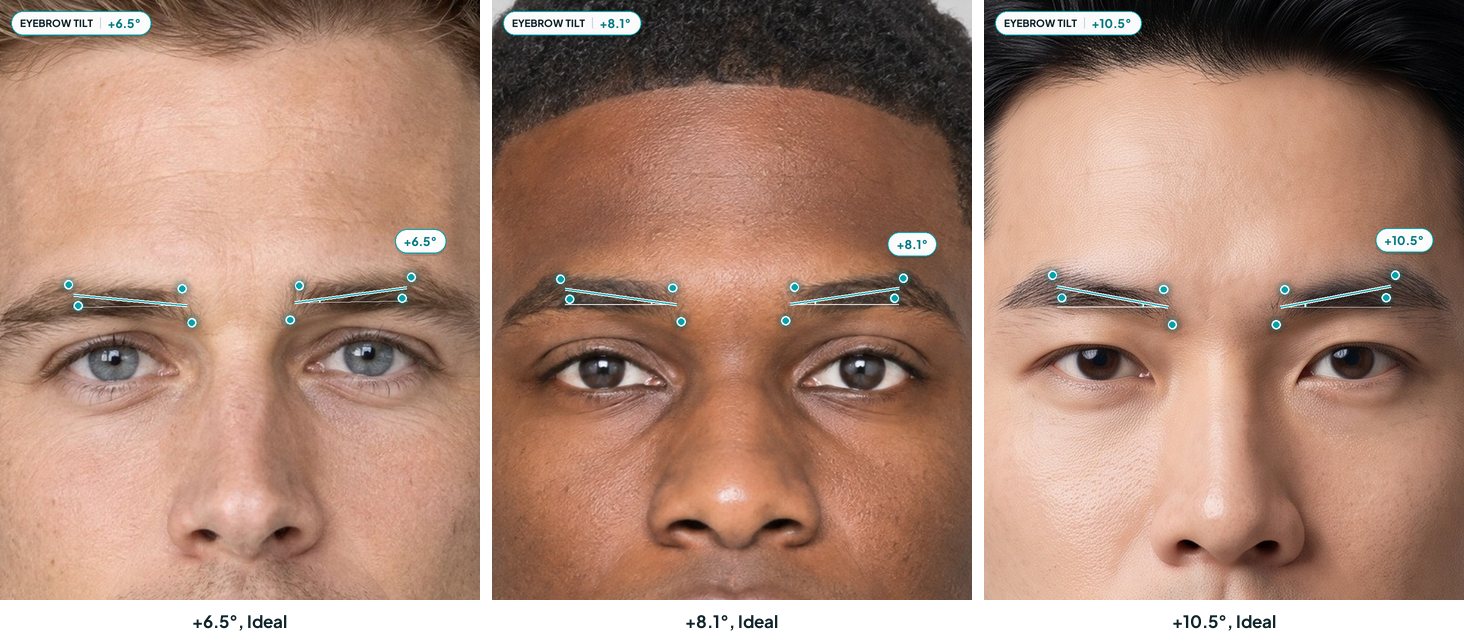
Pluck only stray hairs between the brows and well below them. If you want flatter brows, don’t take hair from the underside of the arch, because that steepens the tilt, and leave the tails alone. There’s more on shaping brows in our glow-up guide.
A haircut that keeps the face square
Short sides with some length on top stop your head looking wider than your jaw, so the jaw stays the widest-looking part of your outline. That one is our own grooming call. Hairline and Hair Length are 8 of the 99 points.
A leaner face
If you carry extra weight, losing some through ordinary diet and exercise lets the bone underneath show. In our scoring that shows up mostly in Angularity, where leanness and jaw definition make up most of the pillar. Judge the change on a fresh photo with the same setup, not in the mirror.
Photos that don’t flatten your features
Use the self-check setup, with the lens at eye level. Light from slightly above or to one side shows the brow and jaw; flat light from the front hides both.
Skip mewing and jaw exercises. There is no good evidence that either reshapes adult bone, and bone and soft tissue set most of the lines on this page. Our gonial angle guide covers what jaw training does and doesn’t change.
Change one or two things at a time, so you can tell which one helped.
Questions people ask
What is facial dimorphism?
Facial dimorphism means the average differences between men's and women's faces, and a dimorphic face shows them strongly. In our report, 50 of 66 measurements have different ranges for men and women, and 9 don't overlap at all. The biggest gaps are in the profile, the lower face and the neck: the brow meets the nose at 116 to 128 degrees in our men's range and 139 to 151 in the women's. What people call masculine only partly matches the real sex difference.
Are masculine faces more attractive?
Up to a point. When women rated men's faces at seven levels of masculinity, ratings rose and then fell: the favorite sat on the masculine side of average, and the most masculine versions scored low. In 1,550 faces from 10 countries, measured masculinity had no clear link with how attractive men were rated. In a separate study of 12 populations, women in only 3 clearly preferred masculinized faces. Masculine faces read as more dominant, which is a different thing from being liked more.
How can I make my face look more masculine?
Change what sits on top of the bone. For men, a full beard moved masculinity ratings more than jaw shape did in a 37-man study; heavy stubble is a lighter version. Fuller, flatter brows read more masculine. Short sides with some height on top keep the face looking square. Losing extra body fat through ordinary diet and exercise lets the jaw show, and photos from about 1.5 m stop the camera distorting your features. Mewing and jaw exercises have no good evidence for reshaping adult bone.
Do I have a masculine or feminine face?
Measure a few lines and see which range they land in. Two phone photos, front and side, can show four. The two clearest are the brow-to-nose angle in profile (men 116 to 128 degrees, women 139 to 151) and the lower third, from nose base to chin, as a share of face height (men 33.9 to 37%, women 30 to 33.1%). Jaw width and brow tilt overlap slightly at the edges. Most faces give a mixed read, and heritage shifts the ranges a little.
What is the most masculine face shape?
Shape charts usually say square, but three lines matter more than the outline: a jaw almost as wide as the cheekbones (87.5 to 91.5% in our men's range), a lower third of 33.9 to 37% of face height and a nearly flat forehead above a forward brow. A face that is wide for its height isn't more masculine by itself, because that ratio barely differs between men and women.
Does testosterone make your face more masculine?
Probably, during development. Sex hormones such as testosterone are thought to shape most of the masculine features, and some of the difference between men and women may simply come with men's larger bodies. A face is not a hormone test, though: it reflects hormones from years ago, not your level today, so we don't read one from a photo. If you're worried about your hormones, ask a doctor.
What are masculine features on a woman?
Straighter, lower brows, a deeper step from brow to nose, a longer lower face or a wider jaw appear on many women's faces and are a normal part of how faces vary. Most of our lines share values between the sexes (41 of the 50 that differ overlap), and a woman's report scores her against the women's ranges, with a Femininity pillar. In a 2018 test on composite faces, thicker brows still helped women's attractiveness, while a softer jaw scored slightly better than a more prominent one.
What is a hyper masculine face?
It's an everyday name for a face that goes past the men's ideal range on several lines at once: a very heavy brow, a very long lower face, a very sharp jaw corner or a jaw as wide as the cheekbones. When 224 women rated men's faces from very feminine to hypermasculine, both ends came out lowest. Our scoring agrees: a 105-degree jaw angle scores 3.9 out of 10, and a jaw as wide as the cheekbones 3.8.
Sources
-
Dong J, Leger K, Shiramizu VKM, Marcinkowska UM, Lee AJ, Jones BC. The importance of face-shape masculinity for perceptions of male dominance depends on study design. Sci Rep. 2023;13:12620. doi:10.1038/s41598-023-39912-x. Full text on Nature ↩↩
-
Perrett DI, Lee KJ, Penton-Voak I, et al. Effects of sexual dimorphism on facial attractiveness. Nature. 1998;394(6696):884-887. doi:10.1038/29772. Article on Nature ↩↩
-
Bannister JJ, Juszczak H, Aponte JD, et al. Sex differences in adult facial three-dimensional morphology: application to gender-affirming facial surgery. Facial Plast Surg Aesthet Med. 2022;24(S2):S24-S30. doi:10.1089/fpsam.2021.0301. Full text on PMC ↩↩↩↩
-
Mogilski JK, Welling LLM. The relative contribution of jawbone and cheekbone prominence, eyebrow thickness, eye size, and face length to evaluations of facial masculinity and attractiveness: a conjoint data-driven approach. Front Psychol. 2018;9:2428. doi:10.3389/fpsyg.2018.02428. Full text on PMC ↩↩↩
-
Geniole SN, Denson TF, Dixson BJ, Carré JM, McCormick CM. Evidence from meta-analyses of the facial width-to-height ratio as an evolved cue of threat. PLoS One. 2015;10(7):e0132726. doi:10.1371/journal.pone.0132726. Full text on PMC ↩↩↩
-
Mitteroecker P, Windhager S, Müller GB, Schaefer K. The morphometrics of “masculinity” in human faces. PLoS One. 2015;10(2):e0118374. doi:10.1371/journal.pone.0118374. Full text on PLOS ONE ↩↩
-
Ward B, Ward M, Fried O, Paskhover B. Nasal distortion in short-distance photographs: the selfie effect. JAMA Facial Plast Surg. 2018;20(4):333-335. doi:10.1001/jamafacial.2018.0009. Full text on PMC ↩
-
Holzleitner IJ, Perrett DI. Women’s preferences for men’s facial masculinity: trade-off accounts revisited. Adapt Human Behav Physiol. 2017;3(4):304-320. doi:10.1007/s40750-017-0070-3. Full text, University of Glasgow ↩
-
Kleisner K, Tureček P, Saribay SA, et al. Distinctiveness and femininity, rather than symmetry and masculinity, affect facial attractiveness across the world. Evol Hum Behav. 2024;45(1):82-90. doi:10.1016/j.evolhumbehav.2023.10.001. Full text, University of Stirling ↩↩
-
Scott IM, Clark AP, Josephson SC, et al. Human preferences for sexually dimorphic faces may be evolutionarily novel. Proc Natl Acad Sci U S A. 2014;111(40):14388-14393. doi:10.1073/pnas.1409643111. Full text on PMC ↩
-
Jones BC, Hahn AC, Fisher CI, et al. No compelling evidence that preferences for facial masculinity track changes in women’s hormonal status. Psychol Sci. 2018;29(6):996-1005. doi:10.1177/0956797618760197. Full text on PMC ↩↩
-
Dixson BJW, Lee AJ, Sherlock JM, Talamas SN. Beneath the beard: do facial morphometrics influence the strength of judgments of men’s beardedness? Evol Hum Behav. 2017;38(2):164-174. doi:10.1016/j.evolhumbehav.2016.08.004. Full text, University of Glasgow ↩↩
-
Janif ZJ, Brooks RC, Dixson BJ. Negative frequency-dependent preferences and variation in male facial hair. Biol Lett. 2014;10(4):20130958. doi:10.1098/rsbl.2013.0958. Full text on PMC ↩
Spotted a mistake? Email support@faceratinglab.com and we will fix it. First published .