Siren eyes: do you have them, and how to get the look
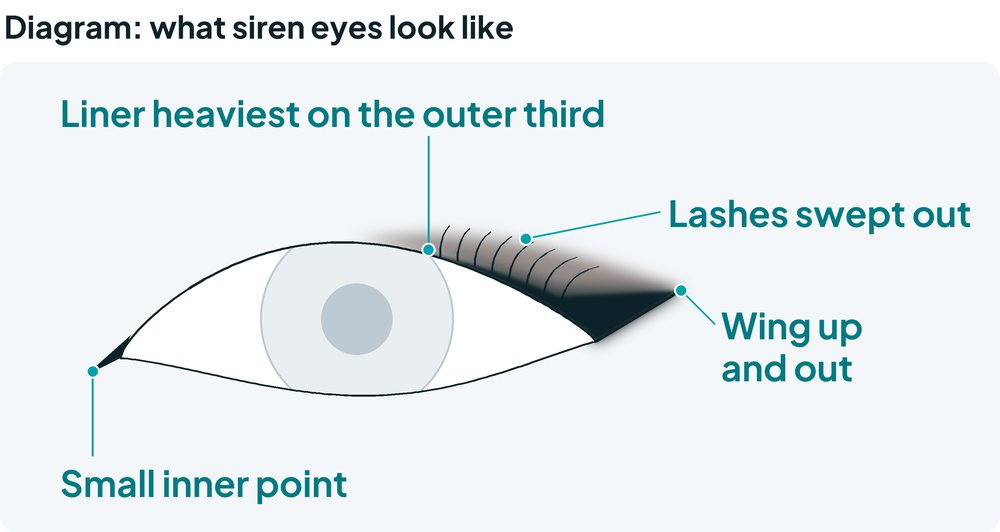
Siren eyes are a makeup look: a smoky wing that makes the eye seem long and lifted. Natural siren eyes have no medical definition, so we use our own rule: corners rising about 6 degrees or more, and an opening at least 3.3 times as wide as tall (3.5 for men).
The short version
- To draw the look, take a smudged wing about 5 mm out and 3 mm up from your outer corner and weight your lashes to the outer third. The corner itself stays put, and hooded lids, level corners and close-set eyes each need a different version.
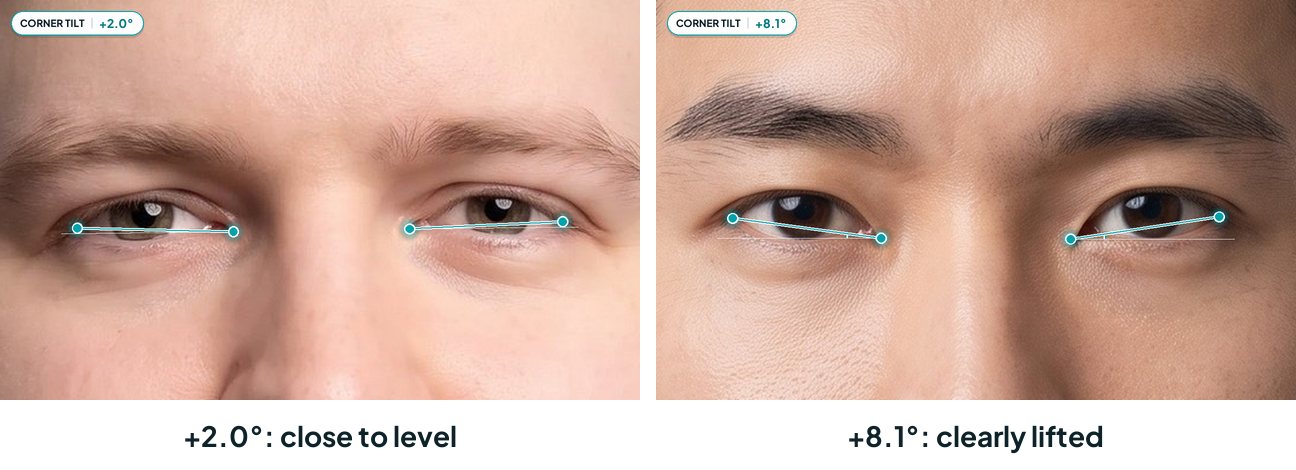
- Corner lift comes down to millimeters. Less than 3 mm of height separates the flattest corners on our four example men (+2.0 degrees) from the steepest (+8.1 degrees).
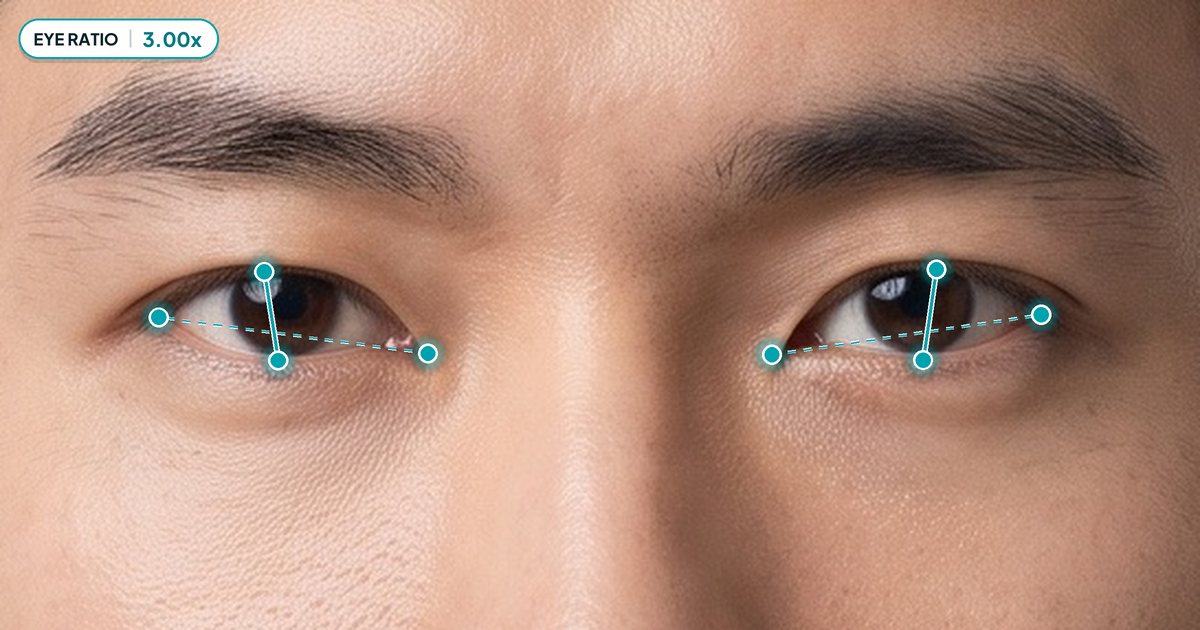
- Lift and length are separate traits. Of our four men, the steepest corners have the shortest opening (3.00 times as wide as tall), the flattest the longest (3.71), and none has both.
- Selfies can inflate both numbers. In one small study, 15 degrees of chin-down added 3 or 4 degrees of tilt by our math, and lowering your lids 1 mm adds about 0.4 to the ratio, so check on a level photo.
- Lifted corners have the better research behind them, and long openings the weaker case, though raising the corner on one edited face lowered ratings. One trait decides little either way. On one of our men, moving tilt from Fair to Ideal adds about 0.05 to his overall.
Siren eyes are one thing you can draw and two things you can measure. The drawing is a smudged wing, up and out, and the measurements are an outer corner that clearly rises and a long, low opening. A face can have either without the other.
Here for the makeup? Jump to the steps or the version for your eyes.
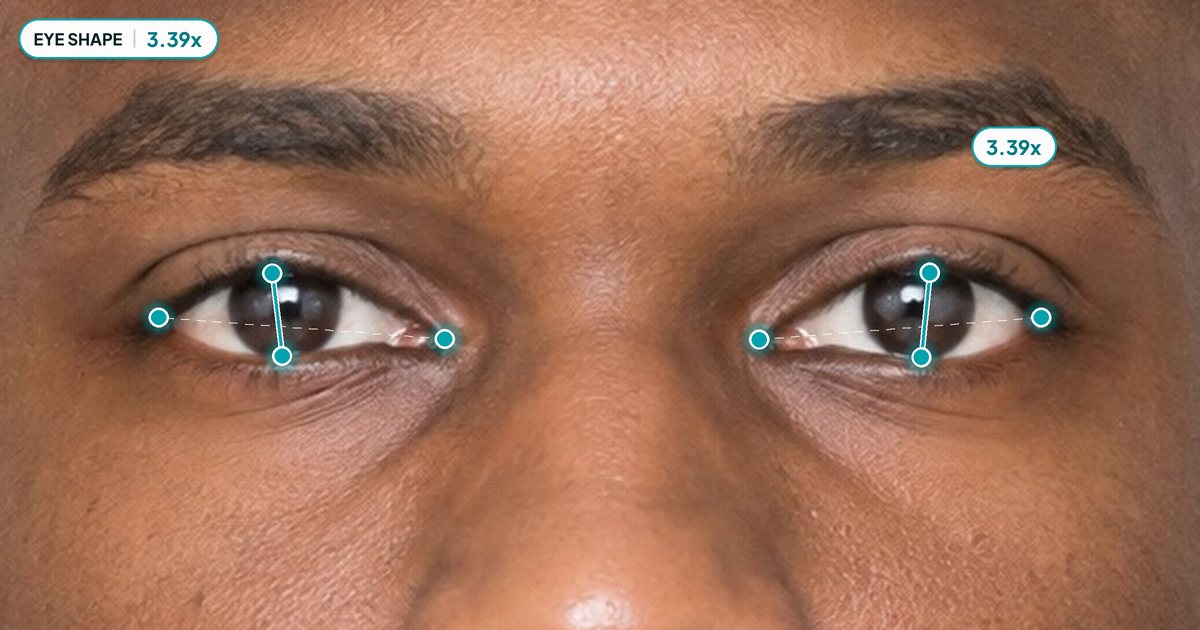
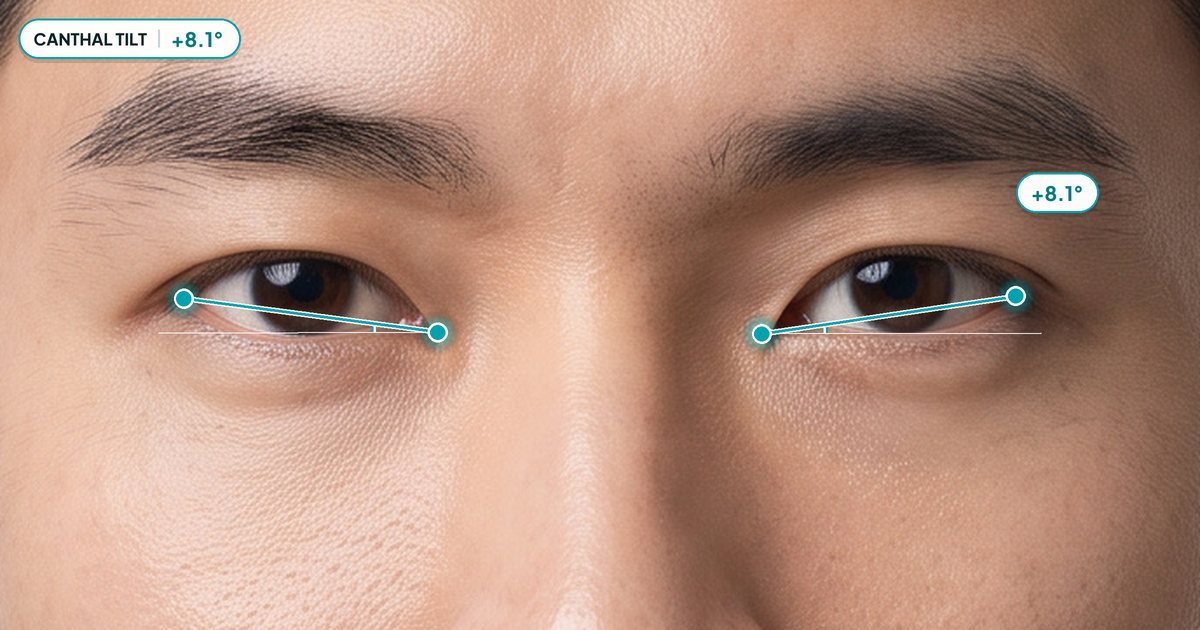
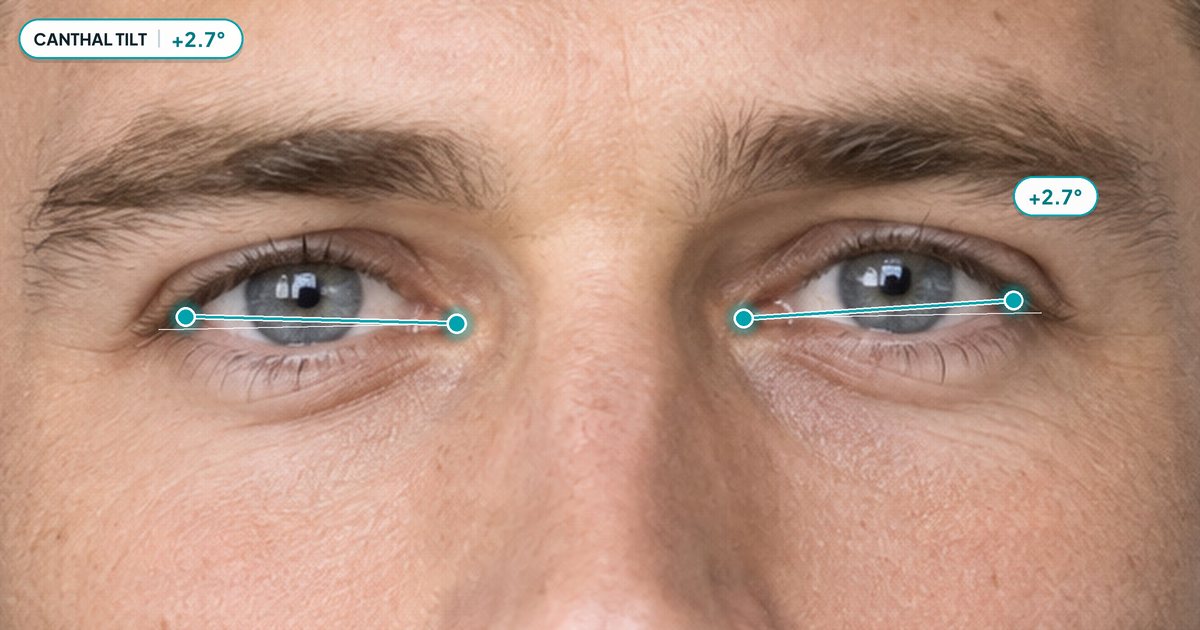
Most pages stop at a phrase like “upturned almond” and give no numbers. Almond alone doesn’t get you there. We measured our four example men, and an eye-shape chart would call three of them almond, at 3.00, 3.27 and 3.39 times as wide as tall. The only one with clearly upturned corners has the shortest opening. Not one of the four has both the lift and the length.
Siren eyes isn’t a medical term. Doctors name single traits, such as an upslanted eye, and usually only when one sits far from the average.1 PubMed had nothing under “siren eyes” or “siren eye” when we searched on 2026-10-31, and we found no research that sets a cut-off. So ours is a rule of thumb, and one level photo shows where you stand and which wing to draw, hooded lids included.
What are siren eyes? The siren eye shape comes down to lift and length
Siren eyes are eye makeup, or a natural eye shape, that looks long and lifted at the outer corner. The nearest plain description is upturned, long almond eyes.
Makeup videos spread the term, and beauty press was writing about it by 2022, when a makeup artist told Allure to think of Angelina Jolie or Megan Fox. The sirens of Greek myth lured sailors to their deaths with a song. Their eyes aren’t the point of the story, so the name borrows a mood, sultry and a little dangerous, and describes no anatomy.
As a natural shape it has two parts, by our rule. The outer corner sits at about +6 degrees or more, the same cut-off eye shapes uses for upturned. On a 28 mm eye that’s 2.9 mm of corner height, a tenth of the width. And the opening reaches the top of your ideal range: 3.3 times as wide as tall for women and 3.5 for men (3.2 and 3.4 on our East Asian ranges).
Length means how many times wider than tall the opening is. In one small study it averaged near 3.2 across three groups by our math, which would put 3.3 only just past average.2 Other samples we cite work out anywhere from about 2.6 to 3.4 by the same math, so treat that as rough.34 A high ratio can come from a wide eye or from a low opening. The widest eye in our set, about 30 mm, comes to only 3.39.
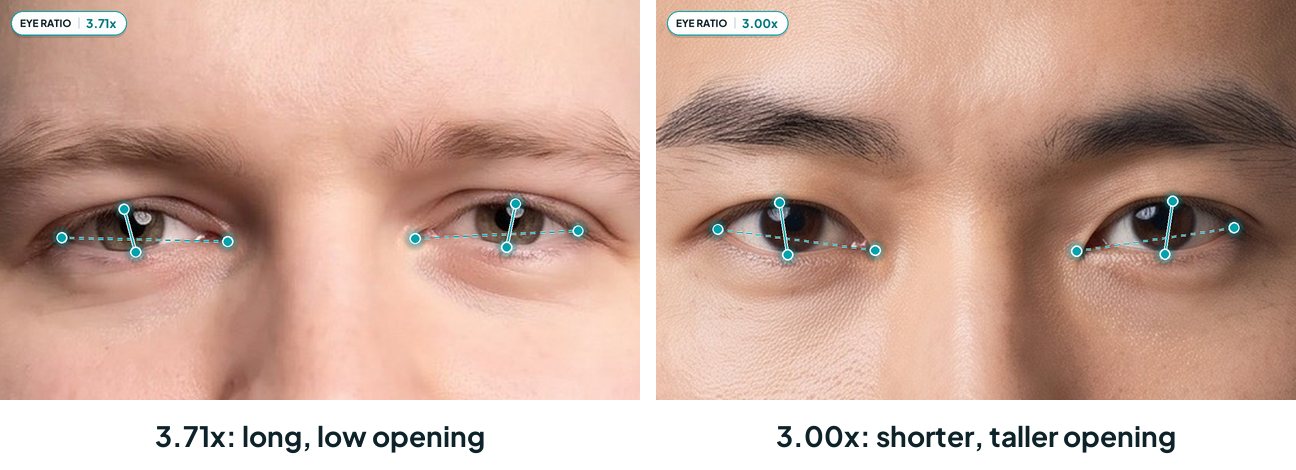
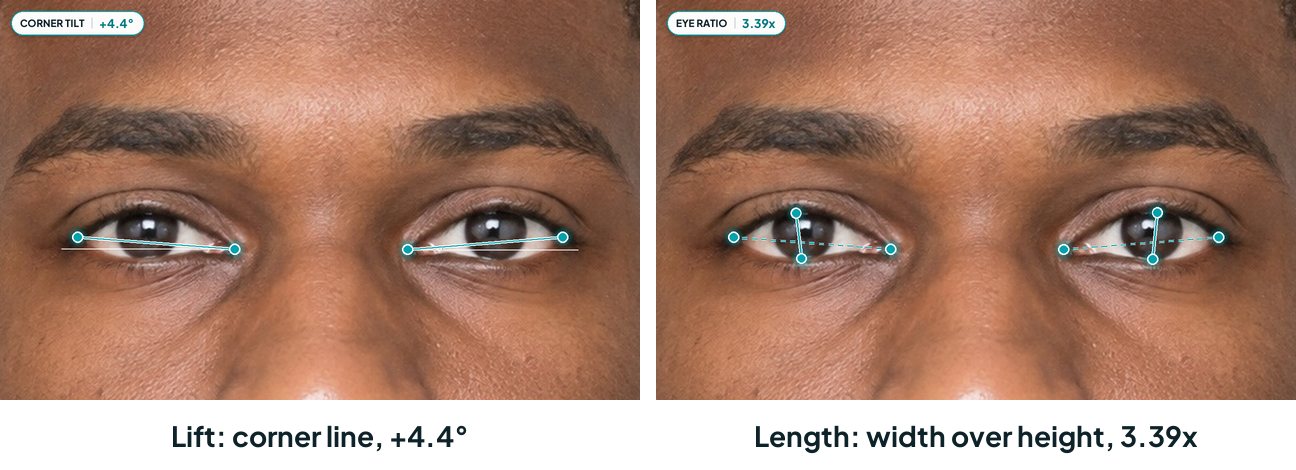
Here are our four men, tilt and ratio first, against the +6 lift mark and the men’s length mark of 3.5. The first is the man in our sample report.
| Face | Lift | Length | Looks |
|---|---|---|---|
| +2.0, 3.71 | About 2 mm short | Past it | Long, not lifted |
| +2.7, 3.27 | About 1.6 mm short | Opening about 0.5 mm taller | In between |
| +4.4, 3.39 | Under 1 mm short | Opening about 0.3 mm taller | Close on both |
| +8.1, 3.00 | Past it | Opening a little over 1 mm taller | Lifted, not long |
On the women’s 3.3 mark the man at +4.4 passes length too. He’s still short on lift. Two of the four sit about 1 mm from having both. We measure faces all day, and a millimeter shouldn’t put anyone in or out of a type. We’d treat natural siren eyes as a place on two scales.
Four men can’t tell you how common any of this is, only that the two traits can split.
Do I have natural siren eyes? Two checks on one photo
By our rule you do if your outer corner rises at least a tenth of your eye’s width and your width-to-height ratio reaches the top of your ideal range.
Take a level photo, not a selfie. Use a friend or a timer and the rear camera, from 1.5 m (5 feet), zoomed in, lens at eye height. Chin level, face relaxed, no smile, no liner, eyes on the lens.
On a phone, open it in your markup tool and draw a straight line through both inner corners, out past the outer ones. Then zoom in until one eye fills the screen.
For lift, mark the gap from that line up to the outer corner on a strip of paper held against the screen, then count how many times it fits across that eye’s width. 10 or fewer puts you past the lift mark.
For length, mark the eye’s height, upper to lower lid, and count the same way, except this time you want more fits, not fewer: a little over 3 (3.3) for women, 3 and a half (3.5) for men.
For exact numbers, use an editor on a computer. It comes down to two divisions.
- Mark the corners. In an editor that shows the cursor position (Paint’s bottom bar on Windows, or Photopea’s Info panel), mark both corners of each eye where the lids meet, not the end of your liner or a lid fold. Each eye should be 100 pixels wide or more.
- Do the lift check. Divide how many pixels higher the outer corner sits by the eye’s width. Average both eyes, which cancels a small head tilt. An answer of 0.1 or more is about +6 degrees or more (0.035 is about +2, 0.07 about +4 and 0.14 about +8).
- Do the length check. Divide the eye’s width by its height, upper to lower lid straight through the pupil, and average both eyes. Compare the answer with 3.3 for women or 3.5 for men.
- Read both answers together. Past both marks meets our rule for natural siren eyes. Past one means lifted or long. Neither means the look is one you draw. Near a mark, retake the photo another day and keep the result that repeats.
Here it is on the man at +4.4. His right eye is 136.5 pixels wide with the outer corner 10.2 pixels higher, which gives 0.075. His left eye gives 0.078. That averages to about +4.4, short of the lift mark. His openings give 3.45 and 3.33, which average 3.39, about 0.1 short of the length mark.
The length mark is the top of your eye ratio range, which moves with the heritage you choose when you upload. The lift mark is our upturned cut-off and stays at +6 for everyone, the bottom of the men’s tilt range in the first row below and just under the women’s. In each row, women are on the top line and men below.
| Heritage | Corner tilt | Eye ratio |
|---|---|---|
| White / European, Black / African heritage, South Asian | +6.8 to +8.5 +6 to +7.7 |
2.8 to 3.3 3 to 3.5 |
| East Asian | +8.5 to +10.2 +7.7 to +9.4 |
2.7 to 3.2 2.9 to 3.4 |
| Mixed, Latino, Middle Eastern or other; Prefer not to say | +7 to +8.7 +6.2 to +7.9 |
2.8 to 3.3 3 to 3.5 |
If you’re a woman, your corners may sit a little higher than a man’s from the same background: about 1 to 2.5 degrees on average in the three Asian samples we checked.345 Either way, a low or high natural tilt is just where your family landed.
Your selfies may disagree. Pose and camera angle are why. Drop your chin and half-close your lids and the man at +4.4 could pass both marks with no change to his face. In a small study of 12 women, 15 degrees of chin-down raised the outer corner from 2.55 to 4.39 mm above the inner one, 3 or 4 degrees by our math, and cut visible lid from 3.8 to 2.6 mm.6 The chin doesn’t do the ratio’s work, though. The opening grew slightly in that study, from 10.6 to 10.9 mm, so that part comes from lowering your lids. On a 28 mm eye, going from a 9 mm opening to an 8 mm one moves the ratio from 3.11 to 3.50.
Chin down and half-lidded is a fine way to take a photo and a poor way to measure. If a selfie says you have them and a level photo says you don’t, believe the level photo.
For the long version of the method, see our canthal tilt test and how the points are placed. Our report measures both numbers, as Lateral canthal tilt and Eye aspect ratio, and never prints the word siren. The call stays yours.
Siren eyes vs doe eyes, measured
Siren eyes push tilt and length. Doe eyes push height and openness. The numbers are our rule again, given for women first.
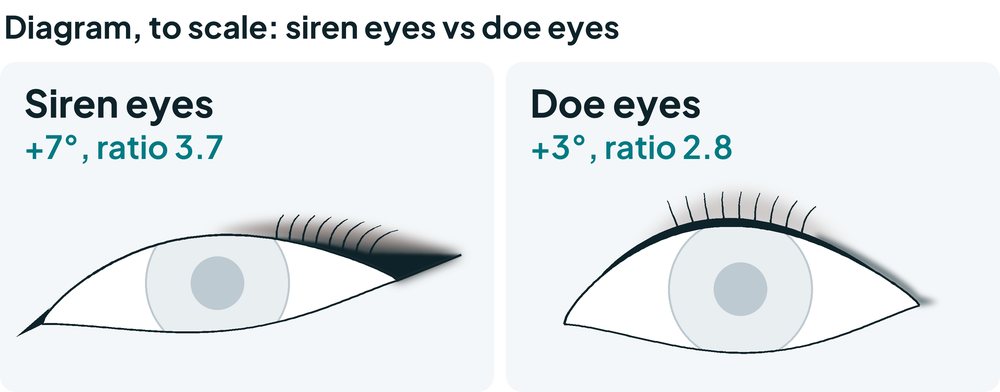
| Siren eyes | Doe eyes | |
|---|---|---|
| Corner line | Clearly rising, +6° or more | About level, +3° or less |
| Opening | Long, 3.3 or more (men 3.5) | Round, 2.8 or less (men 3.0) |
| Liner | Heaviest on the outer third, winged up and out | Close to the lashes, soft at the outer corner |
| Inner corner | Small dark point or flick | Light and bright |
| Lashes | Outer third, swept out | Center, lifted over the iris |
| Looks | Long and lifted | Round and open |
| Supposed mood | Sharp, a little dangerous | Soft, innocent |
The same two checks show which column you sit nearer. You may also read that doe eyes turn down at the corners. Nothing in the doe makeup look needs that.
Each gives up points on one measurement. On the women’s +6.8 to +8.5 tilt and 2.8 to 3.3 ratio ranges, a siren eye at +7 and 3.7 scores 10 on tilt and 6.6 on length, and a doe eye at +3 and 2.8 scores 4.7 and 10. That 4.7 is one measurement among 65+, and people draw doe eyes on purpose. Pick by the look you want, not the eye you started with.
Fox eyes, if you’ve seen that one too, is a close relative. Beauty pages describe a lifted, elongated shape drawn with liner and shadow, and we found no agreed way to tell the two apart.
How to do siren eyes makeup, step by step
To get siren eyes with makeup, draw a smudged wing about 5 mm (1/5 inch) out and 3 mm (1/8 inch) up from your outer corner, add a small inner point and weight your lashes to the outer third. No makeup? Skip to the brows and photo tips.
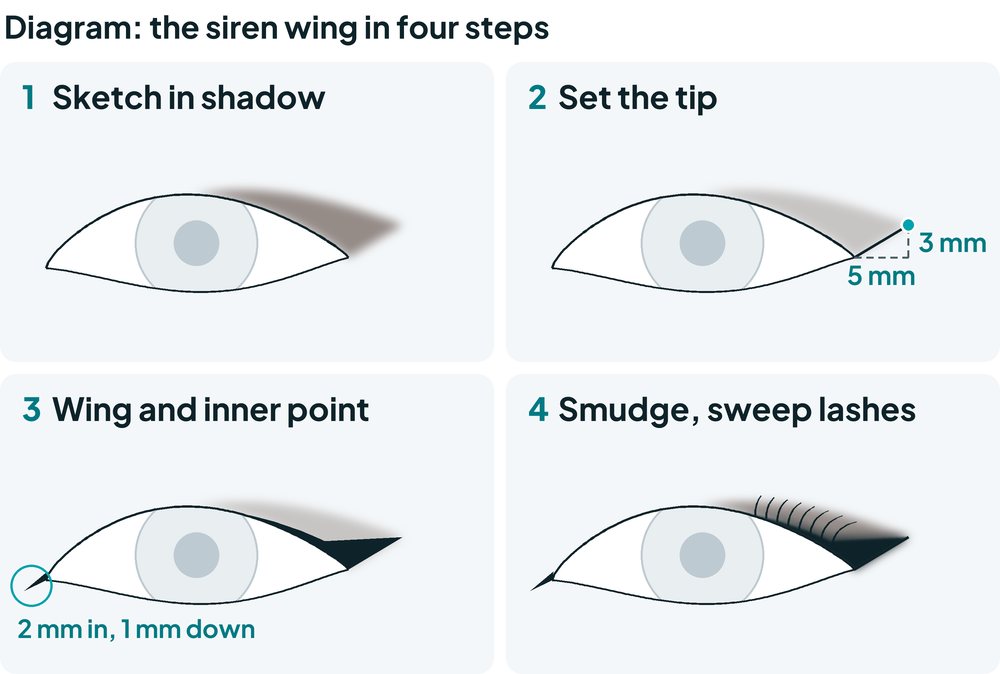
The siren makeup look sits between a cat eye and a smoky eye: a cat eye’s wing with a softer edge, on a smoky base. The easiest eyeliner for siren eyes is a pencil or gel, because you need a line you can smudge and liquid can set before you get there. Start in black or brown. Plum, gray and deep blue work once you’ve got the shape. These steps and the wing numbers below are makeup-artist practice and our own geometry, because we found no study of the look.
- Base and sketch. Blend a brown or dark shadow over the outer third, then sketch the wing in shadow with an angled brush, which is easy to move.
- Set the tip. With your eye open and looking straight ahead, mark the wing tip 5 mm out and 3 mm up from where the lids meet. With no ruler at the mirror, use a standard wooden pencil, about 7 mm wide. That makes 5 mm about two-thirds of its width and 3 mm a little under half.
- Draw the wing. Run liner from the tip back to the upper lash line, thin through the inner half and thicker over the outer third.
- Add the inner point. Draw a small point 2 mm in and 1 mm down from the inner corner, which steepens the whole line by about a degree. Skip it if your eyes sit close together.
- Smudge and sharpen. Soften the liner’s top edge into the shadow with a clean brush before it dries, because a dry line won’t blend. Then sharpen under the wing with a flat brush and a little concealer.
- Waterline. Run liner along the wet rim under your upper lashes, called tightlining, to darken the lash root. We’d skip the lower rim unless you want it heavy. Artists disagree, and under-eye shadow lowered ratings in the nearest study we found, though it didn’t test liner.7
- Lashes. Put mascara on the outer third and brush it out. By siren lashes, people usually mean false lashes weighted outward: half lashes on the outer third, or cat-eye lashes that get longer toward the outer corner.
How far to draw your siren eyeliner wing
Treat the wing as an extension of your corner line. Measured from the inner corner to the wing tip, here’s what each one comes to on a 28 mm eye with a 9 mm opening at +2.
| Wing, out and up | Drawn line | Ratio |
|---|---|---|
| No wing | +2.0° | 3.11 |
| 3 mm, 2 mm | +5.5° | 3.44 |
| 5 mm, 3 mm | +6.9° | 3.67 |
| 5 mm, 5 mm | +10.3° | 3.67 |
| 8 mm, 3 mm | +6.3° | 4.00 |
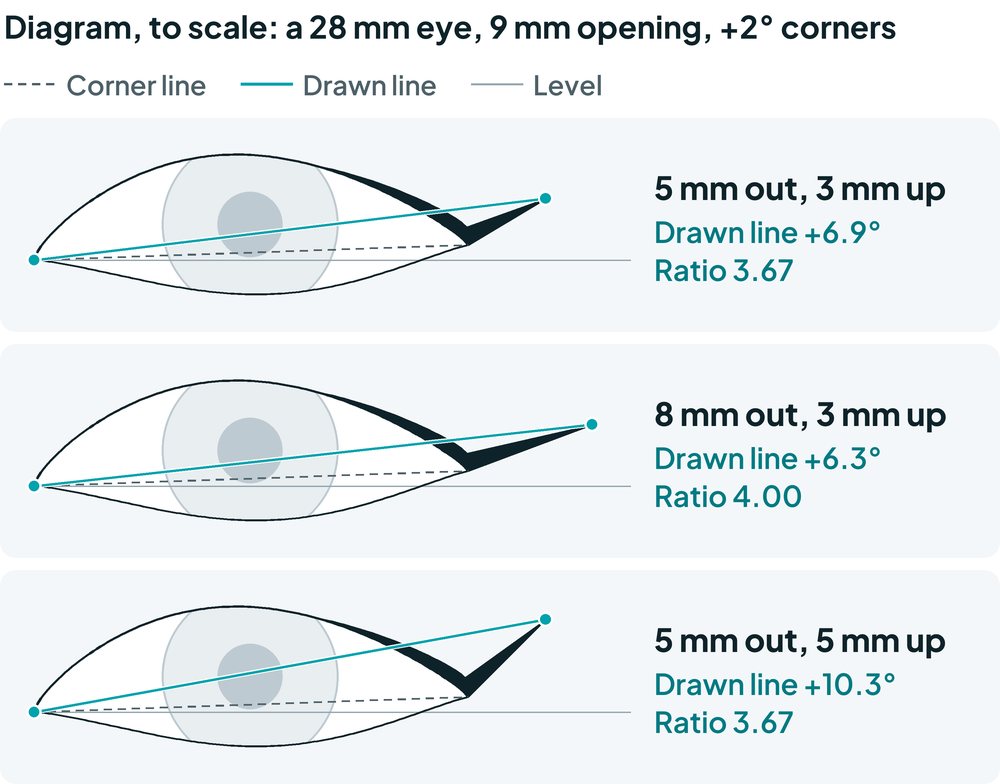
Tutorials argue about aiming along the lower lash line or up toward the brow. The lower aim gets you the longer line and the higher aim the steeper one, so pick whichever half your check says you’re missing. From a +2 eye, the 5 mm and 3 mm wing crosses both of our marks. Other eyes need other numbers.
A wing can’t move your corner, though, which is why the check is done bare-eyed. The research we found measures size, not tilt: liner or mascara made eyes look up to 6% larger and shadow about 5%, and liner added nothing once mascara was on.8 Short on time? For size at least, do the mascara, though that study and the brow study below share an author from a cosmetics company’s research center.
Siren eyes for hooded eyes and other shapes
Hooded eyes
For siren eyes on hooded lids, draw the wing with your eye open, looking straight ahead, and start at about 5 mm. If the tip disappears, lengthen it until it shows.
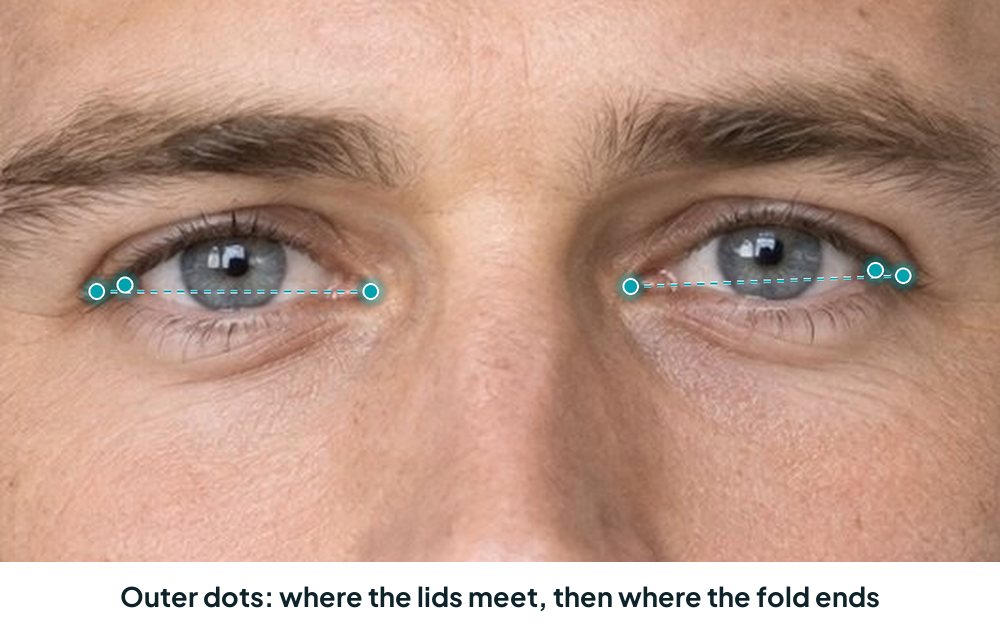
On our four men, all rated 8 for hooding where 10 means no sign of it, the fold ends about 3 to 3.6 mm past the corner. We’d expect even a 3 mm wing to get lost there. A heavier hood can reach further and hang lower. Trust your mirror over our millimeters. Sketch in shadow first, taking it slightly above the crease so it shows with your eye open. With your eye closed the wing may look bent, which is fine.
Other eye shapes
The same wing lands differently on different corners. Find the row closest to your results. The man in our sample report sits in the fifth: the standard wing, 5 mm out and 3 mm up, takes his ratio to 4.4, so his row says short and steep. If your lids are hooded too, lengthen any wing here until the tip shows.
| Your eyes | Same wing | Try this |
|---|---|---|
| In the middle (+3 to +5, ratio 3.0 to 3.4) | Works as written | Follow the steps as written. From a +4 eye with a 9 mm opening you land at +8.5° and 3.67 |
| Level corners | Comes to only +5.2° | Aim steeper: 5 mm out, 4 mm up comes to +6.9° |
| Downturned corners (-2°) | Comes to only +3.5° | 5 mm out, 5 mm up comes to +6.9°. Start the flick before the lid curves down |
| Round opening (2.8) | Reaches only 3.3 | Go longer: 8 mm out comes to 3.6, with lashes on the outer third |
| Long, low opening, flat corners (+2°, 3.71) | Takes the ratio to 4.4 | Short and steep: 3 mm out, 3 mm up comes to +7.3° |
| Already lifted (+8°, 3.00) | Steepens it to +12° | Long and flat: 5 mm out, 1 mm up comes to +8.5° and 3.54 |
Two kinds of eye sit outside the table. A monolid has no crease to aim at, so draw with your eye open, make the line thick enough to show and curl your lashes first. If your eyes are close-set, with a gap between the inner corners clearly under one eye width, a dark inner point narrows that gap further. Skip it, keep the inner corner light and push color outward.
For level or downturned corners, we go further in eyeliner for a negative canthal tilt.
How to get siren eyes naturally, with brows, lashes and the camera
You can’t move the corner itself, because it’s anchored to bone by a tendon. Apart from a slow drift with age, only a medical procedure moves it for good. Brows, lashes and the camera change how it looks.
Brows first. The usual advice is to lift them. We wouldn’t, at least not the whole brow. If you change anything, change the arch, by the millimeter or two that grooming can shift. On one edited female face, eyes looked about 1 to 2% larger with low brows than with high brows, and without shadow, high brows made them look slightly smaller than they are. In a separate survey, 73% of 56 students picked the version with lower brows as more attractive.9 Raised brows also scored lower on attractiveness in a larger rating study.10 We found no test of changing just the arch or the tail.
Work with the brow you have, men included. Brush the hairs up with clear gel, trim only strays under the arch, keep the tail’s natural length and fill it so it falls gently. A falling tail costs you nothing on our scale. On all four of our men it ends about 1.9 to 4.6 mm below the head, and all four brows sit inside the men’s ideal range.
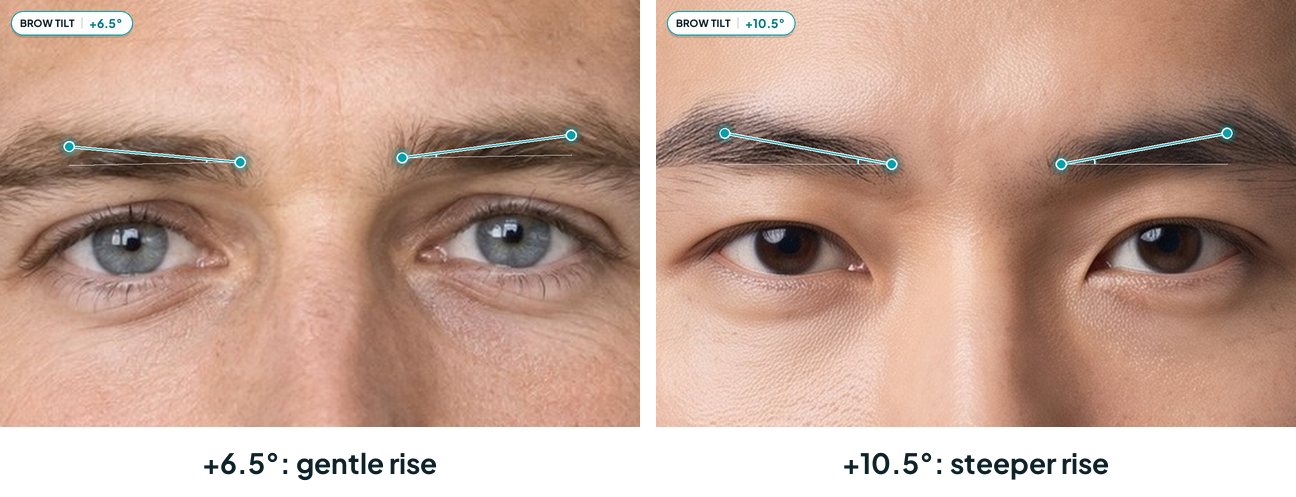
For lashes, curl the outer third. For a photo, tip your chin down a little and lower your lids slightly. You keep the extra lift and length for exactly as long as the shutter’s open, so don’t measure in that pose.
Ignore the videos selling the shape through exercises or tongue posture: we found no trial behind either. Tape lasts only while it’s on. Pulling at your corners for a photo lasts even less, and since many people’s eyes are naturally upturned, it can come across as mocking them.
Are siren eyes more attractive?
We found no study of siren eyes, so nobody can say yet. Of the two traits behind them, the lift has the better support and the case for length is weak.
The closest we found to the combination is 126 Italian beauty-competition semi-finalists, men and women, whose openings were longer and whose corners were steeper than those of ordinary people of a similar age. Don’t lean on that too hard. They were measured just before the event, the paper doesn’t say whether they wore makeup, and its authors note that makeup can make the slant look steeper.11 Higher scorers among 3,517 Asian adults also had steeper corners. A computer model did the main scoring, and a check with human ratings mostly agreed.12 Korean pageant contestants showed no significant difference.13 So the corner sits higher in people rated as attractive in some studies, not all.
Long is the weak half. These studies report length on its own, not our ratio, and the Italian one didn’t measure lid-to-lid height, so it can’t say those eyes were more elongated. Among the 3,517 adults, higher scores went with shorter openings and more eyelid height, though the length result was less consistent in men.12
More lift isn’t always better, either. When one face was edited and shown to 2,081 raters, a higher outer corner lowered attractiveness and trust ratings and raised threat and dominance ratings. The abstract doesn’t say how big the edit was.10 If the look’s dangerous reputation has any data behind it, this is what we found. All of it is correlation or edited images, and only the Italian study and the 3,517 adults clearly included men.
Our report leans the same way, which is no independent proof, since its ranges draw on this kind of research. On the women’s +6.8 to +8.5 range, +7 scores a full 10 and +6 sits just under it at 9.4, and tilt loses points again past +8.5 (+12 scores 5.2). Length gets no credit past 3.3 and only loses points from there. If your corners lift, you have the half with some research behind it. If your opening is long, treat it as a style. With neither, the look is still yours to draw.
On the man at +2.7, taking canthal tilt all the way from Fair to Ideal moves his overall from 7.04 to about 7.09. Five hundredths of a point, from the half of the look with the better research behind it. That’s how little one measurement decides.
Start with a level photo and the two checks, then pick your row in the table.
Questions people ask
What are siren eyes actually called?
They have no medical or official name, because siren eyes is a makeup and social media term. PubMed had nothing under that phrase or under "siren eye" when we searched on 2026-10-31. The nearest plain description is upturned, long almond eyes. A doctor would describe single traits, such as an upslanted eye, and usually only when one sits far from the average.
What does siren eyes mean?
It means eye makeup, or a natural shape, that looks long and lifted, with a sharp, slightly dangerous reputation. The name comes from the sirens of Greek myth, whose song lured sailors, so it borrows a mood and describes no anatomy. Beauty press was writing about the look by 2022. Eye shape says nothing about personality or intent, whatever captions imply.
What do siren eyes look like?
Siren eyes look long and lifted: a dark, smudged wing rises from the outer corner, liner is heaviest on the outer third, a small dark point sits at the inner corner and the lashes sweep out at the outer edge. As a natural shape, the outer corner sits clearly above the inner one and the opening is low for its width. In 2022 a makeup artist told Allure to think of Angelina Jolie or Megan Fox.
Can you get siren eyes naturally?
You can have the shape naturally, but you can't move the outer corner to build it, because it's anchored to bone by a tendon. To see where you stand, measure your corner tilt and eye ratio on a level photo. Brows, curled outer lashes and photo angle change how the shape looks. We found no trial showing that exercises or tongue posture create it, and tape lasts only while it's on.
Can you do siren eyes on hooded eyes?
Yes, if you draw with your eye open and looking straight ahead, so you can see what stays visible. By our estimate the lid fold runs about 3 to 3.6 mm past the corner on our four example men, so a very short wing can vanish into it, and a heavier hood can cover more. Start at about 5 mm and lengthen until the tip shows. We found no study of this, so treat it as makeup craft.
Are siren eyes or doe eyes more attractive?
We found no study comparing them, so there's no winner to name. Upward tilt goes with higher ratings in some studies but not all, the case for a long opening is weak, and raising the corner on one edited face lowered ratings. Our ideal ranges reward a siren's lift and a doe's opening. Either way it's one trait on a whole face: on one of our example men, moving tilt from Fair to Ideal adds about 0.05 to his overall.
What are siren lashes?
Siren lashes are lashes weighted toward the outer third of the eye and swept outward, so they carry on the line of the wing. Common choices are half lashes on the outer third, cat-eye false lashes that get longer toward the outer corner, or mascara brushed outward there. They add to the long, lifted look and don't change the shape of your eye.
Can contact lenses give you siren eyes?
No. A colored lens changes the color of your iris, and sometimes how large it looks, and leaves the outline of your eye alone, so your corners and lids stay where they are. Some shops sell lenses as a way to get the shape, but what changes the outline you see is liner and how open your lids are.
Sources
-
Hall BD, Graham JM Jr, Cassidy SB, Opitz JM. Elements of morphology: standard terminology for the periorbital region. Am J Med Genet A. 2009;149A(1):29-39. doi:10.1002/ajmg.a.32597. Definition in the Human Phenotype Ontology ↩
-
Fry CL, Naugle TC Jr, Cole SA, Gelfond J, Chittoor G, Mariani AF, Goros MW, Haik BG, Voruganti VS. The Latino eyelid: anthropometric analysis of a spectrum of findings. Ophthalmic Plast Reconstr Surg. 2017;33(6):440-445. doi:10.1097/IOP.0000000000000821. Full text on PMC ↩
-
Packiriswamy V, Kumar P, Rao KG. Photogrammetric analysis of palpebral fissure dimensions and its position in Malaysian South Indian ethnic adults by gender. N Am J Med Sci. 2012;4(10):458-462. doi:10.4103/1947-2714.101984. Abstract on PubMed ↩↩
-
Park DH, Choi WS, Yoon SH, Song CH. Anthropometry of Asian eyelids by age. Plast Reconstr Surg. 2008;121(4):1405-1413. doi:10.1097/01.prs.0000304608.33432.67. Abstract on PubMed ↩↩
-
Shin DY, Cho WK, Paik JS, Yang SW. Upper eyelid contour measurement in an Asian population using Bezier curve analysis. PLoS One. 2025;20(6):e0316714. doi:10.1371/journal.pone.0316714. Full text on the journal’s site ↩
-
Vaca EE, Bricker JT, Mioton LM, Fagien S, Alghoul MS. The influence of sagittal head tilt on periorbital appearance: implications for clinical photography and the evaluation of postoperative results. Aesthet Surg J Open Forum. 2022;4:ojab043. doi:10.1093/asjof/ojab043. Full text on PMC ↩
-
Killian AC, Mitra S, Peissig JJ. The role of regional contrast changes and asymmetry in facial attractiveness related to cosmetic use. Front Psychol. 2018;9:2448. doi:10.3389/fpsyg.2018.02448. Full text on PMC ↩
-
Matsushita S, Morikawa K, Yamanami H. Measurement of eye size illusion caused by eyeliner, mascara, and eye shadow. J Cosmet Sci. 2015;66(3):161-174. Synopsis on the journal’s site ↩
-
Morikawa K, Matsushita S, Tomita A, Yamanami H. A real-life illusion of assimilation in the human face: eye size illusion caused by eyebrows and eye shadow. Front Hum Neurosci. 2015;9:139. doi:10.3389/fnhum.2015.00139. Full text on the journal’s site ↩
-
Kempa J, Kasielska-Trojan A, Gabryszewski M, Antoszewski B, Biesman BS, Knoedler L, Cotofana S, Alfertshofer M. Understanding the impact of eyebrow and lateral canthal height on the perception of character traits: a rating-based analysis of 2081 participants. J Plast Reconstr Aesthet Surg. 2025;104:417-425. doi:10.1016/j.bjps.2025.03.040. Abstract on PubMed ↩↩
-
Sforza C, Dolci C, Grandi G, Tartaglia GM, Laino A, Ferrario VF. Comparison of soft-tissue orbital morphometry in attractive and normal Italian subjects. Angle Orthod. 2015;85(1):127-133. doi:10.2319/012814-75.1. Full text on PMC ↩
-
Wang B, Ran Z, Deng Y, Wang H, Yin L, Zhuang S. Associations between palpebral fissure morphology and AI-derived facial attractiveness scores in Asian adults. J Plast Reconstr Aesthet Surg. 2026;123:135-143. doi:10.1016/j.bjps.2026.09.005. Abstract on PubMed ↩↩
-
Kim YC, Kwon JG, Kim SC, et al. Comparison of periorbital anthropometry between beauty pageant contestants and ordinary young women with Korean ethnicity: a three-dimensional photogrammetric analysis. Aesthetic Plast Surg. 2018;42(2):479-490. doi:10.1007/s00266-017-1040-7. Abstract on PubMed ↩
Spotted a mistake? Email support@faceratinglab.com and we will fix it.