Canthal tilt test: check yours and spot a fake result
A canthal tilt test measures the angle from your inner to your outer eye corner, in degrees above or below level. You can do it from one phone photo taken at eye height with your head straight.
The short version
- Mark four points, the inner and outer corner of each eye where the lids meet, and average the two eyes. Rise over run, times 57, gives the degrees, or read them off the table on this page.
- Most eyes tilt a few degrees up, and plenty sit below the ideal range, which starts at +6 for men of most heritages and +6.8 for women. That gap costs little: taking our sample face from +2.7 all the way into his range would lift his overall score by about 0.05 out of 10.
- Phone height is the error that sticks. By our calculation, every 5 degrees of camera or chin angle moves the reading about 1 degree, and one photo study found more. So stand back: 1.5 m and 2x zoom, not a selfie. A 5-degree head lean looks worse, -2.4 and +7.7 on our sample face, but averaging both eyes cancels it.
- Apps don't even agree on labels: the same +2 degrees is slightly upturned, mild positive, neutral or right on the line, depending on the tool. In research, an automatic tool was about 1 degree off careful hand measurement on average.
- Trust a result only when you can see its lines on your photo. Average three level photos, and treat anything within a degree of a cut-off as sitting on it.
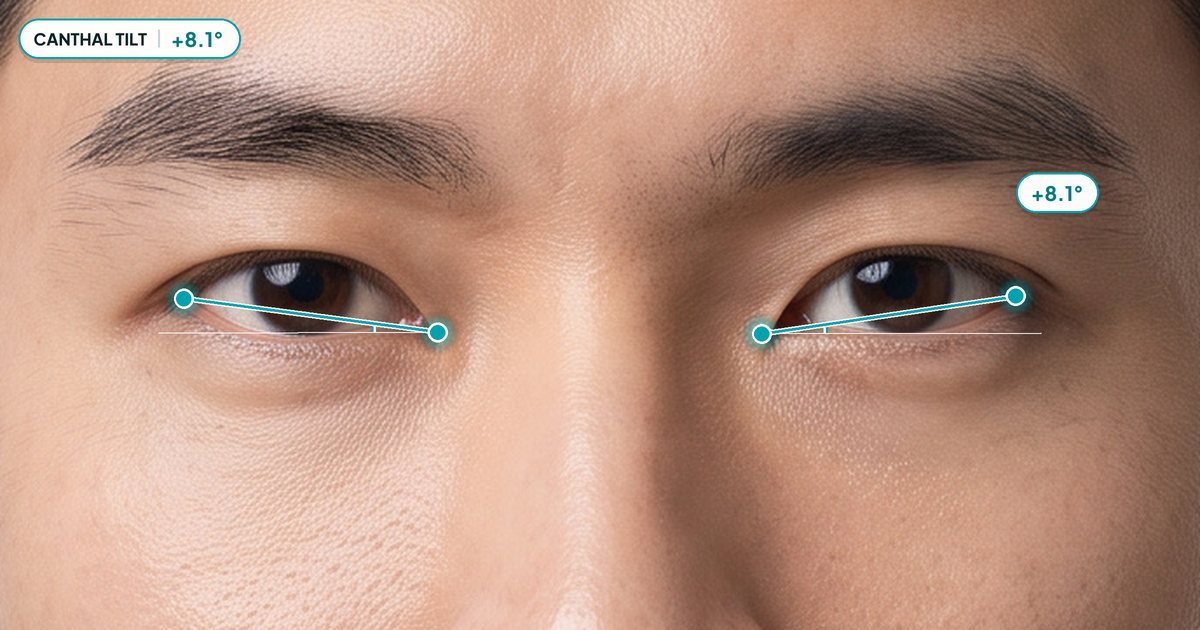
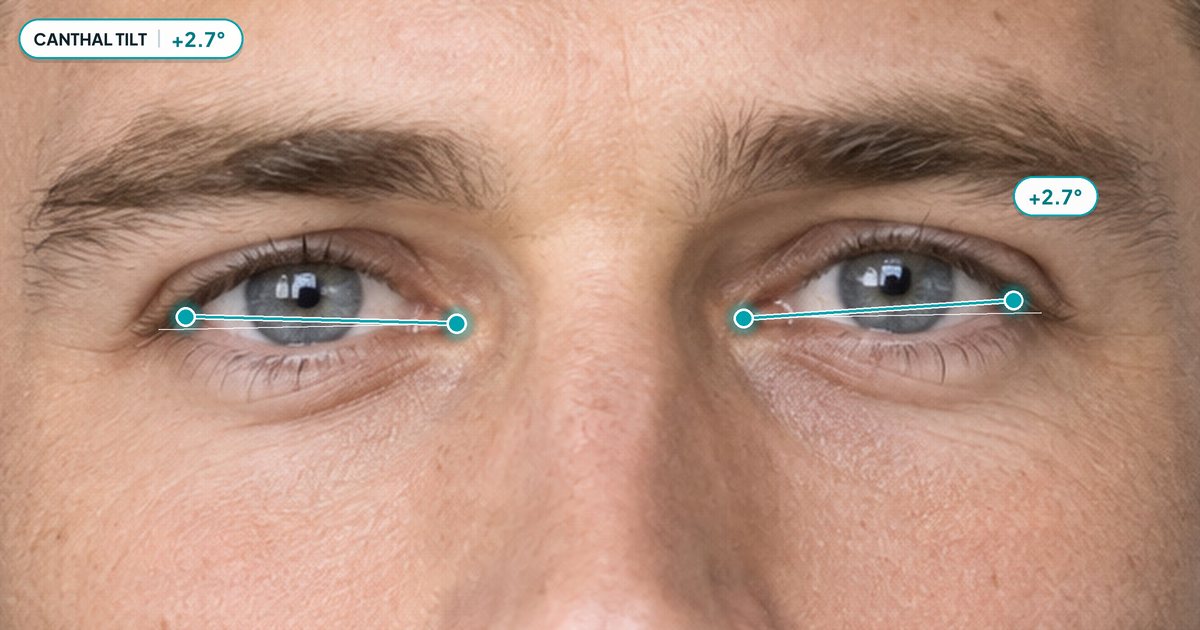
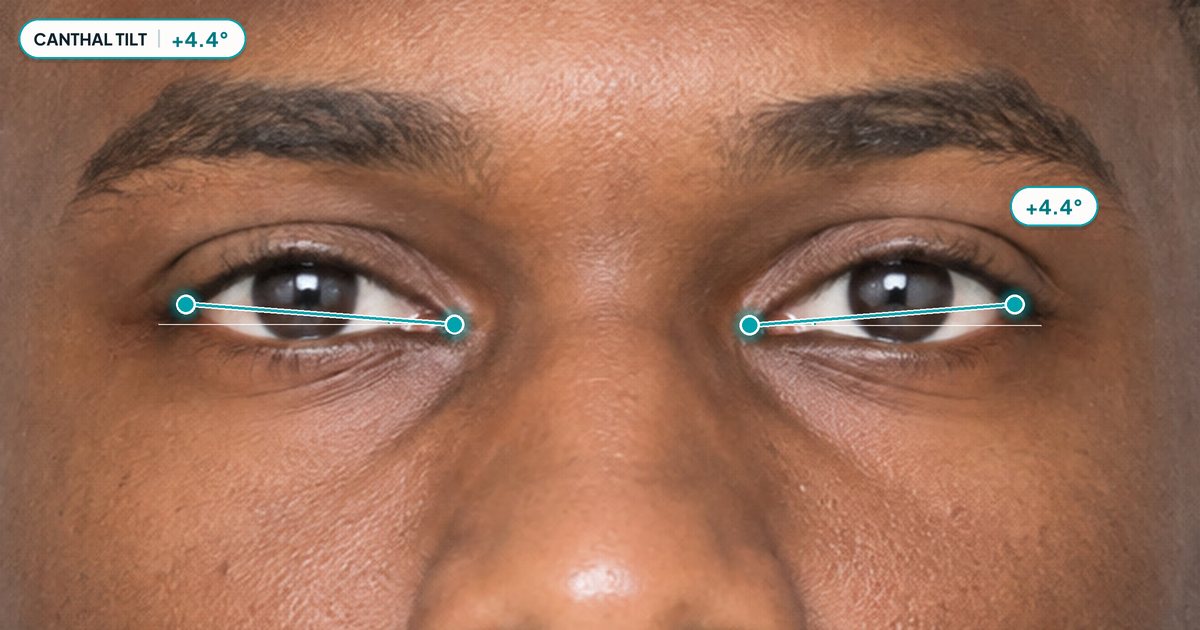
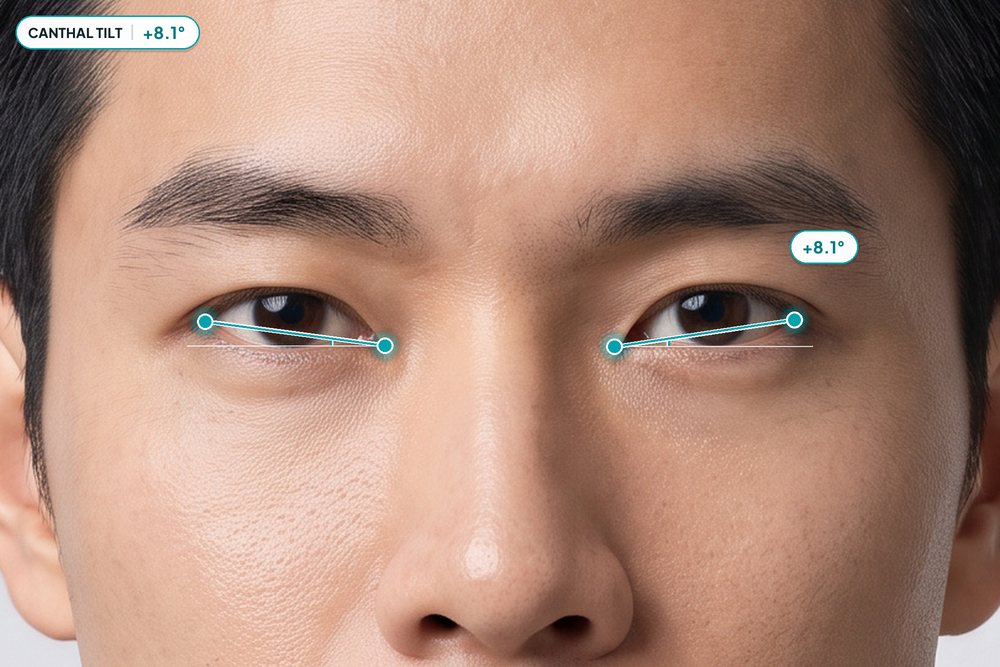
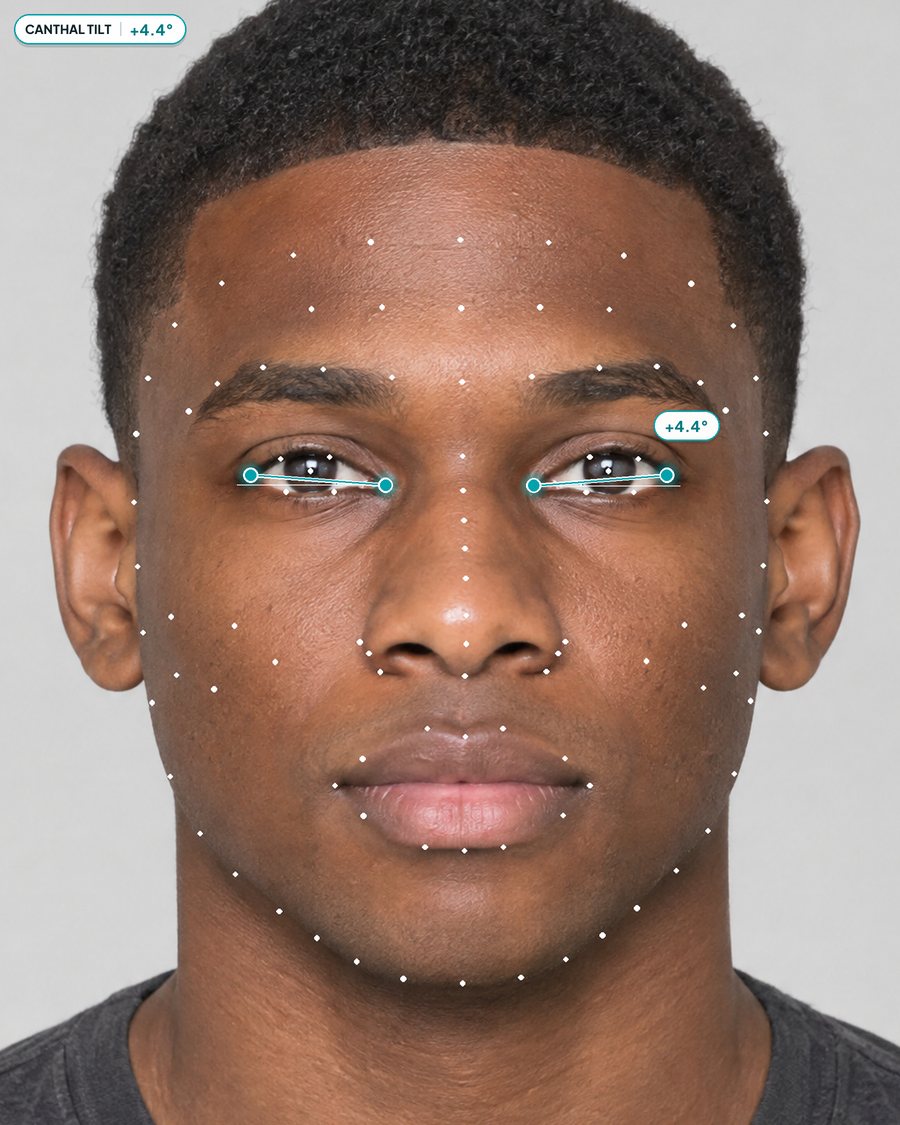
A canthal tilt test comes down to four points on one level photo, and for most people the result lands a few degrees above zero, because the average adult eye tilts slightly up.1 Our three example faces read +2.7, +4.4 and +8.1: all up, and two of them still below their ideal range.
Most of what goes wrong happens before you measure. By our calculation, a phone held 10 cm (4 inches) below your eyes makes a selfie taken at 30 cm (12 inches) read almost 4 degrees lower, and one photo study suggests the real shift is bigger. The same mistake from 1.5 m (5 feet) moves it by less than 1.
So put your effort into the photo. The math is one division, and the table below does even that for you. If you came here with an app’s verdict already, start with why apps disagree.
How to measure canthal tilt from a phone photo
You can tell which way your canthal tilt goes from a photo in about a minute, without a single number. Take a level photo (step 1 below), open it in your phone’s markup tool, zoom in and draw a straight line through both inner corners, out past the outer ones. Outer corners clearly above it mean positive, clearly below it negative. The line tips with your head, so a small lean can’t fake the answer. A mirror can’t do this, because you can’t zoom in or draw on it. Close to the line, you need the steps.
- Take one level photo. Have a friend take it from about 1.5 m (5 feet), rear camera zoomed to 2x or 3x, lens at the height of your eyes. Alone, prop the phone at eye height and use the timer. Chin level, eyes on the lens rather than the screen, a relaxed face, no glasses, hair off the eye corners.
- Open the original photo in an editor that shows the cursor position in image pixels: Paint’s bottom bar on Windows, Photopea or GIMP. Not a screenshot, and not a copy sent through a chat app, which shrinks it. This part is easier on a laptop: a mouse lands on a single pixel, a fingertip doesn’t. Zoom in and check in the readout that each eye is at least 100 pixels wide, 150 if you can. If it’s smaller, retake the photo with more zoom.
- Mark four points. Each inner corner (the medial canthus) goes where the upper and lower lids meet beside the nose, not on the pink tissue. Each outer corner (the lateral canthus) goes where the lids meet at the side, not at the end of the lashes or a liner wing. If a skin fold covers the inner corner or a heavy lid hides the outer one, mark where the lids seem to meet and expect a less exact result.1
- For each eye, write down two numbers: the run (how many pixels across from inner to outer corner) and the rise (how many pixels higher the outer corner sits). Editors count y downward, so rise = inner y minus outer y. A lower outer corner gives a negative rise.
- Turn each eye into degrees with the table below, using the rise per 100 pixels of run. Or multiply rise / run by 57.
- Average the two eyes. That’s your result, even if your head leaned a little. Optional check: measure the line through your two pupil centers the same way. Its slope is your lean, and half the difference between your two eyes’ numbers should come out close to it. If the lean and that half-difference are more than 1 degree apart, re-check your points before you believe either eye. If they hold, your two eyes may simply tilt a little differently, and the average still stands.
- Repeat on two more level photos and average all three. Expect them to differ a little: one pixel at one corner, or a slightly different chin height, is worth a few tenths of a degree.
Which level line? For the average of both eyes, any of them. Doctors draw it through the two inner corners, with the head straight and the eyes looking forward,1 as do studies on front photos2 and the quick check above. Steps 4 and 5 use the photo’s own rows of pixels, and our analysis levels on your pupils (how it places the points).
Per eye, those lines give different numbers, because tipping the reference line raises one eye’s reading by exactly what it lowers the other’s. On the +2.7 face from our sample report, the photo edge gives +1.5 and +3.8, the pupil line +2.6 and +2.7. Average: about +2.7 either way. That’s why you never measure eye tilt from one eye alone: against the photo edge, one eye on its own carries your head’s lean, which is how people get a “negative” eye and a “positive” one from the same photo.
The photo-edge pair also explains step 6’s check. Half the difference between +1.5 and +3.8 is 1.2, and his head leaned 1.1 degrees. That only works when your two eyes tilt about the same once the photo is level. On each of our three example faces they sit within about half a degree of each other, but yours may differ more.
Canthal tilt calculator table, from pixels to degrees
Step 5 is the whole canthal tilt calculator: rise divided by run, times 57, within 0.1 degree of the exact trigonometry up to 10 degrees. The table runs it the other way, so you can see what a tilt looks like in pixels and millimeters before you measure.
| Tilt | Outer corner higher, per 100 px of run | On an eye about 28 mm wide |
|---|---|---|
| -2° | 3.5 px lower | about 1 mm lower |
| 0° | 0 px (level) | 0 mm |
| +1° | 1.7 px | 0.5 mm |
| +2° | 3.5 px | 1.0 mm |
| +3° | 5.2 px | 1.5 mm |
| +4° | 7.0 px | 2.0 mm |
| +5° | 8.7 px | 2.4 mm |
| +6° | 10.5 px | 2.9 mm |
| +8° | 14.1 px | 3.9 mm |
| +10° | 17.6 px | 4.9 mm |
Our men’s ideal range starts at +6 for most heritages, 10.5 px per 100, and the women’s at +6.8, about 11.9 px.
Here it is on the man at the top of this page. On our 1045-pixel-wide original (this page shows it enlarged), each of his eyes is about 88 px across, and the outer corners sit 6.6 and 6.9 px above the inner ones. Per 100 px that’s 7.5 and 7.8, between the table’s 4 and 5 degree rows: +4.3 and +4.5. Average, +4.4. His eyes are a little under step 2’s 100-pixel minimum, so treat that last decimal loosely.
The table also shows how small the target is. One degree is about half a millimeter of corner height. Each pixel is worth 57 divided by the eye’s width in pixels: 0.65 degrees on his 88 px eyes, 0.44 on a 130 px eye and almost 1 on a 60 px eye from a shrunken copy.
Five things that fake a canthal tilt test result
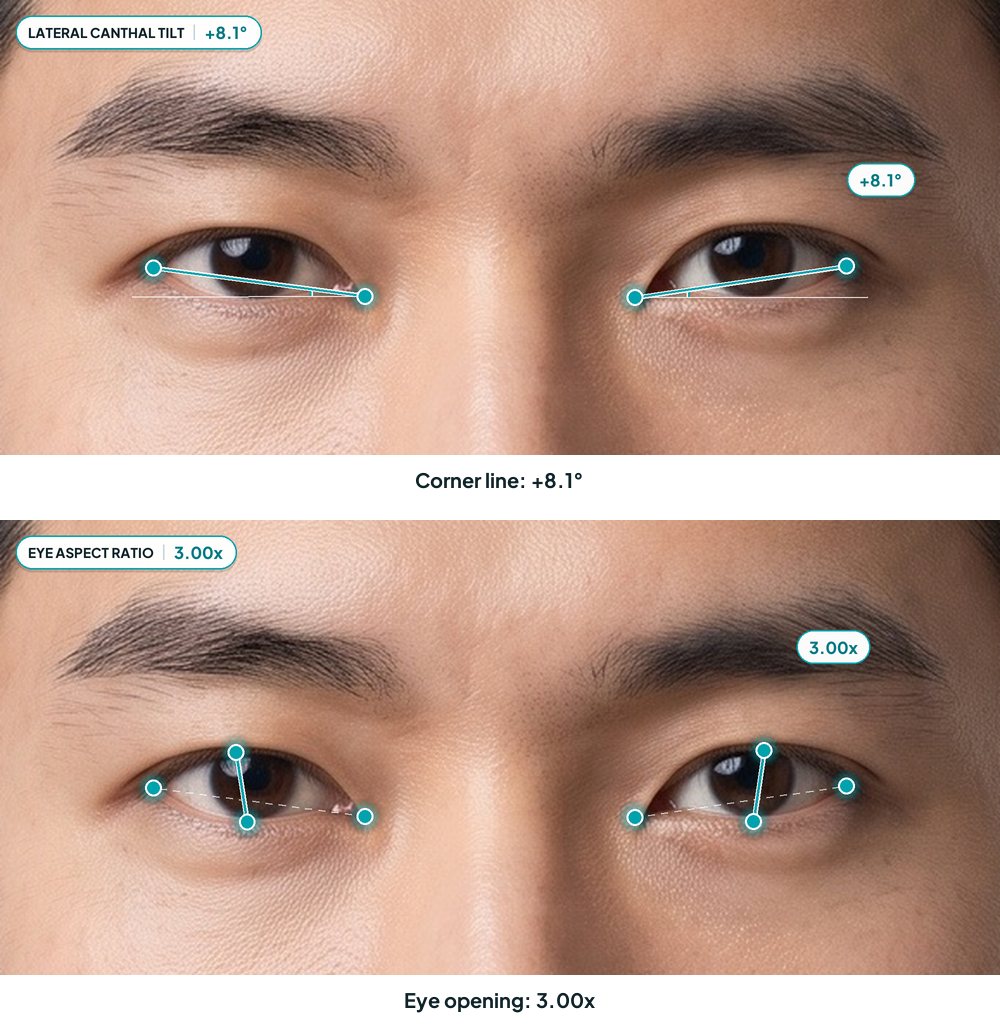
Two of these can move your average by whole degrees: the phone’s height and a misplaced point. The head lean looks the most dramatic and matters least, because averaging both eyes cancels it. Gaze and smiling can matter too, but we found no study that sizes them for a photo like yours.
| What went wrong | What it does | How big | Fix |
|---|---|---|---|
| Head leaning to one side | Adds to one eye what it takes from the other | 5° lean: -2.4 and +7.7 on our +2.7 face. 10°: -7.4 and +12.7. Average stays +2.7 | Average both eyes |
| Phone above or below your eyes, or chin up or down | Phone below or chin up reads lower; phone above or chin down reads higher | 1° or more per 5° of chin or camera angle. Phone 10 cm off eye level: 3.7° at 30 cm, 0.8° at 1.5 m. Both our estimates; the one photo study found more | Lens at eye height, 1.5 m away, 2x or 3x zoom |
| Looking at the screen | Looking down narrows the eye opening and makes it more down-slanted4 | Unknown for a glance at the screen; the study tested 20° and 40° down | Look into the lens and use the timer |
| Smiling or squinting | The ring muscle around the eye can bunch the lower lid up5 | Unknown | A relaxed face |
| Points in the wrong place | Moves that eye’s reading | 1 mm at one corner is about 2° | Where the lids meet, zoomed in |
Chin tilt doesn’t cancel, because a raised or tucked chin moves both eyes the same way. In one small study of 12 women, 15 degrees of chin-up took the outer corner from 2.55 mm above the inner one to 0.13 mm on average, close to level.6 That’s about 5 degrees of tilt, more than our own estimate of 3 for the same chin angle. A phone held below your face acts much like raising your chin.
Close selfies add a second problem. At 20 to 30 cm (8 to 12 inches), a phone stretched the middle of the face vertically by 12 to 18% compared with a camera photo from 1.5 m (5 feet).7 We found no study of what distance alone does to tilt, so we won’t invent a number. Standing back is the safe default anyway.
Smiling is the sneaky one, because a slight smile feels like your normal face.
Face the light, so no shadow hides a corner. And if a selfie reads negative, run the two-photo “is it your camera” check before you believe it.
What your canthal tilt number means
Compare yours with the right group before you judge it, because the usual tilt depends on ancestry. In one small US study, the averages came to about +2.5 degrees for young White adults, +6 for Latino adults and +8 for East Asian adults.3 In a South Indian study, men averaged +5 and women +6.2
“Neutral” has no agreed cut-off. The tools we checked draw it somewhere inside -2 to +2 degrees.
In makeup terms, a clearly positive tilt is upturned eyes and a negative one downturned. Our guide to upturned and downturned eyes puts the +2.7 and +8.1 faces side by side, and only the second reads as upturned at a glance. “Hunter eyes” asks for more: a positive tilt plus low, straight brows and little visible upper lid. This test checks only the first.
Our analysis scores your result against an ideal range for your sex and heritage. For men it’s +6 to +7.7 for White, Black and South Asian heritage, +7.7 to +9.4 for East Asian, and +6.2 to +7.9 for everyone else, including mixed heritage or not stated. Women’s sit 0.8 higher. Our main guide has the full table of ideal ranges by sex and heritage.
Below your ideal is not the same as tilting down. The man at the top of this page tilts clearly up at +4.4, 1.6 under the men’s range, and still scores 8.2, Great. The score falls gently: Great within about 1.8 degrees of your range, 5 out of 10 at 3.6 degrees outside it. And sitting under the range is ordinary: that +2.5 study average for young White adults is well under the +6 where our men’s range starts.
Whatever your number, it counts for less in a whole face than the internet suggests. Canthal tilt is 1 of 33 front measurements in our Harmony pillar. Moving the sample face’s +2.7 all the way into his ideal range would lift his overall score by about 0.05 out of 10 (how much canthal tilt matters in a whole face).
If a careful, level photo still reads below zero, see negative canthal tilt for what that means and what helps. Exercises won’t move it, because the outer corner is anchored to bone by a tendon, and tape lifts the skin only while it’s on. What you can change is how it reads: a brow tail groomed or filled so it doesn’t droop, frames that lift at the outer edge and liner angled up (how to make your canthal tilt look more positive).
Why canthal tilt apps and checkers give different results
Canthal tilt apps and checkers disagree first about words. Each draws its own cut-offs and places the corners its own way, so one reading can get four verdicts. Here is +2 degrees through six kinds of tool.
| The tool | How it finds and levels the corners | What +2° is called | Draws its lines? |
|---|---|---|---|
| An on-device calculator | 478 points, a level line set square to a midline fitted down the face; no result past 5° of chin tilt | Slightly upturned (its band is +2 to +4) | Yes |
| A checker with a confidence score | Corner points against a horizontal line | Right on its line between neutral (-2 to +2) and positive | Not stated |
| A tool with a male/female switch | 68 points, a line parallel to the floor, gives a range | Neutral in one of its tables, mild positive in another | Points, in its paid report |
| An app that gives one number | Against horizontal; says it corrects slight head tilt | Neutral (its neutral runs -1 to +2) | No |
| A live camera filter | A line that moves with your head | No number | Live only |
| Our report | 478 points, leveled on the pupils, both eyes averaged | Depends on your range. White, Black or South Asian heritage: Fair (4.4 out of 10) for men, Focus area (3.4) for women | Yes, on your photo |
Our labels (Fair, Good, Great) measure distance from your ideal range, not the direction of the tilt: a Fair at +2 still tilts up.
In tools that average both eyes, the level line cancels out, so the rest of the gap comes from where each one puts the corners. Trained graders marking the same photo by hand differ by about 0.6 degrees on average.8 An automatic tool tested on 45 front photos in a 2025 study was about 1 degree off careful hand measurement on average, and within about 3 degrees on roughly 19 photos in 20.8 On a phone photo, a degree is only about two pixels at one corner, so when two tools are a degree apart, that tells you nothing about which one is right.
Some tools point out that the same photo gives the same number twice. That proves the math repeats. It says nothing about whether the photo was right. The 2025 study used professional-camera photos, and its authors say the tools still need proper testing on phone photos.8 We found no consumer canthal tilt app, ours included, that has published accuracy against careful hand measurement on phone photos. Whole-face scores have the same problem (why the same face gets different scores).
How to check any canthal tilt result, including ours
Any tool that draws its points can be checked in a minute. A number with no lines can’t be checked at all. Zoom in on the drawing and look for three things:
- The drawn points on the lid junctions from step 3, not on pink tissue or lashes.
- A level line set by your face (pupils or inner corners), not the edge of the photo.
- Two eyes within 1 to 2 degrees of each other on a leveled result. Further apart, re-check the points: one may be off, or your eyes may simply differ.
Then give it three level photos and average them. Say you get +1.8, and an app’s neutral band ends at +2.
That 0.2 degrees is less than one pixel at one corner. Call it on the line, and don’t be surprised if another app calls it positive.
Hold our report to the same test. It draws the four corners, the pupil-level guide and the angle on your photo, so you can zoom in and argue with any point. It can’t fix a raised or tucked chin: take the front photo level. One scan reads one front photo, so compare it with your own measurement of two more level photos. The sample report shows the lines on the man behind the lean examples above.
Questions people ask
What canthal tilt do I have?
Most likely a few degrees positive. The average adult eye slants slightly up, and the group averages we found run from about +2.5 to +8 degrees depending on ancestry. To find yours, mark the four eye corners on one level photo and average the two eyes. For White, Black or South Asian heritage, our ideal ranges start at +6 for men and +6.8 for women, and East Asian ranges sit 1.7 higher. Many people sit below them, and a result up to about 1.8 degrees under still scores Great.
How do you test your canthal tilt at home?
Take one level photo from about 1.5 m, with the lens at eye height and the camera zoomed to 2x or 3x. Open the full-size photo in an editor that shows pixel positions and mark the inner and outer corner of each eye where the lids meet. For each eye, divide the rise by the run and multiply by 57 to get degrees. Average the two eyes, then repeat on two more photos.
Can you check canthal tilt in a mirror?
Only roughly. A mirror can show an obvious upward or downward slant, but you can't mark the corners, zoom in or draw on it. Without a line through the inner corners you're judging against the room, and even a 2-degree lean, easy to miss, splits a +2.7 tilt into +0.6 on one eye and +4.7 on the other. The standard method needs the head straight and the eyes looking ahead, so use a level photo when you want a number.
Does smiling change canthal tilt?
Sometimes. To see it on your own face, take one photo relaxed and one with a slight smile, the same way, and measure both. A smile tightens the ring muscle around the eye, which can bunch the lower lid up. That changes the eye opening straight away and sometimes moves a corner point too, for example when the lid pushes into or hides the outer corner. Take your test photo with a relaxed, neutral face.
Does head tilt in a photo affect canthal tilt?
Yes, and the two kinds behave differently. A sideways lean raises one eye's reading and lowers the other's by the same amount, so the two-eye average cancels it: a 5-degree lean would turn +2.7 into -2.4 and +7.7, average still +2.7. A raised or tucked chin does not cancel. By our calculation it moves the reading about 1 degree per 5 degrees of chin angle, and one small photo study found a bigger effect, so keep your chin level and the lens at eye height.
Are canthal tilt apps accurate?
We found no consumer app that has published accuracy figures for phone photos. In research on standardized photos, trained graders measuring the same photo differed by about 0.6 degrees on average. An automatic tool was about 1 degree off careful hand measurement on average, and within about 3 degrees on roughly 19 photos in 20. So read any app's result as an approximate number, and prefer one that draws its lines on your photo so you can check the points.
Sources
-
Hall BD, Graham JM Jr, Cassidy SB, Opitz JM. Elements of morphology: standard terminology for the periorbital region. Am J Med Genet A. 2009;149A(1):29-39. doi:10.1002/ajmg.a.32597. Definition on the NIH Elements of Morphology site ↩↩↩
-
Vasanthakumar P, Kumar P, Rao M. Anthropometric analysis of palpebral fissure dimensions and its position in South Indian ethnic adults. Oman Med J. 2013;28(1):26-32. doi:10.5001/omj.2013.06. Full text on PMC ↩↩
-
Fry CL, Naugle TC Jr, Cole SA, et al. The Latino eyelid: anthropometric analysis of a spectrum of findings. Ophthalmic Plast Reconstr Surg. 2017;33(6):440-445. doi:10.1097/IOP.0000000000000821. Full text on PMC ↩
-
Read SA, Collins MJ, Carney LG, Iskander DR. The morphology of the palpebral fissure in different directions of vertical gaze. Optom Vis Sci. 2006;83(10):715-722. doi:10.1097/01.opx.0000236811.78177.97. Abstract on PubMed ↩
-
Naik MN. Hills and valleys: understanding the under-eye. J Cutan Aesthet Surg. 2016;9(2):61-64. doi:10.4103/0974-2077.184048. Full text on PMC ↩
-
Vaca EE, Bricker JT, Mioton LM, Fagien S, Alghoul MS. The influence of sagittal head tilt on periorbital appearance: implications for clinical photography and the evaluation of postoperative results. Aesthet Surg J Open Forum. 2022;4:ojab043. doi:10.1093/asjof/ojab043. Full text on PMC ↩
-
Derakhshan A, Gadkaree SK, Barbarite ER, Lindeborg MM, Bhama PK, Shaye DA. Quantifying facial distortion in modern digital photography. Laryngoscope. 2024;134(3):1234-1238. doi:10.1002/lary.30935. Abstract on PubMed ↩
-
Peterson JC, Nahass GR, Lasalle C, et al. Development and validation of a semiautomated tool for measuring periorbital distances. Ophthalmol Sci. 2025;5(6):100887. doi:10.1016/j.xops.2025.100887. Full text on PMC ↩↩↩
Spotted a mistake? Email support@faceratinglab.com and we will fix it.