Eyebrow shapes: the 6 types and which one suits you
The common eyebrow shapes are straight, soft arch, high arch, rounded and S-shaped, and we add a sixth, the rising brow. The one that suits you is usually the one you already grow, tidied: a soft arch for most men, a high arch for most women.
The short version
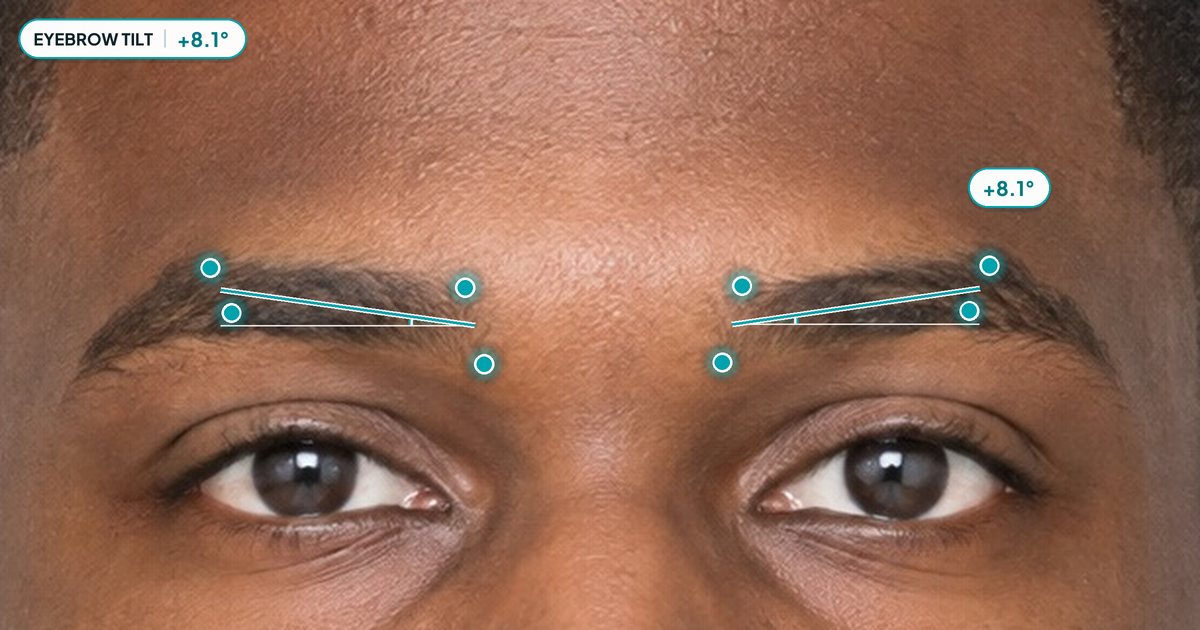
- Straight, soft arch and high arch are only millimeters apart: what separates them is how far the arch rises above the brow head. On the four men we measured, the flattest and steepest brows differ by 2.2 mm at the arch, so a millimeter or two of grooming can tip a brow into the next shape.
- Our ideal brow tilt is 6.5 to 11 degrees for men and 10.5 to 15 for women, so a man's brow in range is flatter and a woman's rises more steeply to its arch. Research also places men's brows lower, on the bony rim.
- Face-shape brow charts are mostly untested. In the one study we found that tested them head-on, a brow drawn for the face shape did no better on round or oval faces and only modestly better on long and square ones.
- Check your brows with the pencil method but don't cut to it: on all four men we measured, the natural tail ran 2.5 to 6 mm past the pencil's tail line, and trimming there would have left every brow-length score at Fair or below.
- The arch forgives small mistakes: by our geometry, plucking 1 mm from under it moves the reading only about 1 degree. Save your caution for the tail, which sets your brow length, since you can always take one more hair tomorrow but can't put one back.
Straight, soft arch and high arch eyebrow shapes sit on one short scale: how far the arch (the peak, about two-thirds of the way out) rises above the brow head (the inner end, nearest your nose). Under 2.5 mm reads straight, 2.5 to 5 mm is a soft arch and 5 to 7.5 mm a high arch, by our rule of thumb for a typical brow. The scale is shorter than it looks. On the four men in our figures, the flattest brow and the steepest were only about 2 mm apart.
Take your cue from your eyes rather than your face shape. Our working rule is a brow that rises a little more steeply than the line through your eye corners. The face-shape charts have less behind them than they look: in the only head-to-head test we found, a brow drawn for a round face did no better than a classic one.2
Brows carry more of a face than people expect. In a small experiment, famous faces were harder to name with the eyebrows erased than with the eyes erased.1 They’re also the part of the eye area you can change fastest, in about 10 minutes with tweezers and a pencil.
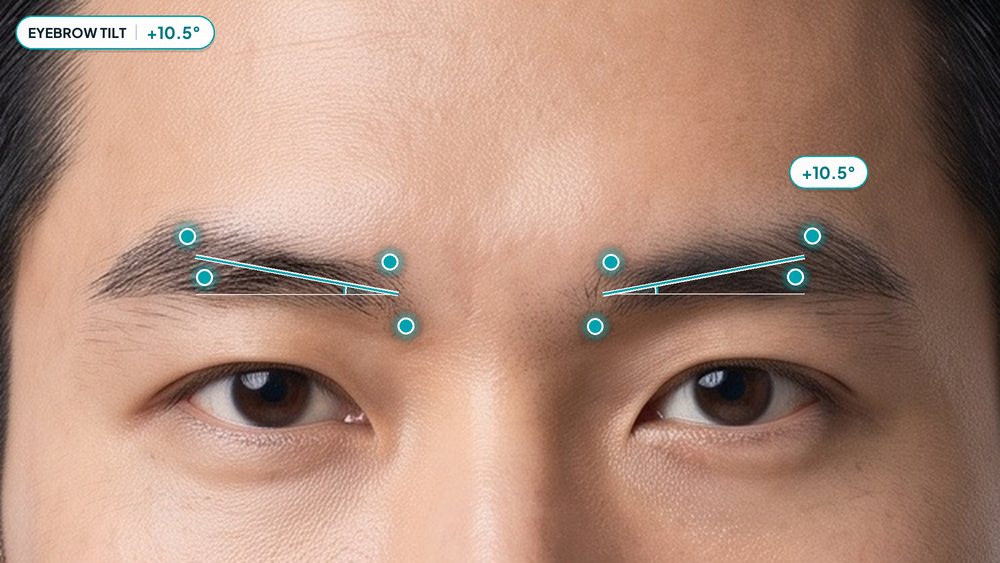
A millimeter or two of grooming at the arch can tip a brow into the next shape.
Types of eyebrow shapes, from straight to high arch
Of the six types of eyebrows, straight, soft arch and high arch sit on one tilt scale. The other three, rounded, S-shaped and rising, describe the curve and the tail, and you judge those by eye.
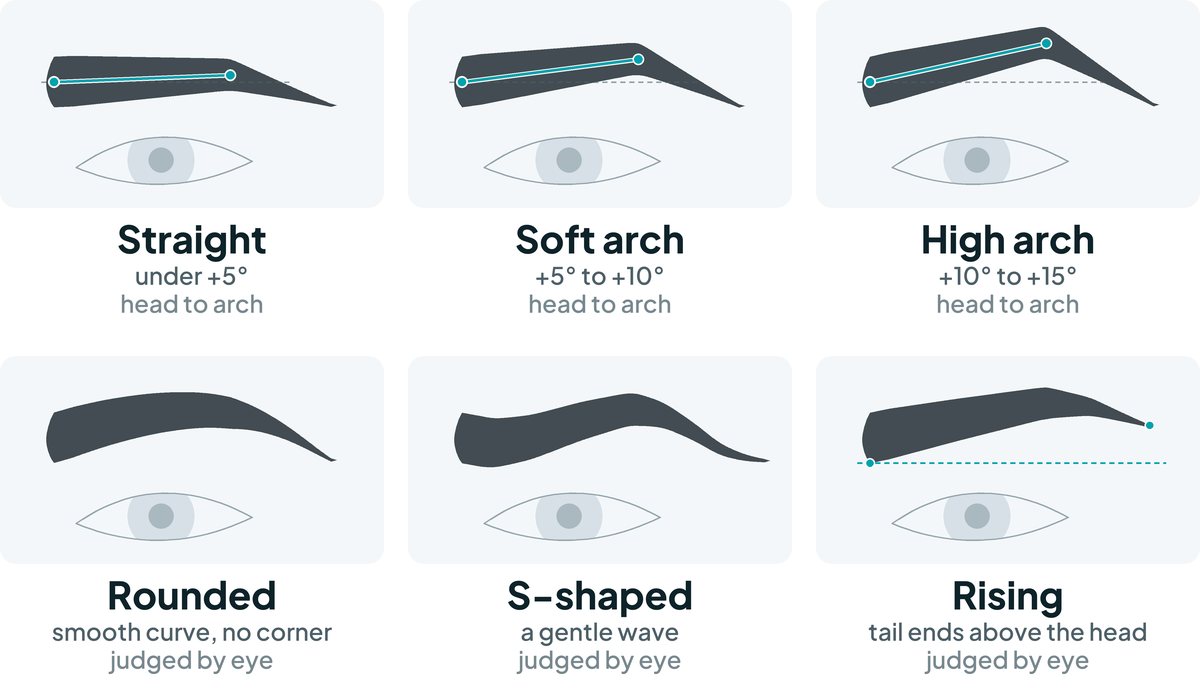
| Shape | Head-to-arch tilt | Arch above the head, on a typical 28 mm run | What it looks like |
|---|---|---|---|
| Straight (flat) | under +5° | under 2.5 mm | Head and arch at almost one height. Great to Fair for men, below the women’s range |
| Soft arch | +5° to +10° | 2.5 to 5 mm | A gentle lift to a soft peak. Most of the men’s range, and three of the four brows in our figures |
| High arch (hard angled) | +10° to +15° | 5 to 7.5 mm | A clear lift to a defined peak. The women’s range. The steepest of our four reads +10.5° |
| Rounded | any | not measured | A smooth curve with no corner at the peak |
| S-shaped | any | not measured | A gentle wave: flat or slightly dipped head, lifted arch, tail curving down and out |
| Rising (upward) | any | any | The tail tip ends clearly above the lower edge of the brow head. The brow in our first figure just qualifies, its tip 2.5 mm above, though still below the middle of its head |
Two cases sit off the table. A very high arch, over +15 degrees, is past both ranges. And a falling tail, one whose tip ends clearly lower than the bottom edge of the brow head, can turn up on any shape. Every tail drops from its arch, but none of our four drops that far.
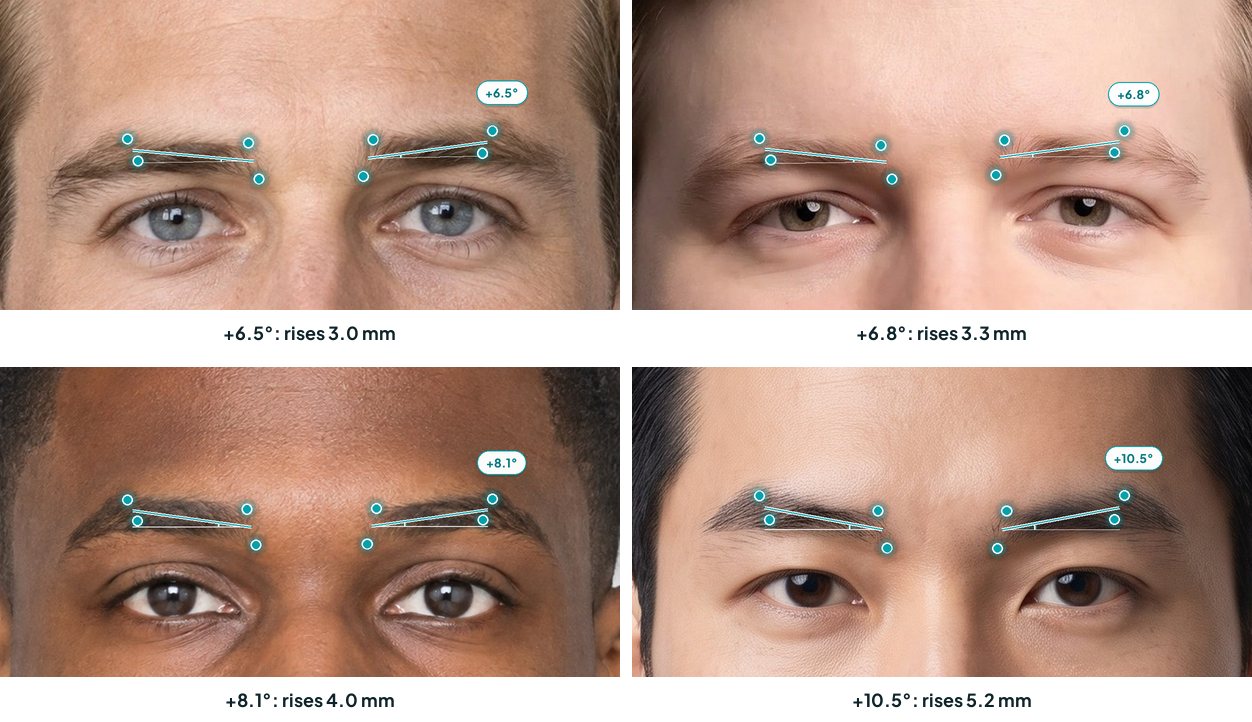
Positive and negative eyebrow tilt
Your report never names a shape. It scores the head-to-arch line out of 10 against your ideal range: Ideal inside it, then Great, Good, Fair or a focus area the further out it falls. Positive tilt means the arch sits higher than the brow head, and negative means lower. The ideal range is +6.5 to +11 degrees for men and +10.5 to +15 for women. Too steep costs points too: for a man, anything above about +14 is no longer Great.
A dead-flat brow scores 4.3 out of 10 (Fair) for a man and 1.4 (a focus area) for a woman. Negative tilt scores lower still. On the men’s range it’s Fair at best and becomes a focus area below about -0.4 degrees. On the women’s range anything under +3.7 is already a focus area, negative or not. None of the brows we measured came close. The flattest reads +6.5.
The slope of the tail doesn’t count. The tilt stops at the arch, so a brow can droop at the end and still read positive, as all four of these do.
Shape changes the mood your face shows at rest. In a study that edited one face 16 ways, a dropped outer brow read as tired, a raised outer brow as surprised, and a lowered inner brow with frown lines as cross. The brow’s shape moved the mood more than its height did.3
Best eyebrow shape for your face shape
No brow shape belongs to one face shape. The one study we found that tested the charts head-on morphed five models into round, square, oval and long faces, then asked 78 people to choose between a brow drawn for the face shape and a classic one.2
| Face shape | Usual chart advice | What that test found |
|---|---|---|
| Round | A lifted, angled arch | No difference from a classic brow |
| Oval | A soft arch; most shapes work | No difference |
| Long (oblong) | Flatter, straighter brows | A flatter brow, preferred by 58.7% of raters |
| Square | A soft curve | More curve toward the outer end, preferred by 62.7% |
| Heart | A soft rounded arch (one salon page says a high arch) | Not tested |
| Diamond | Rounded or a soft curve | Not tested |
There’s no single best brow either. Raters up to 30 marked down an arched brow that peaks in the middle, the version raters over 50 liked best.5 In another study, a moderately curved brow beat both the least and the most curved versions tested.6 Both rated a handful of women’s faces only, so for men they’re a hint at best.
Our own four men don’t line up with the charts. The longest face has the flattest brow, +6.5, as a chart would want. But the roundest, the man in our sample report, has the next flattest, +6.8, where a chart would draw a lifted arch. Both score Ideal. Four faces prove nothing, but they show how loosely brows track face shape.
Here’s what we’d do, and it’s styling, not research. Stay inside your tilt range and let face shape decide only where in it. A round face can take the top of the range if you want the lift the charts promise, with the tail kept long. A long face suits the flatter end. On a square or diamond face, soften the peak into a curve so it doesn’t add another corner. Heart and oval faces can wear almost anything in range. If you’re not sure which face shape you have, find it in three steps from one photo.
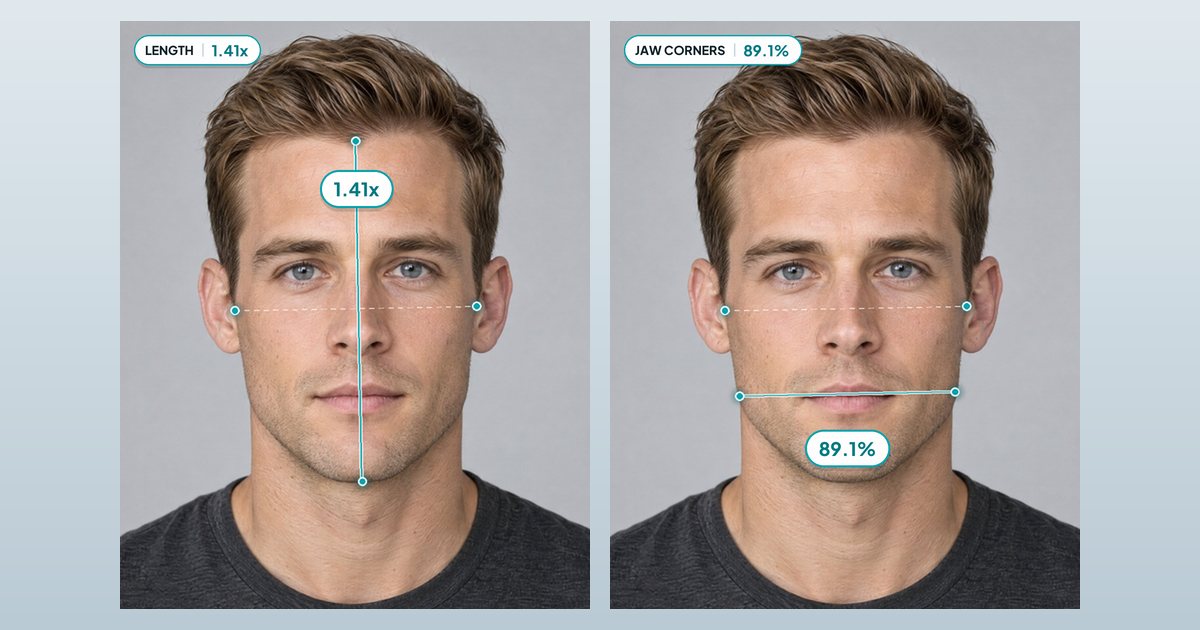
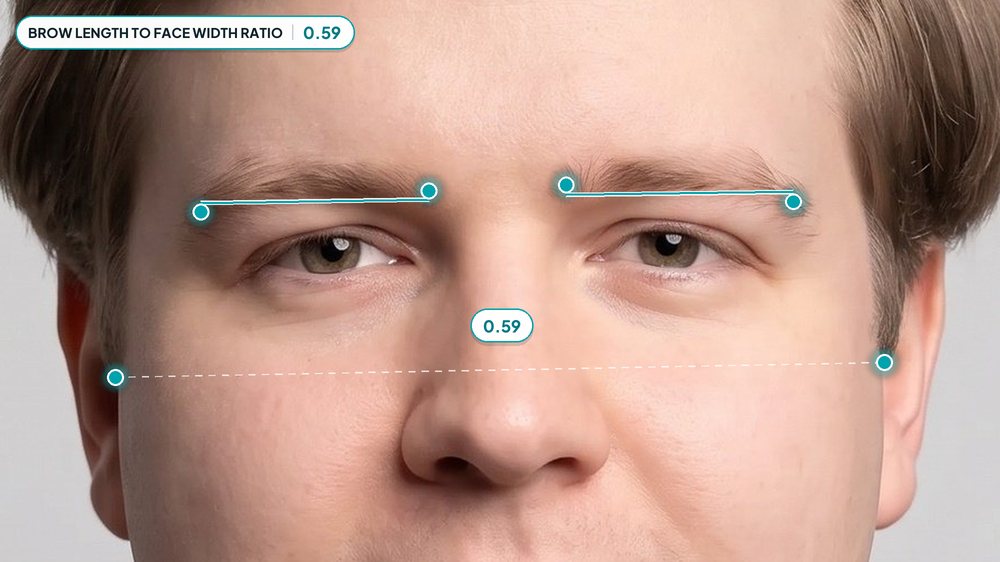
Our engine links brows to face shape in one way only, through width. It divides brow length by cheekbone width, so a wider face, as round faces often are, needs longer brows for the same balance. None of the men in our figures reaches the men’s ideal of 0.69 to 0.76. Their brows run 0.59 to 0.62, which is why the tail gets so much attention further down.
Eyebrow shape for your eye shape
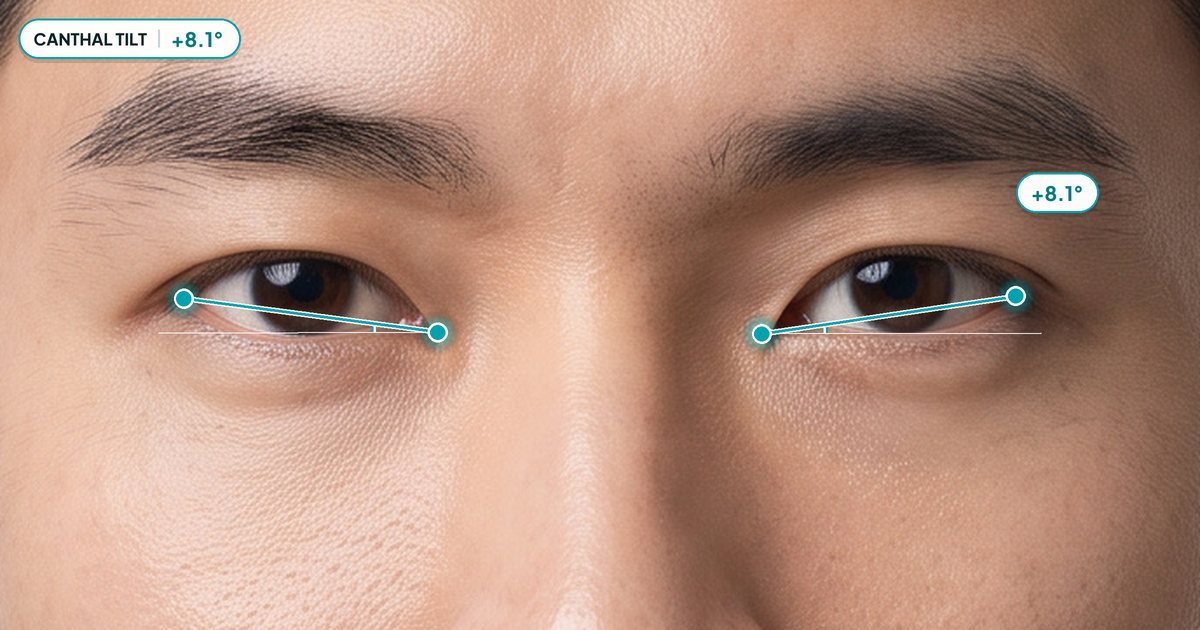
Start from the line through your eye corners and let the brow rise a little more steeply. On every man we measured, including the one in our sample report, the brow line rose 2.5 to 4.8 degrees more than the tilt of their eye corners. Our standard ideal ranges lean the same way: the middle of the men’s brow range sits 1.9 degrees steeper than the middle of their eye-corner range, and the women’s 5 degrees steeper.
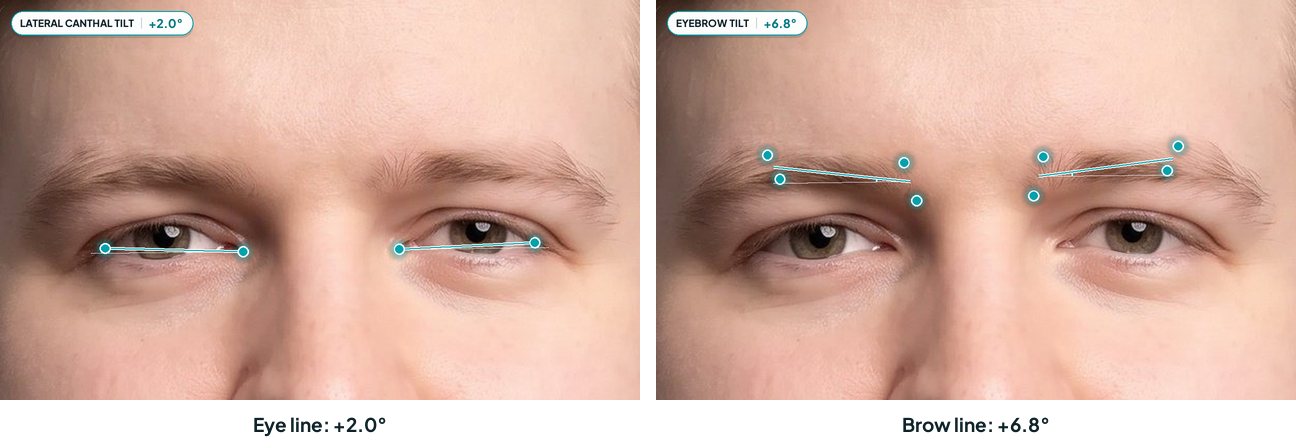
Each eye shape then needs one small change.
If your eye corners sit level or turn down, keep the peak two-thirds of the way along and end the tail no lower than the lower edge of the brow head, because a dropped outer brow reads tired.3 The negative canthal tilt guide covers the frames that help too.
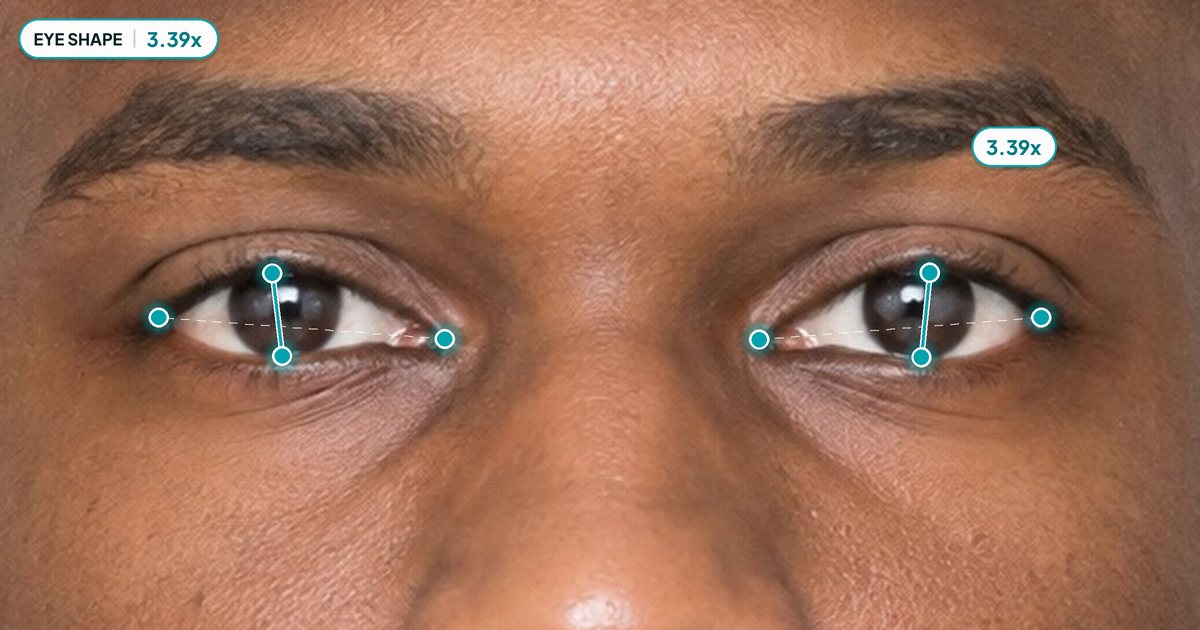
Upturned eyes are the easy case. The eye line already lifts, so the brow needs less extra rise. The man in our first figure has the most upturned eyes of our four, +8.1 degrees at the corners, and his brow rises only about 2.5 degrees more, to +10.5.
With hooded eyes, take strays from under the arch, a hair at a time, so a little more lid shows, and leave the rest of the brow full. Our report’s own tip for eyelid hooding starts with “Tidy brows with a clean arch”. Men should stop at the strays. A hair or two shows more lid, and a new lower edge makes the brow look done.
For close-set or wide-set eyes, start the brow just past the inner eye corner, toward the nose. With close-set eyes, don’t start any closer to the nose than that. With wide-set eyes, fill a sparse head in toward the nose until it reaches that point. The anchor follows your own eye spacing, while a start taken from the nose ties your brows to your nose width.
These tips come from four measured faces and the ideal ranges. We found no study that tests them.
Eyebrow shapes for men and women
Men’s brows are usually flatter and sit lower, on the bony rim above the eye.8 Women’s rise more toward a peak, and a review puts them a few millimeters higher, above the rim.9 Our ideal ranges, taken from facial-proportion research, turn the tilt half of that into numbers and add a range for length.
That picture of men’s brows comes from a study that measured, rather than rated, 300 White male professional models, and it adds one detail: the peak sits toward the outer end.8
| Measurement | Men | Women |
|---|---|---|
| Brow tilt, head to arch | 6.5 to 11° | 10.5 to 15° |
| Arch above the head, on a 28 mm run | 3.2 to 5.4 mm | 5.2 to 7.5 mm |
| Brow length ÷ cheekbone width | 0.69 to 0.76 | 0.65 to 0.72 |
| Where the brow sits (from research, not our ranges) | On the bony rim above the eye | A few mm above the rim |
Your report does score the gap from pupil to brow head, but at low confidence, so it never becomes a strength or focus area.
For a man, the best shape is usually the one he grows, tidied toward a soft arch and kept full.
Full or thin? Fuller, by a small margin. In a study of 922 raters, most around 20, thicker brows made faces look more attractive, women’s faces a little more than men’s. They also made faces look more masculine.7 That’s why fuller brows are on our list of what makes a face look masculine. The old idea that women look better with thin brows gets no support from it.
For women, the range asks for more lift, a high arch. We’d pair it with a full head, a peak about two-thirds of the way out and a tail no lower than the head’s lower edge. The arched-brow steps below get you there without overdoing it. A dead-straight brow lands as a focus area on the women’s range. That’s one line out of the 65+ in the report, and straight brows are a deliberate, popular look, so if you like yours, keep them.
Measure your eyebrow shape on a photo before you pluck
One level photo and two dots per brow give you a rough read of your shape, and the same photo becomes your before shot.
- Have a friend shoot from 1.5 m (5 feet) with the rear camera at eye height, zoomed in. Arm’s-length selfies change a face’s proportions, and at 1.5 m the effect is essentially gone.10
- Keep your chin level, eyes on the lens and brows relaxed, with hair and glasses off the brows. Raised brows or a frown change the reading.
- Rotate the photo until your pupils sit on one level line. That’s the line our engine measures against.
- Put two dots on each brow. The first goes on the lower edge of the brow head, where its lowest hairs are. The second goes in the middle of the brow at the arch, two-thirds of the way along, roughly above a point 3 mm inside your outer eye corner. That’s close to where our engine’s line runs, as the first figure shows.
- Measure the run along the level line and the rise, which is how much higher the arch dot sits. You can count pixels in any photo editor that shows the cursor position or use a ruler on the zoomed-in screen, because only the ratio matters. Divide the rise by the run and find your shape in the table below. The brow in our first figure works out at 0.19 (5.2 mm over 28 mm), just into a high arch and at the top of the men’s range.
- Do both brows and average them. Each man’s two brows were within 0.4 degrees of each other. If yours differ by several degrees, retake the photo. If the gap stays, your brows may simply differ, which is common.
- Check the tail. A review puts its tip at about the height of the brow head,9 and as a grooming rule we keep it no lower than the head’s lower edge. On our four men it ran about 12 mm past the outer eye corner. Keep this photo, and retake it the same way after you groom.
| Rise ÷ run | Angle, with a protractor or angle app | Reads as |
|---|---|---|
| under 0.09 | under 5° | Straight |
| 0.09 to 0.18 | 5° to 10° | Soft arch |
| 0.18 to 0.27 | 10° to 15° | High arch |
| over 0.27 | over 15° | Very high |
| 0.11 to 0.19 | 6.5° to 11° | Men’s ideal range |
| 0.19 to 0.27 | 10.5° to 15° | Women’s ideal range |
Your report reads a similar line from a 478-point face mesh. The mesh follows the brow’s overall position, so a few stray hairs won’t move it, but a reshaped arch can. Its head point sits low in the brow head, which is why step 4 puts your dot on the lower edge. Dot the middle of the head instead and the brows in our figures read several degrees flatter. Treat a hand reading as a before-and-after check, not a forecast of your score. How it works shows where the report places its points.
Brow mapping with a pencil, checked on four measured brows
The three-line pencil method is a decent rough map but a poor set of cut lines. Trimming to it would have shortened every brow we measured, and by our length range they were already a little short.
Salon and brand pages teach this version. Hold a pencil straight up from the side of the nostril: the brow starts there. Angle it through the outer edge of the iris, or the pupil in some versions: that’s the peak. Angle it through the outer eye corner: that’s where the tail ends. The textbook version is credited to the makeup artist Westmore. When 50 makeup artists rated it against two newer maps that put the arch further out, none came out ahead.4
We placed those lines on the four men using the engine’s points.
The tails ran long. Every natural tail went 2.5 to 6 mm past the tail line. Cutting there would take one man’s brow length from Good (7.2) to a focus area (3.1), and would leave every one of them at Fair or below.
Step 2 of his plan in our sample report says it plainly: “Keep the natural length of your brows and avoid shortening the outer ends.”
The heads started early, 4 to 6.5 mm closer to the nose than the nostril line, partly because each of these men has a nose wider than the gap between his eyes. The inner eye corner is the steadier guide. Every head started 2 to 3 mm in from it, toward the nose.
The peak landed between the lines. The point our engine treats as the arch sits 64 to 65% of the way along, past the pupil line, a few millimeters inside the iris-edge line and 2 to 4 mm inside the outer eye corner. The classic rule puts the peak above the outer edge of the iris,9 and a rating study of women’s faces liked it best halfway from there to the outer eye corner on Caucasian faces, and above the corner on Asian faces.6
Use the pencil to spot strays and trust your own tail for length. For where the brow starts, go by your inner eye corner, since the nostril line moves with your nose width.
How to shape your eyebrows at home in 10 minutes
Most of a good shape is removing less, which is why the scissors come before the tweezers and the tail keeps its length.
- Work in daylight with clean, dry brows, a spoolie, small scissors, slanted tweezers and a brow pencil. Lightly outline the shape you want, so anything outside it is a stray.
- Brush the hairs up and snip only the tips that pass the top edge, a little at a time.
- Tweeze between the brows and the strays well below them, one hair at a time, in the direction of growth. Leave the top edge alone on the first pass.
- Keep the tail’s length. If it’s sparse, fill it with short strokes inside its natural line.
- Every few hairs, step back and compare both sides. You can always take one more hair tomorrow.
- Set the hairs with a clear or tinted brow gel.
Go slowly when you’re close to the line between two shapes. At the arch, the reading follows the middle of the brow, so taking 1 mm off the underside moves that middle only half a millimeter, at most about 1 degree on our estimate.
How to get straight eyebrows
Stop plucking under the arch. Fill under it with pencil or powder so the lower edge runs level, keep the tail tip level with the lower edge of the head, and brush the head hairs up with gel. Filling 1 mm under the arch flattens it by about 1 degree.
How to get arched eyebrows
To arch your eyebrows, take strays only from under the outer third. Keep the peak two-thirds of the way along, add a little fill above it, and never thin the brow head. Stop well short of a steep arch. Over-raised brows look surprised, and a low inner brow under a high peak reads cross.93 For a lifted, siren-style brow, change the arch by a millimeter or two and leave the rest where it is.
How to shape eyebrows for men
For most men, steps 2 and 3 are the whole job, and then you stop. That’s why brows are one of the quickest wins in a glow-up: 10 minutes with scissors and tweezers is usually all a man’s brows need. Leave the underside of the arch alone, apart from the odd stray. Plucking there steepens the tilt, and in our view a steep, clean arch is what makes a man’s brows look “done”.
Eyebrow shaper, tweezers, wax or threading
Start with tweezers. They take one hair at a time, which is the right speed when a millimeter changes the reading. An eyebrow shaper, a small guarded razor, is for fuzz and strays outside your outline, never the edges or the tail. Draw your outline first, hold the skin taut and use short, light strokes with the growth, well away from the eye.
Wax and threading take many hairs in one pass, so if you book either, go with your outline drawn and ask them to leave the tail. Tinting darkens light hairs and lamination sets them brushed up. Neither adds or removes hair, so shape first. On fair brows, a tinted brow gel adds definition without looking done. It’s the tip our report gives with its brow color rating.
If you change one habit, leave your tails alone. Every brow in our figures was already a little short for its face by our length range. If you’ve already taken too much, fill inside your natural line with pencil and keep the tweezers away from that spot. Take your level photo today, groom, and retake it the same way in a week.
Questions people ask
What eyebrow shape is best for me?
Usually the one that follows your natural growth, tidied and kept inside your range (6.5 to 11 degrees of tilt for men, 10.5 to 15 for women). For most men that's a soft arch, for most women a high arch that peaks about two-thirds of the way out. Research hasn't settled on one best shape. Our working rule, from four measured faces and our ideal ranges, is a brow that rises a little more steeply than the line through your eye corners.
What eyebrow shape suits a round face?
The usual advice is a lifted, angled arch. But in the one study we found that compared face-shape brows with a classic brow, round faces showed no difference between the two. If you want the lift, go to the top of your range (6.5 to 11 degrees for men, 10.5 to 15 for women) and stop there. Keep the tail long too, since a wider face needs a longer brow for the same balance.
Are straight or arched eyebrows more attractive?
Neither wins outright. In one rating study, a moderately curved brow beat both the least and the most curved versions tested; a dead-flat brow wasn't among them. Taste shifts with age too: in another, raters up to 30 ruled out an arched brow that peaks in the middle, while raters over 50 preferred it. Our ideal ranges put men's brows flatter (6.5 to 11 degrees) and women's steeper (10.5 to 15). A straight brow scores lower on that one line, but it's a deliberate style.
Where should the arch of my eyebrow be?
About two-thirds of the way along the brow. The classic rule puts it above the outer edge of the iris, and a rating study of women's faces liked it a little further out, halfway to the outer eye corner or above it. A study of male models found the peak toward the outer end. On the four men we measured, the point our engine treats as the arch sits 64 to 65% along, 2 to 4 mm inside the outer eye corner.
How should men shape their eyebrows?
Mostly by removing less. Three jobs cover it: clear the gap between the brows, take the odd hair well below them and snip long hairs that stick up past the top edge. Leave the underside of the arch alone, apart from the odd stray, because plucking there steepens the brow, and in our view a steep arch is what makes a man's brows look done. The men's ideal tilt is 6.5 to 11 degrees, flatter than the women's 10.5 to 15.
How do you shape eyebrows with an eyebrow shaper?
An eyebrow shaper is a small guarded razor for clearing fuzz and strays outside your brow line. Outline your shape with a brow pencil first. Hold the skin taut, use short, light strokes in the direction of growth, and keep the blade well away from your eye. Never run it along the tail: every brow we measured was already a little short for its face by our length range, and shaving the tail shortens it further. Trim long tips with small scissors instead, and use your own blade only.
How do I know what eyebrow shape I have?
Take a level photo from about 1.5 m with relaxed brows, and rotate it so your pupils sit level. Mark the lower edge of each brow head and the middle of the brow at the arch, two-thirds of the way along. Divide the rise by the run. By our rule of thumb, under 0.09 reads straight, 0.09 to 0.18 a soft arch and 0.18 to 0.27 a high arch. Treat a hand reading as a rough guide. Rounded, S-shaped and rising brows you judge by eye.
Sources
-
Sadr J, Jarudi I, Sinha P. The role of eyebrows in face recognition. Perception. 2003;32(3):285-293. doi:10.1068/p5027. Abstract on PubMed ↩
-
Baker SB, Dayan JH, Crane A, Kim S. The influence of brow shape on the perception of facial form and brow aesthetics. Plast Reconstr Surg. 2007;119(7):2240-2247. doi:10.1097/01.prs.0000260771.76102.6c. Abstract on PubMed ↩↩
-
Knoll BI, Attkiss KJ, Persing JA. The influence of forehead, brow, and periorbital aesthetics on perceived expression in the youthful face. Plast Reconstr Surg. 2008;121(5):1793-1802. doi:10.1097/prs.0b013e31816b13fe. Abstract on PubMed ↩↩↩
-
Hamamoto AA, Liu TW, Wong BJ. Identifying ideal brow vector position: empirical analysis of three brow archetypes. Facial Plast Surg. 2013;29(1):76-82. doi:10.1055/s-0033-1333841. Abstract on PubMed ↩
-
Feser DK, Gründl M, Eisenmann-Klein M, Prantl L. Attractiveness of eyebrow position and shape in females depends on the age of the beholder. Aesthetic Plast Surg. 2007;31(2):154-160. doi:10.1007/s00266-006-0149-x. Abstract on PubMed ↩
-
Zeng R, Moellhoff N, Cotofana S, Giunta R, Wiggenhauser S, Glaue E, Yi KH, Philipp-Dormston WG, Merkel C, Frank K. A gaze into the eyebrow standards of Asian versus Caucasian women. Aesthetic Plast Surg. 2024;48(23):4725-4734. doi:10.1007/s00266-024-04240-6. Abstract on PubMed ↩↩
-
Mogilski JK, Welling LLM. The relative contribution of jawbone and cheekbone prominence, eyebrow thickness, eye size, and face length to evaluations of facial masculinity and attractiveness: a conjoint data-driven approach. Front Psychol. 2018;9:2428. doi:10.3389/fpsyg.2018.02428. Full text on PMC ↩
-
Pietruski P, Majak M. The male eyebrow and eyelid: an anthropometric analysis of White professional models. Plast Reconstr Surg. 2023;152(2):248e-256e. doi:10.1097/prs.0000000000010253. Abstract on PubMed ↩↩
-
Yalçınkaya E, Cingi C, Söken H, Ulusoy S, Muluk NB. Aesthetic analysis of the ideal eyebrow shape and position. Eur Arch Otorhinolaryngol. 2016;273(2):305-310. doi:10.1007/s00405-014-3356-0. Abstract on PubMed ↩↩↩↩
-
Ward B, Ward M, Fried O, Paskhover B. Nasal distortion in short-distance photographs: the selfie effect. JAMA Facial Plast Surg. 2018;20(4):333-335. doi:10.1001/jamafacial.2018.0009. Full text on PMC ↩
Spotted a mistake? Email support@faceratinglab.com and we will fix it.