Wide nose: how wide is too wide, and how to make it look narrower
Your nose counts as wide on our scoring when its base is more than 1.16 times the gap between your inner eye corners (1.06 for a woman), which is where our ideal range ends. A reading a little over 1.0 is normal, but take it from a photo shot at 1.5 m: a selfie from 30 cm makes a nose measure about 30% wider against the cheekbones.
The short version
- A nose a little wider than the gap between your eyes is the normal case. It was wider in 88% of 100 adults photographed from 1.5 m, and our ideal range for men already starts above an even match, at 1.04.
- Close-set eyes push the reading up the same way a wider nose does. Two of our men read 1.27 and 1.08, and about 83% of that difference comes from their eye spacing.
- Check yours on a photo from 1.5 m (5 feet) with a relaxed mouth, since a full smile alone spreads the nostril wings by about 4 mm. Zoom until your inner-eye gap spans 3 cm on a ruler: a base of 3.12 to 3.48 cm is in range for a man, 2.82 to 3.18 cm for a woman.
- Once the photo is right, the one other tip with a study behind it is skilled, blended contour. Glasses and brows are styling, and we found no study showing exercises, clips or taping change nose width.
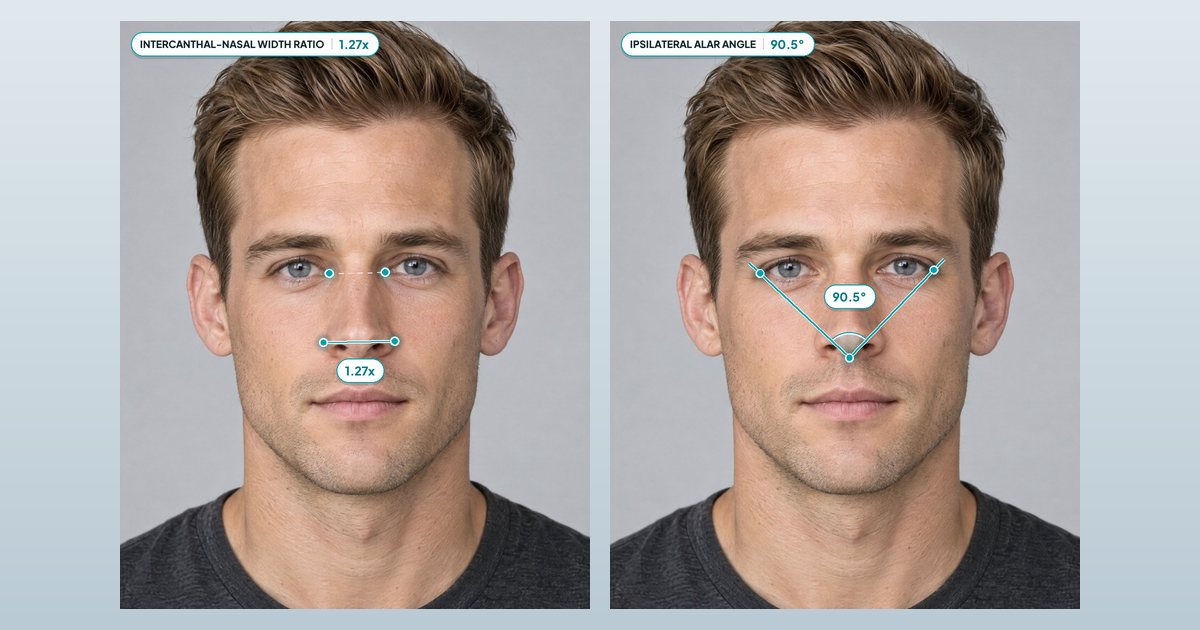
- The ipsilateral alar angle never touches your nostrils. It's the angle at the bottom of your nose between lines to your outer eye corners, ideal at 86.5 to 92.5 degrees for men and 87.5 to 93.5 for women.
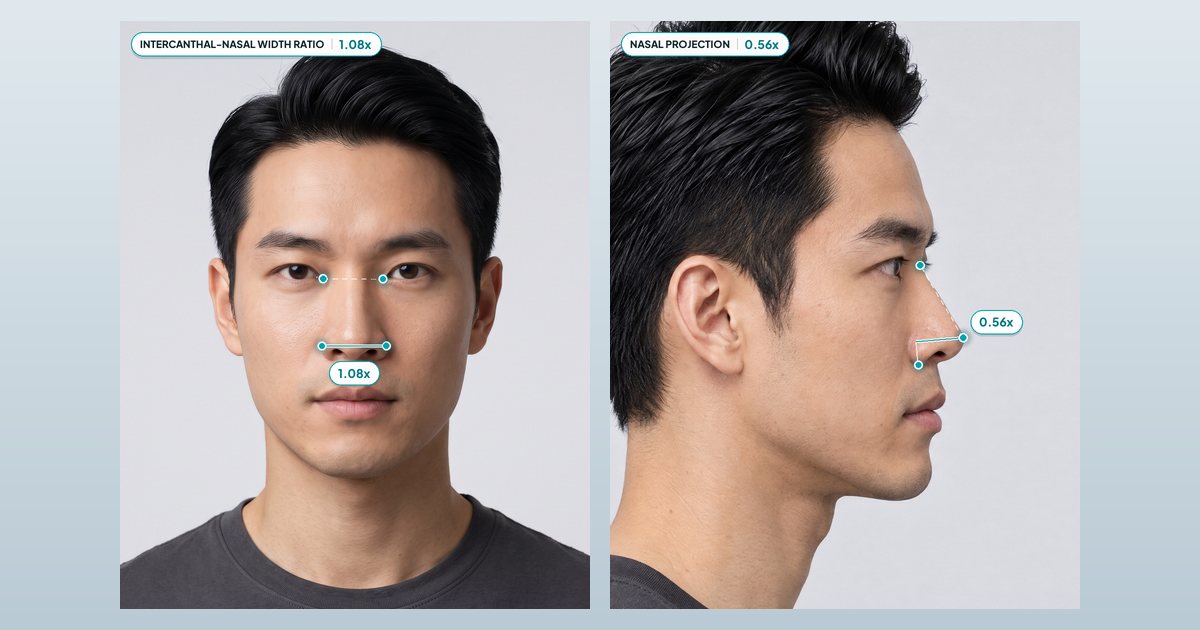
Three of the four men we measured for this guide have a wide nose by the men’s cut-off of 1.16 times the inner-eye gap. They read 1.20, 1.26 and 1.27, and even the widest still scores Good on it. The 1.20 belongs to the man in our sample report, and his report scores it Great, 9.3 out of 10.
Part of the number isn’t nose at all. Our man at 1.27 and our man at 1.08 have almost the same nose for their faces. The first one’s eyes just sit closer together.
So before you decide you have a broad nose, rule out your eye spacing and the camera. If you still want it to look narrower, start with the photo, then blended contour.
What is considered a wide nose?
For a man, a nose base wider than 1.16 times the gap between the inner eye corners counts as wide on our scoring. For a woman the line is 1.06. We take the base across the outer edges of the nostril wings, the alar width. The report calls this the Intercanthal-nasal width ratio, and draws a solid line across the wings and a dashed one between the eye corners. It never calls your nose wide. You get the number and a label, from Ideal down to Focus area. We’ll call it the width ratio from here.
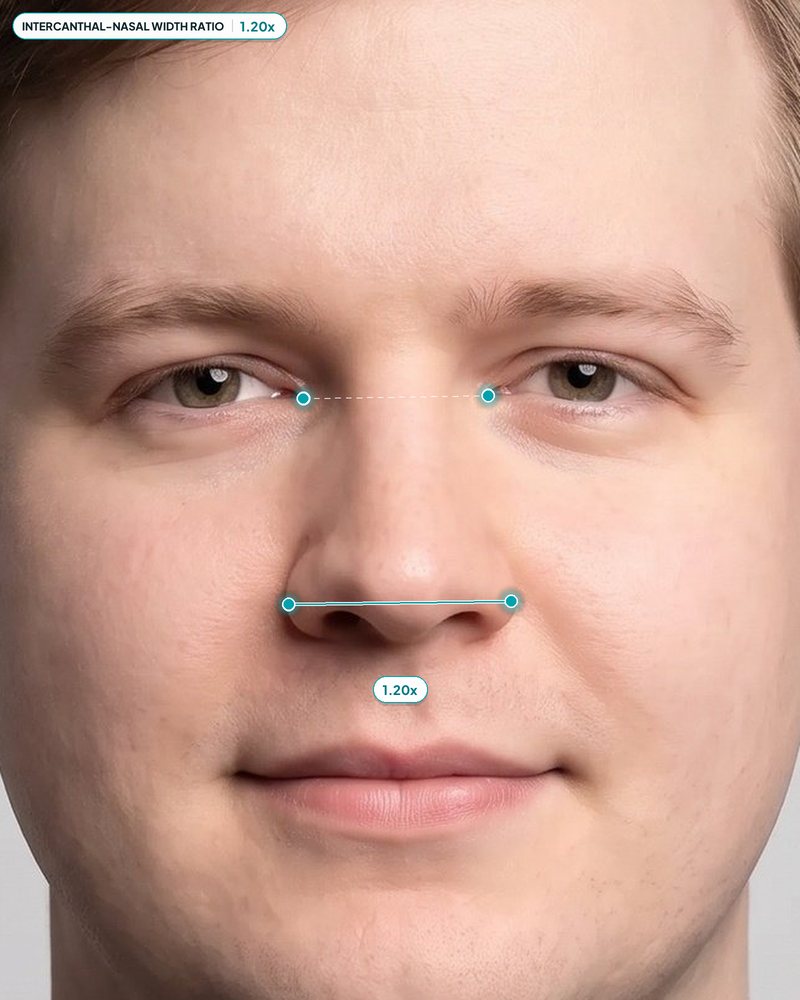
No study we found sets a cut-off for a nose being too wide for the eye gap. Ours is simply where our ideal range ends: a scoring line, not a medical one. Past it, the labels step down slowly:
| Report label | Men | Women |
|---|---|---|
| Ideal | 1.04 to 1.16 | 0.94 to 1.06 |
| Great | up to about 1.24 | up to about 1.14 |
| Good | up to about 1.29 | up to about 1.19 |
| Fair | up to about 1.34 | up to about 1.24 |
| Focus area | above about 1.34 | above about 1.24 |
So the ideal nose width for a man starts a little wider than his eye gap, and for a woman it’s centered on an even match.
The old rule says your nose should match the gap between your eyes. Don’t hold yourself to an exact match, because most faces miss it, and our ranges leave room on either side. The rule held for 40% of 153 adults in the classic study that tested it,1 and for about 1 in 5 of 1,050 in a later one.2 In 168 students, the nose was the wider of the two in 92% of men and over half the women.3
The study closest to how our report works photographed 100 adults from 1.5 m, and the nose was wider than the eye gap in 88% of them.4 Their averages, 1.17 for men and 1.13 for women, sit past our ideal tops but inside Great, so a slightly wide reading is the ordinary one. We go through that study in our nose type check.
Men’s noses run about 3 to 4 mm wider on average,5 while the gap between the eyes is about the same in both sexes.3 Our women’s range sits lower to match. The range in your own report can also shift by a few hundredths with the heritage you choose at upload.
Why close-set eyes can make a nose measure wide
People often call it the nose width to eye width ratio, but it uses the gap between your inner eye corners, not the width of one eye. Since the ratio divides one width by the other, a narrower eye gap raises it the same way a wider nose does. Our report says as much on the measurement: it can’t tell the two apart.
Man B and Man D show how far that goes. Measured against the width across their cheekbones, their noses are almost the same size, 27.5% and 26.7%. But Man B’s inner eye corners sit closer together, at 21.6% of that width against 24.9%. His ratio reads 1.27, which counts as wide. Man D’s reads 1.08, inside the range.
About 83% of the difference between those two numbers comes from the eye spacing. Only about 17% comes from the nose.
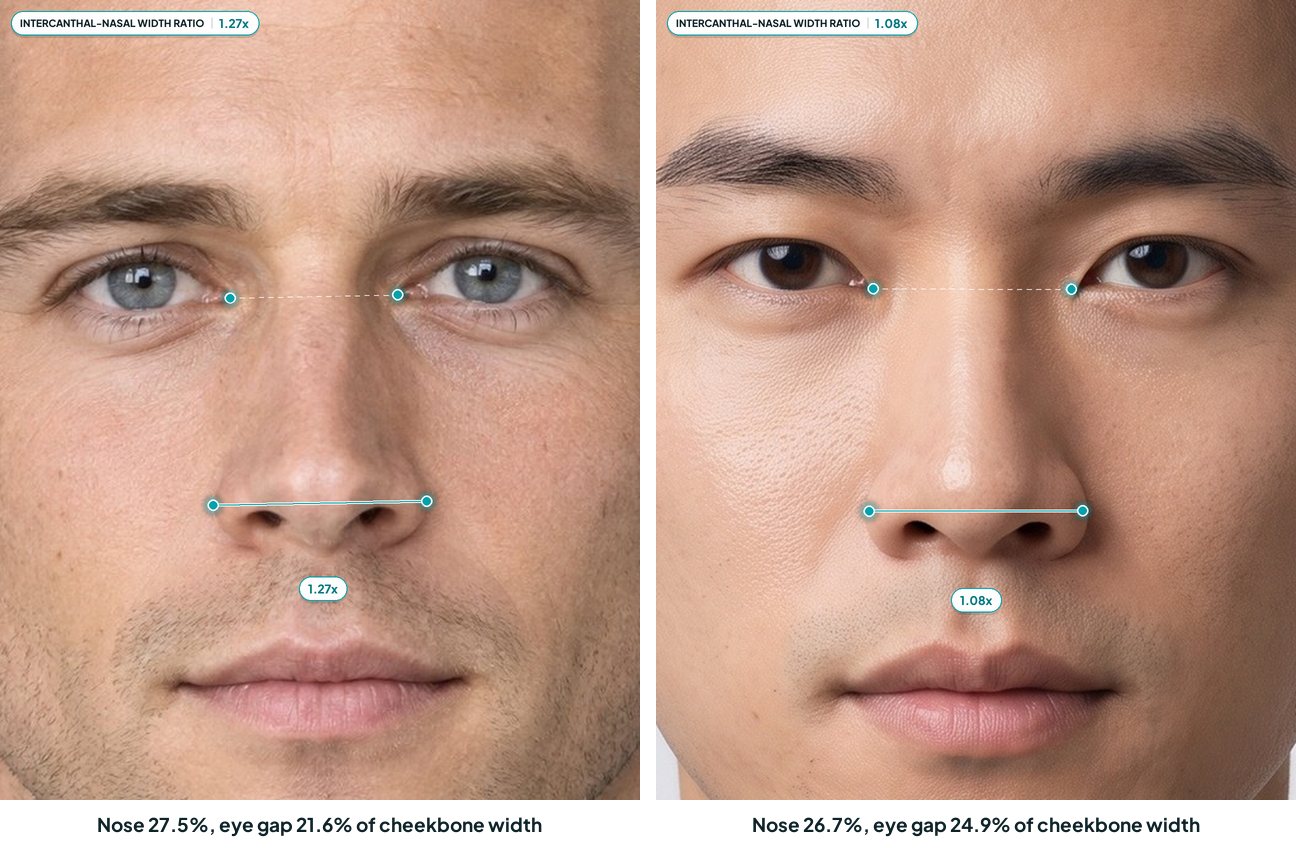
Man C is the opposite case. His nose base is the broadest of the four, 29.9% of his cheekbone width, but his eye gap is wider than Man B’s too (23.7% against 21.6%), so he reads 1.26, just under B. The cheekbone shares are our own arithmetic from the points the report draws.
| Man | Width ratio (report label) | Nose base, % of cheekbone width | Inner-eye gap, % of cheekbone width |
|---|---|---|---|
| A (sample report) | 1.20 (Great) | 26.1% | 21.7% |
| B | 1.27 (Good) | 27.5% | 21.6% |
| C | 1.26 (Good) | 29.9% | 23.7% |
| D | 1.08 (Ideal) | 26.7% | 24.9% |
If your eyes sit on the close side, they may be doing most of the work in your reading. Step 6 of the self-check below shows how to tell, and our guide to close-set eyes shows how the eye gap is measured.
Why your nose looks wider in selfies and when you smile
A close camera and a full smile both widen your nose on a photo, and the smile alone can carry an in-range nose past our 1.16 line.
A phone held 30 cm (12 inches) away makes a nose measure about 30% wider against the cheekbones than a photo from 1.5 m (5 feet), where the effect is gone.5 That’s camera geometry, calculated rather than measured on real photos. Your nose hasn’t changed. Our width ratio rises too, by an amount we haven’t measured.
Then the smile, which pulls the nostril wings outward. In 50 adults, mostly women, photographed both ways, the width across the outer edges of the wings grew in 48 of them, by about 4 mm on average, roughly a tenth.6 By our arithmetic, a man at 1.10 at rest would read about 1.22 in a full smile if his eye gap stays put.
If you check one thing before deciding your nose is wide, check how far away the camera was. The photo setup in our nose type guide covers the rest.
Nose too wide for your face? Check your mouth and your bridge
“Too wide for your face” always means wide next to something. Besides your eyes, our report checks two other neighbors: your mouth and your bridge.
Start with the mouth. The Mouth-to-nose width ratio divides the width between your mouth corners by your nose base. Our range is 1.42 to 1.50 for men and 1.52 to 1.60 for women. Our four men run 1.29 to 1.45, and three of them sit below the range. The one inside, Man A, has a slight smile in his photo, which widens the mouth, so measure yours relaxed.
Against his eye gap, Man D’s nose is the narrowest of the four. Against his mouth it’s the widest: his mouth is 1.29 nose bases across, which his report labels Fair. This ratio has the same catch as the eye gap, since a narrower mouth lowers it just as a wider nose does.
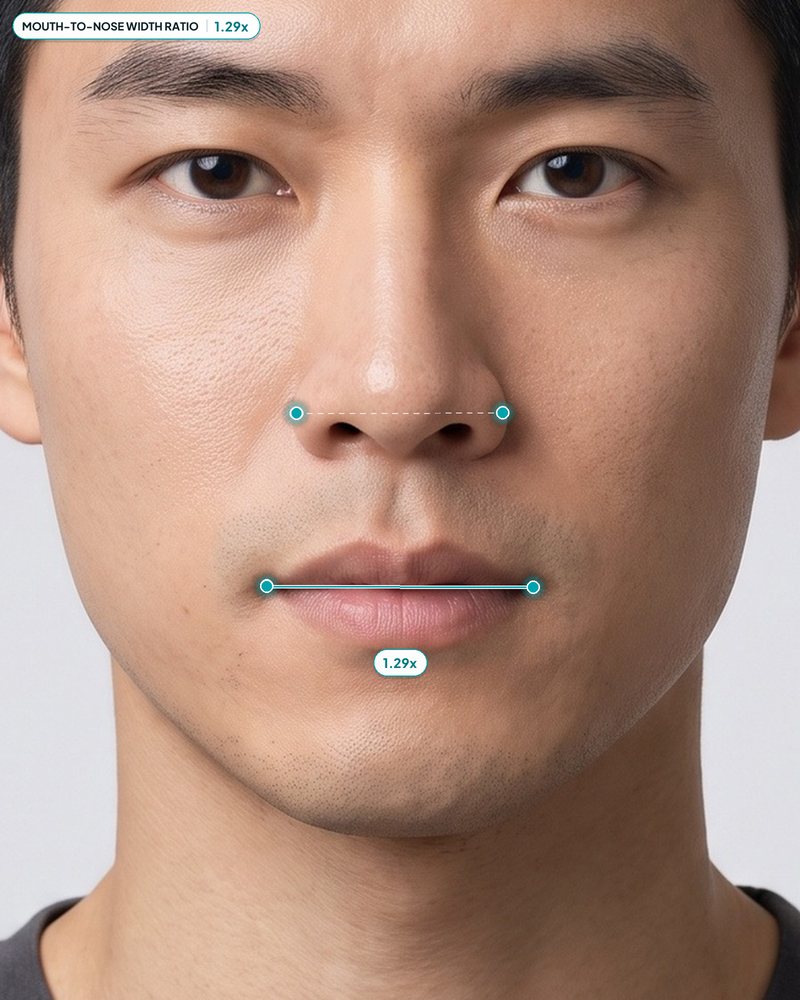
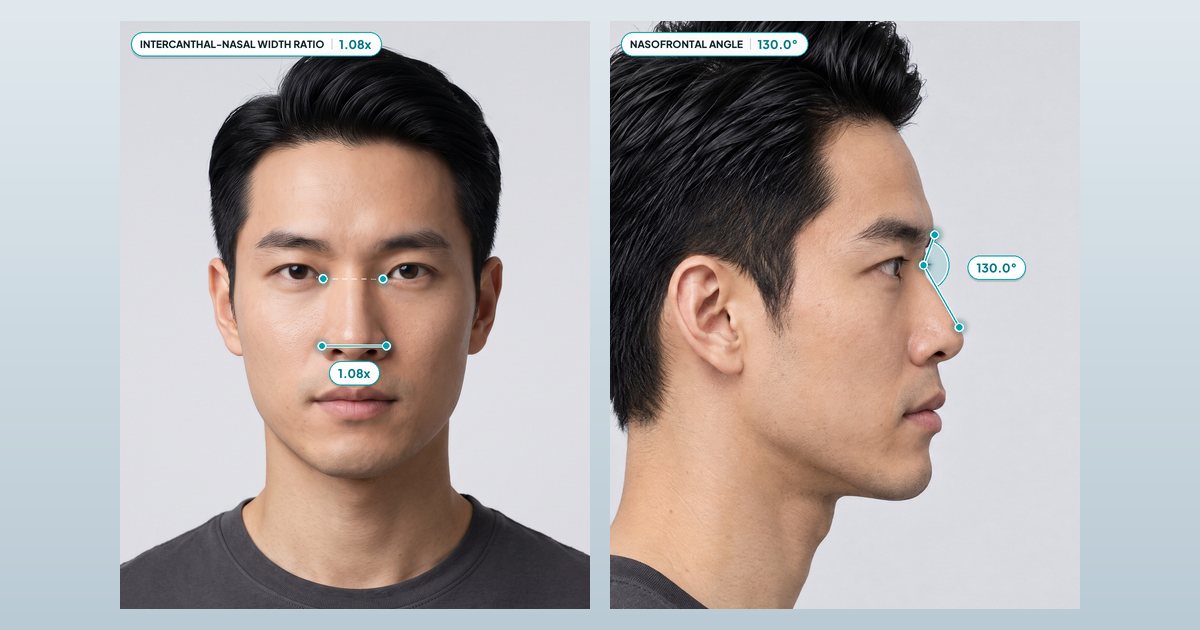
Width can also sit at the bony bridge, at the tip or across the soft nostril wings at the base, which is what most people mean by wide nostrils. Our width ratio reads only the base. The tip has its own number, the Nasal tip angle, but it’s taken on your side photo and reads how rounded the tip is, not how wide. Bulbous tips in our nose types guide shows how a round tip is read.
A flat nose is a different thing again. The word describes a low bridge that sits close to the face in profile, and the width section of the same guide explains how we read it.
For bridge width, the report’s Nose bridge to nose width divides your nose base by the width of your bridge, which shows how much the nose flares toward the bottom. A high number means the width sits low, in the nostril wings. A low one means the nose is broad most of the way down. Our men’s bases come to 1.94 to 2.01 bridges wide, just under the men’s range of 2.06 to 2.14 (2.16 to 2.24 for women), so their bridges are a little broad for their bases, though all four score Great on it. It’s a Low-confidence reading, since shadows move the bridge points.
The whole face has an old rule too: a nose a quarter as wide as the face. It holds up better on averages than on people. Published averages land almost exactly on a quarter,5 but an exact match turned up in only 3 to 4% of 1,050 adults.2 Our four men’s nose bases sit a little over it, at 26% to 30% of cheekbone width.
What the ipsilateral alar angle measures, and why it isn’t nose width
The ipsilateral alar angle is the angle at the bottom of your nose, where it meets the upper lip, between lines drawn to the outer corners of your eyes. Our ideal range is 86.5 to 92.5 degrees for men and 87.5 to 93.5 for women. Great runs to about 96 degrees for men and 97 for women.
It’s a measurement face-analysis tools use, and we found no paper in medical research that defines or tests it. Our engine’s own method notes are blunt about the name: “Despite its name, this is not the slope of a nostril edge.” The angle opens when the outer eye points sit wider apart, or when the bottom of the nose sits closer to eye level. The nostril wings play no part.
Two of our men show it. Man B has the highest width ratio of the four, 1.27, and an angle of 90.5 degrees, right inside the range. Man C has almost the same ratio, 1.26, and the widest angle, 96.4 degrees.
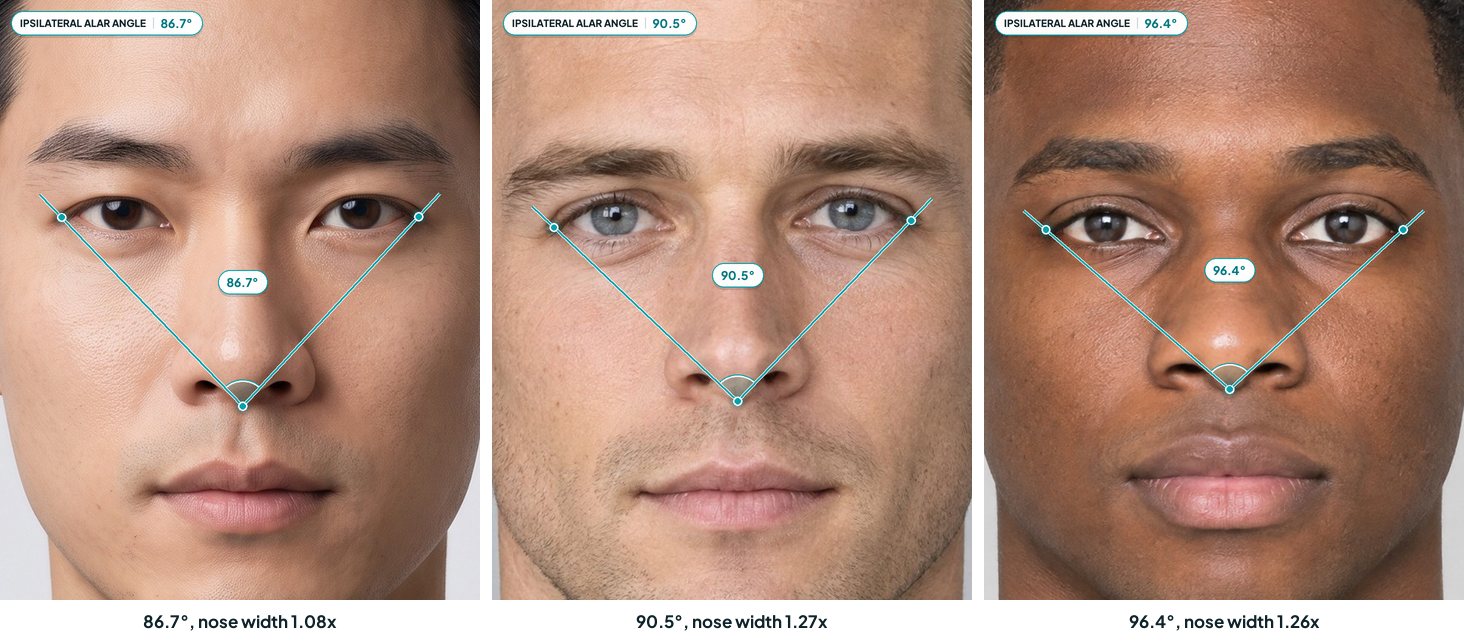
What opens Man C’s angle is a short, wide midface. The bottom of his nose sits closer to eye level than Man D’s, and his outer eye corners sit a little wider apart. His 96.4 scores Good. For a wide-nose question, this is one of the least useful numbers in the Nose section. Stick with the width ratio, and check where each point landed on your photo. How the measurements work explains the points.
How to check if your nose is wide
Compare your nose base with your inner-eye gap on a front photo, using a ruler held to the screen. It takes five minutes.
- Have a friend take a front photo from about 1.5 m (5 feet), or prop your phone at eye level that far away and use the self-timer. Zoom in, or crop afterwards, rather than stepping closer. Keep your mouth relaxed and closed, hair back and glasses off, with even light from the front.
- Hold a ruler against the screen and zoom until the gap between your inner eye corners, where the upper and lower lids meet beside your nose, spans exactly 3 cm.
- Find the outer edges of your nostril wings at their widest, against your cheeks. Use those, not the nostril openings.
- Measure your nose base with the same ruler, then redo steps 2 to 4 and average the two readings. A 1 mm slip moves the ratio about 0.03 on the nose base and 0.04 on the eye gap, and the whole Ideal band is only 0.12 wide.
- Read your result. For a man, a base from 3.12 to 3.48 cm is inside the range. Past 3.48 cm it counts as wide on our scoring, though up to about 3.7 cm still scores Great. For a woman, the range is 2.82 to 3.18 cm, and Great runs to about 3.4 cm.
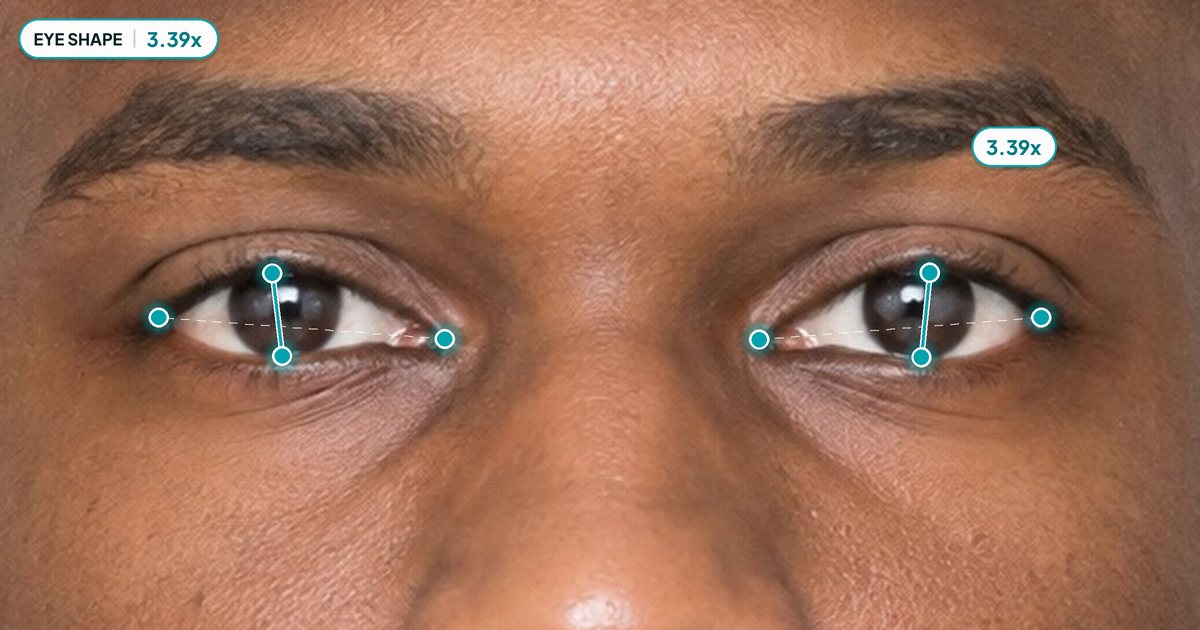
- If you read wide, check your eye spacing at the same zoom. Measure one eye from its inner corner to its outer corner. If it comes to about 3.5 cm or more against your 3 cm gap, your eyes sit on the close side, which is ordinary variation, and part of your reading comes from the spacing rather than your nose.
- Mark your nose base on the edge of a piece of paper and lay it across your relaxed mouth. In range, the mouth is about one and a half nose bases wide: 1.42 to 1.50 times for men, 1.52 to 1.60 for women.
If your nose only looked wide in a selfie or a smiling photo, believe this one instead.
Leave the ipsilateral alar angle to the report, since 1 mm at the point under your nose moves it about 1.3 degrees.
Is a wide nose attractive?
A slightly wide nose is the common case, and a few millimeters can be hard to see. In the one study we found that changed nose width and nothing else, some people had trouble telling its 2 mm steps apart.7 Our scoring is gentle too: this one measurement’s score, out of 10, only drops to 5 at about 1.32 for men and 1.22 for women. Man B, at 1.27, gets Good, 6.7 out of 10, and a woman at 1.10, past her 1.06 top, would get Great.
That study did lean narrow. Its 203 clinic patients chose between 3D faces with the nose equal to the eye gap, or 2 or 4 mm either side. Noses wider than the gap were liked least, and the top pick was equal to the gap for the man’s face and 2 mm narrower for the woman’s. That’s one clinic and two model faces.7
On men, a broader nose, along with wider-set eyes, is part of the shape women rated as more masculine in a study of 24 men’s faces,8 and what makes a face masculine covers the pattern.
One number never decides how attractive someone is, and it doesn’t decide our overall score either. Among our four men, the lowest width ratio (1.08) and the highest (1.27) belong to the two top scores of the four, 7.12 and 7.04. Width is one of 65+ measurements, and facial harmony is how they add up.
How to make your nose look less wide
Start with the photo, since a close camera and a full smile both add width your nose doesn’t have at rest. Those two and blended contour are the only tips here with studies behind them that we found. The rest, from where to shade to glasses, brows, beard and hair, is styling practice, so trust your mirror on those. You can’t reshape the nose itself, and changing it is a medical decision we stay out of.
In photos
Stand well back and keep the lens at eye level. Light from slightly to one side puts the sides of your nose in soft shade, and a small turn toward three-quarter helps too. Our report’s Nose section puts the main point in one line: “Phone cameras held close make the nose look bigger.”
How to contour a wide nose
Contour can work, though only a professional’s version has been tested. In one paper, a makeup artist did 32 women’s makeup, contour included, and their noses looked smaller. When 44 women did their own makeup, as they would for a night out, their noses looked no different in size. The effect showed in blurred copies of the photos but not in copies that kept only fine detail, which points to soft, broad shading over sharp lines.9
- Pick a matte contour shade a little darker than your skin and a matte highlight a little lighter.
- Shade two soft lines down the sides of your nose, from the inner ends of your brows to just above the nostril wings. Keep them straight and a little closer together than the flare at the base, so they outline a narrower nose.
- Run a slim highlight down the bridge and stop it above the tip.
- We’d leave the wing edges bare, since shade there traces the very width you want to play down.
- Blend until no edge shows, then check from a step back.
Only women’s faces were tested, but we’d expect the same shading to work for anyone who wears contour. The contour figure in our nose types guide shows these lines on a face.
Glasses, brows, beard and hair
That same Nose section suggests glasses with a defined bridge. If your reading comes partly from close-set eyes, stylists tend to go the other way, with a thin or clear bridge, as our eye shapes guide notes. Either way, pick a frame at least as wide as your face, so your nose doesn’t look bigger by contrast, with a solid top bar that draws a strong line across the face above the nose.
Keep the natural gap between your brows rather than plucking it wider, since a broad bare patch above the nose makes the whole area look wider. For men, a beard kept fuller along the jaw than on the cheeks widens the lower face, so the nose takes up less of the picture. With longer hair, face-framing layers or a little volume at cheekbone level do the same job higher up.
What has no evidence behind it
Nose exercises, nose-shaper clips and taping all promise a slimmer nose. We found no study showing that any of them changes nose width, so we wouldn’t spend money on them.
Spend five minutes on a retake instead: 1.5 m away, a friend or the self-timer, mouth relaxed, then the ruler check. If your base runs past about 3.7 cm on a 3 cm eye gap (3.4 cm for a woman), check your eye spacing first (step 6), since the eye gap is the other half of the ratio. If your spacing looks ordinary, the photo, contour and glasses tips above are the parts you control.
Questions people ask
Why do some people have wider noses?
Genes play a big part, through many variants that each have a small effect. A gene study of about 6,000 people linked separate variants to how broad the bridge and the nostril wings are. A 2017 study of 3D scans of about 2,600 people found nostril width partly tracks the climate your ancestors lived in, wider on average where it was warm and humid, though it varies a lot within any group. Men's noses run about 3 to 4 mm wider, and an old break can change a nose's shape.
Why does my nose look wider when I smile?
Smiling pulls the nostril wings outward. In a full smile they spread by about 4 mm, roughly a tenth of their width, and almost everyone's do. On our scale that's enough to move a man from 1.10 at rest to about 1.22, past the 1.16 line, though the change goes away when the smile does. Our report is scored on a relaxed face, so shoot with your mouth closed and still.
Can you make a wide nose smaller naturally?
Not the nose itself. We found no study showing that exercises, clips or taping change nose width. What you can change is how wide it looks. A photo from 1.5 m (5 feet) instead of 30 cm (12 inches) takes away the roughly 30% a close phone adds to nose width against the cheekbones, and a relaxed mouth avoids the spread of a full smile. In one study, contour applied by a professional also made noses look smaller.
Does your nose get wider as you age?
A little, it seems. A 2011 study measured the noses of 859 people aged 4 to 73 in 3D, and the nose and the base of the nostril wings were larger in older age groups, from childhood into old age. The nose's width-to-height ratio showed no steady change with age, so it grows in both directions rather than only spreading. That study compared age groups instead of following the same people over time.
What is the ipsilateral alar angle?
It's the angle at the bottom of your nose, where it meets your upper lip, between lines to the outer corners of your eyes. Our ideal range is 86.5 to 92.5 degrees for men and 87.5 to 93.5 for women. Despite the name, it doesn't use the nostril wings, so it says more about eye spacing and midface height than nose width. Our two highest width ratios sit 6 degrees apart on it. It comes from face-analysis tools; we found no medical paper on it.
What counts as a wide nose for a woman?
On our scoring, a nose base more than about 1.06 times the gap between your inner eye corners. Our women's range is 0.94 to 1.06, and Great runs to about 1.14. With the eye gap zoomed to 3 cm on screen, an in-range base spans 2.82 to 3.18 cm. Women's noses average about 3 to 4 mm narrower than men's with about the same eye gap, and in one student sample 56% of women had a nose wider than their eye gap, so a reading over 1.0 is common.
Sources
-
Farkas LG, Hreczko TA, Kolar JC, Munro IR. Vertical and horizontal proportions of the face in young adult North American Caucasians: revision of neoclassical canons. Plast Reconstr Surg. 1985;75(3):328-338. doi:10.1097/00006534-198503000-00005. Abstract on PubMed ↩
-
Borman H, Ozgur F, Gursu G. Evaluation of soft-tissue morphology of the face in 1,050 young adults. Ann Plast Surg. 1999;42(3):280-288. doi:10.1097/00000637-199903000-00009. Abstract on PubMed ↩↩
-
Al-Sebaei MO. The validity of three neo-classical facial canons in young adults originating from the Arabian Peninsula. Head Face Med. 2015;11:4. doi:10.1186/s13005-015-0064-y. Full text on PMC ↩↩
-
Ballin AC, Carvalho B, Dolci JEL, Becker R, Berger C, Mocellin M. Anthropometric study of the caucasian nose in the city of Curitiba: relevance of population evaluation. Braz J Otorhinolaryngol. 2018;84(4):486-493. doi:10.1016/j.bjorl.2017.06.004. Full text on PMC ↩
-
Ward B, Ward M, Fried O, Paskhover B. Nasal distortion in short-distance photographs: the selfie effect. JAMA Facial Plast Surg. 2018;20(4):333-335. doi:10.1001/jamafacial.2018.0009. Full text on PMC ↩↩↩
-
Beiraghi-Toosi A, Rezaei E, Zanjani E. Relationship between hyperactivity of depressor septi nasi muscle and changes of alar base and flaring during smile. World J Plast Surg. 2016;5(1):45-50. PMID: 27308240. Full text on PMC ↩
-
Tavakoli K, Sazgar AK, Hasanzade A, Sazgar AA. Ideal nasal preferences: a quantitative investigation with 3D imaging in the Iranian population. Arch Plast Surg. 2023;50(4):340-347. doi:10.1055/a-2091-6820. Full text on PMC ↩↩
-
Mitteroecker P, Windhager S, Müller GB, Schaefer K. The morphometrics of “masculinity” in human faces. PLoS One. 2015;10(2):e0118374. doi:10.1371/journal.pone.0118374. Full text on PMC ↩
-
Jones AL, Porcheron A, Russell R. Makeup changes the apparent size of facial features. Psychol Aesthet Creat Arts. 2018;12(3):359-368. doi:10.1037/aca0000152. Paper on Gettysburg College’s repository ↩
Spotted a mistake? Email support@faceratinglab.com and we will fix it.