What type of nose do I have? Check it with 3 phone photos
Your nose shape takes at least three words to describe, one each for the bridge, the tip and the width, and no name is better than another. A side photo shows the bridge (straight, Greek, Roman, hooked or scooped) and where the tip points (upturned or snub). A front photo settles the width, and a view from below only breaks ties on the tip (button or round). Or upload the front and side photos and our report measures them for you.
The short version
- Most nose names are decided from the side: a front photo settles width but can't reliably show your bridge line or where your tip points, and 8 of the 13 measurements in our report's Nose section come from the side photo alone.
- Expect more than one name, because bridge, tip and width are named separately, and none of them is a fault: the four example men we measured each collected three to five.
- A card edge on a side photo is the check we'd trust most by hand: on the edge is straight (Greek if there's almost no dip at the root), past it is Roman or hooked, and behind it is scooped.
- On our report's ranges, upturned takes two tests on a level photo: tip rotation over +21.5 degrees and a nose-to-lip angle over 114 for men (+30.5 and 118 for women). On our four example men, drawing the line to the very tip instead of halfway over-read it by about 6 to 20 degrees.
- No study we found sets the angle where one nose type becomes another, so the cut-offs here are the edges of our report's ideal ranges. A value just past one only leans that way, and falling outside one is ordinary.
Ask “what type of nose do I have” and you expect one word back. You’ll usually need a short list, because one name rarely covers a bridge, a tip and a width. Start with the side photo: a straight bridge alone crosses off Roman, hooked and scooped.
Man A, the one in our sample report, has a straight bridge, a tip that’s upturned, snub and round, and a slightly wide base. That’s five names for one nose. The other three example men we measured got three or four each.
For the quick version, hold your side photo against the bridge outlines, the tip outlines and the “What you see” column in the table further down. Rather not draw lines? Upload a front and side photo and our report draws them. You get numbers and no type name, and that same table turns one into the other.
What nose shape do I have? Start with three photos
To know your nose shape, take three photos from about 5 feet (1.5 m). A close selfie isn’t one of them, and the one from below is only a tiebreaker.
| Photo | How to take it | What it settles |
|---|---|---|
| Side | A friend or a propped phone on a 10-second timer, about 5 feet (1.5 m) away, lens at eye level, head level | Bridge, root, tip direction and reach |
| From below | Same distance, head back until your nose tip lines up with the underside of your brow. Skip it if your tip is clear from the side | Tip shape, by eye only (our upload takes front and side) |
| Front | Same distance, lens at eye level, head level, neutral face | Width, how wide the tip looks |
You’ll also need a card edge, your phone’s markup pen, a protractor app and, for the snub check, a ruler.
A phone 12 inches (30 cm) from your face makes your nose measure about 30% wider against your cheekbones, on one geometric model. At 5 feet (1.5 m) there’s essentially no difference,1 so if your nose looks big in selfies, part of that can be the camera. Keep your hair back, and skip glasses and nose contour.
What type of nose bridge do I have? Straight, Roman, hooked or scooped
Lay a straight edge along your bridge on the side photo. On the edge is straight, past it is a hump, behind it is a scoop. If you only do one check, do this one. We’d trust it most by hand, and it needs no protractor.
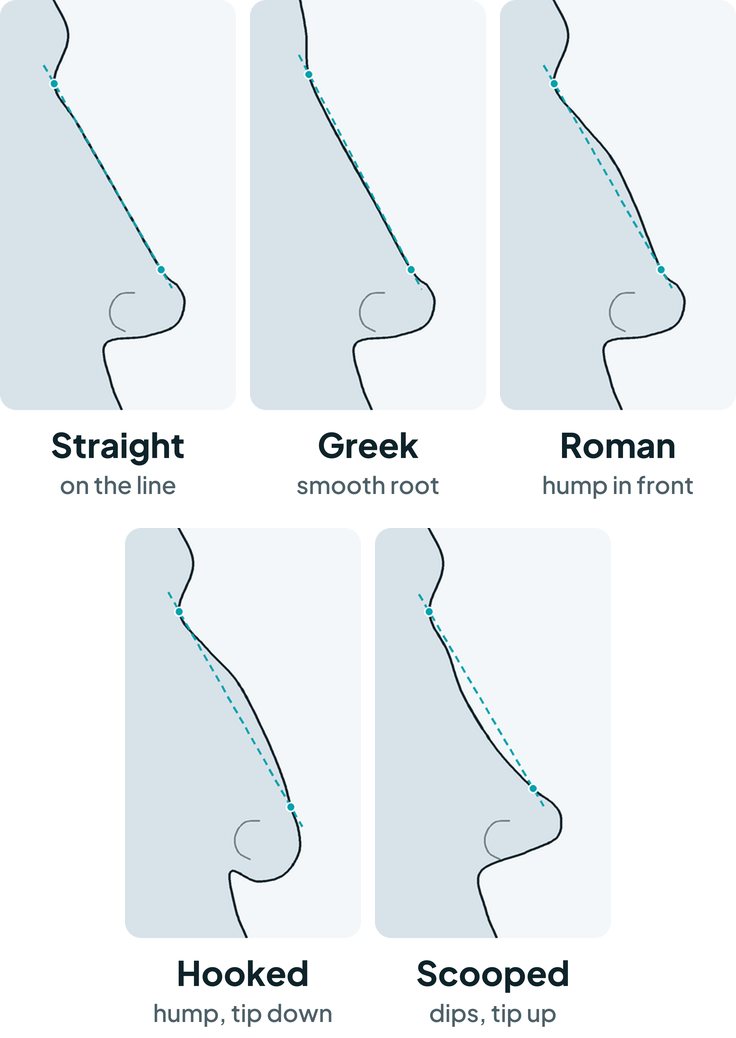
Roman and hooked both sit past the edge (aquiline gets used for both). On a Roman nose the tip’s tilt stays inside our range, and on a hooked nose it sits lower, which the level-photo check measures.
- Zoom in until your nose fills about 4 inches (10 cm) of the screen, from the dip between your eyes to the tip.
- Hold a card edge so it touches your bridge a quarter of the way down from the dip (about 1 inch, or 2.5 cm, at this zoom) and just above the tip, not on it.
- Look at the gap.
All four of our example men have straight bridges, and the outline stayed within about 1 mm of the edge at life size, by our estimate. That’s about 2 mm on screen at this zoom, roughly the thickness of a coin, so treat a clear gap past that as a hump if the outline sits in front of the edge, or a scoop if it dips behind. It’s our rule of thumb. None of the four has either, so we can’t say exactly where one starts. That says nothing about how common a hump is. Four men is a tiny sample.
Run the card down to the tip itself and the outline just above it pokes past the edge, which is only the tip rounding off. The card checks the line and not the height, so a low bridge can still be straight.
The dip at the root separates straight from Greek
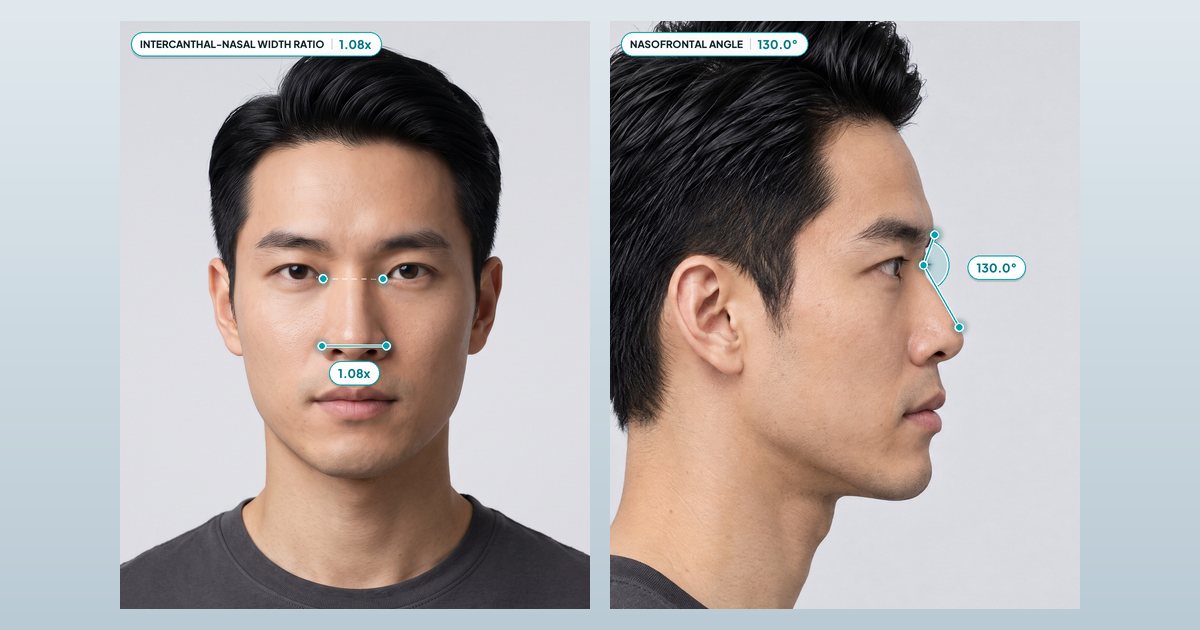
Greek is a straight nose with almost no dip at the root, the spot between your eyes. Draw from your forehead between the brows to the deepest point between your eyes, then down to just above the tip. The men’s range is 116 to 128 degrees, and 128 or more leans Greek. That’s a low bar: men in two published samples averaged close to it or past it, by different methods.23 So call it Greek only if your forehead and bridge also look like one line. Man D clears the mark at 130.0 and still shows a small dip in the photo below.
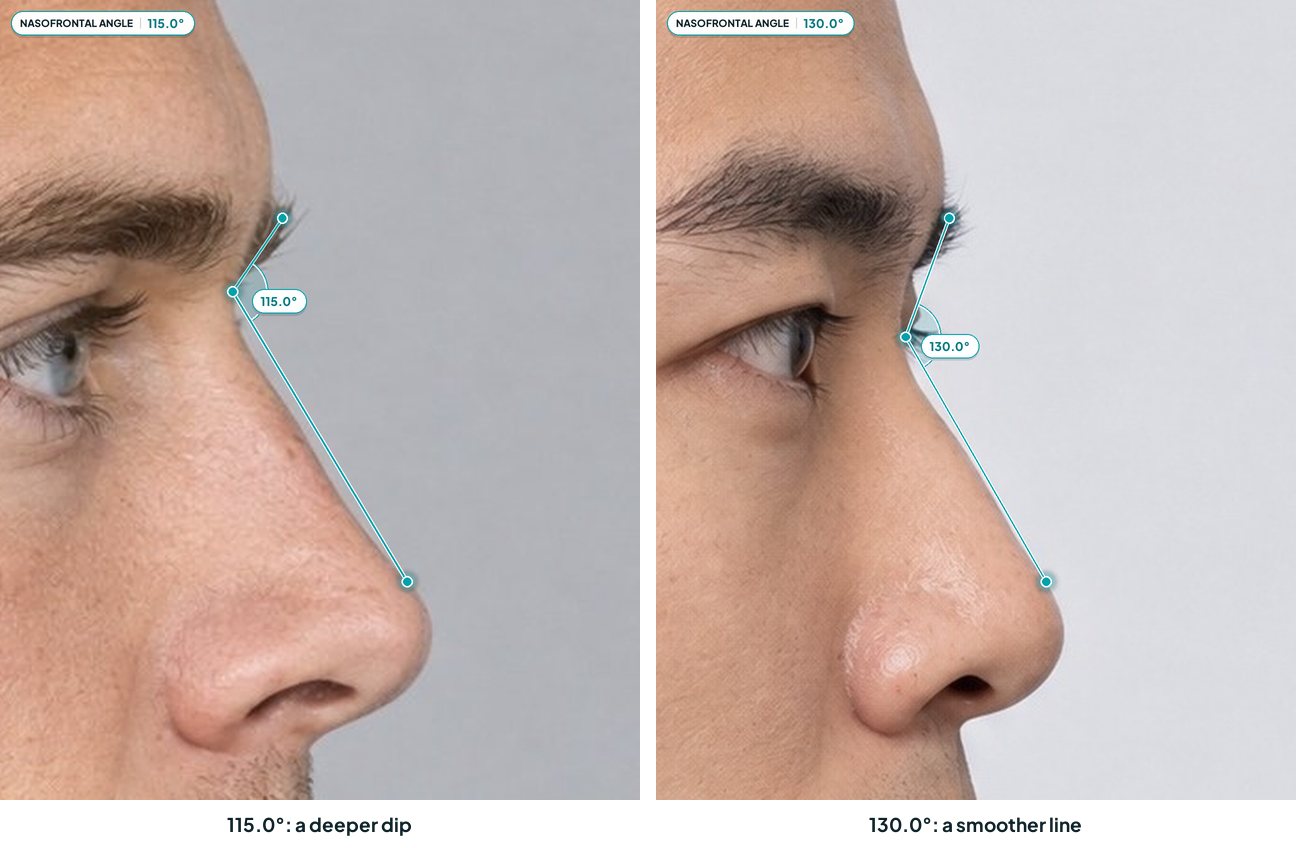
If you’re a woman, go by eye. Our report’s range for women runs 139 to 151, but those two samples put men and women only 5 to 9 degrees apart,23 so we wouldn’t treat 151 as a line you have to clear.
Upturned and snub noses start with a level photo
This is the fiddliest check on the page, so do it once and do it slowly. On our report’s ranges, an upturned nose passes two tests. Tip rotation is how far the underside of your nose tilts above level, and a plus means it points up. The nose-to-lip angle is the corner where that underside meets your upper lip. A man passes at over +21.5 and over 114 degrees, a woman at over +30.5 and over 118. Treat the 118 loosely: the two samples from the Greek check found no significant gap between men and women on this angle.23
- Find the lowest point of the bony rim under your eye with a fingertip. With your phone’s markup pen, draw from your ear opening to that point. Save it, then use the straighten slider in your photo editor until the line is flat.
- Draw along the underside of your nose from where it meets your lip, and stop halfway to the tip.
- Draw from the same point down the front of your upper lip.
- A protractor app gives you both angles. Without one, +21.5 is about a quarter of a right angle, and 114 is a right angle plus about a quarter. For women, +30.5 is about a third of a right angle, and 118 is a right angle plus a little under a third.
If the card found a hump, go by rotation alone. For men, +11.5 to +21.5 is Roman, under that leans hooked (more clearly the nearer the tip gets to level), and over it no single name fits, so write both: hump and upturned. Women’s numbers are in the table below.
Don’t skip the level line. It sat 2 to 5 degrees off the camera’s horizontal on our four photos, in either direction. Skip it and Man D jumps from +21.1, inside the range, to +26.1, past the cut-off.
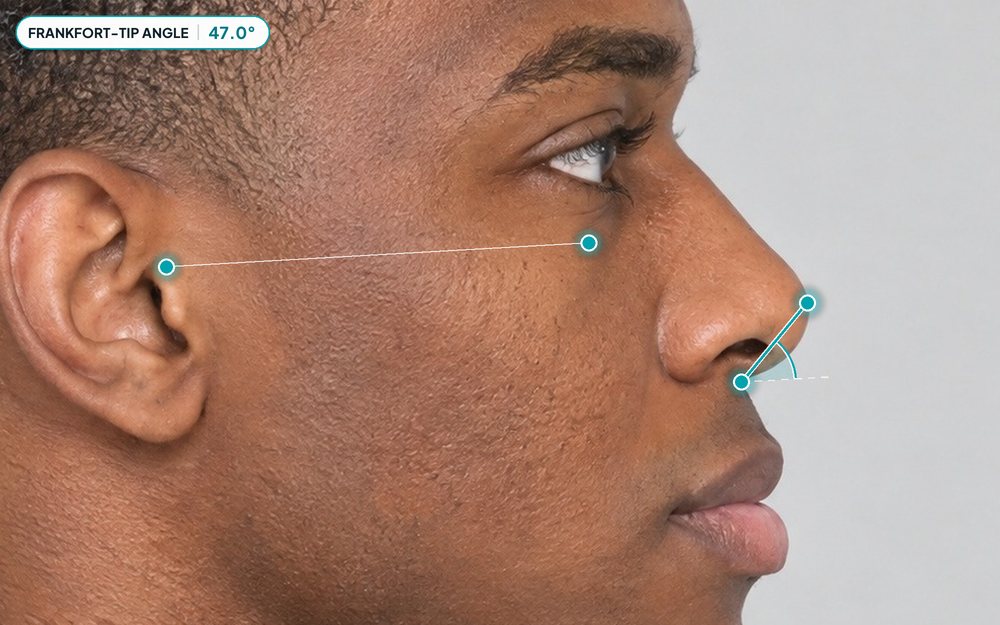
The halfway stop looks fussy until you skip it. On our four men, drawing to the very tip over-reads by about 6 to 20 degrees, and all of them, even Man D, would land well past +21.5.
Our rule uses two tests, because one angle can mislead. In 100 volunteers, no single way of measuring how far a tip turns up worked for everyone, and a sloped upper lip was one of the things that threw them off.4 All four men have upper lips that slope forward. Man C’s slopes most, about 26 degrees, so he measures +26.5 with a nose-to-lip angle of 91.0. That low second number comes from his lip, not his nose.
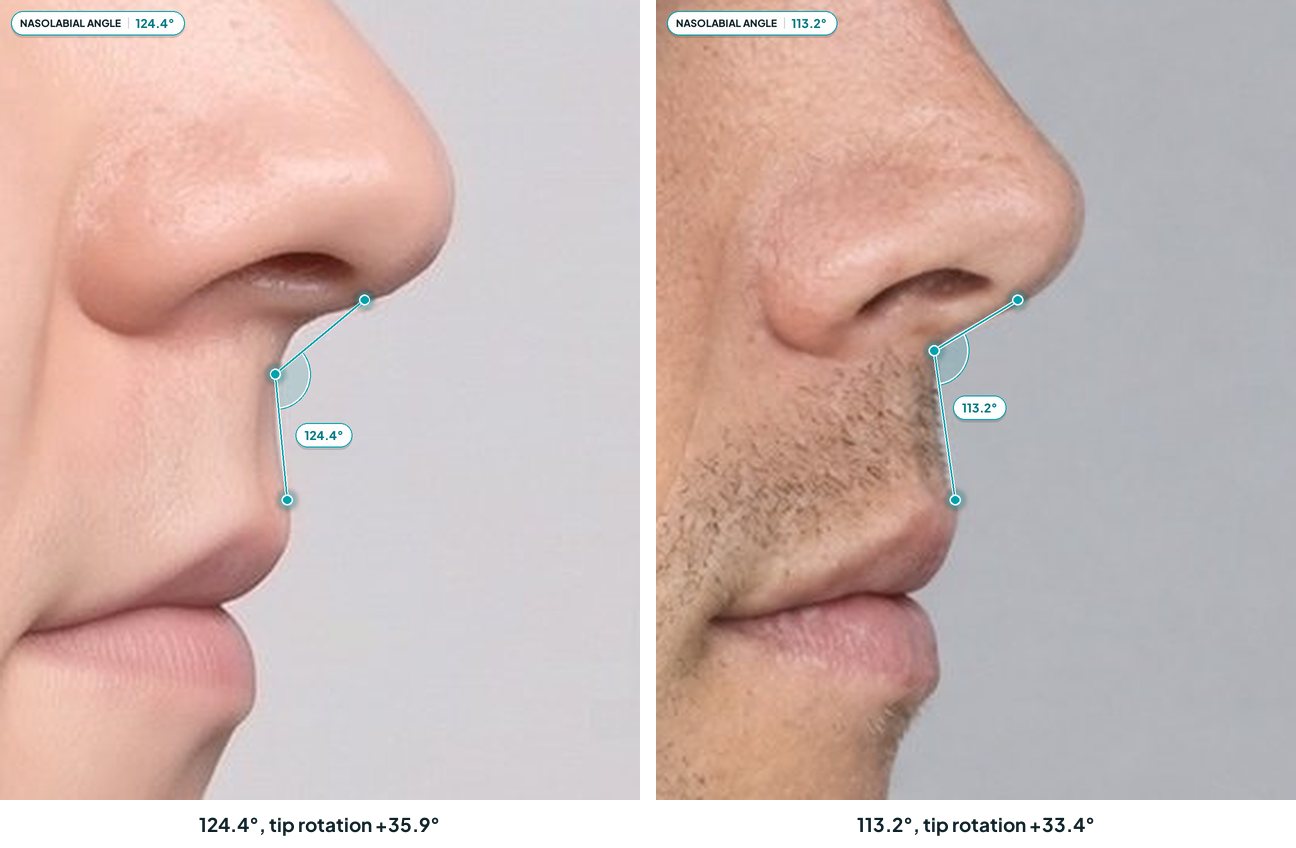
These short lines are touchy. A 1 mm slip at life size moves the root angle 3 to 6 degrees and tip rotation 5 to 7, and our report marks rotation Low confidence. We’d only trust a reading that clears the cut-off by about 5 degrees. We found no study of phone photos marked by hand. Treat your readings as rough.
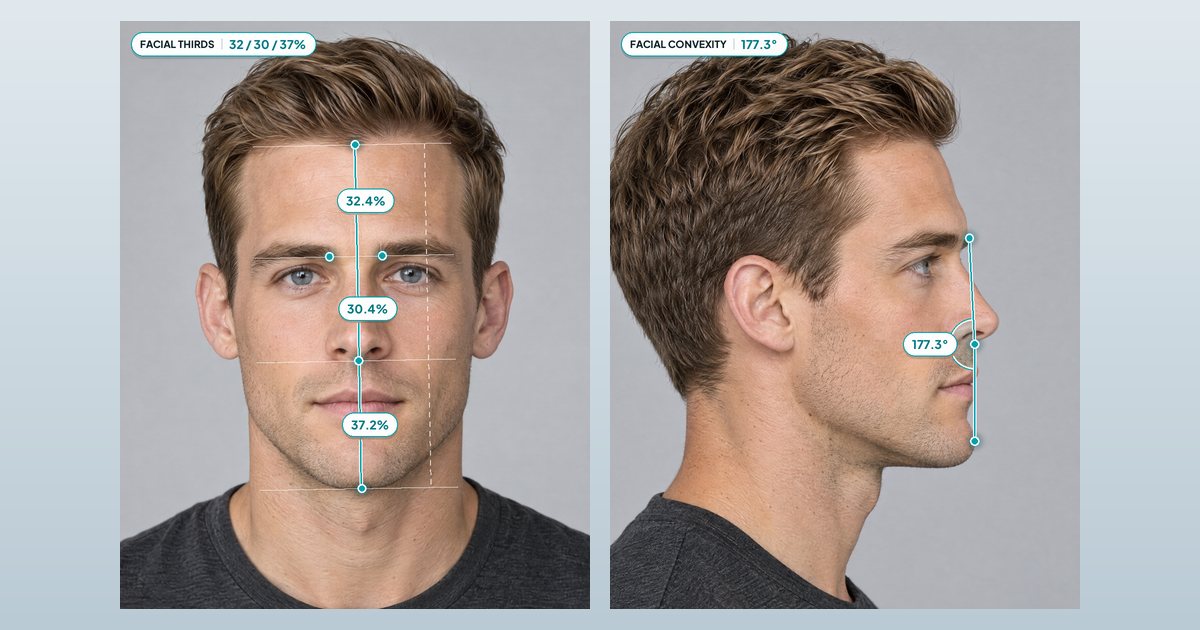
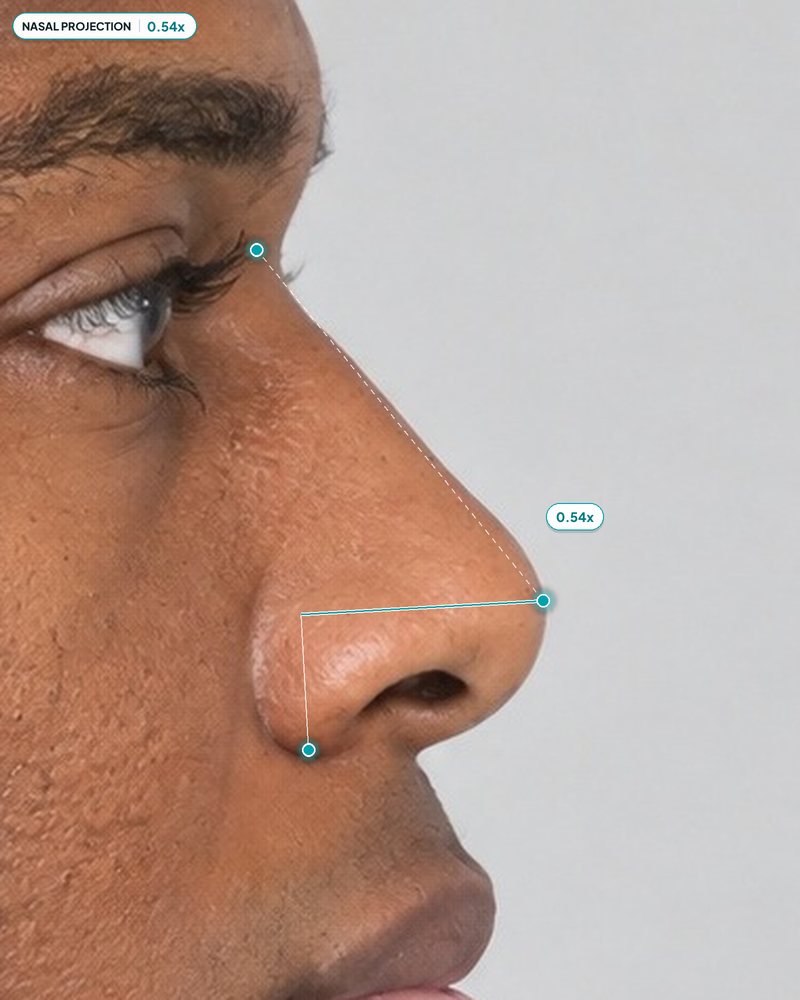
Snub is upturned plus a short reach, and reach takes two lengths, both drawn on Man C’s bridge photo above. Measure level from the back of your nostril wing to the tip (his short level line), then from the tip up the bridge line to the height of your root (his dashed line). Divide the first by the second, which gives him 0.54. Under 0.58 for men or 0.55 for women counts as short. A short reach alone means nothing. All four men come in at 0.51 to 0.56, and only Man A also passes both upturned tests.
Round tips, button noses and the view from below
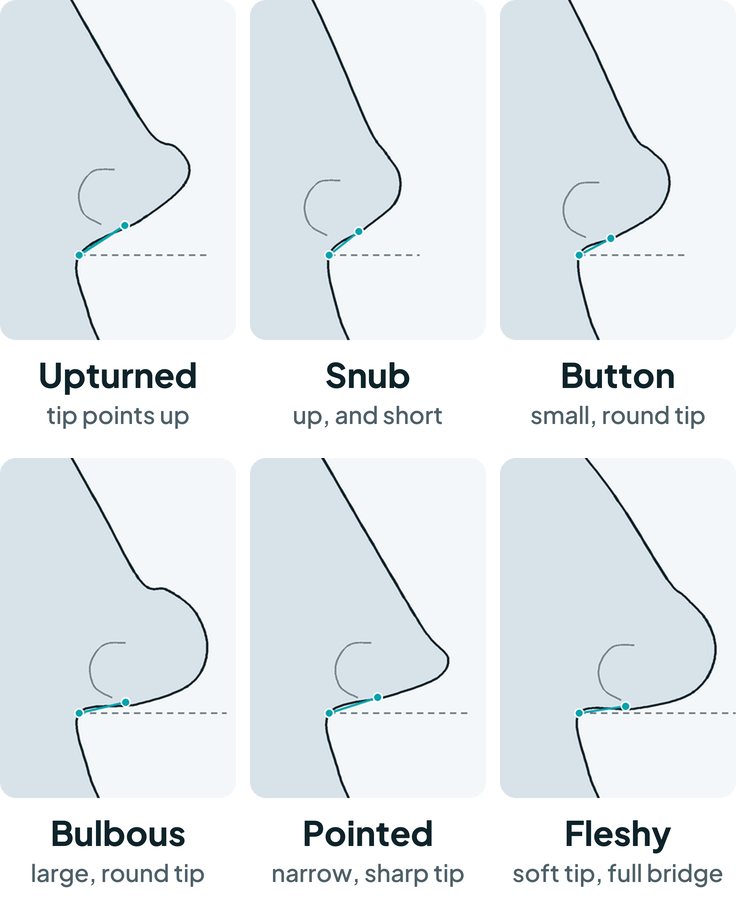
Judge round by eye against the tip outlines. A button is a small round tip with a modest reach and a slight upturn, on a nose that looks small overall.
Don’t measure the tip angle yourself. Its points sit 5 to 7 mm from the tip, so 1 mm at life size moves it 8 to 12 degrees. Our report marks it Low confidence too. All four men sit past the men’s cut-off of 138.5. None of them is a button.
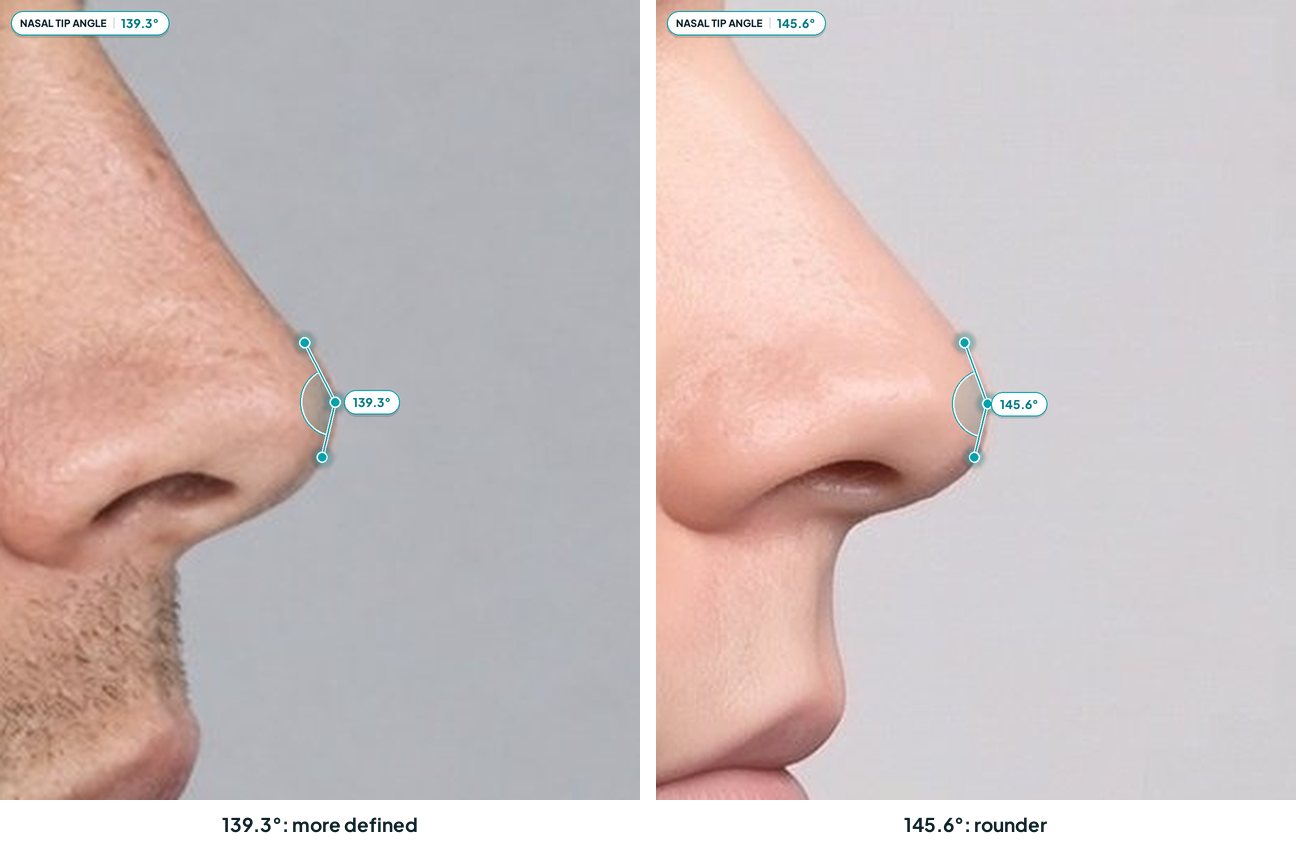
The view from below is a tiebreaker for the tip and gives no number. One study of 121 photos from below said there was no distinct boundary between the six base shapes it sorted, none of them button or round.5 Check whether the tip looks small and round or wide and full, then stop. Every nose shows more nostril from this angle, and nostril shape doesn’t change your name. An upturned tip doesn’t always mean visible nostrils head-on either. Man A’s turns up most, yet our report still rates his Nostril exposure 9 of 10, where 10 means no issue.
If this view disagrees with the side photo on the bridge or tip direction, believe the side photo.
The front photo decides if your nose is wide or narrow
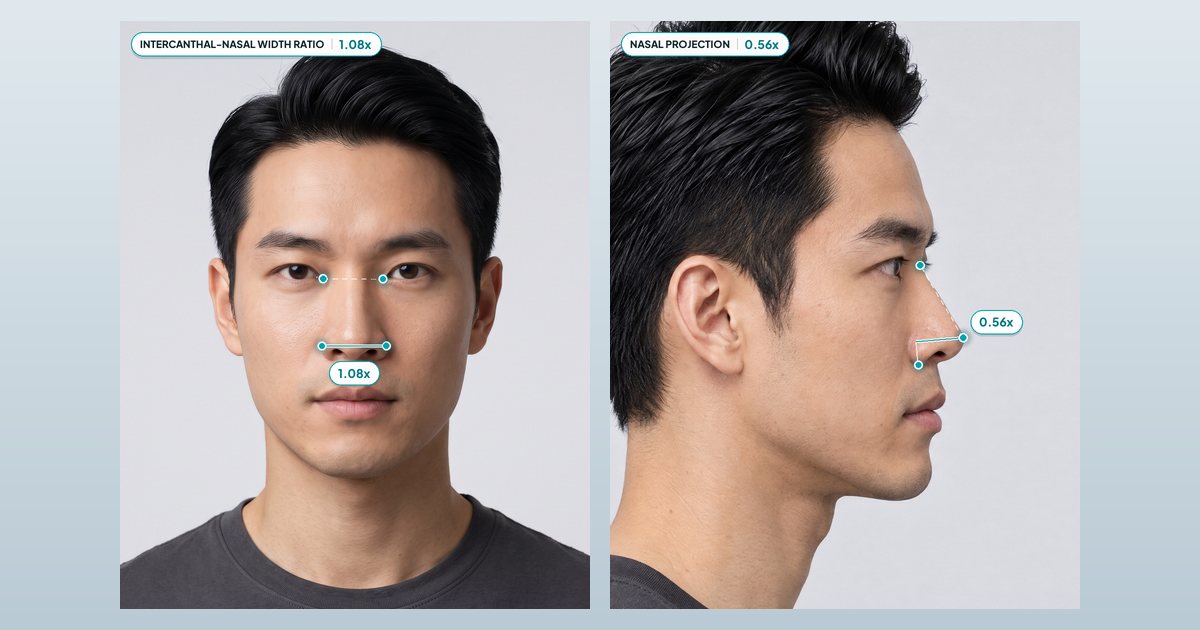
Compare your nose base with the gap between your inner eye corners. A man’s range is 1.04 to 1.16 times the gap and a woman’s 0.94 to 1.06. Above that is wide, below it is narrow. The top photo on this page shows both lines on Man D.
Mark that gap on a paper edge and lay it across the outer edges of your nostril wings, not the openings. Inside the range, a man’s base runs a little past the mark, by up to about a sixth of the gap, and a woman’s about matches it.
Three of our four men come out wide, with Man D inside the range. That’s ordinary. In 100 adults photographed from 5 feet, the nose was the wider of the two in 88%. The averages of 1.17 for men and 1.13 for women both sit past our wide cut-offs,2 so wide here only means past our scoring range. The eye gap is also your ruler, so close-set eyes can push an ordinary nose past the cut-off.
So what type of nose do I have?
Your answer comes in three parts, bridge, tip and width, plus the nearest common name if one fits. It might look like this: straight, upturned, wide, and snub if the tip also stops short.
| Name | What you see | Men | Women |
|---|---|---|---|
| Straight | Outline stays on the edge | Card gap under about 2 mm on screen | Same test |
| Greek | Straight, almost no dip at the root | Root angle 128° or more | By eye; our range runs 139 to 151° |
| Roman | Hump past the edge, tip tilt inside our range | Rotation +11.5 to +21.5° | +20.5 to +30.5° |
| Hooked | Hump and a low tip | Rotation under +11.5° | Under +20.5° |
| Scooped | Dips behind the edge, tip up | Rotation over +21.5° | Over +30.5° |
| Upturned | Tip up on both tests | Over +21.5° and over 114° | Over +30.5° and over 118° |
| Snub | Upturned and a short reach | Reach under 0.58 | Under 0.55 |
| Round tip | Rounded, not narrow | By eye; report tip angle over 138.5° | By eye; over 136.5° |
| Button | Small nose, round tip, slight upturn | Round tip, and small by eye | Same test |
| Bulbous | Round tip that also looks wide from the front | By eye | By eye |
| Wide | Base wider than the range | Over 1.16 times the eye gap | Over 1.06 |
| Narrow | Base narrower than the range | Under 1.04 times the eye gap | Under 0.94 |
If no row fits your tip or width, write what’s left: mid-range tilt or medium width inside the range, and low tip under the rotation range with no hump. If rotation passes and nose-to-lip doesn’t, write leaning upturned when the miss is a few degrees, like Man B. Further off, skip the direction and write the tip shape alone, like Man C’s round. That’s a complete answer.
Our four men on the men’s cut-offs. All four have straight bridges and still come out four different ways. Tip numbers are rotation, then nose-to-lip.
| Man | Bridge | Tip | Width | Nearest name |
|---|---|---|---|---|
| A (our sample report) | Straight | Upturned on both tests (+35.9, 124.4), short reach (0.51), round | Wide, 1.20 | Snub |
| B | Straight, deepest root at 115.0 | Just misses upturned (+33.4, 113.2), only just round | Wide, 1.27 | Straight, leaning upturned |
| C | Straight | Not upturned (+26.5, 91.0, his lip slopes forward), round | Wide, 1.26 | Straight with a round tip; no single name fits |
| D (top of this page) | Straight, root 130.0 | Mid-range tilt, near the top (+21.1, 99.2), round | Medium, 1.08 | Leans Greek |
Each man collects three to five names.
We found no study that sets the angle where one nose type becomes another, so we set these cut-offs ourselves, at the edges of the ranges our report scores against. A value just past one only leans that way, and a reading within a few degrees can land on either side.
Pointed, fleshy, flat and crooked are on the full chart of nose names. Some charts say celestial or retroussé for upturned, and hawk for hooked.
We found no proper count of these names, so ignore any chart that calls one the rarest. Our chart guide covers how many nose types there are and why nobody can rank them.
Can a nose shape test, quiz, scanner or detector tell you your type?
Partly. A nose shape detector or AI scanner can read width from a front photo, and a quiz can give you a word to test. Neither settles the names that depend on your profile.
We checked the US results for this search on 2026-11-01. All four scanners we could check in the top 12 start from a front photo, and three of them say on their own pages that a front view can’t reliably show the bridge. One makes you pick your bridge shape yourself, and the top result hands back only a width-to-height band. The closest published detector we found reads only width against height from one front photo, and its authors say it leaves out depth and tip reach and hasn’t been tested on real patient photos.6
A nose shape quiz asks you to label your nose by eye, and a mostly-As quiz can’t return a mix. Labels given by eye also often disagree. In a forensic study built on photos of 900 men, people sorting 43 face features, the nose among them, mismatched 19% to 39% of the time, even with a reference atlas in hand.7 That goes for the by-eye rows in our table too. Hold round, button and bulbous loosely.
A chart that hands you exactly one name is telling you less than your own side photo.
Ours takes a front and a side photo and draws every line on them, so you can see where each point landed and how the measurements work. No published study has tested our numbers either, which is why the lines are there for you to check.
What to do with your answer
Treat your answer as a description. The studies on which shape people prefer don’t crown a winner. In our own scoring, your nose ratings make up about a tenth of Masculinity or Femininity and about 8% of Features, two of your 4 pillar scores. In Harmony, 15 of the 65 measurements touch your nose. One number never decides how attractive someone is.
You didn’t pick this shape. It comes partly from genes, and nostril width partly tracks the climate your ancestors lived in. It also drifts slowly: 48 adults scanned about 12 years apart had noses about 1.4 to 1.7 mm longer in profile.8 Rhinoplasty changes the structure, and that’s a medical decision we stay out of.
Two styling habits are yours to use, though we found no test of either. A lens at eye level or a little above shows less nostril, and a glasses bridge on or just under a hump breaks up the profile. The chart guide has beard and contour tips by type.
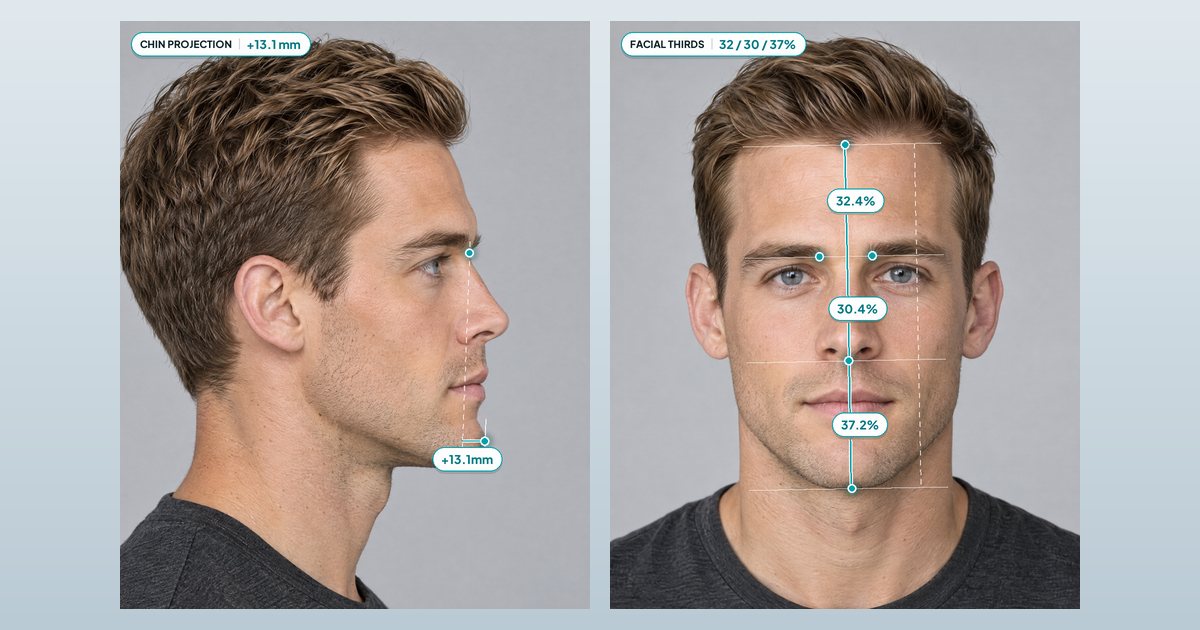
Surgeons often say how big a nose looks depends partly on how far forward the chin sits. We found no direct test of that, but look at your whole face before you decide your nose is the problem.
Write your answer down. If any word in it surprises you, retake that photo from 5 feet and check again before you believe it.
Questions people ask
How do I know what type of nose I have?
Take a side and a front photo from about 5 feet (1.5 m), plus one from below if your tip is unclear. On the side photo, lay a card edge along your bridge: on the edge is straight, past it is a hump and behind it is a scoop. Then check where your tip points. On the front photo, compare your nose base with the gap between your inner eye corners. Write one word each for bridge, tip and width, then the nearest common name if one fits.
Can you tell your nose type from one photo?
Part of it. A side photo shows the bridge, the dip at the root, where the tip points and how far it reaches. A front photo gives width. One front photo can't show your bridge line, and three of the scanners ranking for this search say so themselves. Of the 13 measurements in our report's Nose section, 8 come from the side photo alone, so if you only take one photo, take the side.
Are nose shape scanners, detectors and quizzes accurate?
We found no published test of any online quiz. The closest published detector reads only width against height from one front photo and leaves out depth and tip reach. Labels given by eye often disagree: people sorting 43 face features mismatched 19% to 39% of the time. Treat any result as a first guess and check it with a card edge. No published study has tested our report's numbers either, so it draws its lines where you can check them.
Can you have two nose types?
Yes. Ask "what is my nose type" or "what shape is my nose" and the honest reply is a short list, because bridge, tip and width get separate names. The four example men we measured each collected three to five. Researchers studying the nose from below also said there was no distinct boundary between shapes, and one nose could fit more than one group. Write your answer in three parts, such as straight, upturned, wide, then add the nearest common name if one fits.
What is my nose shape if no single name fits?
Then write the parts and skip the name. One of the men we measured came out straight with a round tip and a wide base, and that's a complete answer to "what nose type do I have". Names only fit some noses, and the pages ranking for this search don't even agree on whether snub and upturned are one type or two. A word each for bridge, tip and width tells you more than one label.
Do I have a Greek or Roman nose?
Lay a card edge along your bridge on a side photo. If the outline stays on the edge with almost no dip at the root, it leans Greek: 128 degrees or more on a man. Our range for women runs 139 to 151, so if you're a woman, go by eye. If the bridge has a hump past the edge and the tip's tilt is inside our range, it's Roman (aquiline gets used for this and for hooked). A straight bridge with a clear dip is neither.
Why does my nose look different in selfies?
A close camera changes the proportions on the photo. From 12 inches (30 cm), a nose measures about 30% wider against the cheekbones than from far away, and at 5 feet (1.5 m) there's essentially no difference. That figure comes from a geometric model, not photos of real people. A low camera also shows more nostril. Retake the photo at 5 feet with the lens at eye level before you judge your nose.
Can your nose type change with age or injury?
Yes, slowly with age and faster with injury. When 48 adults were scanned about 12 years apart, their noses were about 1.4 to 1.7 mm longer in profile and the root angle had opened about 2.5 to 3.2 degrees, so a reading near a cut-off can drift. An injury can change the bridge or leave it crooked. If your nose changed after a knock, or you have trouble breathing, talk to a doctor.
Sources
-
Ward B, Ward M, Fried O, Paskhover B. Nasal distortion in short-distance photographs: the selfie effect. JAMA Facial Plast Surg. 2018;20(4):333-335. doi:10.1001/jamafacial.2018.0009. Full text on PMC ↩
-
Ballin AC, Carvalho B, Dolci JEL, Becker R, Berger C, Mocellin M. Anthropometric study of the caucasian nose in the city of Curitiba: relevance of population evaluation. Braz J Otorhinolaryngol. 2018;84(4):486-493. doi:10.1016/j.bjorl.2017.06.004. Full text on PMC ↩↩↩↩
-
Uzun A, Ozdemir F. Morphometric analysis of nasal shapes and angles in young adults. Braz J Otorhinolaryngol. 2014;80(5):397-402. doi:10.1016/j.bjorl.2014.07.010. Full text on PMC ↩↩↩
-
Kim DW, Egan KK. Metrics of nasal tip rotation: a comparative analysis. Laryngoscope. 2006;116(6):872-877. doi:10.1097/01.mlg.0000216796.63683.d3. Abstract on PubMed ↩
-
Barnes CH, Chen H, Chen JJ, Su E, Moy WJ, Wong BJF. Quantitative analysis and classification of the nasal base using a parametric model. JAMA Facial Plast Surg. 2018;20(2):160-165. doi:10.1001/jamafacial.2017.1785. Full text on PMC ↩
-
Saravi B, Schorn L, Lommen J, Wilkat M, Vollmer A, Güzel HE, Vollmer M, Schrader F, Sproll CK, Kübler NR, Singh DD. Automatic apparent nasal index from single facial photographs using a lightweight deep learning pipeline: a pilot study. Medicina (Kaunas). 2025;61(11):1922. doi:10.3390/medicina61111922. Full text on PMC ↩
-
Ritz-Timme S, Gabriel P, Obertová Z, Boguslawski M, Mayer F, Drabik A, Poppa P, De Angelis D, Ciaffi R, Zanotti B, Gibelli D, Cattaneo C. A new atlas for the evaluation of facial features: advantages, limits, and applicability. Int J Legal Med. 2011;125(2):301-306. doi:10.1007/s00414-010-0446-4. Abstract on PubMed. The project’s conference abstract names nose tip shape and nasal root among the traits: Cattaneo C, De Angelis D, Gabriel P, Ritz-Timme S, Tutkuviene J, Gibelli D. AAFS Proceedings. 2009;H62. PDF ↩
-
Kim Y, Park JH, Park M, et al. Differences in nasal shapes and the degree of changes over a decade or more: a paired analysis. Clin Exp Otorhinolaryngol. 2024;17(1):56-63. doi:10.21053/ceo.2023.01137. Full text on PMC ↩
Spotted a mistake? Email support@faceratinglab.com and we will fix it.