Perfect side profile: 6 measurements, ideal ranges for men and women
On our ranges, a perfect side profile is slightly convex rather than straight: the outline from brow to chin bends 170 to 175 degrees at the nose base on a man, 168 to 173 on a woman. None of our four example men hits all six profile checks.
The short version
- A dead-straight profile isn't the ideal. At 180 degrees it scores 6.4 out of 10 for a man and 4.6 for a woman, because our ideal sits a few degrees convex.
- If you check only one thing, check your lips: lay a ruler from nose tip to chin, and a small gap behind your lower lip is in range for men and women. Lip position is also the strictest of the six checks, with the score halving 2 mm outside the range.
- Across our four example men, only 11 of 24 readings sit inside the ideal range, but 18 of 24 score 8 or more out of 10.
- The best-balanced profile we measured has the furthest-back chin of the four, 4.9 mm behind our reference line, and that chin scores 8.0 out of 10.
- Your face's own structure sets most of a profile. What you control is the photo (fully side-on, 1.5 m away, head level, lips relaxed) and the outline a beard, hair or makeup adds.
A perfect side profile curves gently from brow to chin. Lay a ruler on a side photo from the point between your brows to the front of your chin, and on a balanced face the base of the nose sits just in front of it. Move the ruler to run from nose tip to chin, and the lower lip sits just behind it, with a small gap.
Most people picture a dead-straight profile. That scores lower than a slight curve, and real faces miss in small ways: the best-balanced of our four men, Man C (the face at the top), is inside the ideal range on 4 of the six checks.
A front photo can’t measure depth. That’s the side photo’s job, and in our report it counts for close to 40% of the Harmony score. No study defines one perfect profile, though.3 Below are the six lines that describe a profile, drawn on real side photos, and a 10-minute check you can do with a phone and a ruler.
What makes a good side profile, from brow to chin
Six measurements trace the outline: one for the whole profile, two at the nose, two around the lips and one at the chin. The side profile anatomy behind them sits on the skin, not the bone. The main points are the front of your brow, the dip where forehead meets nose (the nasal root), the tip of your nose, the spot where nose meets upper lip (the nose base), the front of each lip, the fold under your lower lip and the front of your chin. Clinicians call four of them glabella, nasion, subnasale and pogonion. Only glabella, the brow point, comes back, in the figure labels and in your report.
They’re 6 of the 33 side measurements in our report. The jaw angle has its own guide, the gonial angle.
Each reading gets a score out of 10 and a label: Ideal inside the range, Great at 8 or more, Good at 6 or more, Fair at 4 or more, and a focus area under 4.
Facial convexity, the shape of the whole profile
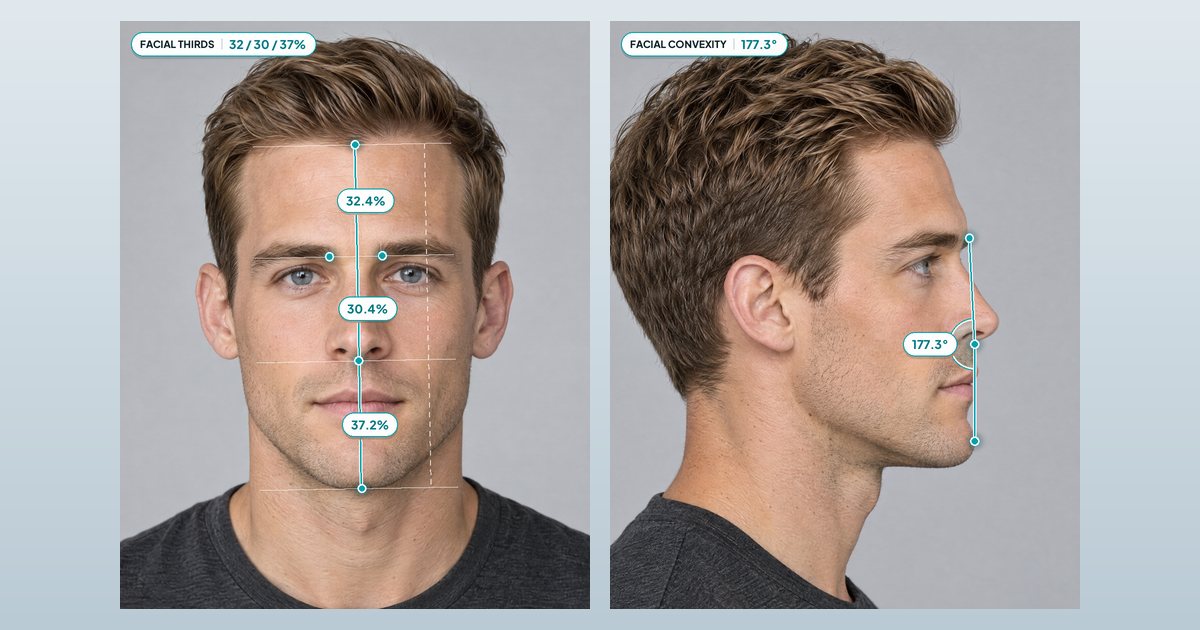
Facial convexity is the angle at the base of your nose between a line up to your brow point and a line down to your chin point.
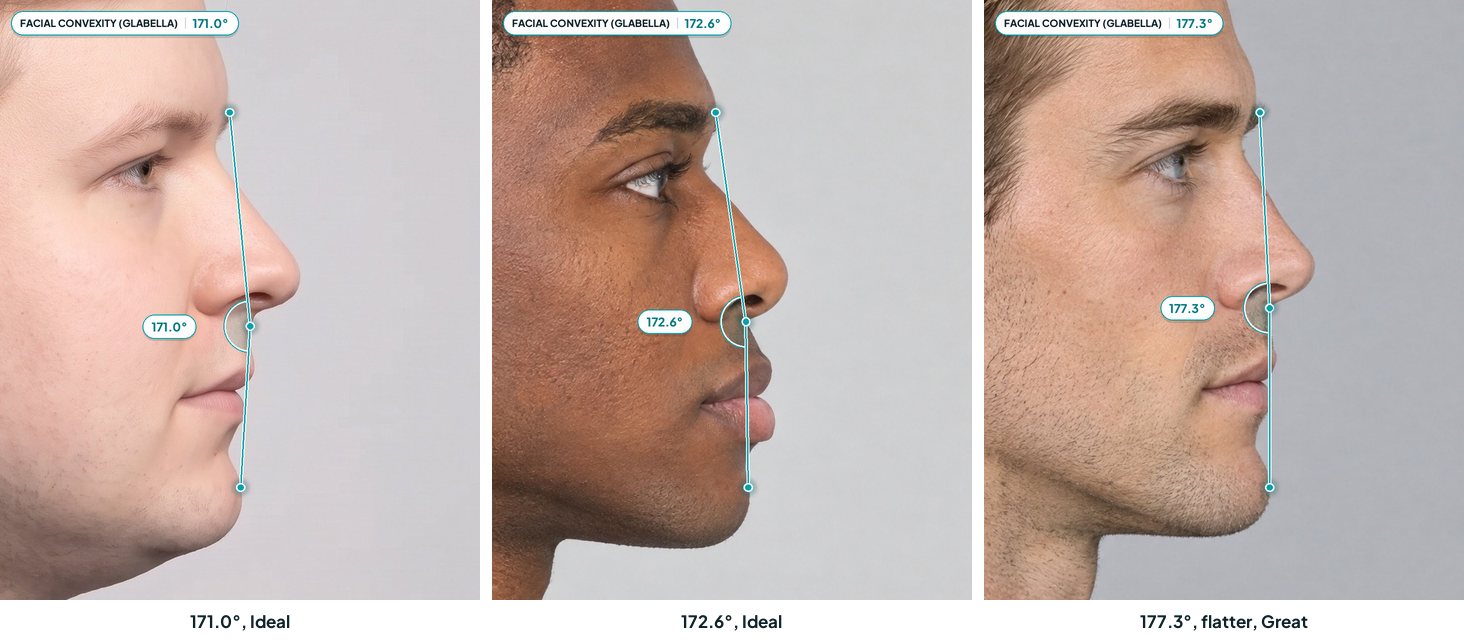
At 180 degrees, brow, nose base and chin sit in a straight line. Under 180 the profile is convex, and all four of our men are, from 171.0 to 177.3 degrees. Over 180 it’s concave, a dished look.
Naini’s convexity study found a straight lower profile rated best, with very convex and very concave versions rated about the same.1 That’s the sharpest clash between the research and our slightly convex ideal, and we come back to it further down. Our score is also tight on this angle: 6.6 degrees outside the range halves it, sooner than any other angle on the page.
The nasofrontal and nasolabial angles
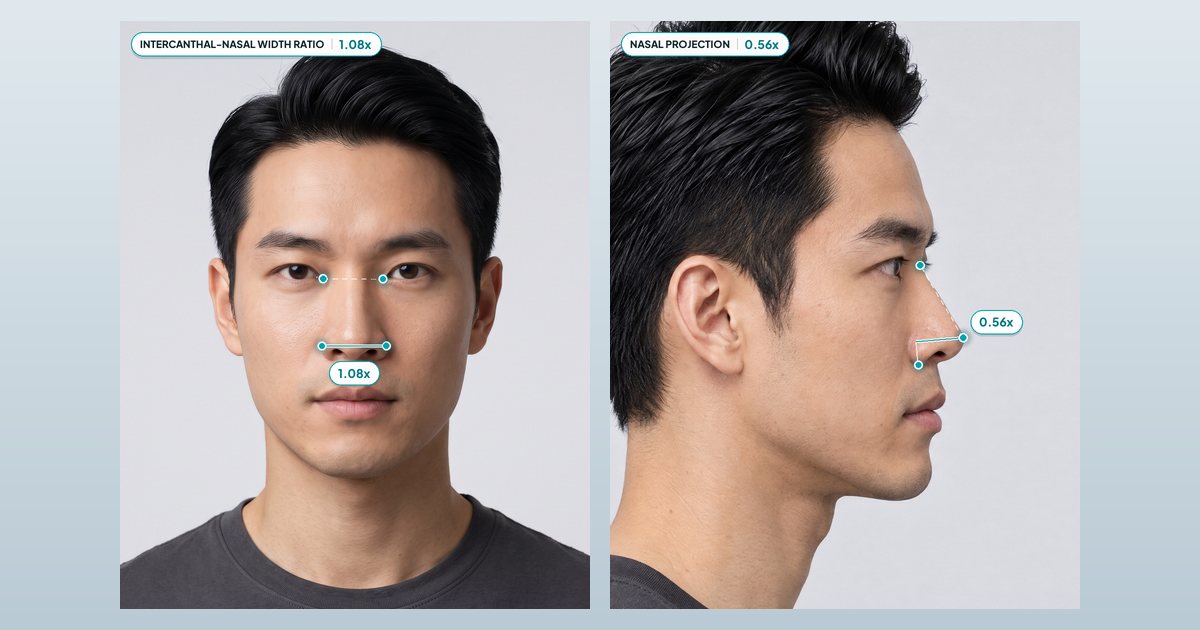
Two angles describe how the nose sits in a perfect side profile. Where your forehead turns into your nose there’s a dip, the nasal root. The nasofrontal angle sits in that dip, with one arm up to your brow point and one down the bridge to just above the tip. Man A reads 119.6, inside our men’s range of 116 to 128 degrees.
When the same UK group reshaped only the bridge, the version raters liked least had a very sharp angle at the root, the look of a bump.4 They favored about 130 degrees and rated 127 to 142 acceptable, a band that starts near the top of our men’s range. Their lower arm ran down the whole bridge and ours stops just above the tip, so the two scales line up only roughly. Our scoring is far gentler on a sharp root: Man B’s 115.0 sits below the band those raters accepted, and it scores Great.
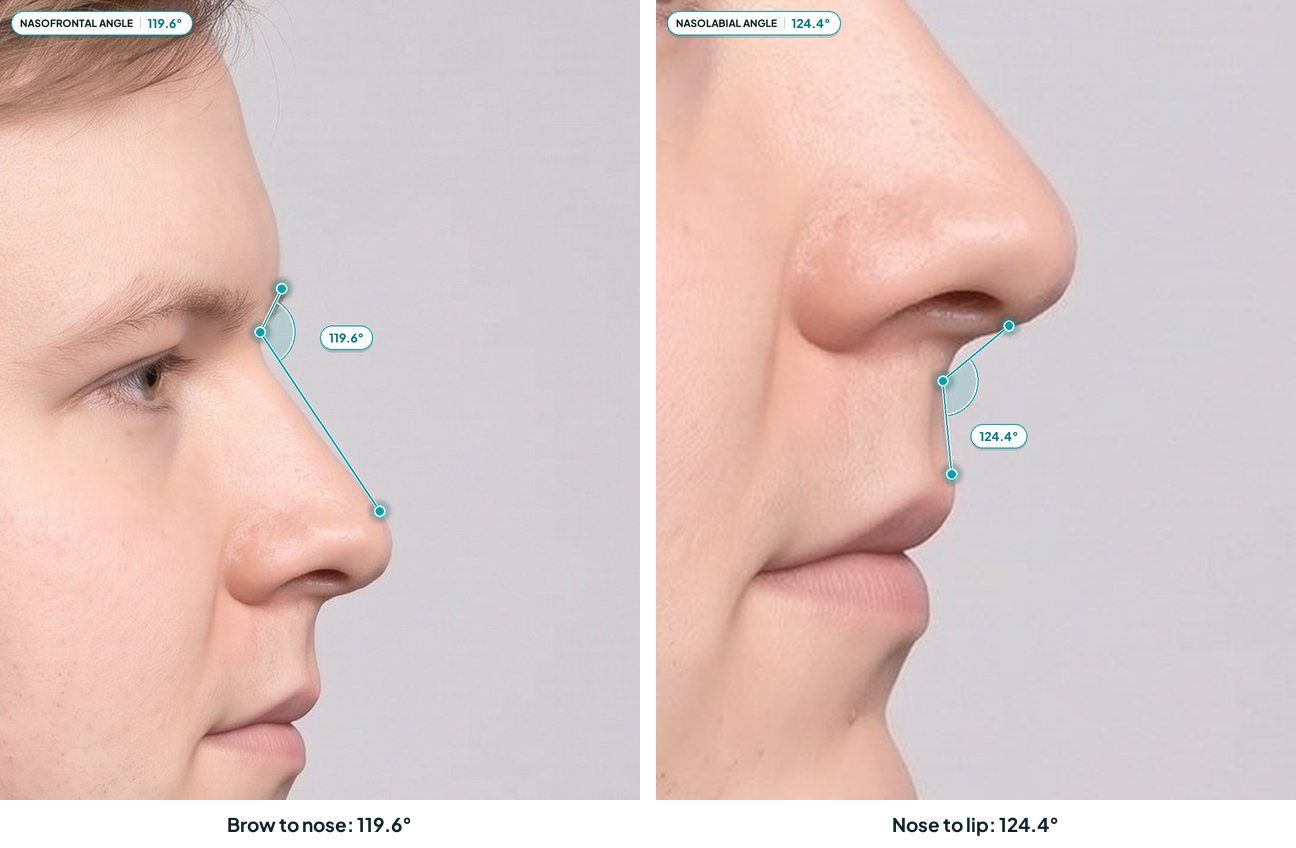
The nasolabial angle is the turn between the underside of your nose and your upper lip. In one study, 98 members of the public ranked three angles for each sex and on average preferred a sharper angle on men, about 97 degrees, than on women, about 105.5 Published ideals run all the way from 90 to 120, and our men’s range of 97 to 114 starts near the men’s average.
On our scoring this angle rarely costs much. Across our four men it spans 33 degrees, from 91.0 to 124.4, and not one scores below 8.8 out of 10. Bumps and scoops on the bridge are a different question, covered in nose shapes in profile.
Lip position and the E-line
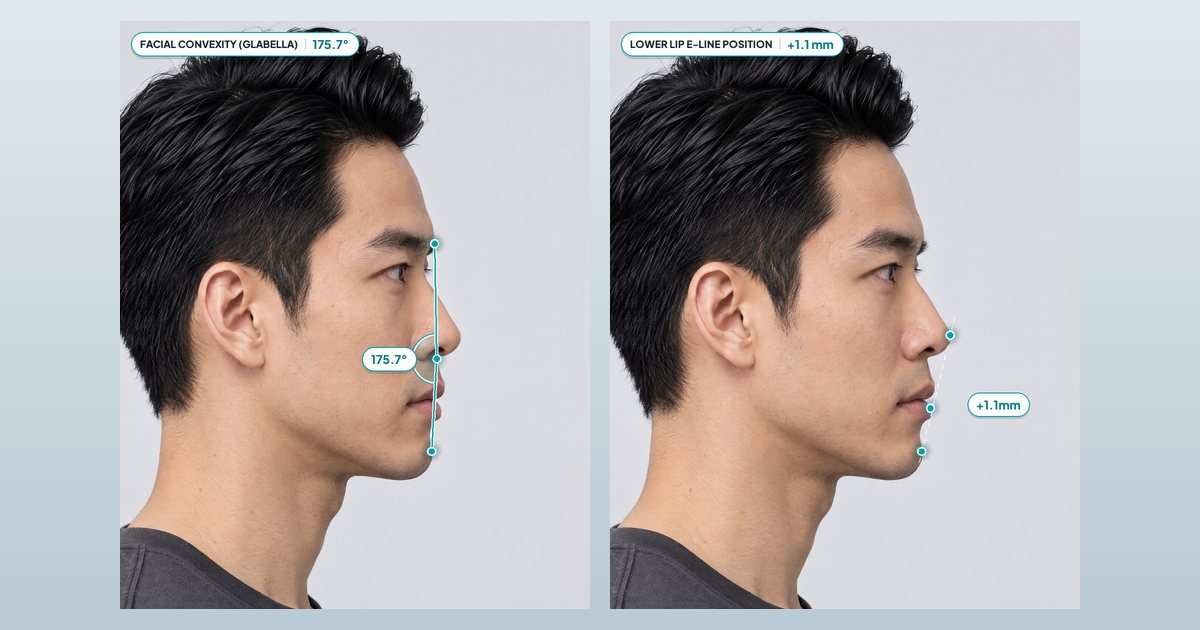
The E-line runs from the tip of your nose to the front of your chin, and the report measures how far each lip sits behind it. A plus number means behind the line, so +3 mm means 3 mm behind.
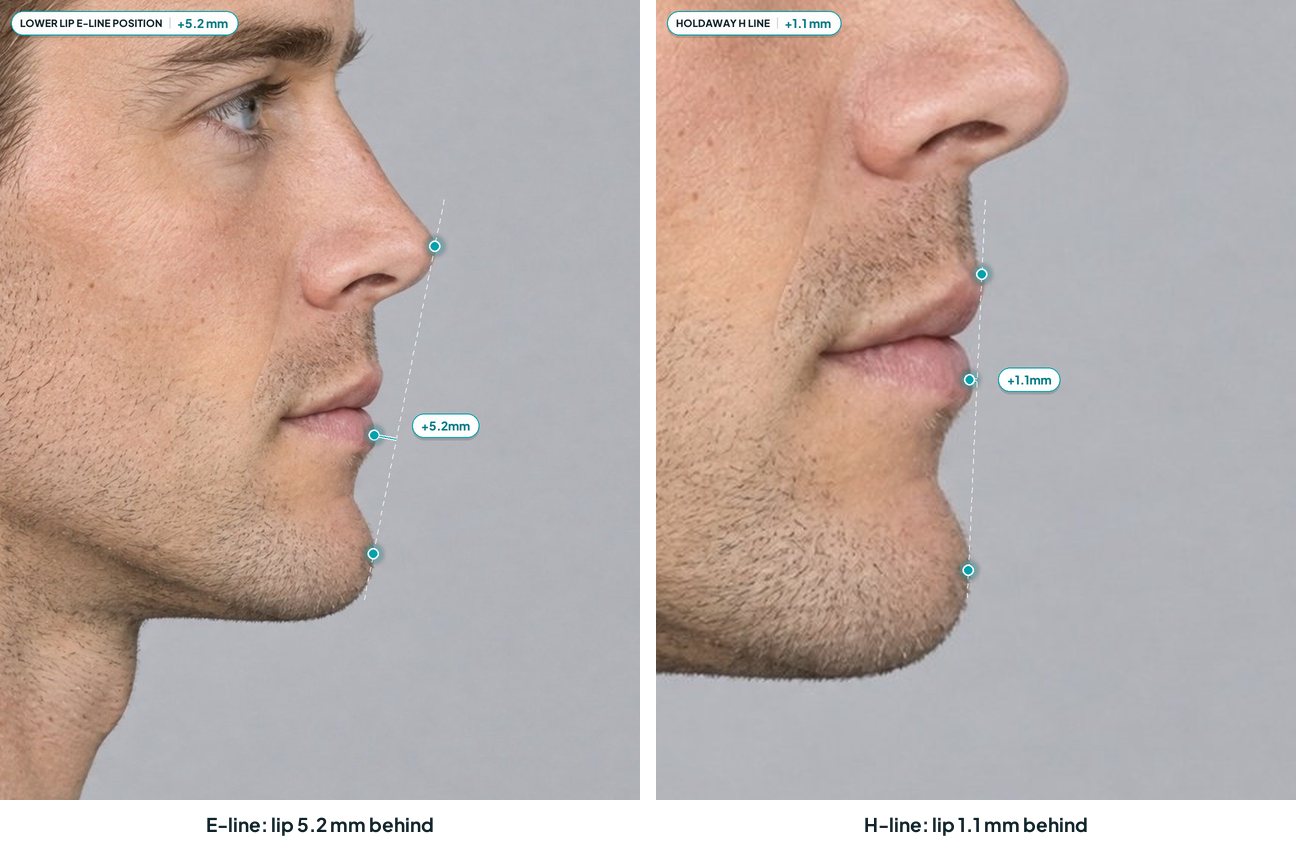
Our men’s range puts the lower lip 1.1 to 4.4 mm behind the line and the upper lip 1.2 to 5.8 mm; for women it’s 0.4 to 3.7 and 0.5 to 5.1. That’s close to the rule from Ricketts, who introduced the E-line: lower lip 2 mm behind, upper lip 4 mm. In a 2025 study, 424 raters from four ethnic backgrounds judged a female profile, and every group liked lips 1 to 4 mm further forward than that.6 On a male silhouette, Naini’s team found lips set slightly forward beat set-back ones, but lips touching or past the line scored lower,7 about where our men’s range stops.
For women, our range agrees with most of those raters: three of the four groups picked a lower lip 1 mm behind the line or touching it, which score Ideal and Great (9.1) on our women’s ranges. The fourth liked lips 2 mm past it, which we’d score much lower, so if your lips sit naturally forward of the line, read our lip score as cautious. For a man, a lower lip touching the line still lands in Good (7.2).
The E-line also reads your nose. Man B’s strong nose tip pushes it forward, so his lip looks set back on the E-line but sits inside the range on the H-line (Holdaway’s line), from upper lip to chin. Our H-line range runs from 0.2 mm in front to 1.2 mm behind for men, and from 0.5 mm in front to 0.9 mm behind for women. Read both before you decide your lips sit too far back.
Lip position is the strictest of the six checks, and it’s also where our measurement is roughest: the millimeters come from an assumed 19 cm face height. Don’t read much into the decimal.
The fold between lower lip and chin
Run a finger down from your lower lip and it drops into a fold before rising onto the chin. The angle at the bottom of that fold is the mentolabial angle: 111 to 127 degrees on our men’s ranges, 116 to 132 for women.
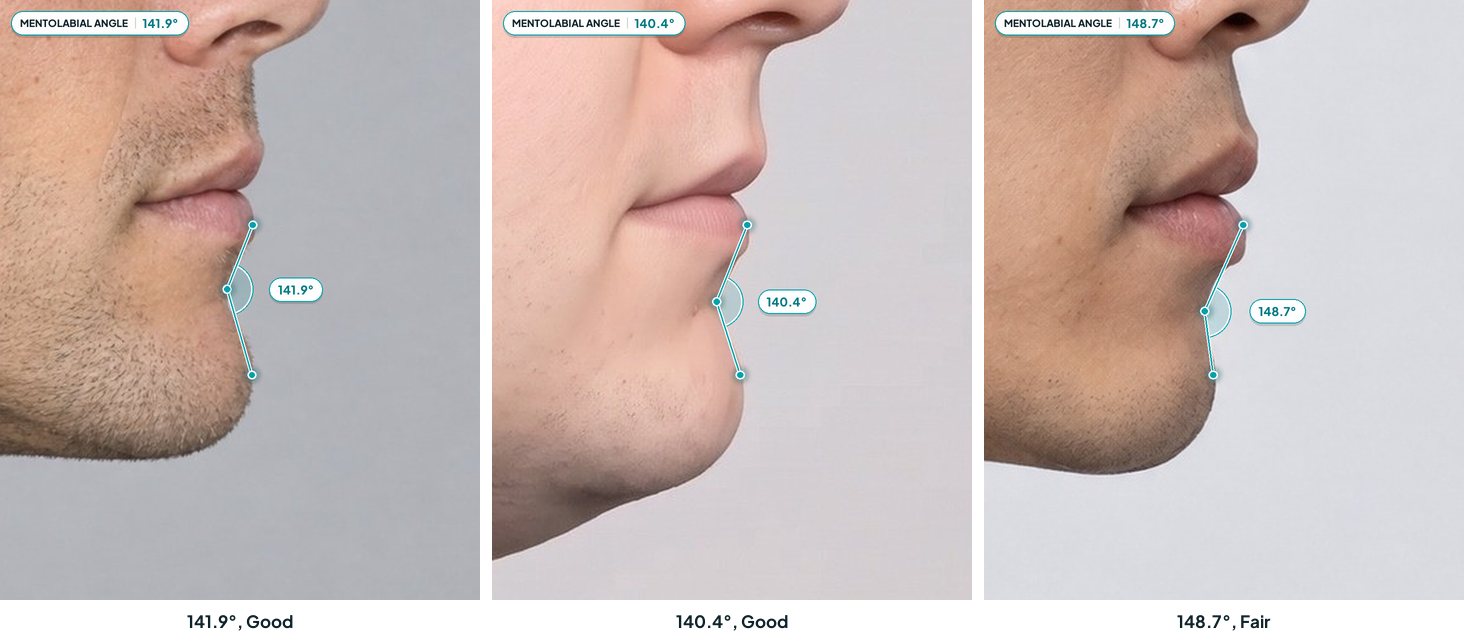
Raters shown a male silhouette with only this fold changed liked about 107 to 118 degrees best and accepted folds up to 140. A very deep or almost flat fold did worst.2
All four of our men sit above their ranges, three of them within 1.5 degrees of each other. Four faces is too few to call that typical, and the averages quoted in that paper mostly sit lower, about 113 to 135. If yours reads around 140, you’re at the edge of what those raters accepted, and in Good on our men’s ranges.
Chin position
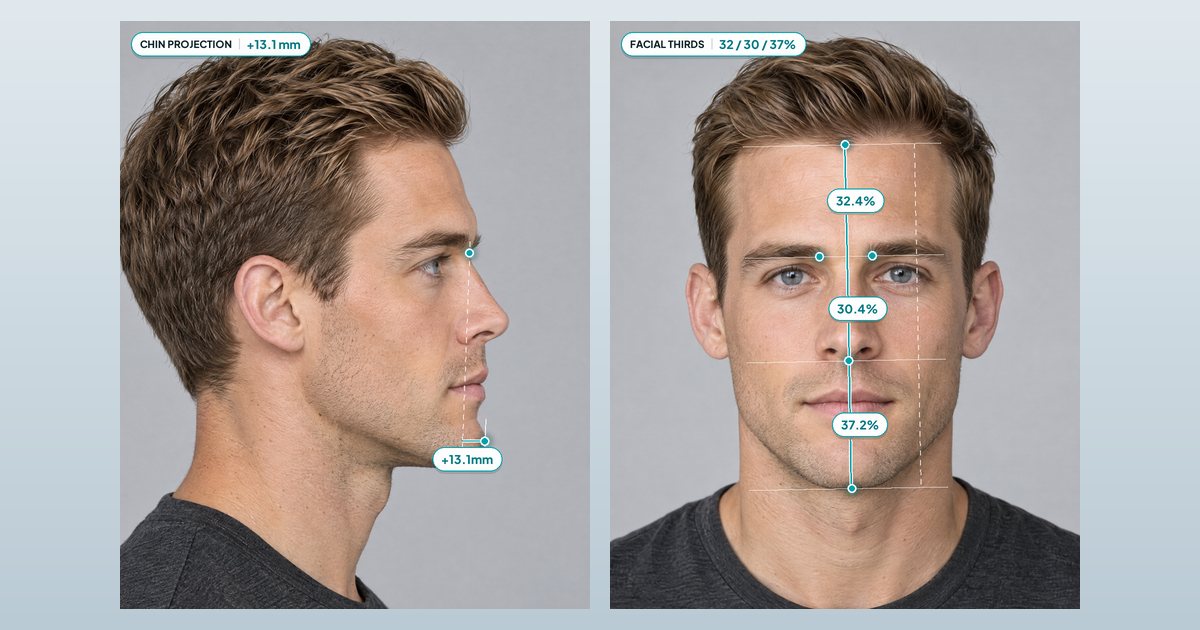
Chin position needs a level photo. The engine levels it on the line from your ear notch to the lower rim of your eye socket (the Frankfort plane), drops a line from the nasal root square to it, and measures how far your chin point sits in front of that line. Our range is 1.5 to 15 mm.
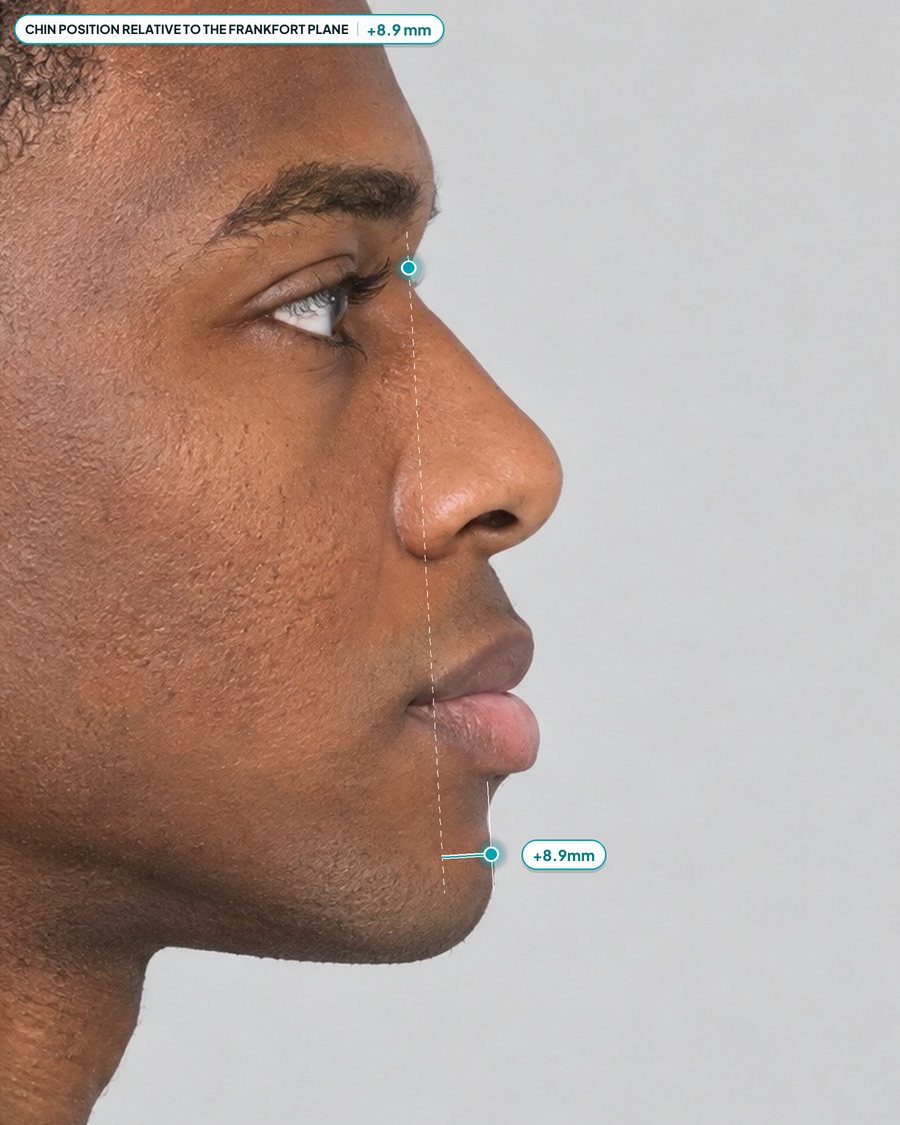
The furthest-back chin of our four, Man C’s at -4.9 mm, belongs to the best-balanced face on this page, and it scores Great. Across the four, chin position spans 18 mm, from -4.9 to +13.1. When Naini’s team moved only the chin, raters barely noticed up to 4 mm either way, and both a set-back and a jutting chin lost points.8 A set-back chin and a strong nose tip move the same E-line, so judge the two together. The chin guide covers how far back counts as recessed.
Ideal side profile ranges for men and women
Read the last column first: it shows how far outside the range a reading can go before its score drops to 5 out of 10.
| Measurement | Men | Women | Score halves at |
|---|---|---|---|
| Facial convexity (whole profile) | 170 to 175° | 168 to 173° | 6.6° outside |
| Nasofrontal angle (forehead to nose) | 116 to 128° | 139 to 151° | 11.8° outside |
| Nasolabial angle (nose to upper lip) | 97 to 114° | 101 to 118° | 21.3° outside |
| Lower lip behind the E-line (nose tip to chin) | 1.1 to 4.4 mm | 0.4 to 3.7 mm | 2 mm outside |
| Mentolabial angle (lip-chin fold) | 111 to 127° | 116 to 132° | 17.6° outside |
| Chin ahead of the nasal-root line | 1.5 to 15 mm | 1.5 to 15 mm | 11.4 mm outside |
Two millimeters of lip position moves the score more than 20 degrees of nose-lip angle, so the ruler from nose tip to chin is the check worth doing by eye.
The heritage you choose at upload can move these ranges by up to about 5 degrees or 1 mm. Chin position stays the same for everyone.
What changes in a woman’s side profile
A woman’s ranges sit 2 degrees more convex and 4 to 5 degrees more open under the nose and under the lower lip. The angle at the nasal root is the exception.
The research behind those small gaps is thin. The nose-lip study above preferred a more open angle on women,5 a 3D study in our nose shapes guide found no such gap, and published norms for the lip-chin fold put the sexes anywhere from about 8 degrees apart to 2.2
At the nasal root, our women’s range of 139 to 151 degrees is 23 degrees more open than the men’s and rewards a smooth line from brow to nose. That’s our range, not a research norm. A deeper nasal root of about 120 degrees, near the middle of our men’s range, would score about 2 out of 10 on it. Keep that in proportion: it’s one of 33 side checks, all weighted the same.
Does anyone have a perfect side profile?
Not among our four men. None is inside the range on all six, and four faces can’t say how rare that is. Most misses are small: 7 of the 13 still score 8 or more out of 10.
| Measurement | Man A, our sample report | Man B | Man C |
|---|---|---|---|
| Facial convexity | 171.0°, Ideal | 177.3°, Great | 175.7°, Ideal |
| Nasofrontal angle | 119.6°, Ideal | 115.0°, Great | 130.0°, Ideal |
| Nasolabial angle | 124.4°, Great | 113.2°, Ideal | 99.2°, Ideal |
| Lower lip E-line | +5.8 mm, Good | +5.2 mm, Great | +1.1 mm, Ideal |
| Mentolabial angle | 140.4°, Good | 141.9°, Good | 148.7°, Fair |
| Chin position | +0.4 mm, Great | +13.1 mm, Ideal | -4.9 mm, Great |
| Inside the range | 2 of 6 | 2 of 6 | 4 of 6 |
Man D, from the convexity and chin figures, is inside on 3 of 6, and his readings are in the totals above. Man C’s ranges are shifted slightly for the heritage chosen at upload.
One number counts for little. The side photo is 38.5% of Harmony and every side measurement weighs the same, so a single reading at zero, with the rest perfect, costs about 0.3 of a Harmony point. A cluster of related misses, like several lip lines at once, pulls harder. The full math is in how the Harmony score is built.
Is a straight, convex or concave side profile most attractive?
A slight convex curve, close to straight, is what our ranges score highest. Research doesn’t pin the exact angle.
In degrees, for men on the default ranges: under 170 is more convex than our ideal, 170 to 175 is the ideal slight curve, 175 to 180 is close to straight, and over 180 is concave. For women, the first two cut-offs drop by 2 degrees, to 168 and 173. These are our cut-offs, not a medical classification.
Our scoring treats both directions alike, much as the convexity study’s raters did. On a man, 165 degrees, 5 under the range, scores the same 6.4 as a straight 180, 5 over it, while 160 drops to 2.5 and a concave 183 to 3.8.
So why does that study say straight while we say slightly convex? Its published summary doesn’t say where its “straight” sits on our 180-degree scale, so the two can’t be lined up. A small 3D study of 30 faces, using the same brow-to-chin angle, points the other way: its five best-rated men had a median of 163.5 degrees, more convex than our range, while for women the gap from the textbook 170 wasn’t significant for the panel as a whole.3 Our range sits between straight and 163.5. If yours reads in the mid 160s, you’re in the company of that study’s best-rated men, even though our score puts it outside the range.
Don’t chase a dead-straight profile. Even on the flattest of our four men, Man B at 177.3 degrees, the nose base sits a little ahead of the line from brow to chin.
Why your side profile looks worse than your front
Often because a front photo hides depth and you rarely see your own profile, so it can look strange to you even when nothing is off. Partly it’s the photo itself, such as a tucked chin.
The front view shows width and spacing; a facial side profile is all projection, so a face can do well from one angle and less well from the other.
Distance should matter less side-on than from the front. One geometric model puts the nose about 30% wider, relative to the cheekbones, in a front photo at 30 cm than at 1.5 m.9 That model covers the front view only. Side-on, your brow-to-chin outline sits roughly flat to the lens, so a close phone should mostly swell the near cheek and ear. Head angle does more damage.
A tucked chin pulls the chin back and bunches the neck. Our engine levels every side photo, correcting tilts of 2.2 to 5.0 degrees on our four example photos, but it can’t undo a head turned toward the camera. Chin position depends on that leveling, so before you decide your chin sits back, check whether it’s a recessed chin or just your head angle.
In the convexity study the harshest judges were patients with jaw-alignment problems, and laypeople were the most forgiving.1 Don’t lean on that too hard: in the nasofrontal study, laypeople were harsher than patients.4
Is my side profile good? Check it from one photo
You can check five of the six with your phone’s photo editor, a ruler or card edge and a protractor app, in about 10 minutes.
- Ask a friend to shoot with the rear camera from about 1.5 m (5 feet), zoomed in, lens at face height. On your own, prop the phone at face height and use the timer. Stand fully side-on, so your far eye hides behind your nose.
- Pull your hair off your forehead and behind your ear, and take off glasses. Close your lips and let them relax, with your teeth lightly together.
- Level the photo. Rotate it until your ear notch, just above the small flap in front of your ear canal, and the lowest point of the bony rim under your eye sit on one level line, the Frankfort plane.
- Set a scale. On a phone, zoom until hairline to chin fills 9.5 cm of screen, so each screen millimeter is about 2 mm of face. On a laptop or tablet, make it 19 cm and the scale is 1 to 1, the same 19 cm face our engine assumes.
- Lips. Lay a ruler or card edge from your nose tip to the front of your chin. A man’s lower lip should sit 1.1 to 4.4 mm behind it, a woman’s 0.4 to 3.7 mm. By eye, a small gap is in range and a lip touching the edge is a near miss (it scores 7.2 out of 10 for a man, 9.1 for a woman), while 1 mm past it drops a man to 4.8. With a strong nose tip, also check the H-line, from upper lip to chin: your lower lip should just touch it.
- Shape. Put dots on the most forward point between your brows, where your nose meets your upper lip, and the most forward point of your chin. Measure the angle at the middle dot with a protractor app: 170 to 175 degrees for men, 168 to 173 for women. Smaller means more convex, and 180 is a straight line.
- Chin. From the deepest point where your forehead meets your nose, draw a line straight down, square to the level line from step 3. Your chin point should sit 1.5 to 15 mm in front of it (about 0.75 to 7.5 mm on a phone screen).
- Angles. Measure the fold under your lower lip and the angle under your nose the same way, against the ranges in the table above. Leave the nasofrontal angle to the report, because its lower point, just above the nose tip, is hard to place by eye. Measure everything twice.
Landing a little outside a range is normal. The last column of the ranges table shows how far is far.
The full method is in how our report levels and measures a side photo.
Side profile myths, checked
Most side profile rules online are either out of date or describe a camera trick.
| Claim | What we found |
|---|---|
| A perfect profile follows the golden ratio | The best-rated faces in a 3D study missed many textbook ideals.3 More in the golden ratio section of our harmony guide. |
| Lips should sit well behind the E-line | On a female profile, raters preferred lips 1 to 4 mm further forward than the old rule,6 and on a male profile set-back lips scored lower than slightly forward ones.7 Our ranges stay close to the old rule but score a lower lip touching the line Great for a woman and Good for a man. |
| The more chin, the better | A jutting chin lost points too, and raters wanted it changed sooner: past 6 mm forward, against 10 mm back.8 |
| A strong jaw angle is what makes a profile | It shapes the lower outline, but it’s one of 33 side checks and weighs the same as each of the six here. See the gonial angle guide. |
| Mewing fixes your side profile | We found no controlled study on adults; what’s in print discusses the trend without measuring results. See what does and doesn’t move a chin. |
| Tilt your chin up to fix it | A photo trick. Our report levels the head before measuring, so the six numbers should stay about the same, though the angle under the chin opens. |
How to improve your side profile without surgery
Nobody gets a perfect side profile from styling alone: bone, cartilage and soft tissue set most of the outline. For a good side profile in photos, what you can change is the photo and your posture, then where the eye lands, with hair, glasses, a beard or makeup.
The cheapest change is the photo itself, set up as in the self-check. Lip posture alone can move two of the six lines: pressed or pushed-out lips shift the lip line, and a smile changes the fold under your lower lip. Keep them closed and relaxed, and save the smile for photos you post.
We haven’t measured any of the styling below, so treat each idea as a test: one change, then a before-and-after side photo.
Hair and glasses for the brow and nose
If your convexity reads under 170, or a strong nose tip pulls your E-line forward as Man B’s does, some height on top evens out the outline. If the dip at your nasal root is deep or sharp (Man B’s 115.0 sits just under our men’s range), frames whose bridge sits right at the root draw less attention to it.
Beard, makeup and posture for the chin and neck
Men, keep the beard a bit longer at the chin point than at the cheeks so the outline carries forward, with the neckline just under the jaw. A beard for a weak or recessed chin has more. When a beard hides the chin, our report estimates the point.
Women, a touch of highlighter on the chin point and soft contour just under the jaw edge bring the chin forward visually.
Everyone, stand with your head stacked over your shoulders and your neck long. It changes the angle under your chin, another side check in our report, with an ideal of 94 to 106 degrees for men and women. If you’re an adult carrying extra weight, losing some through ordinary diet and exercise tends to thin the soft tissue there too; the study linking BMI to facial soft-tissue thickness is in posture and the angle under your chin. If you’re still growing, leave weight targets out of it.
Retake the side photo in the same spot and light each time, or you’ll end up measuring the lighting. Our guide on how to glow up runs the same one-change loop for the whole face.
Questions people ask
What does a perfect side profile look like?
A perfect side profile is a gentle curve from brow to chin in which no part jumps forward or sinks back. Three ruler checks describe it: the nose base sits just in front of a brow-to-chin line, the lower lip just behind a nose-to-chin line, and the chin ahead of a line dropped from the dip between forehead and nose. In our ranges the bend at the nose base is 170 to 175 degrees for a man and 168 to 173 for a woman.
What is the perfect side profile for a woman?
A woman's perfect side profile is like a man's, a couple of degrees more convex and more open under the nose and lower lip. Our women's ranges put the bend at the nose base at 168 to 173 degrees, the nose-to-lip angle at 101 to 118, the lip-chin fold at 116 to 132 and the lower lip 0.4 to 3.7 mm behind the nose-to-chin line. In a 2025 study, most groups liked the lower lip 1 mm behind that line or touching it, which our ranges score Ideal and Great.
What is the perfect side profile for a man?
A man's perfect side profile is slightly convex: in our men's ranges it bends 170 to 175 degrees at the nose base, a few degrees short of straight. The lower lip sits 1.1 to 4.4 mm behind a line from nose tip to chin, the fold under it measures 111 to 127 degrees, and the chin sits 1.5 to 15 mm in front of a line dropped from the top of the nose. In one rating study of a male profile, lips set slightly forward beat set-back ones.
Why does my front look good but my side profile doesn't?
The front view hides depth, and the profile is nothing but depth: how far your brow, nose, lips and chin project. You also see your profile far less often, so it looks unfamiliar. Side photos are often taken with the head tucked or the lips tense, and each of those can make it read worse. In our report the side photo counts for close to 40% of the Harmony score, so a good front still carries more weight.
Is my side profile good?
One leveled side photo from 1.5 m gives a fair answer. Lay a ruler from nose tip to chin: your lower lip should sit just behind it, with a small gap. Your chin should sit in front of a line dropped from the deepest point where your forehead meets your nose, and the bend at the nose base should fall a few degrees short of straight. Our four example men each missed two to four of the six profile checks, and a reading just outside a range usually scores well.
Does mewing change your side profile?
We found no controlled study showing that mewing changes an adult's side profile. What's published is commentary and analyses of social-media trends, none testing whether it works. The six profile measurements follow bone and the soft tissue over it. Spend the effort on the photo, your posture, a beard or makeup instead.
How do I get a perfect side profile?
No styling makes the numbers perfect, but the photo and your posture change how a profile reads. Shoot fully side-on from 1.5 m, lens at face height, head level and lips relaxed. Stand with your head stacked over your shoulders. Men can keep a beard a bit longer at the chin point, and women can add highlighter on the chin and soft contour under the jaw. For adults carrying extra weight, losing some through ordinary diet and exercise tends to thin the area under the chin.
Sources
-
Naini FB, Donaldson AN, McDonald F, Cobourne MT. Assessing the influence of lower facial profile convexity on perceived attractiveness in the orthognathic patient, clinician, and layperson. Oral Surg Oral Med Oral Pathol Oral Radiol. 2012;114(3):303-311. doi:10.1016/j.tripleo.2011.07.031. Abstract on PubMed ↩↩↩
-
Naini FB, Cobourne MT, Garagiola U, McDonald F, Wertheim D. Mentolabial angle and aesthetics: a quantitative investigation of idealized and normative values. Maxillofac Plast Reconstr Surg. 2017;39(1):4. doi:10.1186/s40902-017-0102-8. Full text on PMC ↩↩↩
-
Zwahlen RA, Tang ATH, Leung WK, Tan SK. Does 3-dimensional facial attractiveness relate to golden ratio, neoclassical canons, ‘ideal’ ratios and ‘ideal’ angles? Maxillofac Plast Reconstr Surg. 2022;44(1):28. doi:10.1186/s40902-022-00358-2. Full text on PMC ↩↩↩
-
Naini FB, Cobourne MT, Garagiola U, McDonald F, Wertheim D. Nasofrontal angle and nasal dorsal aesthetics: a quantitative investigation of idealized and normative values. Facial Plast Surg. 2016;32(4):444-451. doi:10.1055/s-0036-1584234. Abstract on PubMed ↩↩
-
Sinno HH, Markarian MK, Ibrahim AMS, Lin SJ. The ideal nasolabial angle in rhinoplasty: a preference analysis of the general population. Plast Reconstr Surg. 2014;134(2):201-210. doi:10.1097/PRS.0000000000000385. Abstract on PubMed ↩↩
-
Sadek MM, Alali MB. Influence of lip protrusion and thickness on the perception of facial profile attractiveness among subjects with different ethnic backgrounds. Angle Orthod. 2025;95(6):656-662. doi:10.2319/092724-796.1. Full text on PMC ↩↩
-
Naini FB, Cobourne MT, McDonald F, Garagiola U, Wertheim D. Quantitative investigation of the esthetic impact of lip prominence in relation to the esthetic line. Am J Orthod Dentofacial Orthop. 2021;159(5):574-581. doi:10.1016/j.ajodo.2020.02.012. Abstract on PubMed ↩↩
-
Naini FB, Donaldson AN, McDonald F, Cobourne MT. Assessing the influence of chin prominence on perceived attractiveness in the orthognathic patient, clinician and layperson. Int J Oral Maxillofac Surg. 2012;41(7):839-846. doi:10.1016/j.ijom.2012.01.012. Abstract on PubMed ↩↩
-
Ward B, Ward M, Fried O, Paskhover B. Nasal distortion in short-distance photographs: the selfie effect. JAMA Facial Plast Surg. 2018;20(4):333-335. doi:10.1001/jamafacial.2018.0009. Full text on PMC ↩
Spotted a mistake? Email support@faceratinglab.com and we will fix it.