Upturned nose: the tip angle that counts for women and men
An upturned nose, also called a turned up, celestial or retroussé nose, has a tip that points up, so the nose can look a little shorter in profile. On the ranges we score, its underside tilts more than 21.5 degrees above level on a man, or 30.5 on a woman, and the corner where it meets the upper lip opens past 114 or 118 degrees.
The short version
- Women's ideal tip range runs 9 degrees higher than men's, so a +33.4 tip that scores Fair on a man's report scores Great on a woman's.
- A slightly upturned tip, up to about 6 degrees past the range, still scores Great.
- As our report draws them, the nose-to-lip angle equals 90 degrees plus your tip rotation minus your upper lip's forward lean, so a forward lip can hide an upturned tip. On our four example men, the lip moved that angle more than the tip did.
- Raters tend to favor a slight upturn on women and a near-straight tip on men. Yet in one small test, four faces rated by 813 people, turning a drooping tip up on its own didn't significantly change any rating.
- We found no evidence that exercises turn a tip up or down. What can change how upturned it looks is camera height and where your contour highlight stops.
On our report, two angles on a side photo decide if you have an upturned nose. The first is how far the nose’s underside tilts up from level: past 21.5 degrees on a man, or 30.5 on a woman, means the tip turns up. The second is the corner where your nose meets your upper lip, which has to open past 114 degrees on a man or 118 on a woman. A lip that leans forward can keep that corner closed even when the tip points up.
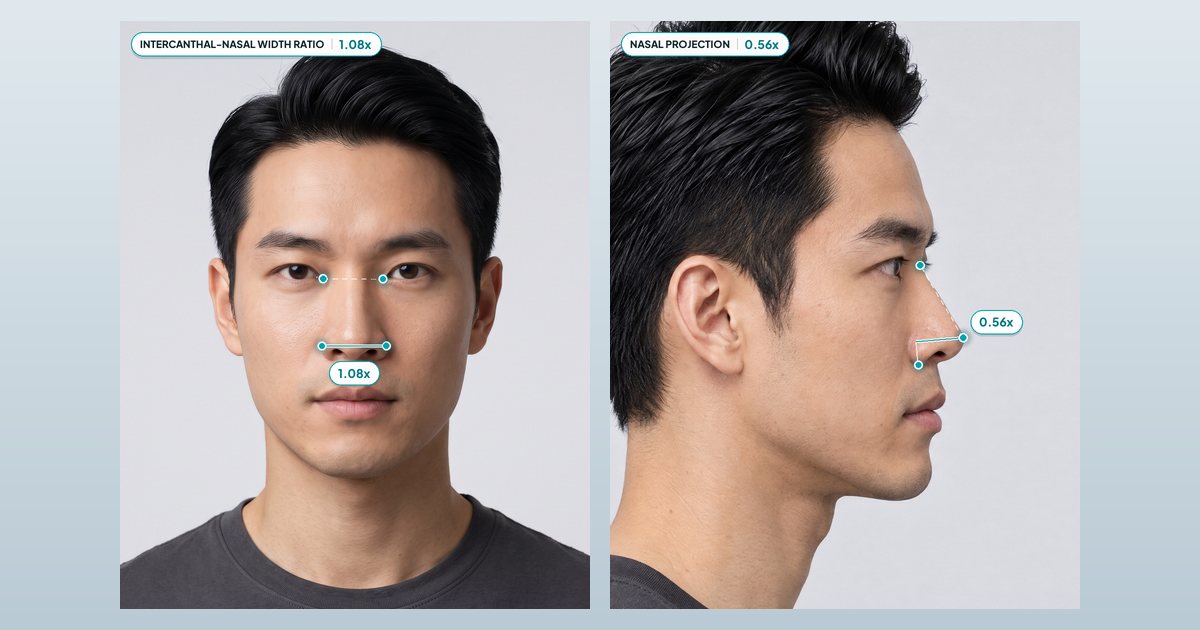
We measured four example men, A to D. Man A is the man in our sample report and in the photo at the top. Here are the other three, most turned up first. Watch where the teal line stops: halfway along the underside, well short of the tip.
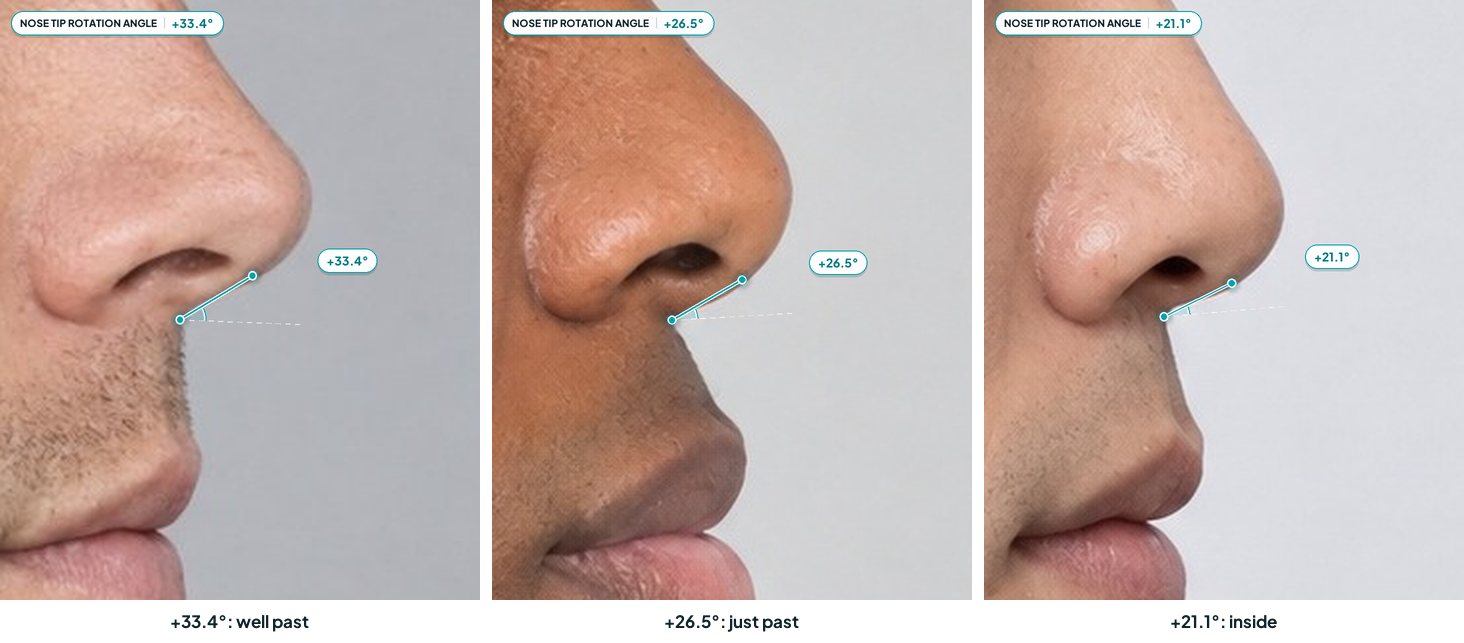
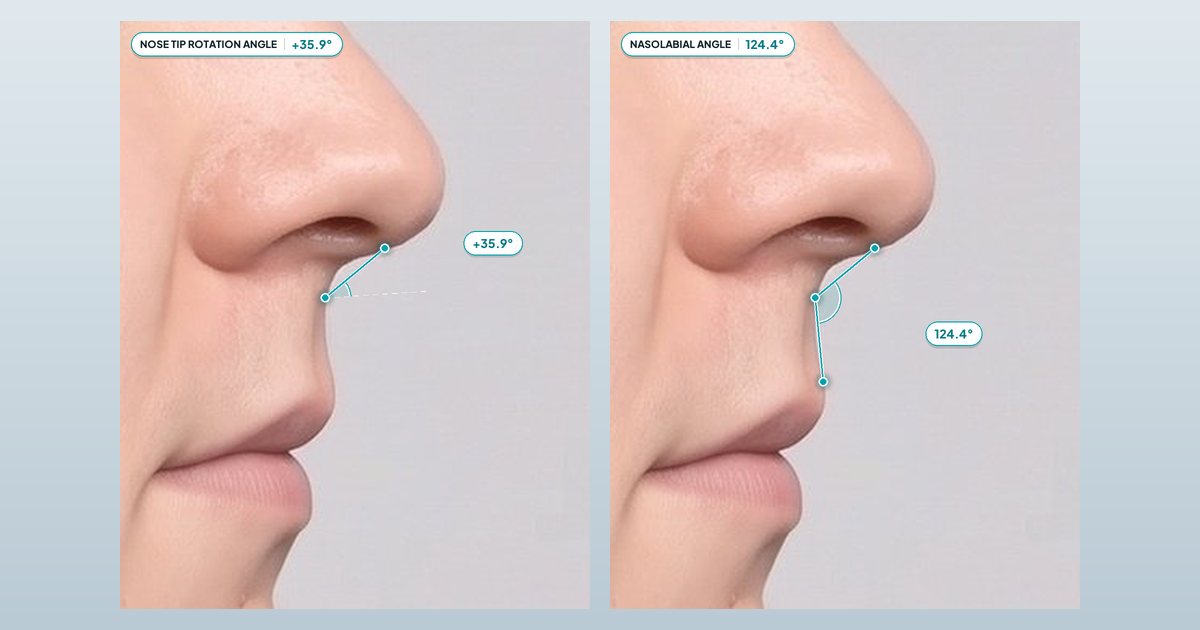
Man A turns up the most of the four, at +35.9 degrees. Yet at that halfway point his underside sits only about 2.3 mm higher than it would at the men’s cut-off, roughly three credit cards stacked. That’s why we never build advice on this angle, however far your tip turns up.
What angle counts as an upturned nose for women and men
Tip rotation (Nose tip rotation angle on the report) follows the underside of your nose from the corner at your lip to a point halfway to the tip, and asks how far that line climbs. The level it’s read against runs from the top of your ear opening to the lowest point of the bony rim under your eye, a level many research photos are taken on. A plus means the underside tilts up. The nose-to-lip (nasolabial) angle keeps the underside line and adds one down the front of your upper lip.
| Measurement | Men | Women |
|---|---|---|
| Tip rotation, Ideal | +11.5 to +21.5° | +20.5 to +30.5° |
| Tip turns up (first test) | over +21.5° | over +30.5° |
| Tip scored Great (slightly upturned) | +21.5 to about +27° | +30.5 to about +36° |
| Tip scored Good | about +27 to +31° | about +36 to +40° |
| Tip scored Fair | about +31 to +35° | about +40 to +44° |
| Tip scored Focus area | over about +35° | over about +44° |
| Nose-to-lip angle, Ideal | 97 to 114° | 101 to 118° |
| Nose-to-lip past Ideal (second test) | over 114° | over 118° |
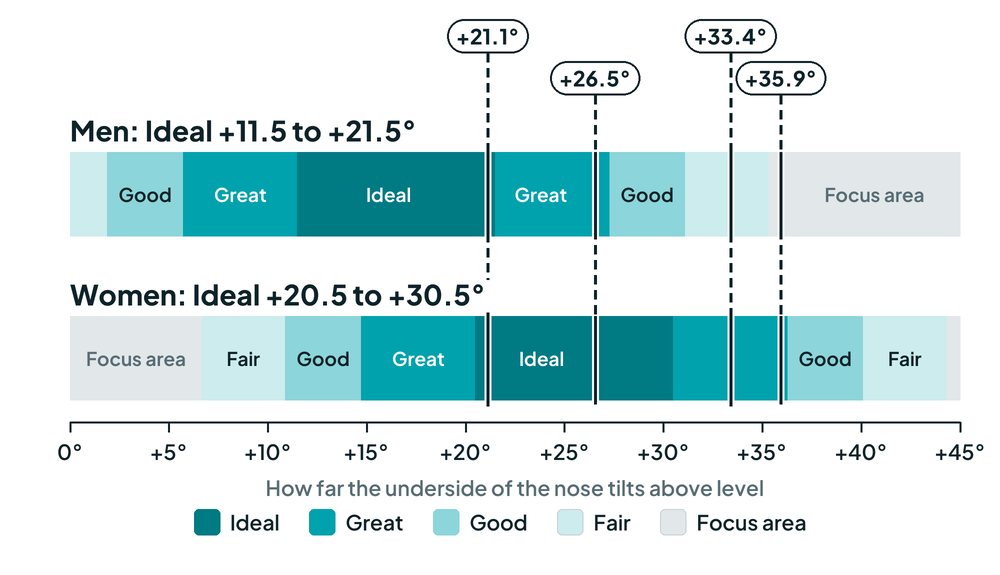
The women’s tip band sits 9 degrees higher than the men’s. That puts a +28 tip at Ideal on a woman’s report and only Good on a man’s.
Some papers use the word “upturned”, but none we read sets a cut-off for it. They measure tip rotation and the nasolabial angle, so these cut-offs are our reading: the top edges of the ideal ranges we score against. They shift a little with the heritage you choose at upload.
Slightly upturned vs very upturned nose, by the numbers
A slightly upturned nose, in our numbers, has a tip up to about 6 degrees past the range, where it still scores Great: about +21.5 to +27 on a man and +30.5 to +36 on a woman. Man C sits in that band at +26.5. At the halfway point his underside is only about 0.7 mm above where the men’s cut-off would put it, about the width of a mechanical pencil lead. The label describes the tip alone, though. His upper lip leans forward, so his nose-to-lip corner stays at 91, far short of 114, and on our two tests his nose isn’t upturned.
| Example man | Tip rotation | On a man’s report | On a woman’s report |
|---|---|---|---|
| Man D | +21.1° | Ideal | Ideal |
| Man C | +26.5° | Great (8.3) | Ideal |
| Man B | +33.4° | Fair (4.8) | Great (9.3) |
| Man A (sample report) | +35.9° | Focus area (3.7) | Great (8.1) |
We’d call a tip very upturned once it scores Focus area: past about +35 on a man or +44 on a woman. Of our four, only Man A gets there, and only on the men’s scale.
What does the report do with it? Very little. We mark tip rotation low confidence, partly because the underside line is only about 9 to 10 mm long. Each degree moves its end only about 0.15 to 0.18 mm, so a 1 mm slip in where a point lands moves the angle about 5.5 to 6.5 degrees. On Man A’s report the tip rotation reads Focus area, yet the focus areas at the top of his report include nothing about his nose. You still get the number and the drawing to check. A very upturned tip sits outside the ideal range, and that’s all it means.
How tip rotation changes the nasolabial angle
One for one, as long as your upper lip stays put. The nose-to-lip angle is 90 degrees, plus your tip rotation, minus your lip lean. Lip lean is how far the line from your nose base to the front of your upper lip tips forward from straight down. It’s plain geometry for the way our report draws the two angles, since they share the underside line, and it matches the report to 0.1 degree on all four men. For Man A, 90 plus 35.9 minus 1.5 gives 124.4.
Man B and Man D show it. Their lips lean about the same, 10 and 12 degrees, while their tips sit 12.3 degrees apart and their nose-to-lip angles 14.0 apart.
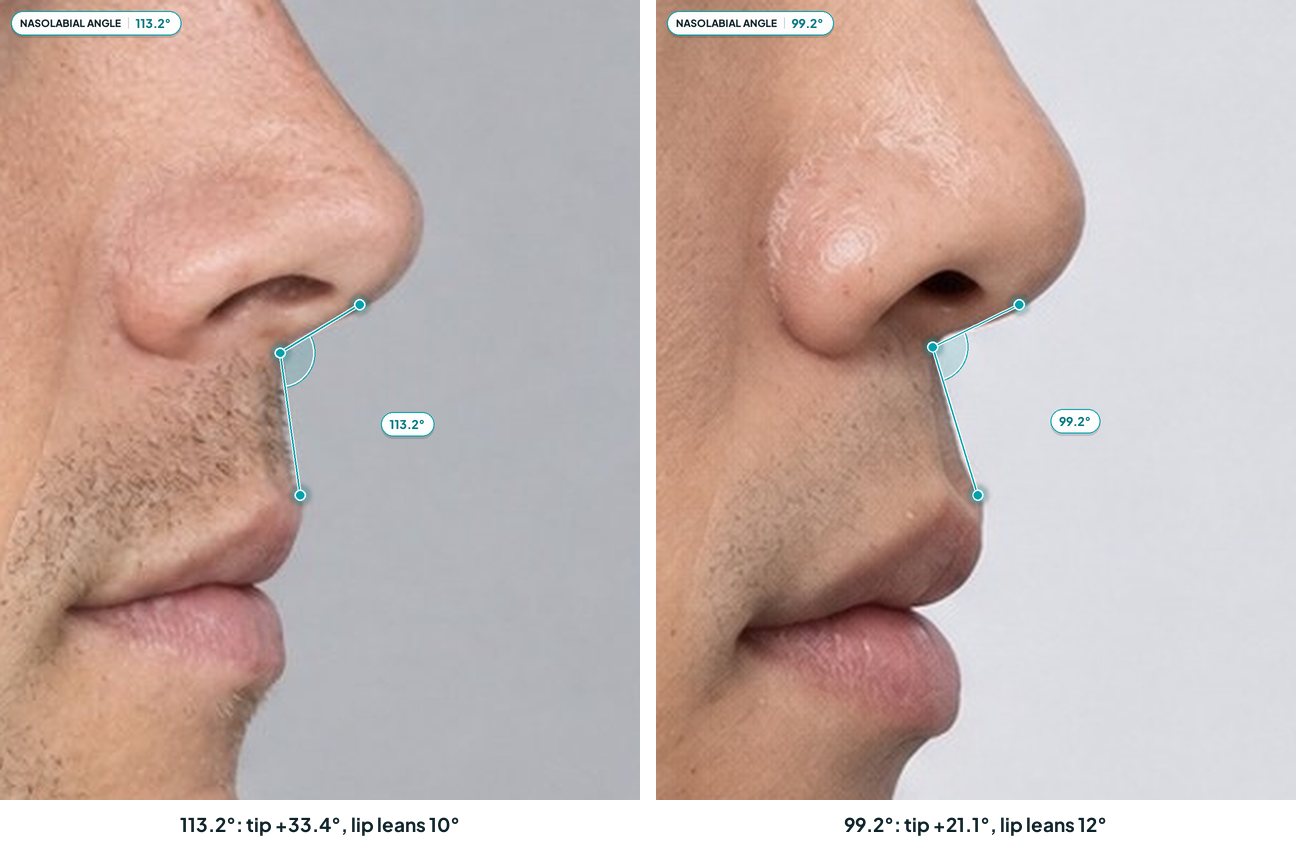
Now let the lip move. Man C’s tip turns up more than Man D’s, +26.5 against +21.1, but his upper lip slopes forward 26 degrees against 12. His nose-to-lip angle is the smaller one, 91.0 against 99.2. The lip wins.
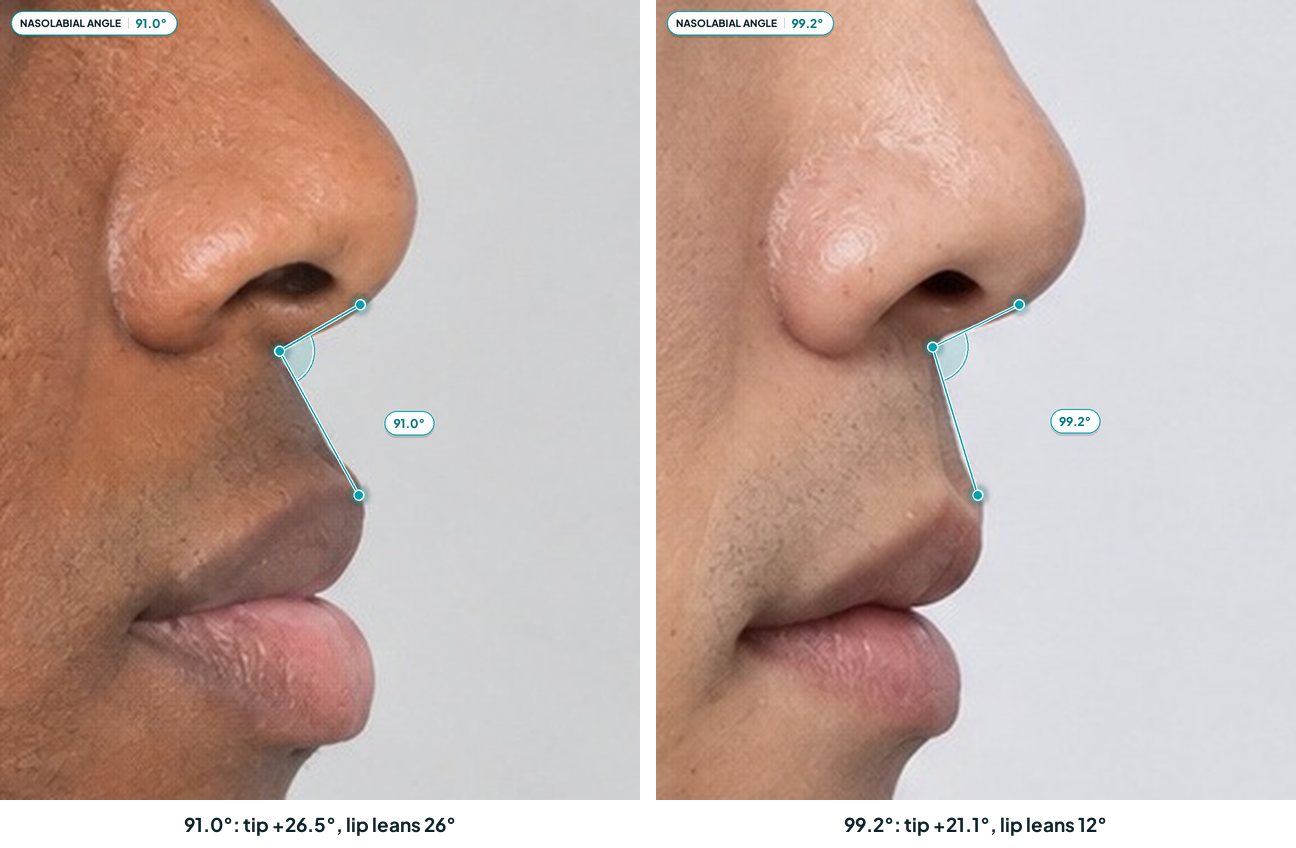
Across our four men, lip lean spreads 24.1 degrees and tip rotation only 14.8. The lip moved the nose-to-lip angle more than the tip did, and that lip effect is why the report keeps a separate tip number. Read the underside first. Of the two lines, it’s the one that leaves the lip out.
Researchers who measured tip rotation three ways on 100 volunteers hit the same snag. The nose-to-lip angle and the tilt of the nostril showed no correlation with each other, and a sloped upper lip was one of the features in faces where the methods split.2 The nasolabial angle in a whole side profile shows how that lip sits against your chin and the rest of your profile.
Put the two tests together and you get a rule of thumb. A man’s nose passes both once his tip clears about +24 degrees plus his lip lean, and never less than +21.5. Man B’s lip leans 10 degrees, so he needs about +34, and he has +33.4. For a woman it’s about +28 plus her lean, never less than +30.5, so if her lip is near upright the tip edge is the one that decides.
How to check if your nose is upturned
A mirror or a front photo can’t measure it, and upturned nostrils, or nostril show, are an unreliable clue on their own, since camera height changes them too. Man A has the most upturned tip here, yet his report still rates his nostril exposure 9 of 10, where 10 means no extra nostril on show. You need a level side photo and two short lines.
- Have a friend take a side photo from about 1.5 m (5 feet), zoomed in, with the lens at nose height and your ear showing. Close-up shots distort noses: in one geometric model, a front selfie from 30 cm made the nose look about 30% wider than a photo from 1.5 m.4
- Look straight ahead, chin level, lips lightly together. No smile, no pout.
- Level the photo. Press a fingertip under your eye to find the lowest point of the bony rim, roughly a finger’s width below your lower lashes. With your phone’s markup pen, draw from the top of your ear opening (the notch just above the small flap in front of it) to that point, then rotate the photo until the line is flat. Our four men’s photos sat 2.2 to 5.0 degrees off level before this step.
- From the corner where your nose meets your lip, draw one line along the underside that stops halfway to the tip, and a second down to the front of your upper lip. Don’t run the first line on to the tip, which reads far too high.
- Measure both with a protractor app. The first line against level is your tip rotation, and the angle between the two lines is your nose-to-lip angle. With no app, +21.5 is a little under a quarter of a right angle and +30.5 about a third.
Then read the two numbers together:
- Upturned: tip past +21.5 and corner past 114 (+30.5 and 118 for a woman), like Man A.
- Leaning upturned: tip past its edge, corner a little short, like Man B.
- Tip turned up, nose not upturned: the tip clears its edge but the corner falls well short because your lip leans forward, like Man C.
- Not upturned: tip inside its range, whatever the corner says, like Man D.
Treat the result as rough. Leveling the photo cancels a tilted head in the numbers, but a low camera still makes a tip look more turned up and a smile moves the lip line, so retake any shot with either. Because the underside line is so short, only trust a hand-drawn tip reading at least 5 degrees from the cut-off, our own rule of thumb. Our step-by-step level-photo method draws each step, and how our report places the points shows where each dot goes.
Why the upturned nose angles you read online don’t agree
The clinic pages that rank for this search give anything from about 90 to 120 degrees.
| Number you’ll see | What it actually is | Source |
|---|---|---|
| About 100 for men, 120 for women | A nose-to-lip target after surgery | One clinic page |
| 90 to 95 for men, 95 to 110 for women | A nose-to-lip angle called typical, with no source given | Another clinic page |
| 106 degrees, “the perfect nose” | The raters’ favorite in one study. It’s a columellar facial angle, a different line from the nose-to-lip angle | Ahmed 20145 |
| 104 to 110 for women, 95 to 100 for men | Where preferred nose-to-lip angles usually cluster, in a review of 31 preference studies | A 2026 review6 |
| About 91 to 116, no significant difference by sex | Average nose-to-lip angles from measured groups of people, varying by study | A 2021 review3 |
| Tip +11.5 to +21.5 (men), +20.5 to +30.5 (women); nose-to-lip 97 to 114, 101 to 118 | Our aesthetic scoring ranges for rating faces | Our report |
Four things help explain the spread. Surgeons don’t agree on how to draw the angle: in a survey of 82 of them, no method won even half the votes.1 Any angle that uses the lip moves when the lip leans. Anything drawn against the photo’s edge moves when the head tilts. And a clinic’s goal for an operation is a different thing from the range real noses fall in.
So ignore anyone who sells one perfect nose angle, the famous 106 included.
Upturned noses don’t look like a female trait in the measurements, either. On the usual stand-in for tip rotation, the nose-to-lip angle, men and women come out about the same on average, with no significant sex effect across 8 mostly orthodontic X-ray studies.3 What usually differs, though not in every study, is the angle raters prefer.6 Our women’s ranges sit higher too, which fits: they’re ideal ranges, not averages.
Upturned vs snub, button and ski slope noses
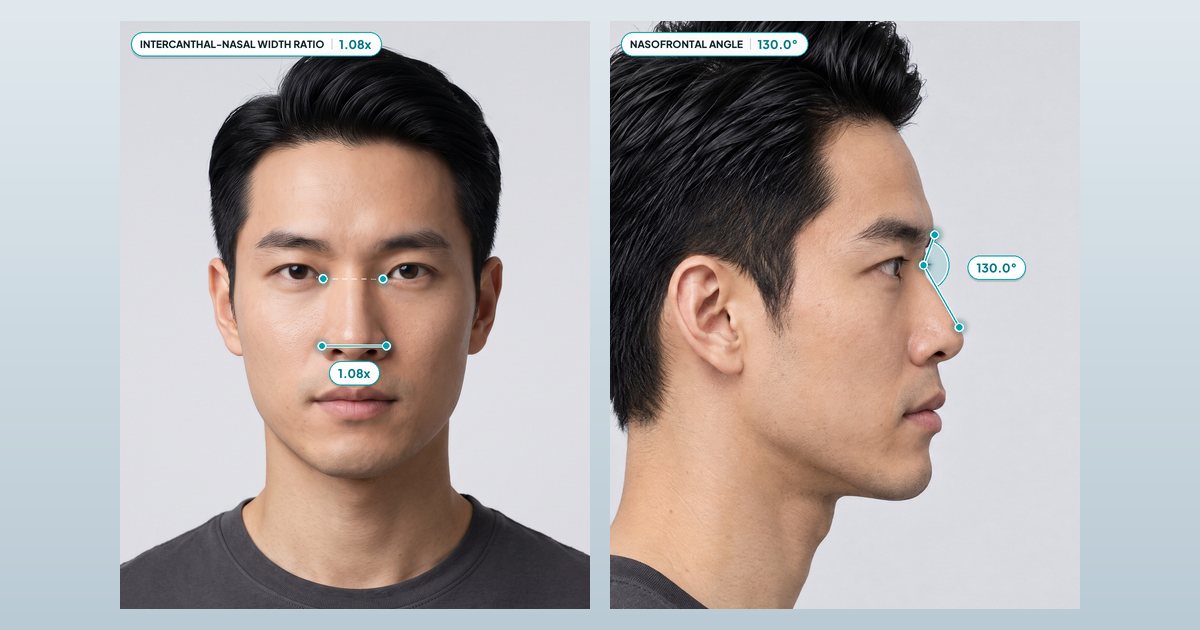
On our report’s ranges, a snub nose is upturned with a short reach: a nasal projection (how far the tip reaches in front of the nostril wing, against the nose’s length) under 0.58 for men or 0.55 for women. Man A, upturned on both tests with a projection of 0.51, is the one of our four that fits. B, C and D also come in under 0.58, but none of them passes both upturned tests, so a short reach alone doesn’t make a snub. A button nose is small with a round tip, often slightly upturned. We have no button number, so judge size and roundness by eye. The outlines in our guide to upturned, snub and button noses show the difference.
A ski slope nose has a bridge that dips before the tip turns up. We have no number for the dip, so check it with the card-edge bridge check and the tip with tip rotation. All four of our men have straight bridges, and three of them still have tips past the men’s range, so an upturned tip doesn’t need a dipped bridge.
Are upturned noses attractive?
When people rate noses, the favorite for women is usually a slight upturn, a nose-to-lip angle of about 104 to 110 degrees, and for men something closer to straight, about 95 to 100. Younger raters lean toward straighter noses with less upturn.6 That women’s favorite sits inside our own women’s Ideal range for the angle, 101 to 118.
The nearest thing research has to a perfect upturned nose is a moderate one. In the largest test we found, about 4,000 raters saw young women’s profiles edited to five tip angles from 96 to 116 degrees. They picked 106, the middle of the five.5 When the middle of five options wins, the menu deserves some of the credit, so 106 is a poor number to aim for. The direction is what holds: the two most rotated versions lost.
The one photo-edit test we found is the surprise. Researchers showed 813 raters either the original or an edited side profile of four people with a drooping tip, and no rater saw two versions of the same face. Turning the tip up on its own didn’t significantly change any rating, attractiveness and age included. A smoother bridge, alone or with the tip also turned up, did move ratings.7 It was a small pilot, all from drooping tips, so it says nothing about making an upturned tip more upturned.
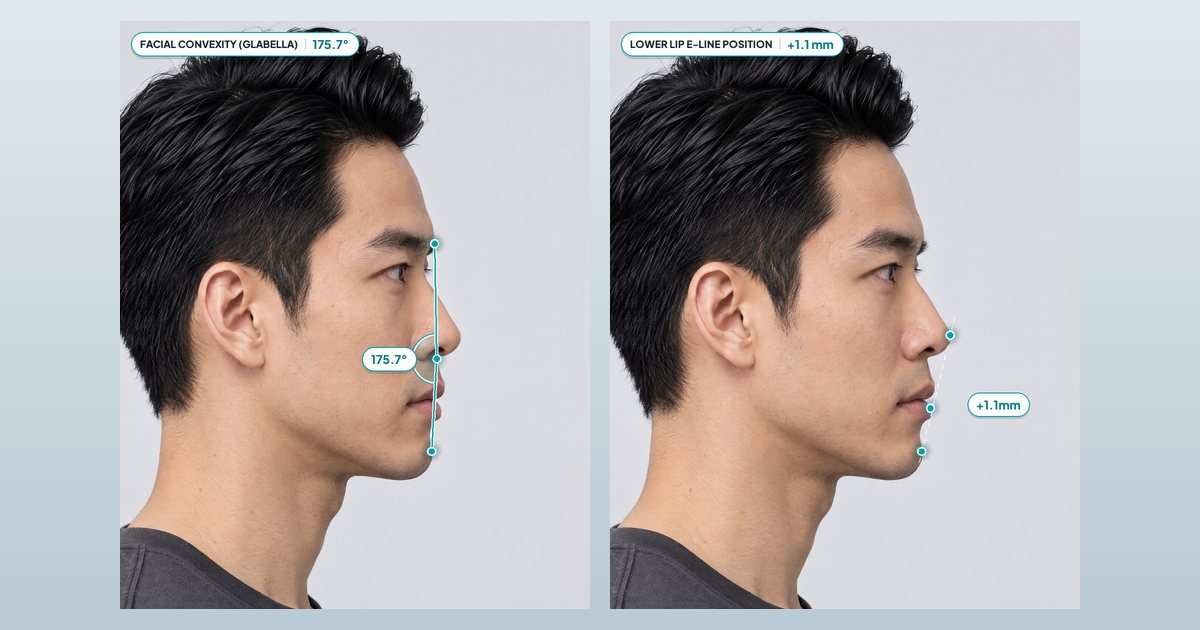
A 2026 review of 31 studies concluded that how the nose fits the whole face mattered more than any one angle.6 Man A shows it: the tip that scores Focus area from the side shares his report with a nose strength, his front-view nose tip position, and his Features pillar still reads Good. A chin that sits further back can make the same nose read bigger, and no single angle decides your harmony.
What causes an upturned nose, and can you change it naturally?
The cartilage of the tip and its support set much of the angle, and you can’t change that naturally. Age slowly lowers a tip, and we found no evidence that exercises, clips or taping turn one up or down. Skip them.
In 39 people X-rayed at about 17, 47 and 57, the tip and the columella (the strip between the nostrils) drifted down and the nose-to-lip angle closed.9 The shape is also partly inherited, through many small genetic effects, with no single gene explaining more than a sliver of it.8 An injury or an earlier nose operation can change it too.
We found no evidence that an upturned tip by itself affects breathing, which depends mainly on the inside of the nose. If you have trouble breathing, see a doctor.
What you can change is how upturned it looks:
- Camera height. Eye level or a little above, chin level, lips together. Shots from below show more nostril.
- Contour. To contour an upturned nose and play the upturn down, end the highlight above the tip and put soft shade just under it. To lift a tip a little, carry a small dot of highlight onto its top, shade still beneath. Blend until no edge shows.
- Glasses. Frames whose bridge sits higher on the nose, such as a keyhole bridge, can make a short nose look longer.
- For men, a mustache or fuller beard adds weight below the nose. We found no test of it, so treat it as a style call.
Contour is the only one with even indirect evidence: makeup done by a professional, contour included, made noses look smaller.10 The rest is styling practice, and contour tips for every nose shape has more.
Start with the side photo from the self-check, and take two. If the readings differ by more than about 5 degrees, retake them before you trust either.
Questions people ask
What is an upturned nose?
It's a nose whose tip points up instead of straight ahead, also called a celestial or retroussé nose. In profile it can look a little shorter. On the ranges our report uses, it means a tip rotation over +21.5 degrees for men or +30.5 for women, with the nose-to-lip angle over 114 or 118. We found no study that sets a cut-off for the word itself. The papers we read measure those two angles.
Are upturned noses attractive?
Usually, in moderation. Raters tend to favor a slight upturn on women and a near-straight tip on men: a 2026 review of 31 preference studies found favorite nose-to-lip angles usually clustering around 104 to 110 degrees for women and 95 to 100 for men. In the largest test we found, about 4,000 raters judging young women's profiles picked a moderate tip over the most upturned options. And in a small test of four faces rated by 813 people, turning a drooping tip up alone didn't significantly change any rating.
Is a slightly upturned nose normal for a man?
Yes. Against a men's ideal range of +11.5 to +21.5 degrees, our report still scores a tip Great up to about +27, and tip rotation never reaches a report's focus areas. Three of our four example men sit past that range. In studies that measured groups of people, men's and women's average nose-to-lip angles come out about the same. Raters just prefer a little less upturn on men, roughly 95 to 100 degrees against 104 to 110 for women.
What is the difference between a ski slope nose and an upturned nose?
A ski slope nose is an upturned nose with one extra feature: a bridge that dips before the tip turns up. Check the two separately on one side photo. Hold a card edge along the bridge to see the dip, and measure tip rotation for the tip. Three of our four example men have tips past the men's range on straight bridges, so an upturned tip doesn't need a dipped bridge.
Can you train your nose to be upturned, or less upturned?
Not the nose itself. We found no study showing that exercises, taping or clips change where a tip points, which mostly comes down to your cartilage. What you can change is how it reads. A camera at eye level or a little above shows less nostril, a level chin keeps the tip from looking lifted, contour can play the upturn down or up a little, and a higher glasses bridge can make a short nose look longer.
How do you contour an upturned nose?
Work with where the highlight ends. Ending it above the tip, with soft shade just underneath, makes the upturn look smaller. A small dot of highlight on top of the tip, shade still below, makes the tip look a touch more turned up. Blend until no edge shows. This is styling practice: in the one related study we found, professional makeup that included contour made noses look smaller, while everyday self-applied makeup didn't.
Does an upturned nose drop with age?
Usually a little. In 39 people X-rayed at about 17, 47 and 57, the nose tip and the strip between the nostrils drifted down, and the nose-to-lip angle closed. So an upturn tends to soften over the decades. Turning a tip up may not make a face look younger, though: in one small pilot, when researchers turned a drooping tip up on a photo, raters' age guesses didn't change significantly.
Does an upturned nose affect breathing?
Not by itself, as far as we know. We found no evidence that an upturned tip harms breathing, which depends mainly on the inside of the nose. If you have trouble breathing, or your nose changed after a knock, see a doctor, who can look inside in a way no photo measurement can.
Sources
-
Harris R, Nagarkar P, Amirlak B. Varied definitions of nasolabial angle: searching for consensus among rhinoplasty surgeons and an algorithm for selecting the ideal method. Plast Reconstr Surg Glob Open. 2016;4(6):e752. doi:10.1097/GOX.0000000000000729. Full text on PMC ↩
-
Kim DW, Egan KK. Metrics of nasal tip rotation: a comparative analysis. Laryngoscope. 2006;116(6):872-877. doi:10.1097/01.mlg.0000216796.63683.d3. Abstract on PubMed ↩
-
Jankowska A, Janiszewska-Olszowska J, Jedliński M, Grocholewicz K. Methods of analysis of the nasal profile: a systematic review with meta-analysis. Biomed Res Int. 2021;2021:6680175. doi:10.1155/2021/6680175. Full text on PMC ↩↩
-
Ward B, Ward M, Fried O, Paskhover B. Nasal distortion in short-distance photographs: the selfie effect. JAMA Facial Plast Surg. 2018;20(4):333-335. doi:10.1001/jamafacial.2018.0009. Full text on PMC ↩
-
Ahmed O, Dhinsa A, Popenko N, Osann K, Crumley RL, Wong BJ. Population-based assessment of currently proposed ideals of nasal tip projection and rotation in young women. JAMA Facial Plast Surg. 2014;16(5):310-318. doi:10.1001/jamafacial.2014.228. Abstract on PubMed ↩↩
-
Khademi Mansour HR, Malik A, North AS, Joshi A. Nasal aesthetic preferences across populations: a systematic review of cultural, ethnic, and generational trends. Aesthet Surg J. 2026;46(8):NP73-NP80. doi:10.1093/asj/sjag062. Full text on PMC ↩↩↩↩
-
Kandathil CK, Saltychev M, Moubayed SP, Most SP. Association of dorsal reduction and tip rotation with social perception. JAMA Facial Plast Surg. 2018;20(5):362-366. doi:10.1001/jamafacial.2018.0317. Full text on PMC ↩
-
Adhikari K, Fuentes-Guajardo M, Quinto-Sanchez M, et al. A genome-wide association scan implicates DCHS2, RUNX2, GLI3, PAX1 and EDAR in human facial variation. Nat Commun. 2016;7:11616. doi:10.1038/ncomms11616. Full text on PMC ↩
-
Pecora NG, Baccetti T, McNamara JA Jr. The aging craniofacial complex: a longitudinal cephalometric study from late adolescence to late adulthood. Am J Orthod Dentofacial Orthop. 2008;134(4):496-505. doi:10.1016/j.ajodo.2006.11.022. Abstract on PubMed ↩
-
Jones AL, Porcheron A, Russell R. Makeup changes the apparent size of facial features. Psychol Aesthet Creat Arts. 2018;12(3):359-368. doi:10.1037/aca0000152. Author manuscript on Swansea University’s repository ↩
Spotted a mistake? Email support@faceratinglab.com and we will fix it.