Face rating apps: 8 checks before you upload or pay
A face rating is a score, often out of 10, that an app or site gives a photo of your face. Some tools measure and some guess. These 8 checks tell them apart and catch weekly plans and photos you can't delete, most of them before you upload or pay.
The short version
- Check the dots first. Measuring isn't automatically more accurate than an AI trained on a crowd's ratings, but when the points and lines are drawn on your own photo, you can catch the one that landed on a shadow.
- Before you upload, find two delete options: one for your photos and report, one for your account. Uninstalling the app leaves any copies on the developer's servers.
- Half our measurements (33 of 66) need a side photo. Without it, three of our four example faces would have scored higher on Harmony, by up to 0.52, so a front-only score can flatter you.
- Score the same measured face against the wrong range set and Harmony, our proportions score, drops 0.5 to 1.5 points on our example faces. Look for a tool that asks your sex and heritage instead of guessing them.
- A $4.99 weekly plan is about $260 a year if nobody cancels, and uninstalling the app doesn't cancel it.
Tested against people, AI face rating sites run high. In one study, five of them scored the same 40 faces about 2 points above a panel of 24 people, on average.1 They mostly agreed with the panel on which faces were more attractive. They just put bigger numbers on them.
Search an app store for a face rating or an attractiveness app and you’ll find four very different kinds of tool sold under the same label. The store page often doesn’t say which kind you’ve found.
We make a face rating too, so read this as a list to hold us to. Our sample report shows every line we draw. And if an app already gave you a number that stung, run it through these checks before you believe it.
8 checks for any face rating app or website
Most of these take a few minutes on a store page or a sample report. Only check 6 needs a result.
| Check | Good sign | Warning sign | Where to look |
|---|---|---|---|
| 1. Measured or guessed | Says what the number is made of | Only “our AI analyzes your face” | Store page, how-it-works page |
| 2. Lines on your photo | Points and lines, each with a value | One number, no points | Screenshots, a sample report |
| 3. Side photo | Asks for a side photo at 90 degrees | One front selfie | Upload instructions |
| 4. Your ranges | Asks your sex, ideally your heritage | One formula for all, or a guess | The upload questions |
| 5. Breakdown and tips | Part scores, tips you control | One number or a rank; photo edits | Sample report |
| 6. Same photo, same score | Moves a tenth or so | Jumps a point or more | Your result |
| 7. Price | One payment, price shown before you pay | “Per week”, a renewing trial | In-App Purchases, price screen |
| 8. Photos and deleting | Delete option for photos and report | No delete option; a public face ranking | Privacy label, Data safety |
A flattering number isn’t one of the checks. If you only have time for two, make it checks 2 and 8. Check 2 tells you whether the number can be checked at all. Check 8 tells you whether your photo can ever come off their server.
Is an AI face rating measured or guessed?
Many AI face ratings predict a number instead of measuring your face. The tell is whether the tool shows points and lines and says what the number is made of.
Four kinds, and how to spot them
- Measurements against ideal ranges. Dots on your photo, a line for each number and a list of what was measured.
- A model trained to copy a crowd. In a widely used research set, 60 young people scored 5,500 front-on photos from 1 to 5, and models learn to predict their average.2 Many AI raters are built this way and carry the taste of whoever scored their training photos. One number, no lines, and sometimes a claim that it was trained on real people’s ratings.
- A chatbot or image model writing about your photo. Confident paragraphs, sometimes laid out like a dashboard, yet no point was ever placed on your photo.
- One golden ratio formula for every face. A 1.618 somewhere on the page and the same target for everyone, though research doesn’t back the golden ratio as the ideal.
If you rule out one kind, make it the third. A paragraph with no points behind it can’t be checked, and nothing stops the next upload from saying something different.
Back to that 40-face study: the sites averaged 6.9 where the panel averaged 5.0, so a site’s 7 was roughly the panel’s 5. Face by face, their scores still tracked the panel’s closely (a correlation of 0.84).1 Its faces were computer-made images of white women, and its panel was 24 doctors in training. We found no peer-reviewed study of app-store apps.
Measuring isn’t automatically more accurate, though. On the 5,500-photo set, models that learn from the whole photo matched the crowd’s average at a correlation of about 0.9, against 0.6 to 0.67 for models given only ratios between face points.2 What measuring gives you is the why: every measurement sits on a line you can find on your own photo. For choosing between dating photos, a crowd-style rater may suit you better, because it reacts to the whole photo, light and expression included. No study we found has tested that.
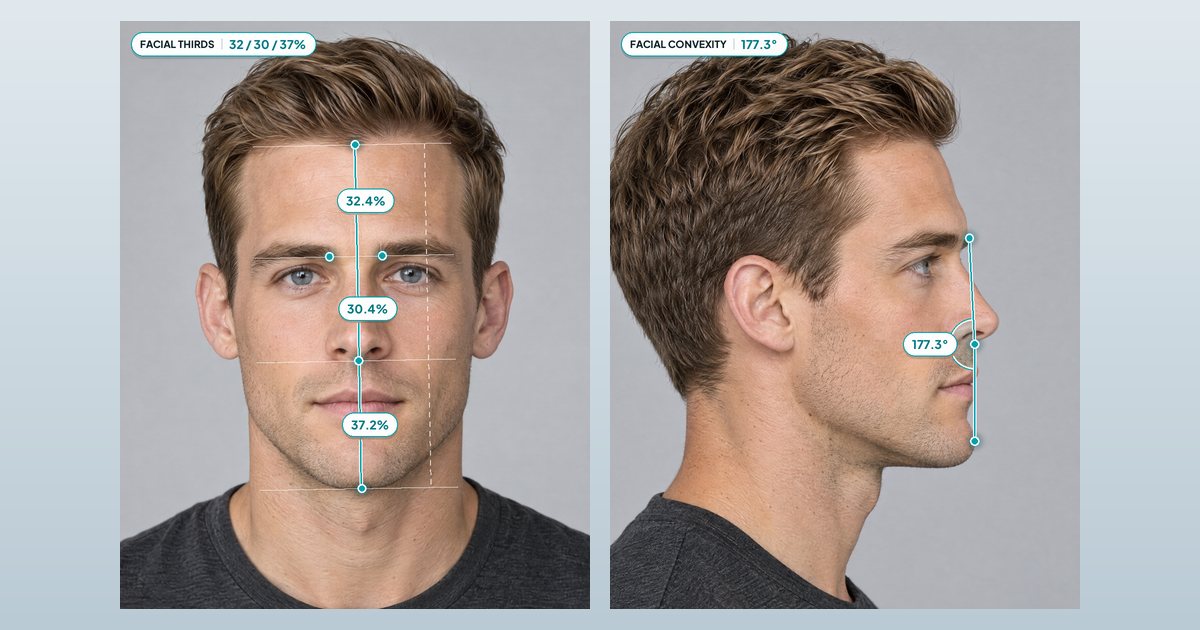
Most facial attractiveness rating tools we read promise some mix of the same five things: symmetry, proportions, jaw, eyes and skin. Ask each one which it measured with points and which it judged from the whole photo. In our report, only one of the 4 pillars, Harmony, comes from drawn lines. The other three rest mostly on 46 visual ratings, like jaw definition and skin, that AI judges from your photos. Each one is listed in the report by name with its own score out of 10, so you can see what moved a pillar even where there is no line to check.
Check the dots on your photo
Software misplaces points. Across 14 studies, software-placed face points sat 0.67 to 4.73 mm from hand-placed ones on average, and that was on 3D scans in research settings, not phone photos.3 When the points are drawn on your photo, you can spot one that landed on a shadow or in a beard. When they’re hidden, you just get a number.
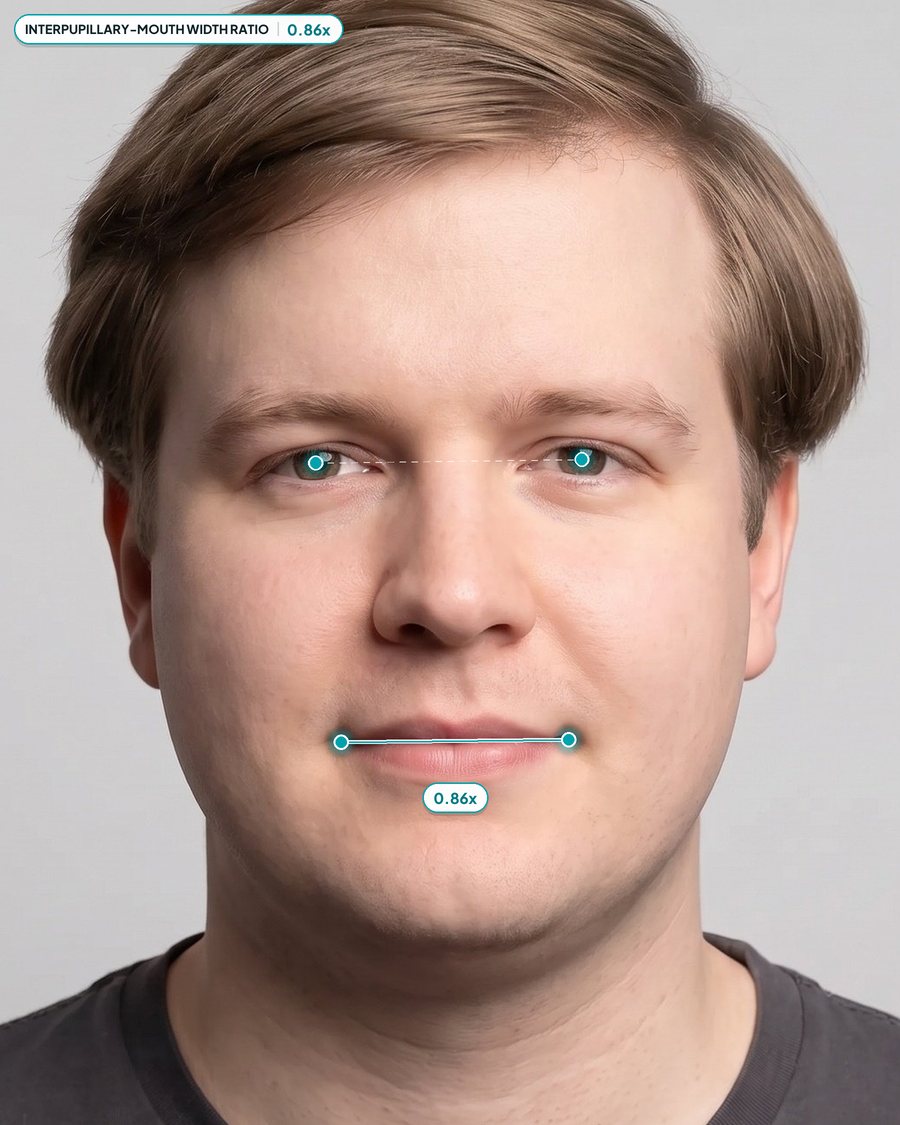
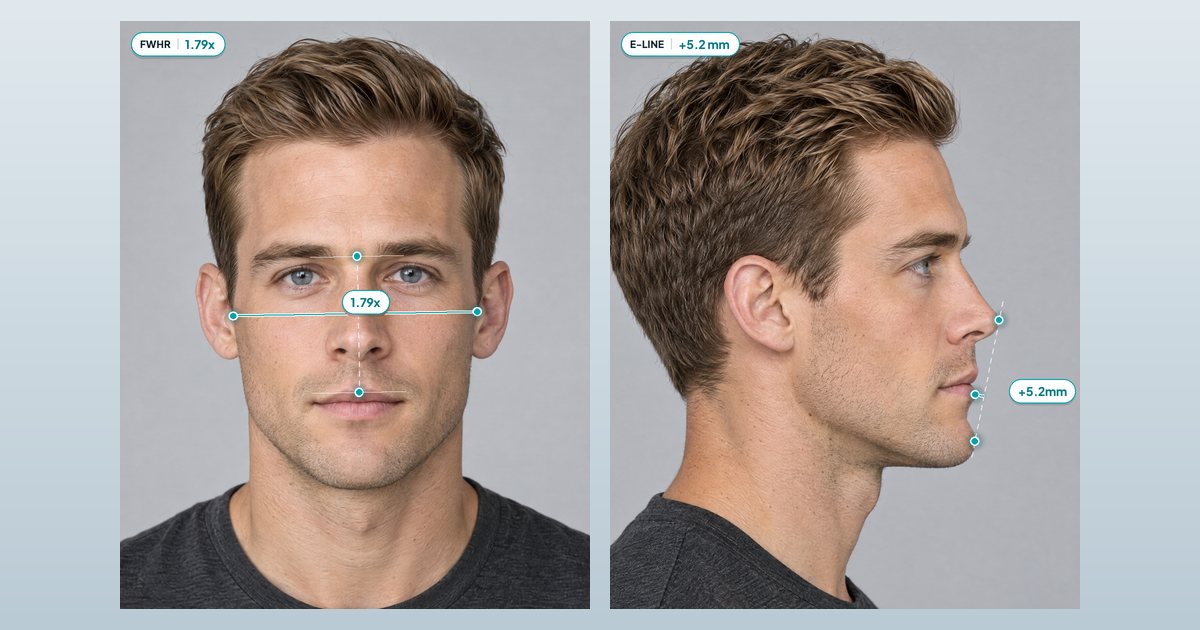
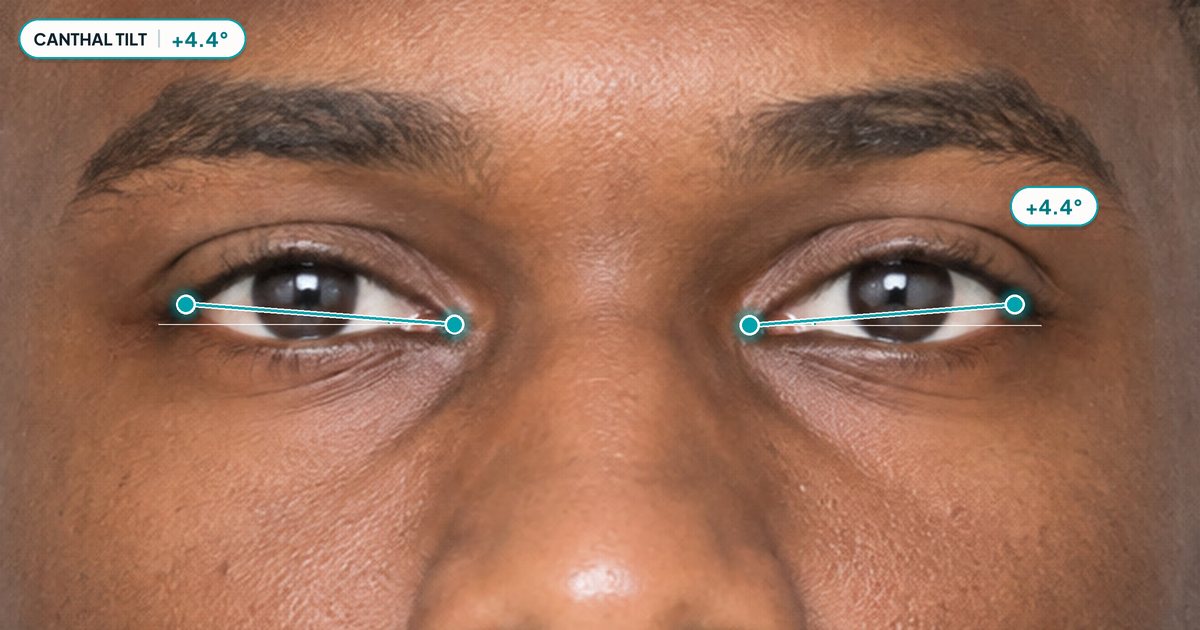
That’s the man in our sample report, and every one of his measurements is drawn like this. Angles between points that sit close together are the touchiest: a 1 mm slip at one eye corner moves canthal tilt by about 2 degrees (what fakes a canthal tilt result).
Our engine checks its own dots too. A point hidden by a beard, hair or a hand is marked “est”, and any of 12 angles that lands outside plausible bounds is flagged, since that almost always means a misplaced point. Those numbers stay out of your strengths, focus areas and plan.
Does it ask for a side photo too?
On a full scan, 33 of our 66 measurements need a side photo. From the front you can’t measure how sharply your jaw turns at the corner, how far your chin sits forward, your nose and lip angles or the curve of your profile. Yet the face rating websites we read ask for one front photo, at least the ones that say, and one rejects a side photo outright. Of the app listings we read, one takes a side photo too.
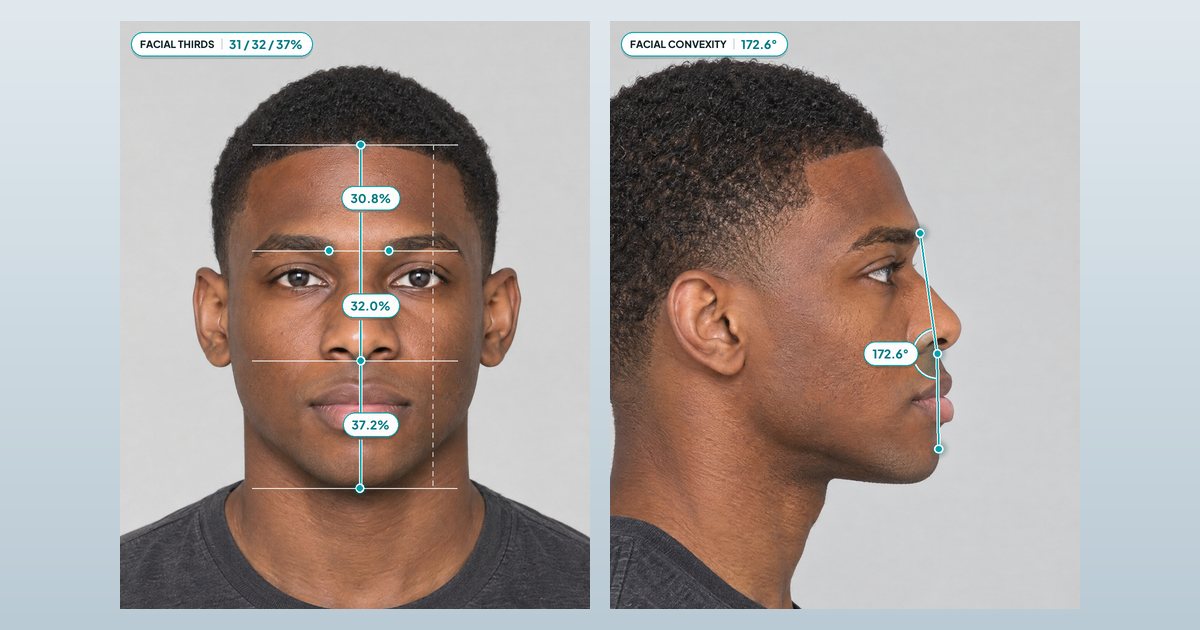
We re-ran Harmony on our four example faces with the front photo only: three would have scored higher, by up to 0.52, and one 0.29 lower. A front-only number can flatter you or sell you short, and you can’t tell which.
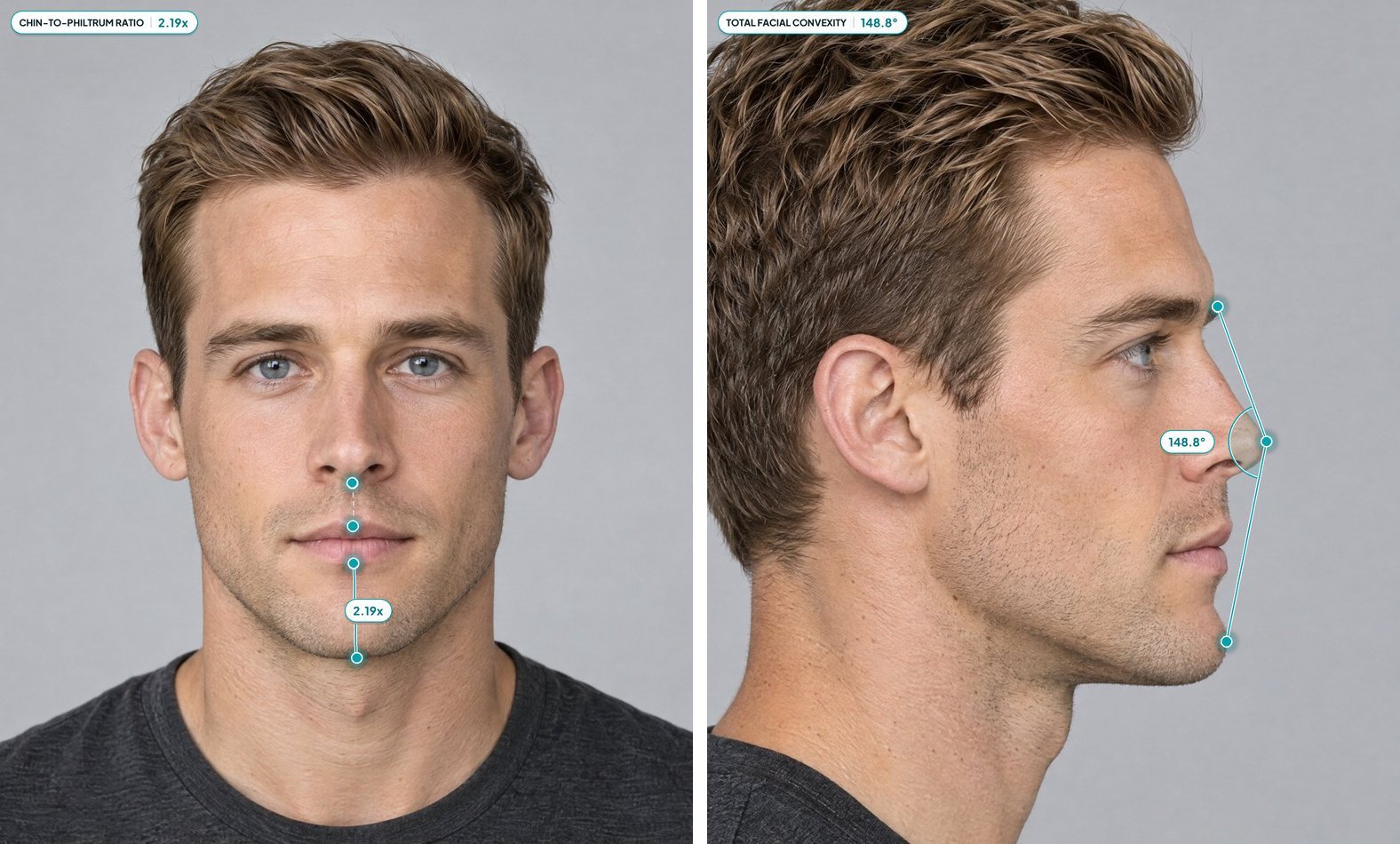
In fairness to front-only tools, people judge the two views much alike. When one group rated 45 men from the front and another group rated them from the side, their average attractiveness ratings largely agreed (a correlation of 0.71).4 So a front photo is enough for a gut-feel score. The side photo is for the 33 measurements a front photo can’t take. Take it at a full 90 degrees with your ear in view, because a half-turned head throws off the side angles.
Ideal ranges for your sex and heritage, or one formula for everyone
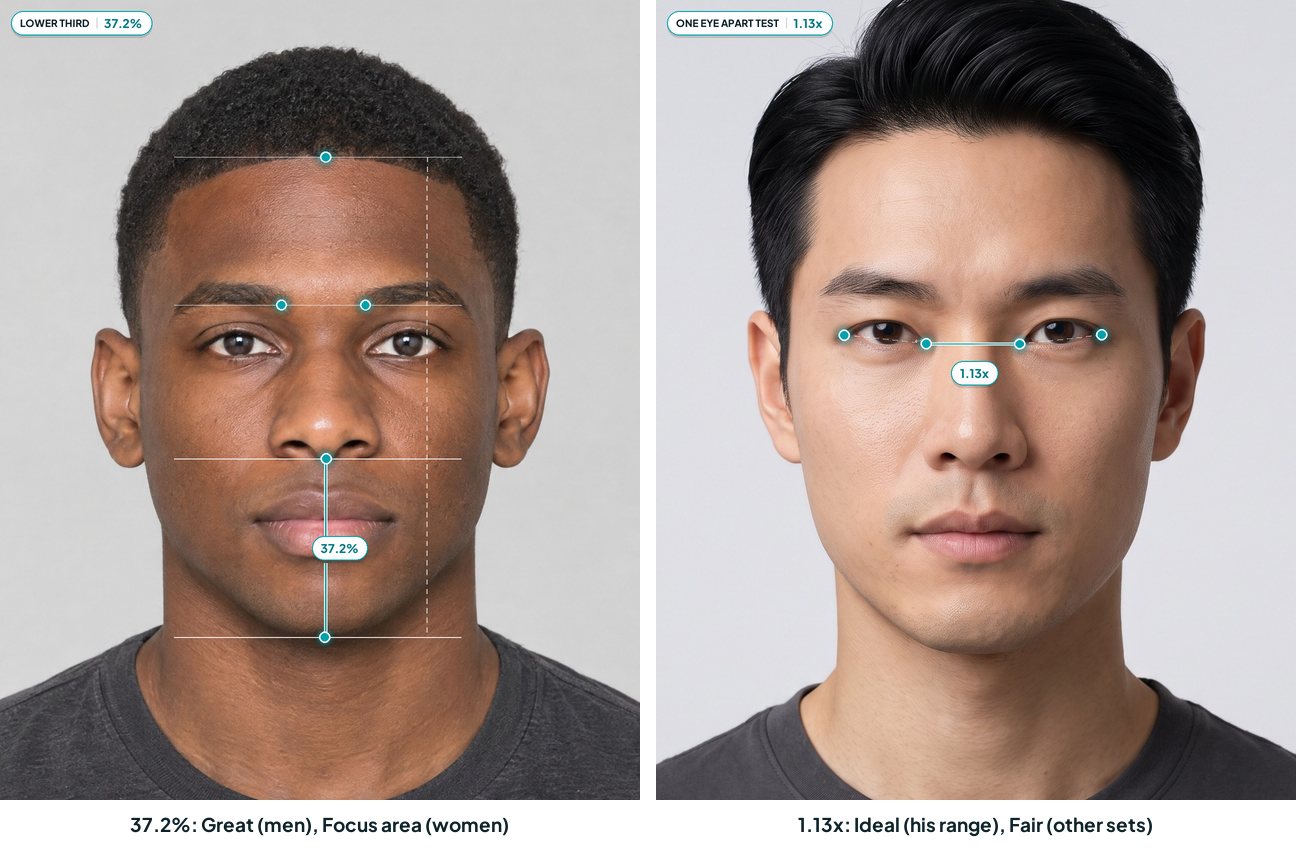
Ideal ranges aren’t the same for everyone. In our engine, 50 of the 66 differ between men and women, and the heritage sets differ from each other on up to 38.
Does that matter? We rescored three of our example faces against a different range set, keeping every measured value. Each row compares a face with itself on its own ranges.
| Face | Scored against | Harmony lost | Ideal measurements lost | Focus areas added |
|---|---|---|---|---|
| Face 1 | Face 2’s set | 0.78 | 12 | 3 |
| Face 2 | Face 1’s set | 0.59 | 3 | 5 |
| Face 2 | Women’s ranges | 1.51 | 5 | 8 |
| Face 3 | Women’s ranges | 0.54 | 9 | 4 |
The wrong set cost these faces 0.5 to 1.5 Harmony points, and it cut both ways: Faces 1 and 2 each lost points on the other’s set, so no set was simply the harsh one. The final score moved less, 0.2 to 0.5, because Harmony is the only pillar scored against ranges. An app that mistook a man for a woman would also swap his Masculinity ratings for Femininity, which this test leaves out.
Rating sites can also score faces of some ethnicities higher than others. In a 2026 study, five of them scored 120 computer-made faces of young women, all front-on with a neutral expression, and gave white women’s faces 8.18 on average and Black women’s 6.91.5 The white and Latino gap was smaller, 0.46, but still significant. The study can’t say why the gaps appear. They tell you something about those sites and nothing about anyone’s face.
Look for a tool that asks your sex and heritage instead of guessing them, uses your heritage only to pick ranges and offers “Prefer not to say”. If you’re a woman, check that the pillar reads Femininity: a tool that scores everyone on Masculinity is probably scoring you as a man (how a masculinity score is built).
One score, or a breakdown with tips you control
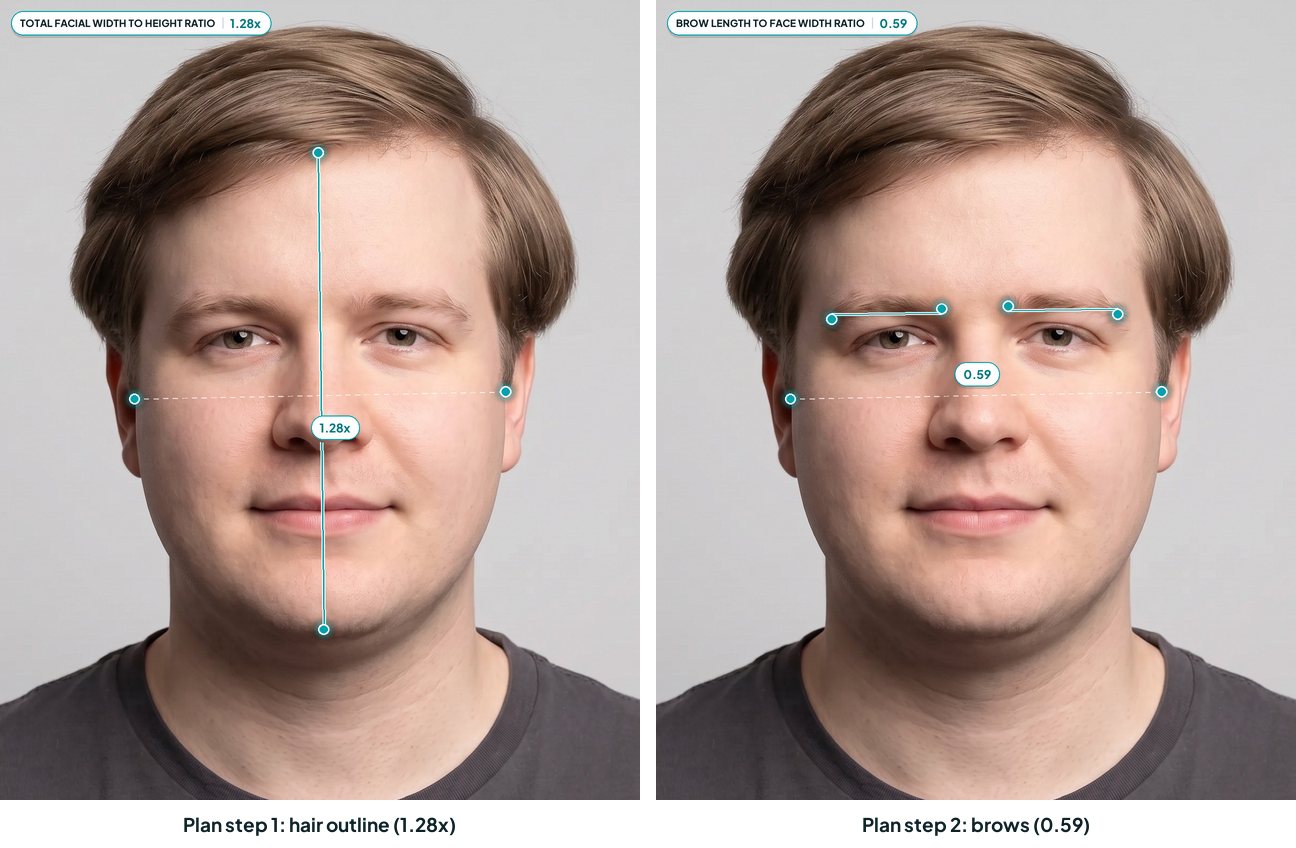
The man in our sample report scores 5.30, Fair. On its own, that tells him nothing to do. The pillars do: his proportions score Good (Harmony 6.87), and Angularity (3.17), which rates how defined his jaw, chin and cheeks look, is a focus area.
Our overall score is a geometric mean of the 4 pillars, so a weak pillar pulls harder than in a plain average (how 4 pillars become one score). With Masculinity 5.12 and Features 7.09 added, his four pillars give 5.30, not the 5.56 a plain average would say. A tool that rated only his proportions would score him higher. One that rated only his jaw definition would score him lower. Both tools would be right about him, and they’d still disagree.
Scales differ too, and a 7 on one site isn’t a 7 on another: on those 120 faces, the most generous site averaged 8.50 and the strictest 6.65.5 A percentile is no better: beating 60% of faces doesn’t tell you why the other 40% scored higher. Our labels are words instead: Exceptional (9+), Great (8+), Good (6+), Fair (4+) and Focus area (under 4), and a measurement inside its ideal range reads Ideal.
Then read the tips. One tool we read tells you to raise your score by editing the photo: retouching it, slimming the face or erasing the beard. That shows the number rates the image, not your face. Good tips stay with what you control: your hair, brows, beard or makeup, glasses, skin care and how you take photos. A report that ends by pointing you to a clinic, or to a peptides guide, is a sales page.
The 2-photo test any face rating should pass
The same photo uploaded twice should get the same score, and two photos taken a minute apart should land close together. One person on a tech forum said a rating site scored two headshots of the same person about 2.5 points apart.
In everyday photos, your best and your worst can be rated further apart than you and a stranger.6 Remember that before any single number, ours included, decides how you feel about your face. So set up the same way every time with the photo checklist, then:
- Take two photos one after the other in the same setup.
- Upload photo 1. Write down the score and, if the tool shows them, two or three measurement values.
- Upload the same file again. The score should match or move by about a tenth; a jump of a point or more means the number isn’t anchored to your face.
- Upload photo 2. If it lands more than a point from photo 1, the tool is reacting to the photo more than measuring your face.
- If the tool draws points, compare the two results. The dots should sit on the same pupils, mouth corners and chin. A dot that moved is usually why a number moved.
On a tool that charges per scan, steps 3 and 4 cost extra scans. If you’d rather not pay for them, look for one that publishes its own repeat results and offers a refund.
Here are ours. Three runs of the same photos through our engine moved the final score by 0.05 for one person and 0.09 for another. Parts of the score are shakier: the side part of Harmony moved by up to 0.47, and one person’s brow-ridge angle score swung 7.9 points out of 10 across the three runs. But one angle is only one of 66 measurements behind Harmony, so it hardly touched the final score. Every measurement also prints its confidence: on a full scan, 17 High, 38 Medium and 11 Low. And we check key points 3 times and keep the middle result. We only tested two people on repeats of the same photos, so treat the tenth and the one point in steps 3 and 4 as our rule of thumb.
Weekly subscription or one payment
Before you install, open the In-App Purchases list on the App Store listing and search the terms for “auto-renews”. Then, on the price screen, watch for “per week”, a trial that renews on its own, or one scan a day with a weekly plan for anything more. A weekly plan at $4.99 comes to about $260 a year if nobody cancels.
Your face doesn’t change week to week, so a weekly plan charges you every week for much the same answer. Scan again after a real change, like a haircut, a new beard or brow shape, or a few months of diet and exercise, with the same photo setup.
If you already subscribed, cancelling takes a minute:
- iPhone: open Settings, tap your name, then Subscriptions, choose the plan and tap Cancel Subscription. Cancel a trial at least 24 hours before it ends (Apple’s steps).
- Android: open the subscriptions page in the Play Store, choose the plan and tap Cancel subscription. Uninstalling the app does not cancel it (Google’s steps).
Ours is one payment, no subscription, with a 100% money-back guarantee.
Where your photo goes, and how to delete it
Four questions to answer about any tool: does your photo leave your phone, is it tied to your account, does your score go public, and how do you delete all of it?
On the App Store, scroll to App Privacy on the listing. “Photos or Videos” under “Data Linked to You” means the photo is tied to your account or device; a photo processed only on the phone doesn’t count as collected (Apple’s definitions). One app we read says it works that way: it measures the face on the phone, never uploads the photo, and its label reads “Data Not Collected”. Linked isn’t bad on its own: a report you can come back to has to be stored somewhere. It only becomes a problem when you can’t delete it.
On Google Play, the same answers sit under Data safety, then See details, including whether you can ask for deletion (Google’s guide). The developer fills in both labels, so read them as the developer’s own claim.
Then find two delete options: one for your photos and report, one for your account. On iPhone, apps that let you create an account must let you start deleting it inside the app (Apple’s rule), and Google Play asks the same. And uninstalling the app deletes nothing on the developer’s servers. In 2021 the US Federal Trade Commission alleged that a photo app kept the photos of people who had deactivated their accounts, despite promising to delete them. The settlement required it to delete those photos and any face recognition models built from its users’ photos.7
Last, search the privacy policy for the word “train” to see whether your photos feed the company’s AI. In the UK, you can ask any organization holding your data to delete it, and it usually has one calendar month to respond (ICO guidance). Several US states, California among them, give you a similar right (California’s guide).
Our answers: your photos leave your phone, because the report lives on our server. There’s no public face ranking, and we never sell your photos or use them to train AI. One click deletes the report and photos, whenever you like.
Once you’ve picked a tool, check the dots on your first result before you read the score. If repeat scans are free or cheap, run the 2-photo test too. When the dots sit where they should and the score holds, the number is worth reading. If not, it’s a guess with a decimal point.
Questions people ask
Are face rating apps accurate?
Partly. They agree with people on order more than on the number. In a study of five AI rating sites, the scores for 40 faces tracked a panel of 24 doctors in training closely (a correlation of 0.84) but ran about 2 points higher on average. We found no peer-reviewed study of app-store apps. A measured rating is only as good as its points, and software can place a point a few millimeters off, so pick a tool that draws its lines where you can check them.
Which face rating app is best?
The one that passes the most of the 8 checks, since we found no study comparing them. If you only check two, look for lines drawn on your own photo and a way to delete your photos and report. Then, if repeat scans are free or cheap, run the 2-photo test: the same photo should get the same score. For choosing a dating photo, a crowd-style rater may suit you better, because it reacts to the whole photo. No study we found has tested that.
How do I see my face rating?
Upload a clear front photo, plus a side photo if the tool asks, taken from about 1.5 m (5 feet) with the lens at eye level. Then read the breakdown as well as the total. Ours takes both photos and, in about a minute, shows your strengths and focus areas with tips you control, backed by 65+ measurements drawn on your photos.
Why do two face rating apps give me different scores?
Partly because some tools score more generously than others: tested on the same 120 faces, five rating sites averaged anywhere from 6.65 to 8.50. Crowd-trained tools also carry the taste of whoever rated their training photos. The ranges matter too: when we scored the same measured face against another range set, Harmony moved by 0.5 to 1.5 points. And if you uploaded two different photos, that alone can move the score.
Is a weekly subscription worth it for a face rating?
Rarely, because your face doesn't change week to week. At $4.99 a week, a plan left on costs about $260 a year, and uninstalling doesn't stop it: cancel under Subscriptions in your iPhone settings or on the Play Store's subscriptions page. Scan again only after a real change, such as a new haircut or brow shape. Ours is one payment, no subscription.
How do I delete my photos from a face rating app?
Use the app's own delete option for your photos and report, then delete your account, because uninstalling the app leaves any copies on its servers. Apple requires apps with sign-up to offer account deletion inside the app, and Google Play has a similar rule. If there's no option, email the developer. In the UK you can ask for your data to be erased, and the organization usually has a month to reply. Ours: delete your report and photos anytime, in one click.
Sources
-
Goshtasbi K, Hakimi AA, Wong BJF. Artificial intelligence versus human focus group rating of facial attractiveness. Facial Plast Surg Aesthet Med. 2024;26(4):371-376. doi:10.1089/fpsam.2023.0281. Abstract on PubMed ↩↩
-
Liang L, Lin L, Jin L, Xie D, Li M. SCUT-FBP5500: a diverse benchmark dataset for multi-paradigm facial beauty prediction. In: 2018 24th International Conference on Pattern Recognition (ICPR). IEEE; 2018:1598-1603. doi:10.1109/ICPR.2018.8546038. Full text on arXiv ↩↩
-
Al-Baker B, Alkalaly A, Ayoub A, Ju X, Mossey P. Accuracy and reliability of automated three-dimensional facial landmarking in medical and biological studies. A systematic review. Eur J Orthod. 2023;45(4):382-395. doi:10.1093/ejo/cjac077. Abstract on PubMed ↩
-
Třebický V, Fialová J, Stella D, Štěrbová Z, Kleisner K, Havlíček J. 360 degrees of facial perception: congruence in perception of frontal portrait, profile, and rotation photographs. Front Psychol. 2018;9:2405. doi:10.3389/fpsyg.2018.02405. Full text on PMC ↩
-
Tripathi NV, Clementi E, Aribindi S, Singh L, Hakimi AA, Chu E, Reilly MJ. Exploring racial bias in rating facial attractiveness among artificial intelligence platforms. Facial Plast Surg. Published online October 21, 2026. doi:10.1055/a-2945-2437. Abstract on PubMed ↩↩
-
Jenkins R, White D, Van Montfort X, Burton AM. Variability in photos of the same face. Cognition. 2011;121(3):313-323. doi:10.1016/j.cognition.2011.08.001. Abstract on PubMed ↩
-
Federal Trade Commission. Everalbum, Inc.; analysis of proposed consent order to aid public comment. Fed Regist. 2021;86:6888-6891. Published January 25, 2021. Federal Register notice ↩
Spotted a mistake? Email support@faceratinglab.com and we will fix it.