Aquiline nose: Roman or hooked, and how to check yours
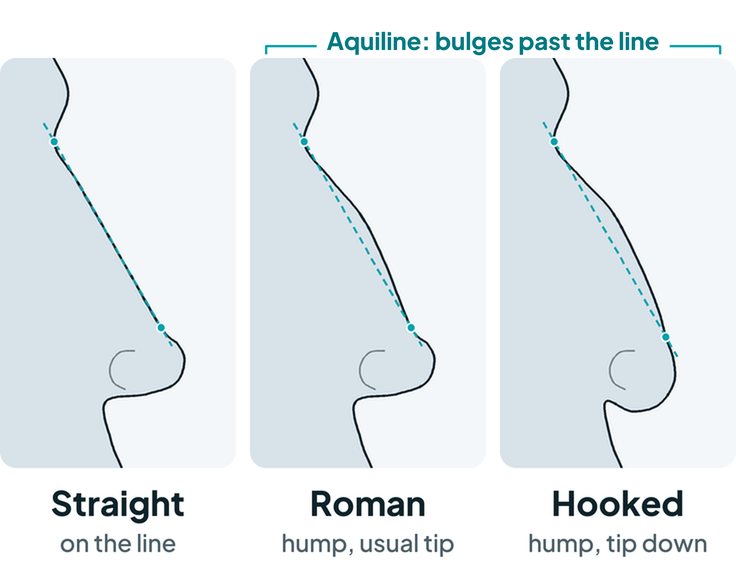
An aquiline nose has a bridge that curves outward, like an eagle's beak. Roman and hooked noses are both aquiline, and the tip tells them apart: a Roman tip tilts up as usual, while a hooked or hawk tip tilts up less, or turns down.
The short version
- On a level side photo, draw a line from a quarter of the way down the bridge to just above the tip: by our rule of thumb, skin poking more than about 1 mm past it at life size is aquiline.
- Roman and hooked noses are both aquiline, and the tip splits them. On our default ranges, a tip rotation under +11.5 degrees on a man or +20.5 on a woman reads hooked, or hawk.
- Our report draws the bridge line but scores no hump. In our test a 2 mm hump, close to the average in a CT study, barely moved one number, and the nose-to-chin angles ignore it.
- In rating studies a straight bridge usually scored a little higher than a humped one: smoothing the hump on four edited faces moved attractiveness from 53.7 to 60.4 out of 100, and the favorite shape shifts by country.
- Nothing at home moves the bridge, but a beard at the chin, glasses that sit on the bump, soft contour and photos from 1.5 m can change how it reads.
Aquiline means eagle-like, from aquila, the Latin for eagle.1 The beak-like curve on a real aquiline nose is usually small, and in our report it counts for less than you’d think.
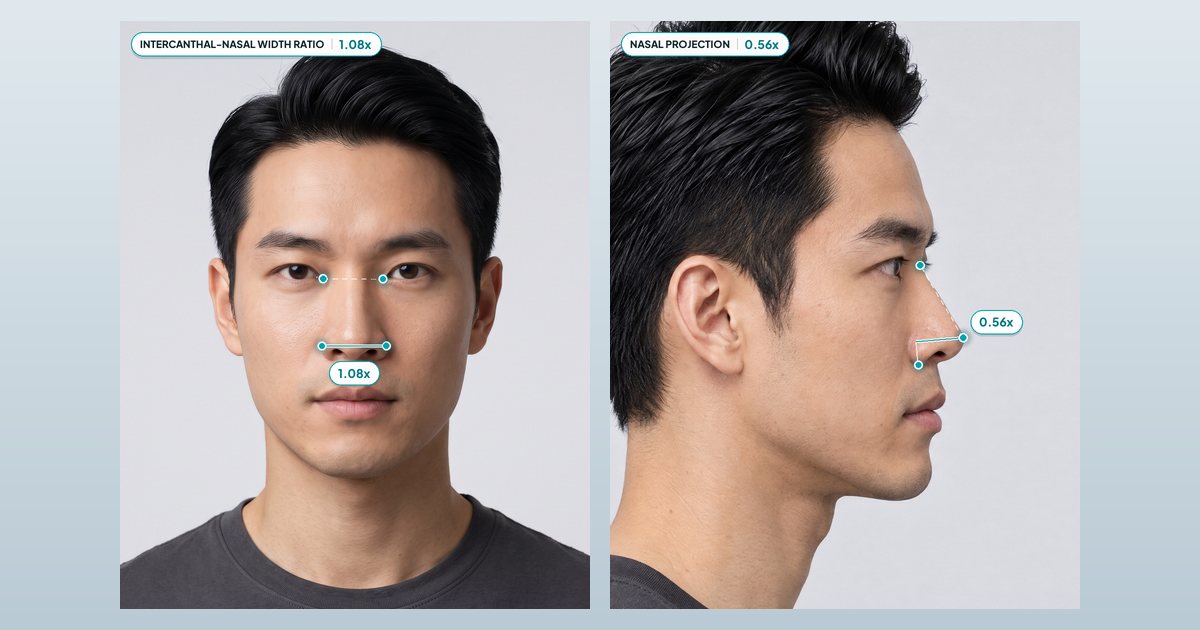
We put that to the test on four example men measured by our engine, Man A to Man D. Man A is the man in our sample report. All four have straight bridges, so we drew a model hump onto their traced outlines. Even a 4 mm hump, bigger than most real ones, moved just one of our report’s measurements, and only a little. In the same model, moving the chin 1 mm shifted several, two nose angles among them by half a degree or more. Your chin touches more of your nose numbers than a bump does, and nothing in the report scores the hump itself.
Aquiline nose vs Roman nose vs hooked nose
Many pages use aquiline, Roman and hooked for the same nose. That’s only half right. A Roman nose is an aquiline nose whose tip keeps the usual upward tilt. A hooked nose, also called a hawk nose, is an aquiline nose whose tip sits low, toward level or pointing down, so the profile curves like a beak.
None of these names has an agreed research definition, and the dictionary blurs them too. It calls a Roman nose “a large nose that curves outward at the top,”2 and uses aquiline mostly for a nose with a broad curve that is slightly hooked.1
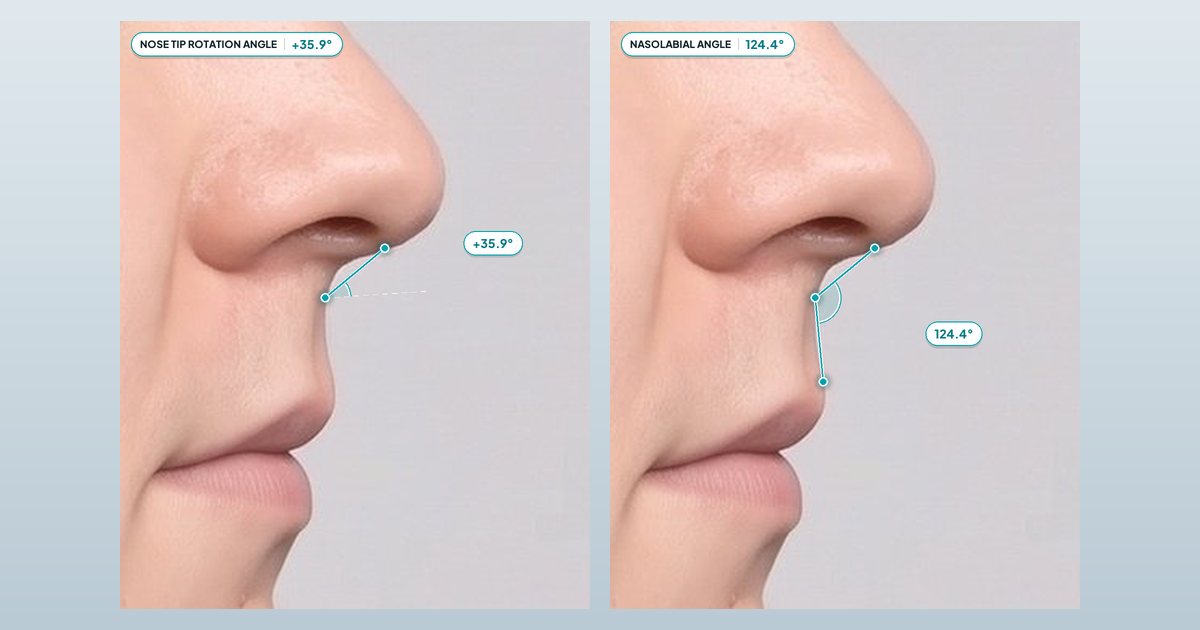
Tip rotation is the tilt of your nose’s underside, from where it meets the upper lip to a point halfway along, never to the tip. It’s read against the head’s own level line, from the ear opening to the bottom of the eye socket, so tipping your head doesn’t change it. A plus means up.
| Name | Bridge on a side photo | Tip rotation, men | Tip rotation, women |
|---|---|---|---|
| Straight | Outline on the line, within about 1 mm in real life | Any | Any |
| Aquiline | Outline clearly in front of the line | Any | Any |
| Roman | In front of the line | +11.5 to +21.5° | +20.5 to +30.5° |
| Hooked or hawk | In front of the line | Under +11.5° | Under +20.5° |
These are our default ranges, the same split as our guide to nose shapes sorted by the bridge line. They shift a little with the heritage you choose at upload.
Our four men show why the tip needs its own test. All four bridges are straight, yet their tips run from +21.1 to +35.9 degrees, a wider spread than the whole Roman band.
Tip rotation is also the shakiest number on this page. The point where the nose meets the lip is hard to place on a photo. A 1 mm slip there, at life size, moves the angle 5 to 7 degrees, half the width of the Roman band or more. Our report marks it low confidence and never lists it among your strengths or focus areas, even when its row says Focus area, as Man A’s +35.9 does. Treat the bridge as your answer and Roman versus hooked as a lean.
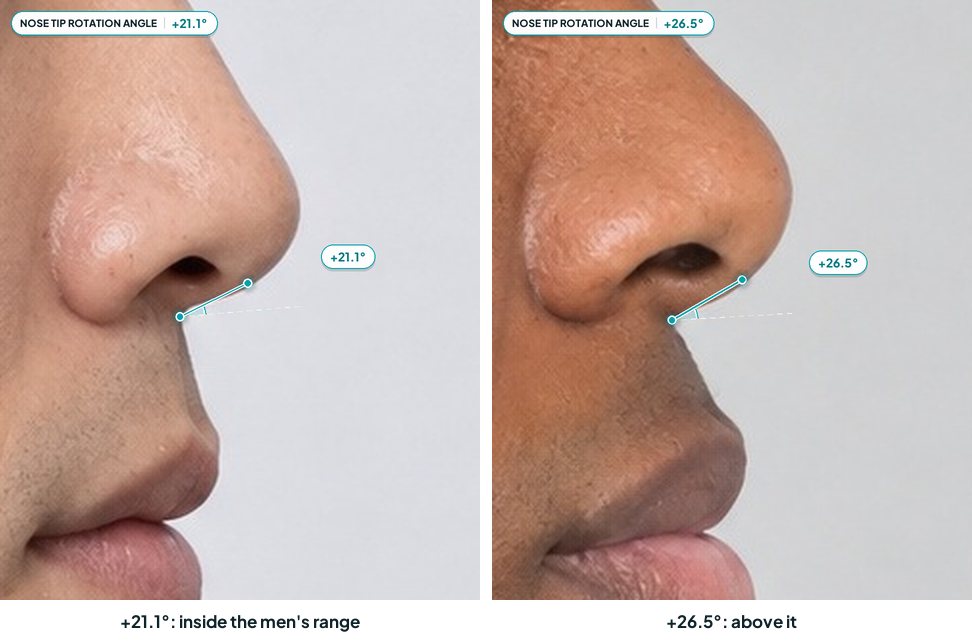
Give Man D a hump and he’d read Roman, near the top of the band at +21.1. Give Man C one, at +26.5, and his tip would sit above the range, a shape with no single name. Call it both: humped and upturned.
The nose-to-lip angle gives a second check, with a catch. A hooked nose often brings it under the range too, below 97 degrees for men or 101 for women. Man C’s angle is 91.0, low enough to look hooked by that test, yet his tip points clearly up at +26.5. His forward-leaning upper lip closes the angle, not his tip, which is why the nose-to-lip angle also reads your lip.
How to tell if you have an aquiline nose from a side photo
On a level side photo, draw a straight line along your bridge, from a quarter of the way down it to just above the tip. Skin poking more than about 1 mm past the line in real life means aquiline, and the tip angle then tells Roman from hooked.
Measure, don’t eyeball: a real hump is small. In a CT study of 134 adults, the 67 who wanted their hump changed had humps averaging 1.8 mm high (1.1 to 3.8 mm) and 17 mm long.4
- Have a friend take a side photo from about 1.5 m (5 feet), zoomed in, lens at eye level, with your hair behind your ear and your chin level. Up close, perspective enlarges whatever is nearest the camera: in one model, a nose 30 cm from the lens looked about 30% wider next to the cheekbones, seen front-on.5
- Level it. With your phone’s markup pen, draw from your ear opening to the lowest point of the bony rim under your eye, then rotate the photo until that line is flat.
- Zoom until your nose fills about 10 cm (4 inches) of the screen, from the dip to the tip.
- With the markup pen, draw a straight line along the bridge, from a point a quarter of the way down it to just above the tip, not on it. No straight-line tool? Lay a card on the screen with its edge on those two points and the card covering your face, so a bump shows as skin poking past the edge.
- Read the bridge between those two points. If the outline stays within about 2 mm of the line on screen, roughly a coin’s thickness (1 mm in real life at this zoom), it’s straight. If skin pokes out past the line by more than that, it’s aquiline. Background showing between the line and the skin means a scoop.
- If it’s aquiline, draw from where your nose meets your lip along the underside, stop halfway to the tip, and measure that line against the level line with a protractor app. Men: +11.5 to +21.5 degrees is Roman, under +11.5 is hooked. Women: +20.5 to +30.5 is Roman, under +20.5 is hooked. Without an app, +11.5 is about an eighth of a right angle and +20.5 a little under a quarter.
- Trust only clear results. A tip within 5 degrees of the hooked line in step 6 is a lean, not a verdict.
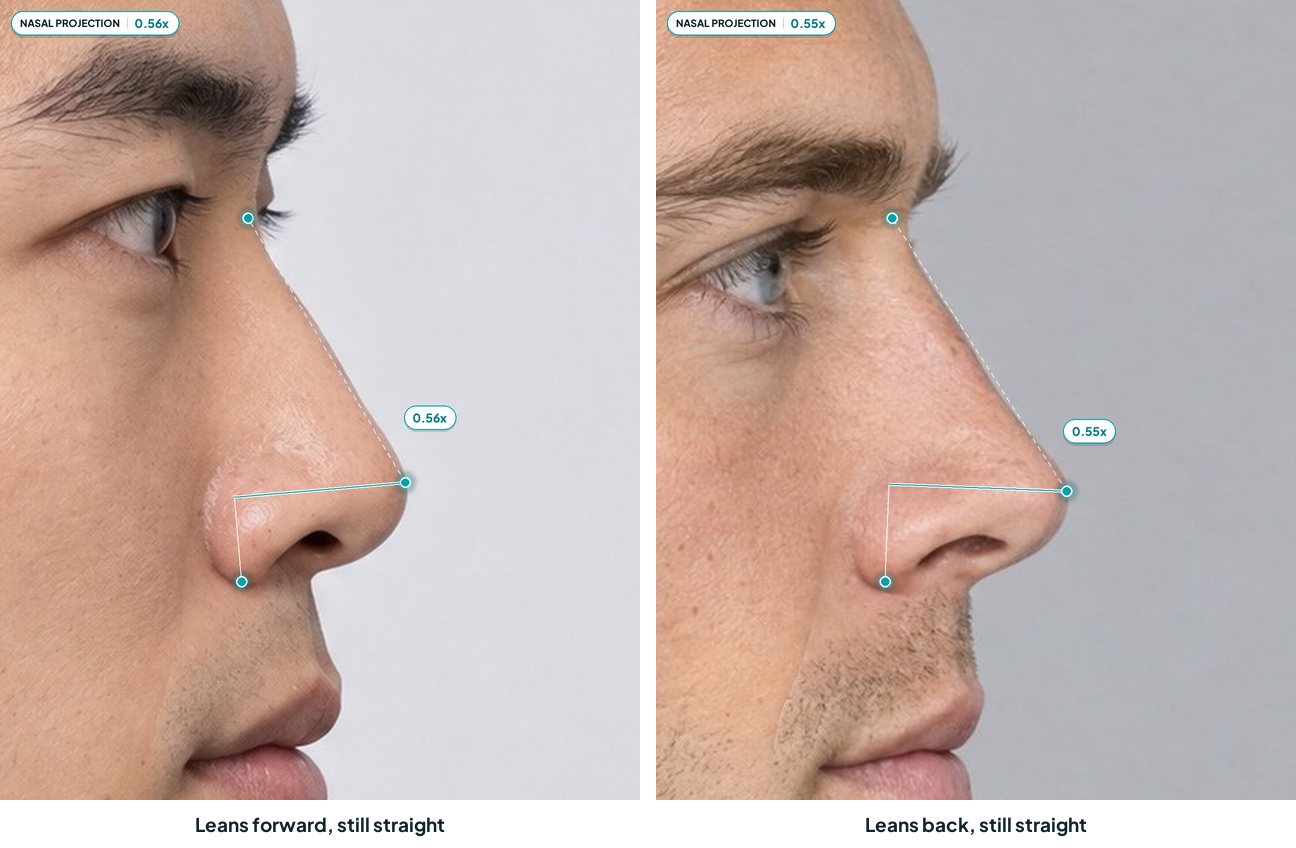
We traced all four twice, on different days, and no bridge strayed more than 1 mm, at most about 2% of a 37 to 44 mm bridge. That’s what straight looks like when you measure it. Expect a small wobble, and don’t call it a hump.
If you only check one thing, check where your line starts and stops. Run it from the root to the very tip and a straight bridge shows a false bulge of 0.3 to 1.5 mm just above the tip, because the tip rounds forward. Start it deep in the dip, even if you stop short of the tip, and the upper bridge falls about 2 to 3 mm behind, a false scoop.
A mild aquiline nose only just clears step 5’s 2 mm on screen. A pronounced one shows without any line. There’s no official cut-off for “aquiline”, so the 2 mm is our own rule of thumb, the same one the full three-photo check uses. We couldn’t test it: none of our four men has a hump.
Two things make the same bump look bigger: a deep dip at the root and a low tip.
One more trap: a dipped chin makes a Roman tip look hooked. Step 2’s level line cancels it.
Our report won’t label your nose aquiline, Roman or hooked. It draws the bridge line and the tip angle on your own side photo, and you read them against the cut-offs above. Look for the dashed line in your Nasal projection drawing and the row called Nose tip rotation angle. A hump shows as your outline bulging past the dashed line mid-bridge. If it sits high, the line’s top dot floats in front of your root instead.
How an aquiline nose fits a balanced side profile
In our report, how a nose fits your profile comes down to two things: how far it stands out from a line between its root and your chin, and where its tip points. The curve of the bridge barely counts.
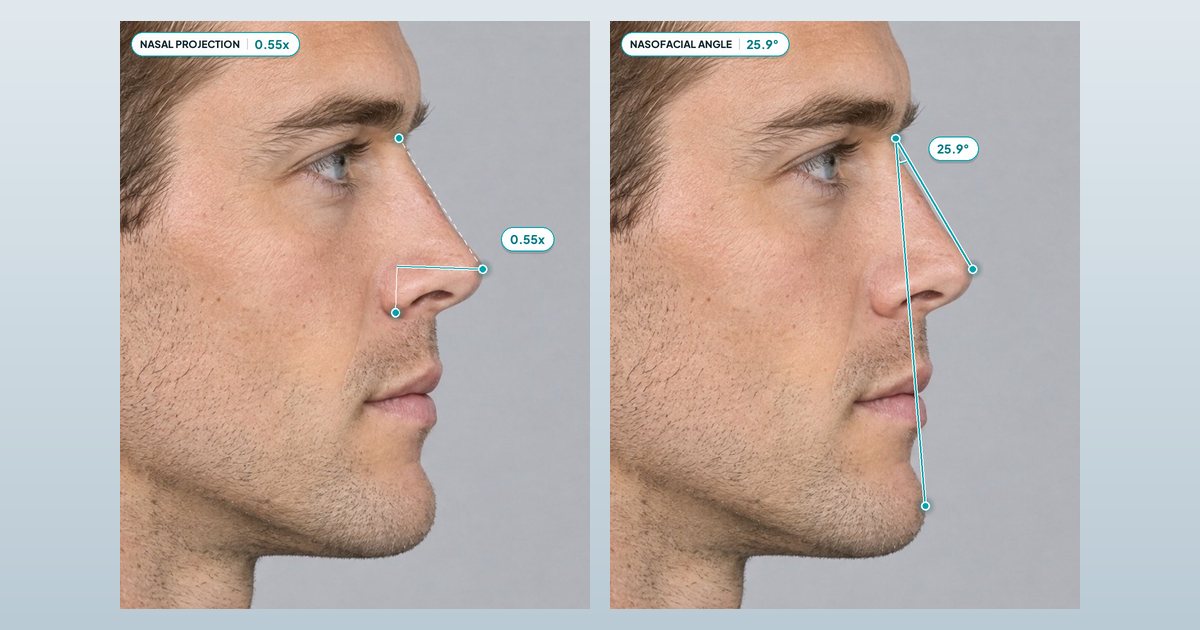
Take a smooth 2 mm hump, close to the average in that CT study. In our test it moved nasal projection, how far the tip reaches past the nostril wing for the nose’s length, by under 0.02. That’s a nudge: the score only falls to 5 out of 10 when the number sits 0.19 outside its range, more than ten times that shift. Even a 4 mm hump moved it 0.04 at most, up when the hump sat high on the bridge and down when it sat lower.
Nothing else moved. Every other side measurement of the nose hangs on points the hump doesn’t touch, such as the root, the tip and the chin. That assumes our engine places them the same way on a humped nose. We didn’t test the by-eye ratings.
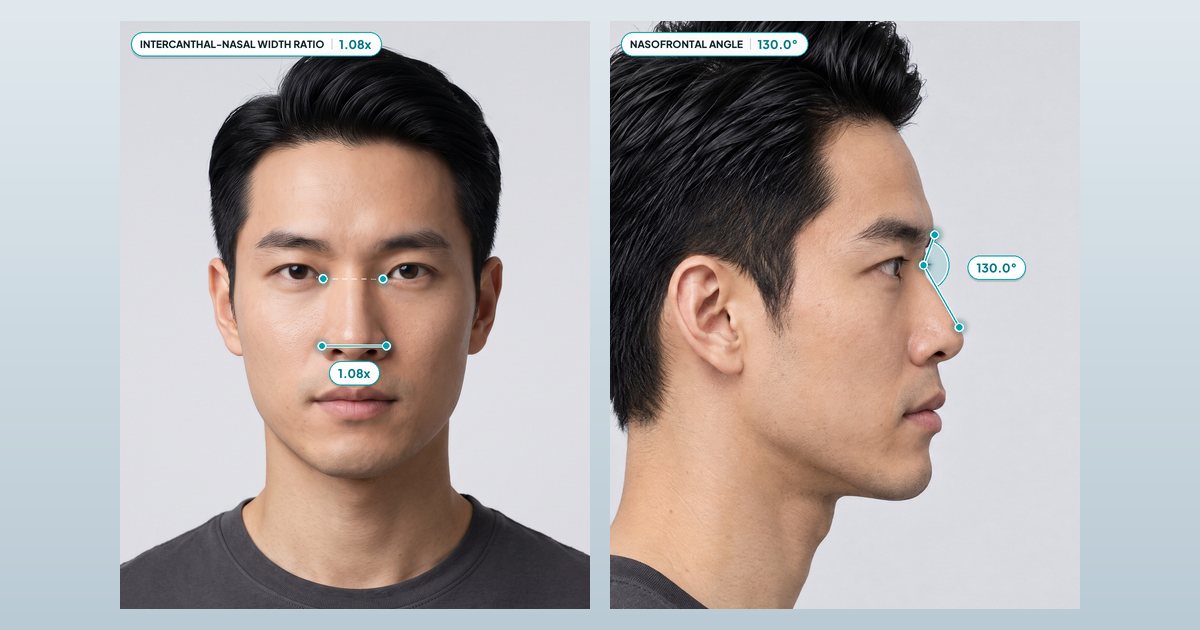
Two angles ignore the hump and follow the tip and the chin instead. Our report marks both high confidence, with the same range for men and women. The nasofacial angle sits at the root, between lines to the tip and the chin, ideal 31 to 35 degrees. Its partner, the nasomental angle, sits at the tip and looks back at the root and the chin: 126 to 131.
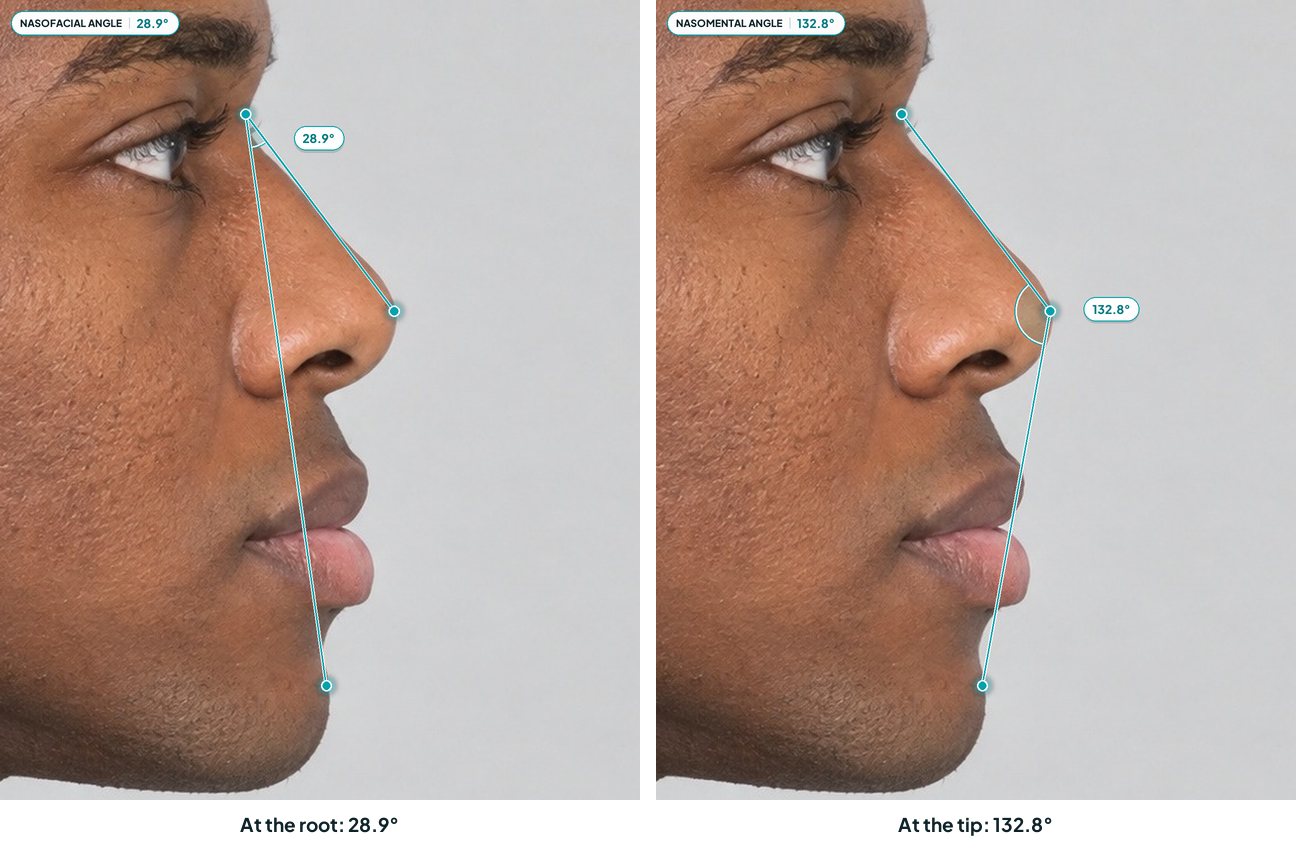
All four of our straight-nosed men sit on the less-projecting side of both: nasofacial 25.9 to 28.9, nasomental 132.4 to 138.2. Here’s what 1 mm does:
| 1 mm further forward | Nasofacial | Nasomental |
|---|---|---|
| Nose tip | +1.0 to +1.2° | -1.8 to -2.1° |
| Chin | -0.5 to -0.6° | +0.7 to +0.8° |
Millimeter for millimeter, the tip moves these angles two to two and a half times as much as the chin. A chin that sits forward by the same amount cancels about half of it. On our four men, a tip 1 to 3 mm further forward moved both angles toward the ideal, and about 2 mm would put Man C inside both ranges.
If your angles already sit inside the ranges, a nose that stands out more pushes them toward the far end, or past it. These numbers describe how faces differ, not changes to make. A nose that stands out is no problem in itself. Whether it fits comes down to your chin.
The lips can cut the other way. On the E-line, drawn from the nose tip to the chin, a tip that stands out more pushes the line forward, and the lips read 0.3 to 0.6 mm further behind it per millimeter of tip.
If your nose looks big in profile, check your chin before your bridge: a chin that sits further back can make any nose read larger.
Is an aquiline nose attractive?
On average, a little less than a straight bridge, when researchers edit the same face both ways.783 Whether a gentle scoop beats a hump depends on the study. Our report doesn’t score the hump at all, and your harmony score weighs the whole face, not one angle.
The one test that gave scores asked 813 raters to judge side profiles of four people, two women and two men, each with a hump and a low tip. Smoothing the hump raised average attractiveness from 53.7 to 60.4 out of 100, about 7 points, and made the faces look a little over a year younger (31.9 to 30.7). Turning the tip up alone made no significant difference.7 It was a pilot, profile view only, with no hump size given.
Another study edited one man’s profile 12 ways for 503 raters, who picked one version per question. Between them, the four hump versions drew 87% of the least-attractive picks and only 8% of the most-attractive. The worst, at 39%, also had the most open angles at the root and under the nose, and those angles seem to have added to it. The winner, a gentle scoop, got just 21% of the picks.8
A third study pointed only partly the same way. Shown 3D models edited in 1 mm steps, about 56% of 203 clinic patients picked the straight bridge, for both the man and the woman. A 1 mm hump came second, at about 26%, picked twice as often as a 1 mm scoop, and the 2 mm scoop came last.3
No single ideal holds everywhere, though. Across 31 studies and 25,382 raters, the favorite bridge shifted by country and by generation.6
Those edited-face tests used one to four faces, rated mostly by white women in online surveys or by one clinic’s patients, on screen rather than in person.
An aquiline nose is a normal shape. A few points on an edited photo is no reason to change a nose you like.
Aquiline nose in men and women
Both sexes have aquiline noses, and the bridge test is the same. Only the tip scale differs.
In a small 1996 X-ray study of 30 men and 30 women, once size was scaled out, the noses had almost identical profile shapes, and both sexes ranged from aquiline to upturned.9
The women’s tip range in our report, +20.5 to +30.5, sits 9 degrees above the men’s and overlaps it by only 1 degree. A tip at +15 would read Roman on a man and hooked on a woman.
Does a slight hump look more masculine? On the profile edited 12 ways, no nose shape was clearly picked as most masculine, and the versions without a hump were picked more often as most feminine.8 In the 3D-model study, about 1 in 3 raters picked a 1 or 2 mm hump for the male model, against about 1 in 8 who picked a scoop. More than half picked straight.3 So no study we found shows raters prefer a slight hump on men over a straight bridge.
Our report does rate the nose by eye, out of 10, inside the Masculinity or Femininity pillar: how masculine it reads on a man, how feminine on a woman. That rating carries a tenth of the pillar and has no rule about humps. Our four men score 6 or 7, and what makes a face masculine covers the rest of that pillar.
Where an aquiline nose comes from, and what changes it
A hump sits where the bone of your bridge hands over to cartilage. In the CT study, every hump peaked over the septal cartilage, with the lower end of the nasal bones joining in.4
Nose shape is also partly inherited. In a DNA study of about 6,000 people, how far the nose sticks out, scored by eye from photos, was the most heritable nose trait they scored: 0.47 on a 0 to 1 scale.10
Age shifts it slowly. In 48 adults scanned 12 years apart on average, the nose got about 1.5 mm longer in profile,11 and a review of the aging nose describes the tip dropping and the bridge starting to look humped.12 On our tip rule, a falling tip can move a Roman reading toward hooked over the decades.
An old break can change a bridge too. We found nothing linking a hump itself to breathing, which depends mostly on the inside of the nose. If your bridge changed after a knock, or you struggle to breathe through your nose, see a doctor.
Nothing you can do at home changes the bridge itself. Skip nose exercises, taping and shapers: we found no evidence that any of them moves bone or cartilage.
How to style and contour an aquiline nose
You can change how it reads without touching it. Only photo distance and contour have studies behind them. The rest are stylists’ habits, and each is easy to undo.
For men, start with the beard. Grow the chin point a little longer than the cheeks, in one of the shapes from a beard for a weak or recessed chin. The beard then carries the profile forward at the bottom, the way the nose does in the middle. That’s a visual effect: our engine measures the skin chin, not the beard.
Glasses come next. Pick a frame whose bridge rests on the bump rather than above it, with a solid top bar, and the bridge stops reading as one unbroken line.
We’d keep some height at the crown or length at the back. With a very short cut, nothing behind the face balances a strong nose.
For photos, use the step 1 setup and turn a little toward three-quarter, which shows less of the bridge line than a full profile.
To contour an aquiline nose, use the same light-and-shade rules as contour tips for every nose shape: soft matte shade over the bump if you want to play it down, and no highlight on it. Add a touch of highlight to the tip only if the tip sits low, and blend until no edge shows. In one study of women’s front-facing photos, noses looked smaller when a professional artist did the makeup, and he said afterwards he had used contour. When a different group of women did their own, noses looked no smaller.13
Plenty of people like a defined bridge, and none of this is required.
Questions people ask
What is an aquiline nose?
An aquiline nose has a bridge that curves outward, like an eagle's beak, so on a side photo its outline pokes clearly past a straight line drawn along the bridge. The name means eagle-like, from aquila, the Latin for eagle. Roman and hooked noses are both aquiline. The tip splits them: it keeps its usual upward tilt on a Roman nose and sits lower on a hooked one.
What is the difference between an aquiline nose and a Roman nose?
A Roman nose is one kind of aquiline nose: the kind whose tip keeps its usual upward tilt. Aquiline also covers the hooked version, where the tip sits lower. On our default ranges, a Roman tip rotates +11.5 to +21.5 degrees on a man and +20.5 to +30.5 on a woman. Some pages use the two words for the same nose, and others put them on a scale by how low the tip sits.
What is a hooked nose, or hawk nose?
It's an aquiline nose whose tip sits lower than usual, toward level or pointing down, so the profile curves like a beak. On our default ranges that means a tip rotation under +11.5 degrees for a man or +20.5 for a woman, measured along the underside of the nose on a level side photo. The nose-to-lip angle is often low too, though a forward-leaning upper lip can close that angle by itself.
Is an aquiline nose attractive?
On average, a little less than a straight bridge. In one rating study, smoothing the hump on four edited profiles moved average attractiveness from 53.7 to 60.4 out of 100. A review of 31 studies found the favorite bridge shifted by country and by generation. And no measurement in our report scores a hump: in our test a 2 mm hump, close to the average in a CT study, barely moved one of them.
What does a mild aquiline nose look like?
Its bridge pokes only just past a straight line drawn from a quarter of the way down the bridge to just above the tip: about 1 mm at life size, or a coin's thickness on screen when the nose fills about 10 cm. On four straight noses we traced, every bridge stayed within about 1 mm of the line, so a mild aquiline bridge sits only just past the wobble a straight one has anyway. That's our rule of thumb, not a tested threshold.
Where do aquiline noses come from, and are they rare?
A hump sits where the bone of the bridge hands over to cartilage. Nose shape is partly inherited: in a DNA study of about 6,000 people, how far the nose sticks out had a heritability of 0.47 on a 0 to 1 scale, though that's overall projection, not the hump. As for rare, nobody seems to have counted. Clinic figures describe only people who wanted their nose changed, so they can't tell you how common yours is.
Can you change an aquiline nose naturally?
Not the bridge itself. We found no evidence that exercises, taping or nose shapers move bone or cartilage. What can change is how the nose reads: a fuller beard at the chin for men, a glasses bridge that sits on the bump, soft contour over the bump, and photos from about 1.5 m with the lens at eye level and your chin level. Most are styling habits rather than tested fixes.
Which famous people have an aquiline nose?
Many pages point to the profiles on ancient Roman portrait busts and coins. Modern celebrity lists mostly copy each other, and none of the ones we read measured anything. Light and camera angle can add or hide a 2 mm bump, so a famous profile tells you little. Check your own level side photo against a straight line along your bridge instead.
Sources
-
Merriam-Webster. Aquiline. Merriam-Webster.com Dictionary. Accessed 2026-11-10. Dictionary entry on Merriam-Webster ↩↩
-
Merriam-Webster. Roman nose. Merriam-Webster.com Dictionary. Accessed 2026-11-10. Dictionary entry on Merriam-Webster ↩
-
Tavakoli K, Sazgar AK, Hasanzade A, Sazgar AA. Ideal nasal preferences: a quantitative investigation with 3D imaging in the Iranian population. Arch Plast Surg. 2023;50(4):340-347. doi:10.1055/a-2091-6820. Full text on PMC ↩↩↩
-
Rodrigues Dias D, Cardoso L, Santos M, Sousa E Castro S, Almeida E Sousa C, Gonçalves Ferreira M. The Caucasian hump: radiologic study of the osteocartilaginous vault versus surface anatomy. Clinical implications in structured and preservation rhinoplasty. Plast Reconstr Surg. 2021;148(3):523-531. doi:10.1097/PRS.0000000000008213. Abstract on PubMed ↩↩
-
Ward B, Ward M, Fried O, Paskhover B. Nasal distortion in short-distance photographs: the selfie effect. JAMA Facial Plast Surg. 2018;20(4):333-335. doi:10.1001/jamafacial.2018.0009. Full text on PMC ↩
-
Khademi Mansour HR, Malik A, North AS, Joshi A. Nasal aesthetic preferences across populations: a systematic review of cultural, ethnic, and generational trends. Aesthet Surg J. 2026;46(8):NP73-NP80. doi:10.1093/asj/sjag062. Full text on PMC ↩
-
Kandathil CK, Saltychev M, Moubayed SP, Most SP. Association of dorsal reduction and tip rotation with social perception. JAMA Facial Plast Surg. 2018;20(5):362-366. doi:10.1001/jamafacial.2018.0317. Full text on PMC ↩↩
-
Nuyen B, Kandathil CK, Saltychev M, Most SP. Social perception of the nasal dorsal contour in male rhinoplasty. JAMA Facial Plast Surg. 2019;21(5):419-425. doi:10.1001/jamafacial.2019.0321. Full text on PMC ↩↩↩
-
Starck WJ, Epker BN. Cephalometric analysis of profile nasal esthetics. Part I. Method and normative data. Int J Adult Orthodon Orthognath Surg. 1996;11(2):91-103. Abstract on PubMed ↩
-
Adhikari K, Fuentes-Guajardo M, Quinto-Sanchez M, et al. A genome-wide association scan implicates DCHS2, RUNX2, GLI3, PAX1 and EDAR in human facial variation. Nat Commun. 2016;7:11616. doi:10.1038/ncomms11616. Full text on PMC ↩
-
Kim Y, Park JH, Park M, et al. Differences in nasal shapes and the degree of changes over a decade or more: a paired analysis. Clin Exp Otorhinolaryngol. 2024;17(1):56-63. doi:10.21053/ceo.2023.01137. Full text on PMC ↩
-
Bayar Muluk N. Structural and functional considerations in rhinoplasty of the aging nose. Aesthet Surg J. 2026;sjag201. doi:10.1093/asj/sjag201. Abstract on PubMed ↩
-
Jones AL, Porcheron A, Russell R. Makeup changes the apparent size of facial features. Psychol Aesthet Creat Arts. 2018;12(3):359-368. doi:10.1037/aca0000152. Author manuscript on Swansea University’s repository ↩
Spotted a mistake? Email support@faceratinglab.com and we will fix it.