Jawline rating: the 4 checks behind any jawline score
On our ranges, a man's jaw angle is ideal at 115 to 121 degrees and his jaw at 87.5 to 91.5% of cheekbone width; a woman's at 118 to 124 degrees and 84 to 88%. Two jaws can sit inside both ranges and still get very different jawline ratings: the difference is in the edge, and an angle can't see it.
The short version
- Our report has no single jawline number: the jaw angle, jaw width and chin are each scored against their own range, from Ideal down to a focus area under 4 of 10, and definition gets its own visual rating from both photos.
- Sex and heritage shift the ranges a little: a woman's jaw-angle range sits 3 degrees more open and her jaw-width range 3.5 points lower than a man's, and East Asian heritage moves the jaw angle 2 degrees higher.
- Two of our example men sit half a degree apart on the jaw angle, both Ideal, yet rate 8 and 3 out of 10 for jaw definition, so a score built only from angles misses the part most people mean by a defined jawline.
- Scores fall gently outside a range: a 125-degree jaw angle still scores 8.2 out of 10 for a man, so a miss of a few degrees costs little.
- Jawline apps disagree because they measure between different points against different ideals, so trust one that draws its points on your photo and gives similar values on two photos taken the same way.
A fair jawline rating checks four things: the angle at your jaw corner, how wide your jaw is next to your cheekbones, how far forward your chin sits, and how defined the edge looks. A side photo shows the angle and the chin; a front photo shows the width. Definition is mostly a visual rating, and it’s the part body fat, posture, a beard and lighting change most.
That last one is where angle-only scores go wrong. Two of our example men, Man A and Man B, measure 115.3 and 115.8 degrees at the jaw corner. Both are Ideal, yet our report rates their jaw definition 8 and 3 out of 10.
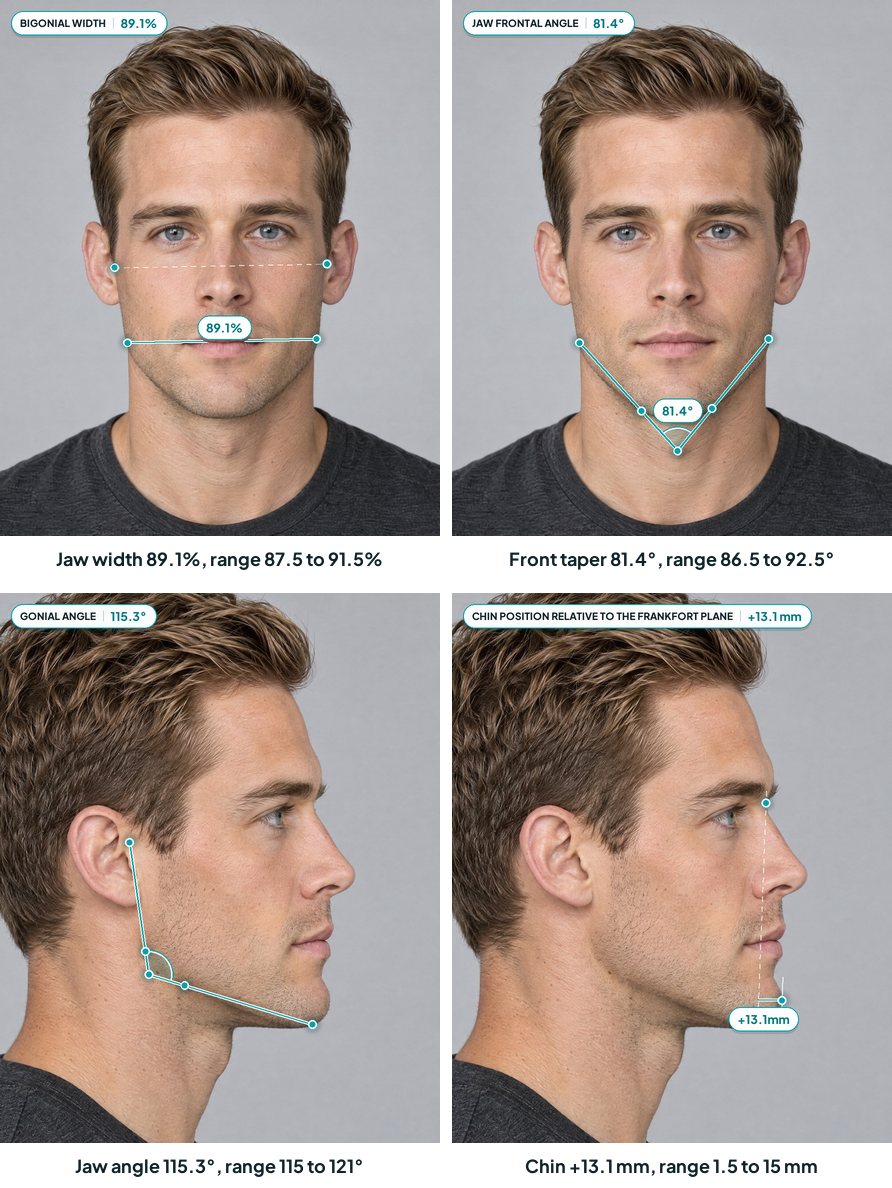
That’s Man A, the sharper jaw of the two. We use four example men on this page: Man B is the man in our sample report, and A, C and D are three more faces our engine measured.
Below: the ranges for men and women, how to check all four parts yourself with two phone photos, and why the same 90.1% jaw is Ideal against one tool’s ideal and too narrow against another’s.
What is a good jawline for men and women?
For a man, our ranges put a good jaw angle at 115 to 121 degrees in profile and the jaw at 87.5 to 91.5% of cheekbone width. The chin sits about 1.5 to 15 mm ahead of the nasal root (the dip between your brows and nose), and the under-chin angle, where the underside of the chin meets the neck, is 94 to 106 degrees. For a woman the angle runs 118 to 124 degrees and the width 84 to 88%; the chin and under-chin ranges are the same. All four of our example men land inside or within a degree of the angle and width ranges, so those two numbers alone couldn’t tell their jaws apart.
| Check | What is measured, and on which photo | Men | Women | What research found |
|---|---|---|---|---|
| Jaw angle | The turn at the jaw corner, side photo (report label: gonial angle) | 115-121° | 118-124° | One X-ray study: average about 123° in men, 126° in women.1 Surveys preferred 130° on men, 125.5° on women.23 |
| Jaw width | Jaw corners as a % of cheekbone width, front photo (bigonial width) | 87.5-91.5% | 84-88% | Women’s jaws rated attractive at about 83% of cheekbone width; on men, close to face width.32 |
| Chin | The chin’s most forward point against the nasal root, on a side photo leveled from ear opening to eye socket rim (chin position relative to the Frankfort plane) | +1.5 to +15 mm | Same | Raters preferred a chin set slightly back over one pushed forward.4 |
| Under-chin and definition | The angle where the under-chin meets the neck, side photo; head posture moves it a lot. Jaw, chin and under-chin definition are rated visually 0 to 10, with no range. | 94-106° | Same | Raters accepted 90 to 105°; ratings fell steadily as the angle opened and were lowest at 125 to 130°.5 |
The research column uses other landmarks and reference lines, so read it for direction, not as numbers to set against ours.
Our jaw-angle range is more closed than both the X-ray average and the angles the surveys preferred: the average man, at about 123 degrees, sits just outside it and still scores Great (9.4 of 10). X-rays show bone and photos the skin outline, so treat that comparison as rough. Adult jaw angles spread about 7 degrees either side of the average (one standard deviation),1 so anything from the mid 110s to the low 130s is an ordinary jaw, whatever its score; the gonial angle guide separates normal from ideal.
Width has a catch: a jaw can read wide only because the cheekbones are narrow.
Treat the preference numbers as thin. The angle and width preferences come from two online surveys by one lead author, the women’s on white faces only; the chin and under-chin results each come from a single computer silhouette in a UK study. We found no study that sets an attractiveness score or a cut-off for a good jawline (the clinical photo scales further down grade only sagging and chin projection), so every band here is our own range.
The sex difference in bone is small. In one X-ray study, women’s jaw angle averaged about 2.6 degrees more open, less than the spread within each sex,1 and in 3D scans of US adults of European descent, men’s jaws were only slightly wider relative to their cheekbones.6 Heritage shifts the ranges a little too: East Asian heritage, for example, moves the jaw angle 2 degrees higher. We ask for heritage at upload; no heritage’s range is better than another’s.
How much does the jaw weigh against other features? In a 2018 study, 922 people ranked composite faces that varied five features, and the jaw carried about a fifth of the weight, level with brow thickness.7 So it matters, but no more than your brows do. In our report the jaw counts in more than one place. The visual Jaw rating is about a fifth of the Masculinity or Femininity pillar, and for women it rewards a more feminine jaw. Jaw, chin and under-chin definition carry about two-thirds of the Angularity pillar.
Why a sharp and a soft jawline can share the same angle
Angle and width describe the jaw’s shape. Sharpness is the soft tissue and shadow at its edge, so the two can disagree. Man A and Man B from the opening are the cleanest case: half a degree apart at the jaw corner, one point apart on width, all four readings Ideal.
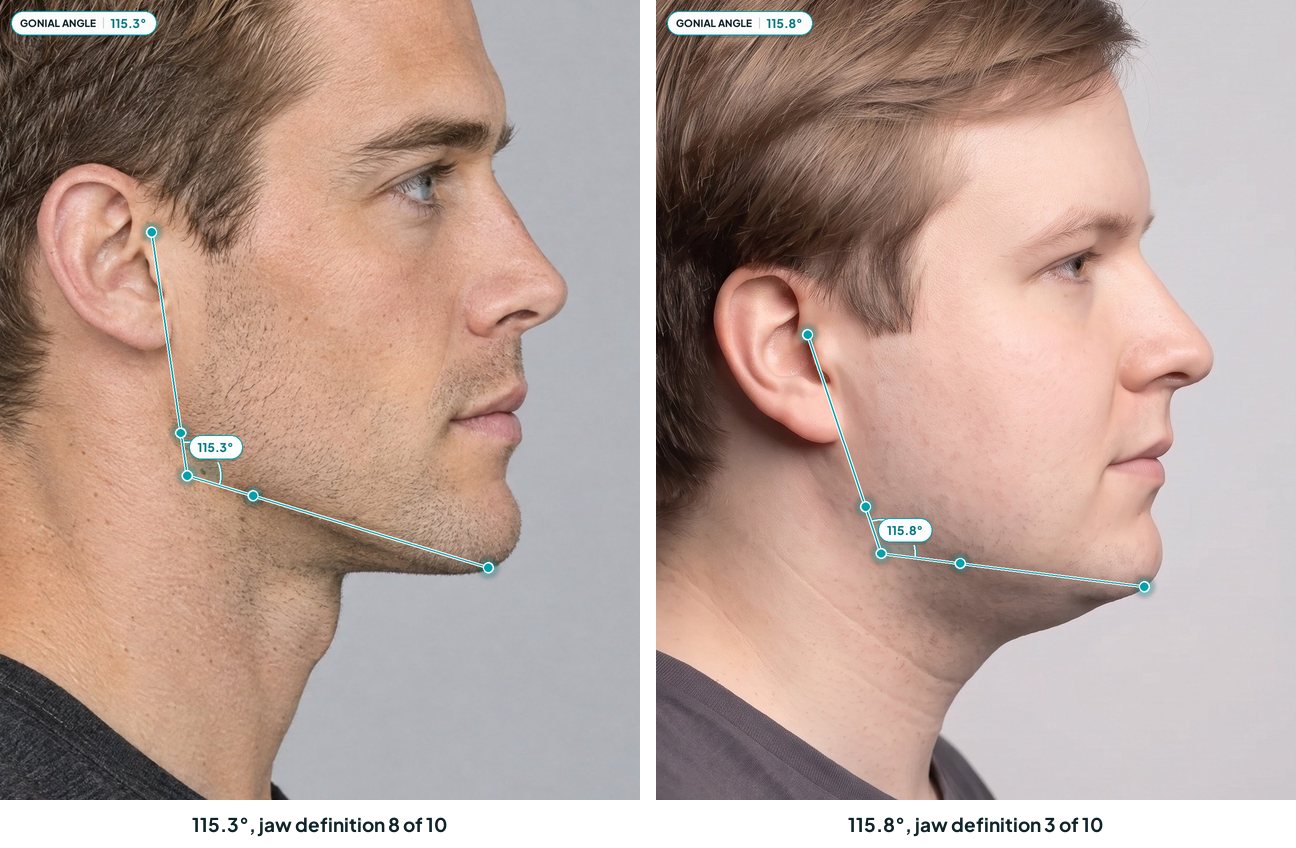
Now look at the edges. Man A has a sharp jaw edge and a clean line under the chin, the defined jawline most people picture. Man B’s jaw edge is softer and his under-chin fuller. Our report rates Man A’s definition 8 of 10 at the jaw, the chin and under the chin. Man B gets 3, 4 and 3, and his report marks Angularity, the pillar where definition is scored, as a focus area.
Definition comes from three of our visual ratings: an AI check reads both photos and scores jaw, chin and under-chin 0 to 10. They’re the bulk of the Angularity pillar, which came out 7.7 for Man A and 3.2 for Man B. Women’s photos get the same three ratings on the same scale, so a clean jaw edge and under-chin count for women too; how feminine the jaw looks is a separate rating in the Femininity pillar.
One total hides all of that. Man B even has the better Harmony score, which comes from measured proportions: 6.9 to 5.9. His overall is still lower, 5.3 to 7.0, mostly because his Angularity and Masculinity pillars are lower.
The under-chin angle, the measured line closest to definition, couldn’t be taken on Man B at all because his photo shows no clear throat point. The visual check still rated his under-chin 3.
Can a jawline app rate you from one selfie?
Only half of it. A front photo shows jaw width and how the outline tapers to the chin, but the jaw angle and the chin’s forward position only show from the side. Most of the jawline apps and checkers we looked at say a side or three-quarter photo shows them better, yet several still score a jaw angle from one front photo.
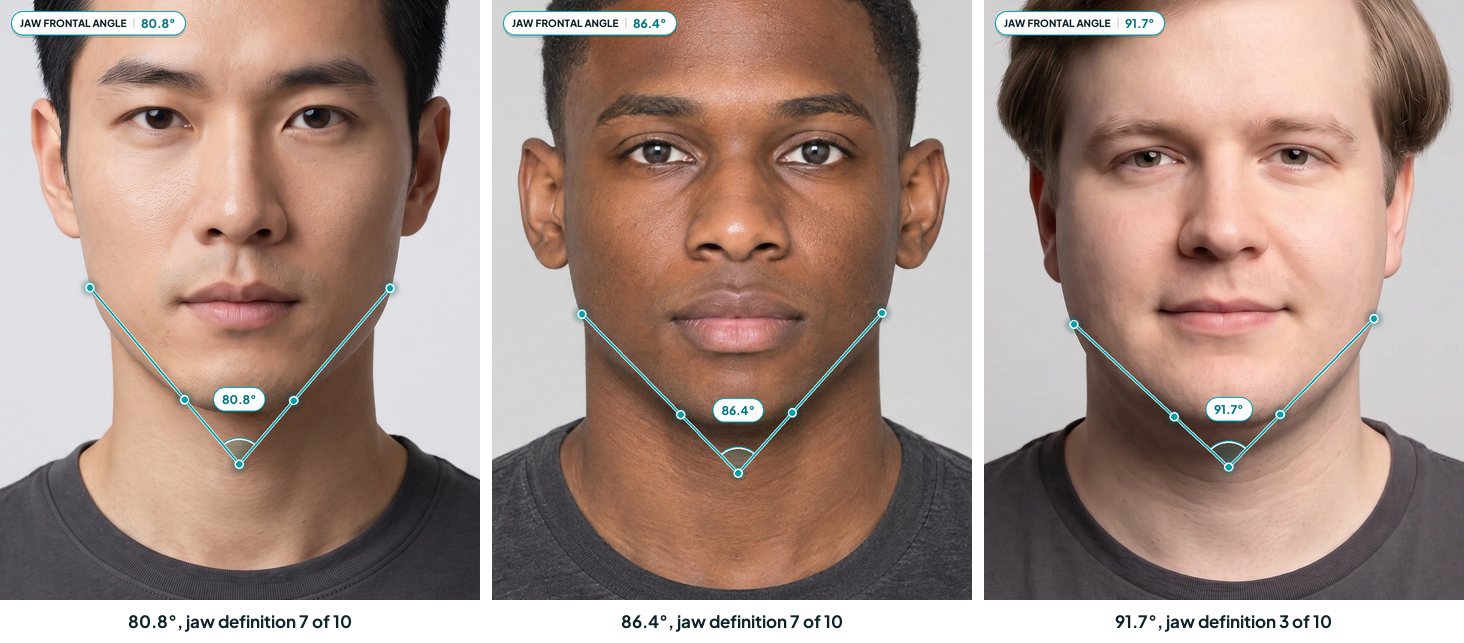
The front jaw angle, top right in the first figure, is the V where the two lower jaw borders, extended, meet below the chin. It reads 80.8 degrees on Man D and 86.4 on Man C, both rated 7 for definition, and 91.7 on Man B, rated 3. Our men’s range is 86.5 to 92.5, so the softest jaw is the only one inside it. Man A, the sharpest jaw on the page, reads 81.4, more than 5 degrees under.
The likely reason is where the points come from. Front jaw corners come from the 478-point face mesh, which follows the outline the camera sees, soft tissue included. So our report flags front-view jaw angles as lower-confidence readings and never makes one a strength or focus area.
That’s why our analysis asks for both photos: width from the front, angle and chin from a leveled side photo, the same reason any face rating needs a side photo. How our report places the points shows each one.
A beard, long hair or heavy shadow can hide the edge too, and our report then marks the jaw values as estimates instead of guessing.
How to read a jawline score
Read any jawline score part by part, each against its own range. Ours doesn’t give a single jawline number at all. The grade words run Ideal (inside the range, 9.5 or more), Great at 8 or more, Good at 6 or more, Fair at 4 or more, and a focus area under 4.
Scores fall gently outside a range. On the men’s ranges:
| Reading | Outside the range by | Score |
|---|---|---|
| Jaw angle 125° | 4° | 8.2, Great |
| Jaw angle 130° | 9° | 4.6, Fair |
| Jaw width 85% | 2.5 points | 8.7, Great |
| Chin 5 mm behind the nasal root | 6.5 mm | 8.0, Great |
| Under-chin angle 120° | 14° | 4.5, Fair |
A jaw angle has to sit about 8 degrees outside its range before the score halves (13 for the under-chin), so a miss of a few degrees is minor. The 4.6 at 130 degrees is our range talking: 130 is an ordinary adult angle, and the one the men’s survey preferred.
Our four example men, part by part:
| Example man | Jaw angle | Jaw width | Chin | Jaw definition |
|---|---|---|---|---|
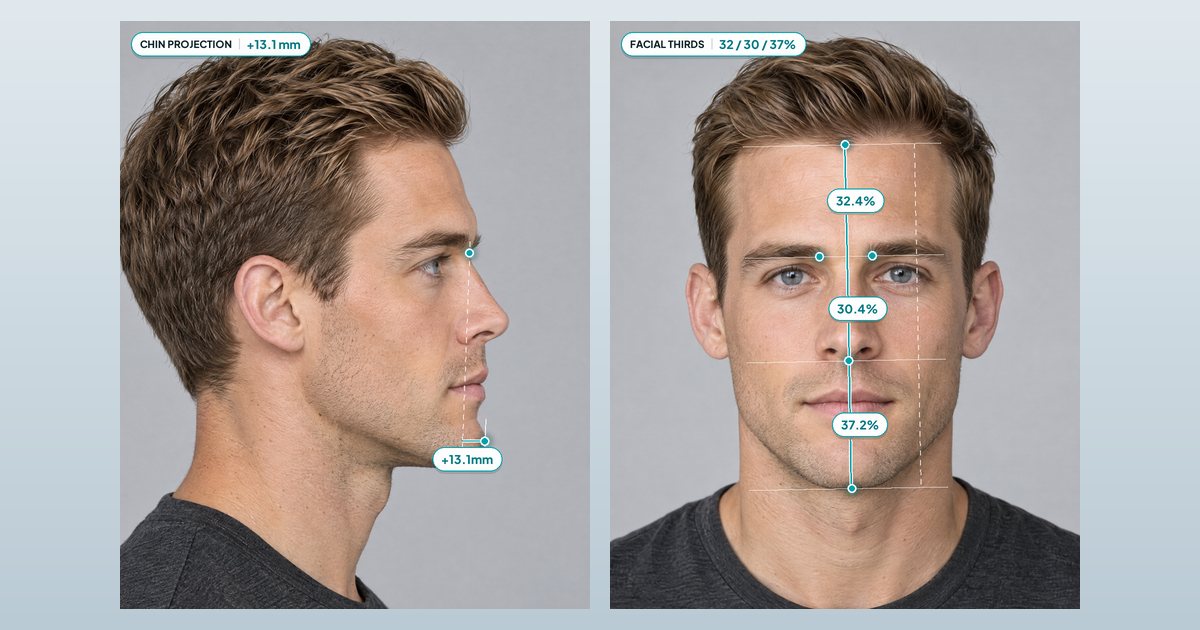
| Man A | 115.3°, Ideal | 89.1%, Ideal | +13.1 mm, Ideal | 8 of 10 |
| Man B | 115.8°, Ideal | 90.1%, Ideal | +0.4 mm, Great | 3 of 10 |
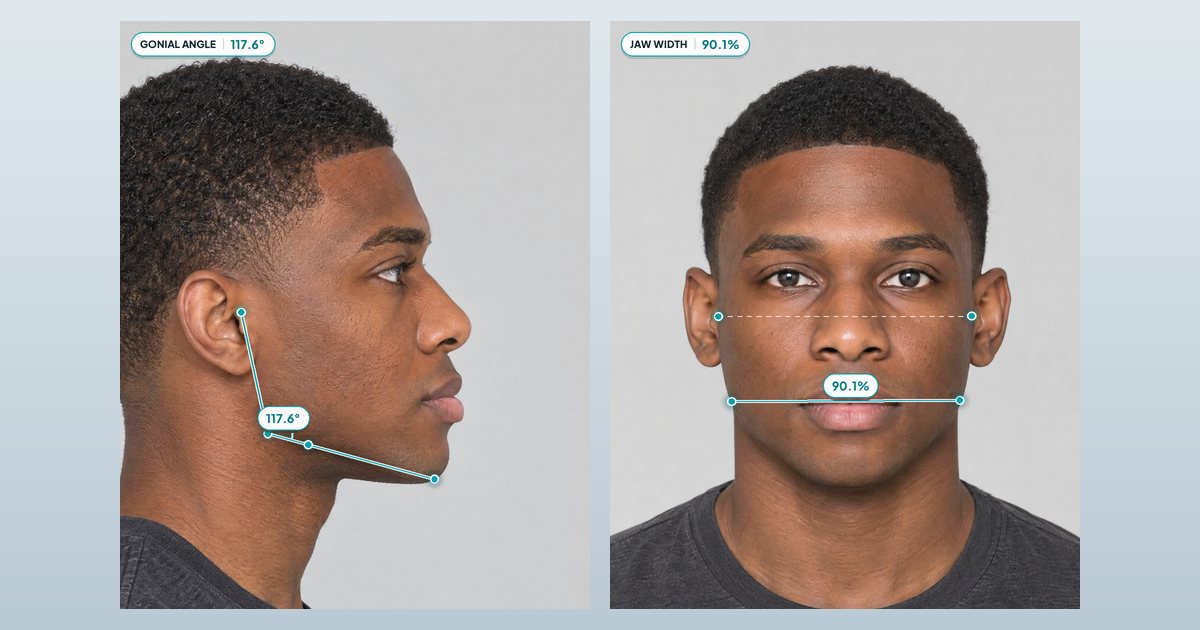
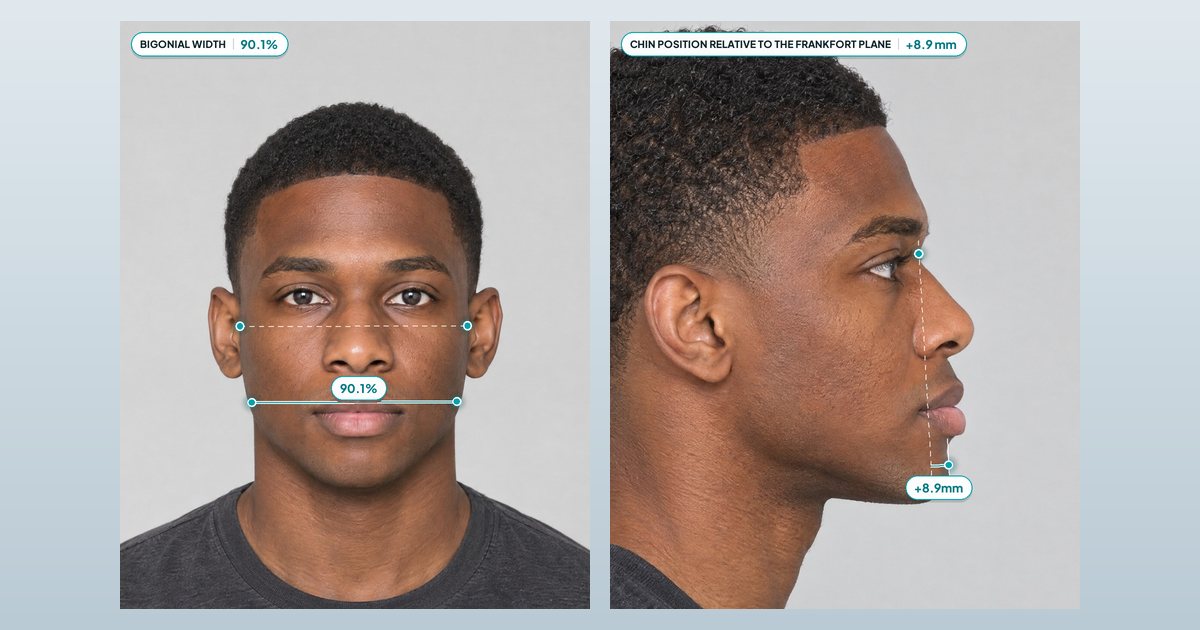
| Man C | 117.6°, Ideal | 90.1%, Ideal | +8.9 mm, Ideal | 7 of 10 |
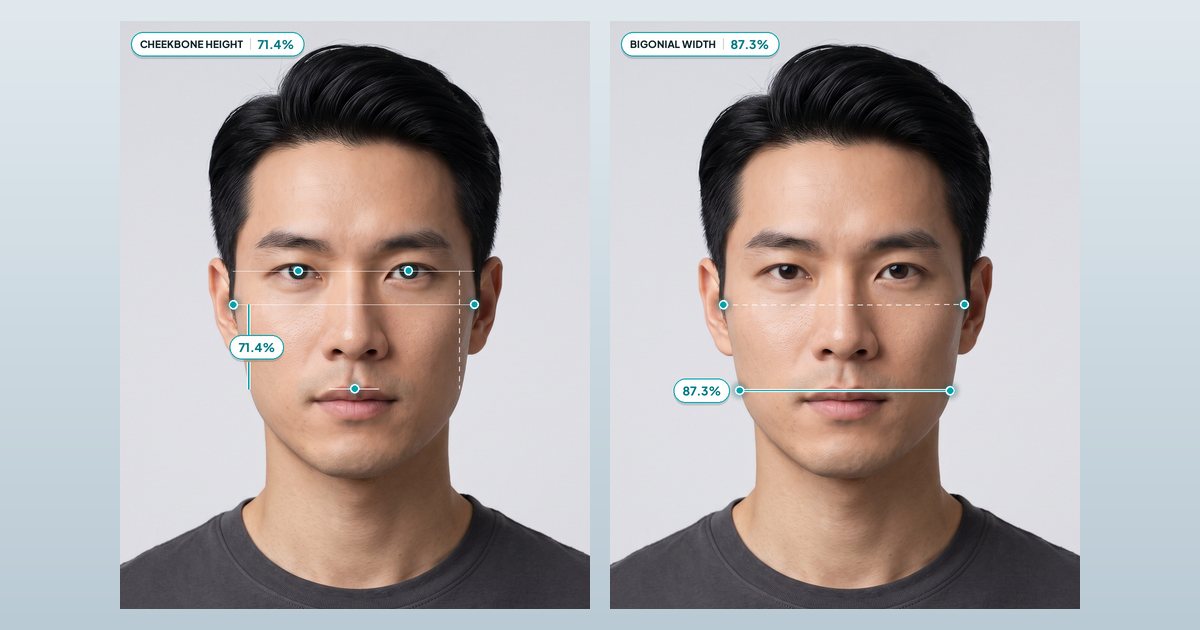
| Man D | 123.8°, Great | 87.3%, Great | -4.9 mm, Great | 7 of 10 |
Man D’s heritage, chosen at upload, puts his jaw-angle range at 117 to 123 degrees, so 123.8 is just outside it. Chin values are estimates, since the photo is scaled from an assumed face height.
Read down the columns. Angle, width and chin land Great or better on all four men, even across an 18 mm spread of chins. Definition alone spreads, from 3 to 8, and it matches how these jaws look in the photos.
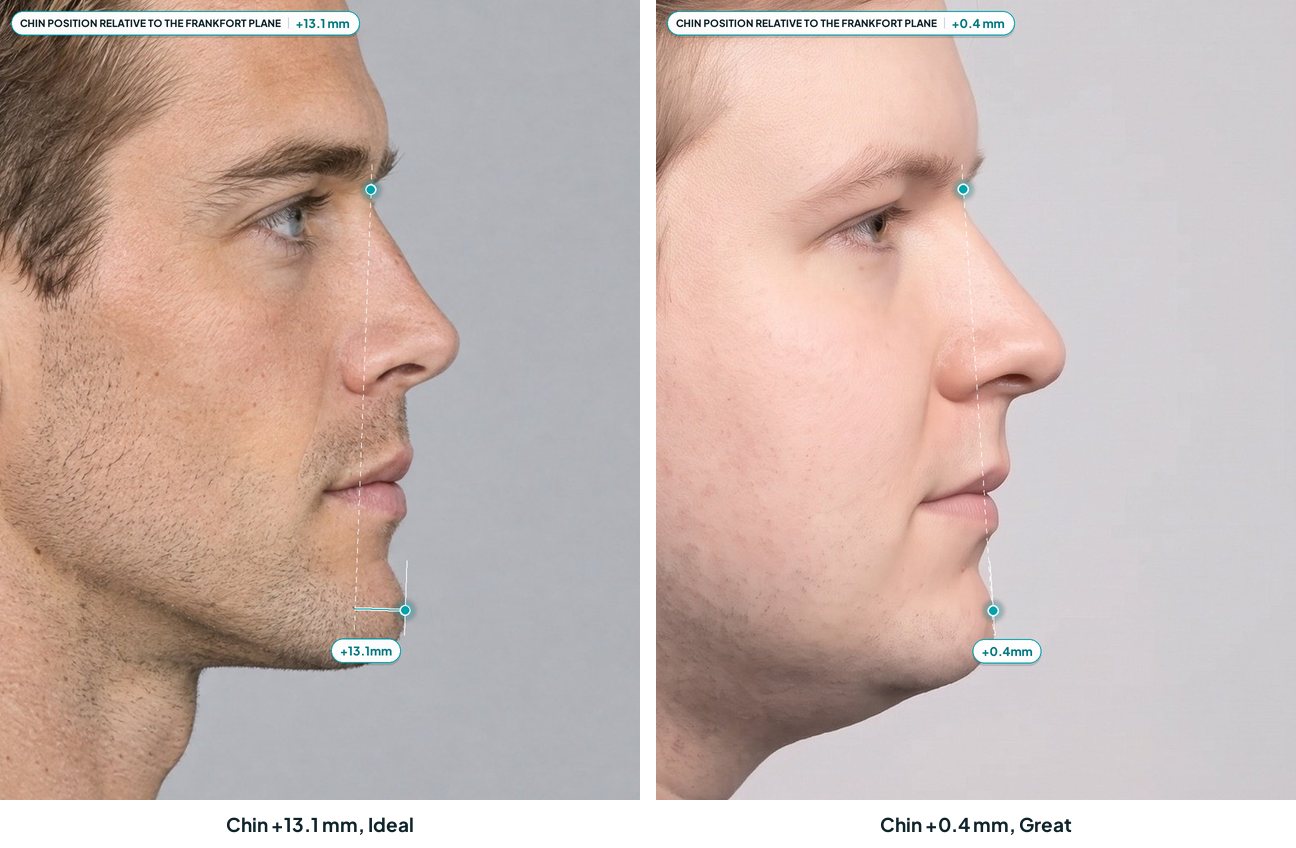
More chin isn’t automatically better. In one rating study, the profile people ranked first had its chin 4 mm behind the study’s ideal, edging out the ideal itself.4 That study used its own reference line, so its millimeters don’t carry over to ours. The recessed chin guide says how far back a chin has to sit before it counts.
“Weak jawline”, the everyday name for a low rating, tends to mean a soft edge or a set-back chin. A low reading is one focus area among several, and no single number decides how attractive you are.
How to rate your jawline with two phone photos
This is the jawline test we’d run by hand: two photos set up the same way, your phone’s markup pen, a protractor app and a ruler. Width comes from the front; the side photo gives the rest.
- Set up. Have a friend shoot with the rear camera from about 1.5 m (5 feet), zooming in if needed: a phone held close makes the nose look bigger relative to the cheekbones.9 Lens at jaw height, soft light in front, hair behind your ears. With a beard, every jaw point is an estimate. The full photo checklist has the rest.
- Pose. Keep your chin level and your head stacked over your shoulders. Lips closed and relaxed, no smile. Take a front photo, then turn a full 90 degrees with your ear in view. Take each one twice.
- Jaw width (front photo). Mark each jaw corner, where the outline turns from cheek into jaw, about level with your mouth (feeling for the corner with a fingertip helps). Then mark the widest part of your face at cheekbone level, skin edge to skin edge, just in front of each ear. Man A’s lines at the top of this page show both. Measure both widths with a ruler on the screen or in pixels in a photo editor, then divide jaw by cheekbone width and multiply by 100. Men 87.5 to 91.5%, women 84 to 88%.
- Jaw angle (side photo). Draw one line down the back edge of your jaw below the ear and one along the lower border toward the chin, then read the angle where they meet, as on Man A’s side photo at the top of this page. Men 115 to 121 degrees, women 118 to 124. The full method is in our gonial angle guide.
- Chin (side photo). Rotate the photo until a line from the top of your ear opening to the lowest point of the bony rim under your eye is level. Drop a vertical line from the deepest point between your brows and nose, like the dashed line in the same figure. A chin on the line or up to about 1.5 cm in front of it is in or near our range. For a rough scale, do what our report does: treat your hairline-to-chin height on the same photo as about 19 cm, so 1.5 cm is about a thirteenth of it. Our chin check goes step by step.
- Under-chin (side photo). Draw one line along the underside of your chin and one down the front of your neck. Our ideal is 94 to 106 degrees, but the adult averages cited in one study run about 118 to 126,5 so most people read above it, and that’s ordinary. It’s also the hardest line to place: Man A, whose under-chin our visual check rates 8 of 10, measures 122.4 degrees. If the angle moves a lot between your two side photos, that’s posture or where you put the points. Bone doesn’t move between two photos.
Your points won’t sit exactly where ours do: jaw corners are hard to see from the front, and chin millimeters are rough, in our report too. Our rule of thumb, not a tested one: a reading more than a few points or degrees outside a range is probably real; treat anything closer to the edge as in range.
Why jawline apps disagree, and how to judge any score
Jawline rating apps disagree because they measure between different points and against different ideals. Their numbers can’t be compared, and jaw width shows it best.
| What a tool calls jaw width | Its ideal | What a 90.1% reading means there |
|---|---|---|
| Visible jaw outline points on the face mesh, against cheekbone width, front photo | 76-82% | Far above the band |
| Jaw-corner points on the face mesh, against cheekbone width, front photo (ours) | 87.5-91.5% | Ideal |
| One app’s jaw against cheekbone width, front or three-quarter photo, no method given | 92-94% | “Too narrow” |
A 90.1% reading, like Man B’s or Man C’s, is Ideal on our scale and outside both other bands, and on their points those jaws wouldn’t read 90.1% in the first place. Part of the gap is different jaw points and part is ideals set with no stated basis.
“Jaw angle” means three different things too. One tool measures a corner on a front photo, with a band of 118 to 126 degrees that it admits is not a clinical jaw angle. Another takes a front or three-quarter photo and calls 120 to 125 ideal for men. We measure the angle on a true side photo.
Some tools also fold jaw symmetry into a jawline score; ours scores it with the whole face.
We found no study that tests any jawline app or checker for accuracy or repeatability, ours included. The nearest thing is clinical: in one scale study, 12 experts graded jawline sagging and chin projection on 5-point photo scales, and in a digital test they agreed closely with each other and with themselves.8 That is the bar to hold any app to: the same face, rated twice, lands in the same place.
Before you trust any jawline score, ask it six things:
- Does it name what it measured, ideally all four parts?
- Does it draw its points on your photo, so you can see whether the jaw corner landed on your jaw?
- Did it use a side photo for the jaw angle and the chin?
- Are its ranges set for your sex?
- Does it tell you which readings are estimates?
- Does it hold steady across two photos taken the same way? That’s the 2-photo test.
Ours answers yes to the first five. The sixth you can check yourself, with two photos, on ours or any other.
What can change your jawline rating, and what can’t
In adults the jaw bone changes slowly; in one X-ray study, older adults had slightly more open jaw angles than people in their 20s.1 What moves a jawline rating is the soft tissue over the bone and the photo. Body fat and beard shape change the tissue; posture and the camera change the photo. Of the measured values, width is where weight shows most, because the front jaw points follow the visible outline.
In 3D scans of US girls and women, a higher BMI went with a lower face that was wider relative to the cheekbones; that study found no such link in males,6 though an earlier photo study found the ratio tracked weight in both sexes.11 For adults carrying extra weight, ordinary diet and exercise are the honest route. An open under-chin angle on its own doesn’t mean you need to lose weight.
A beard changes how a man’s face is rated more than jaw size does: under a beard, a bigger jaw added little to how masculine or dominant a face looked, and bearded faces with smaller jaws were rated the most attractive.10 If you’re clean-shaven and your under-chin angle reads open, try what our report suggests: a short, even beard grown for three to four weeks, neckline set just under the jaw, throat kept clean. It changes the visible outline, not the bone. If you already have one, take two side photos, one fuller at the jaw corners and one neater at the sides, and style before you cut.
Women can tuck their hair behind the ear to show the jaw corner in photos, and a soft contour shade just under the jaw edge sharpens it on camera.
Posture and the camera change what people see fastest. Stand tall with your head stacked over your shoulders, since head position moves the under-chin line a lot. For everyday photos, hold the camera at or a little above eye level, push your face slightly toward the lens with your chin tipped down a touch, and face soft light from a little above, which leaves a light shadow under the jaw edge. For a fair rating, stick to the setup in the steps above.
Skip the gum and the jaw trainers. In a 6-month randomized trial, chewing gum three times a day raised bite force but left jaw muscle thickness and jaw shape unchanged.12 Jaw trainers work the same muscles, and we found no controlled study showing that they, or mewing, reshape an adult jaw.
Take your two photos and run the four checks, or open our sample report to see the jaw lines drawn on Man B, strengths included.
Questions people ask
What is a good jawline score?
There's no universal one, because each part has its own range. On ours, a good jawline sits inside or close to each: for men a jaw angle of 115 to 121 degrees and a jaw 87.5 to 91.5% of cheekbone width, for women 118 to 124 degrees and 84 to 88%, and for both a chin about 1.5 to 15 mm ahead of the nasal root. A part rated Great or better needs nothing. One app's 0 to 100 score can't be compared with another's.
How do I know if I have a good jawline?
Look at the four parts in two photos taken from about 1.5 m with your chin level. Jaw width comes from the front photo; the jaw angle, chin position and under-chin line come from the side photo. Compare each with its range, then look at the jaw edge in a side photo with even light, because that's where definition shows. If you'd rather not run the jawline test by hand, our analysis draws the lines for you from one front and one side photo.
How much does your jawline affect attractiveness?
A fair amount, but it's one feature among several. In a 2018 study by Mogilski and Welling, where 922 people ranked composite faces with five features changed, the jaw carried about a fifth of the weight, level with eyebrow thickness and a little ahead of cheekbones and eye size, and a more masculine jaw helped men's faces more than women's. In our report, jaw, chin and under-chin definition make up about two-thirds of the Angularity score, and the visual Jaw rating is about a fifth of Masculinity or Femininity.
Why does my jawline rating change between photos?
Mostly camera distance, head tilt and light. A phone held close changes proportions, and a raised or tucked chin moves the under-chin angle most. Light can leave a shadow under the jaw edge or flatten it, and hair or a beard can hide the corner. Our report levels the side photo on your ear and eye socket, so small head tilts change the chin and jaw-border readings less, and it marks hidden jaw points as estimates.
Can an app rate my jawline from a front photo?
Partly. A front photo can measure jaw width and how the outline tapers to the chin, but not the jaw angle or how far your chin sits forward. Those need a side photo. Front-view angles also follow the visible outline, soft tissue included: in our example set, the man with the softest jaw had the most textbook front angle, 91.7 degrees.
How accurate is a jawline rating app?
We found no study testing any jawline app, checker or rater for accuracy or repeatability, ours included. What you can check is whether a tool shows its work: it names each measurement, draws its points on your photo, takes the jaw angle and chin from a side photo, uses ranges for your sex, and gives similar values on two photos taken the same way. A front-only tool can't see the true jaw angle or how far your chin sits forward.
Is a good jawline different for women?
A little. Our women's ranges put the jaw angle at 118 to 124 degrees and jaw width at 84 to 88% of cheekbone width, against 115 to 121 degrees and 87.5 to 91.5% for men; chin and under-chin ranges match. In one X-ray study, women's jaw angle averaged only about 2.6 degrees more open. One survey of white women's faces preferred about 125.5 degrees, still Great on our range; its 83% width figure used different points. For women, our visual Jaw rating rewards a more feminine jaw.
Sources
-
Leversha J, McKeough G, Myrteza A, et al. Age and gender correlation of gonial angle, ramus height and bigonial width in dentate subjects in a dental school in Far North Queensland. J Clin Exp Dent. 2016;8(1):e49-e54. doi:10.4317/jced.52683. Full text on PMC ↩↩↩↩
-
Mommaerts MY. The ideal male jaw angle: an Internet survey. J Craniomaxillofac Surg. 2016;44(4):381-391. doi:10.1016/j.jcms.2015.12.012. Abstract on PubMed ↩↩
-
Mommaerts MY, Cleymaet R. The ideal shape of the female jaw angle: an online survey. J Craniomaxillofac Surg. 2023;51(10):597-602. doi:10.1016/j.jcms.2023.08.009. Abstract on PubMed ↩↩
-
Modarai F, Donaldson JC, Naini FB. The influence of lower lip position on the perceived attractiveness of chin prominence. Angle Orthod. 2013;83(5):795-800. doi:10.2319/122912-974.1. Full text on PMC ↩↩
-
Naini FB, Cobourne MT, McDonald F, Wertheim D. Submental-cervical angle: perceived attractiveness and threshold values of desire for surgery. J Maxillofac Oral Surg. 2016;15(4):469-477. doi:10.1007/s12663-015-0872-4. Full text on PMC ↩↩
-
Hodges-Simeon CR, Albert G, Richardson GB, et al. Was facial width-to-height ratio subject to sexual selection pressures? A life course approach. PLoS One. 2021;16(3):e0240284. doi:10.1371/journal.pone.0240284. Full text on PMC ↩↩
-
Mogilski JK, Welling LLM. The relative contribution of jawbone and cheekbone prominence, eyebrow thickness, eye size, and face length to evaluations of facial masculinity and attractiveness: a conjoint data-driven approach. Front Psychol. 2018;9:2428. doi:10.3389/fpsyg.2018.02428. Full text on PMC ↩
-
Pooth R, Prinz V, Cajkovsky M, et al. Validated 5-point photonumeric scales for the assessment of the jowls and chin. J Cosmet Dermatol. 2022;21(2):600-607. doi:10.1111/jocd.14661. Abstract on PubMed ↩
-
Ward B, Ward M, Fried O, Paskhover B. Nasal distortion in short-distance photographs: the selfie effect. JAMA Facial Plast Surg. 2018;20(4):333-335. doi:10.1001/jamafacial.2018.0009. Full text on PMC ↩
-
Dixson BJW, Lee AJ, Sherlock JM, Talamas SN. Beneath the beard: do facial morphometrics influence the strength of judgments of men’s beardedness? Evol Hum Behav. 2017;38(2):164-174. doi:10.1016/j.evolhumbehav.2016.08.004. Record on the University of Glasgow repository ↩
-
Coetzee V, Chen J, Perrett DI, Stephen ID. Deciphering faces: quantifiable visual cues to weight. Perception. 2010;39(1):51-61. doi:10.1068/p6560. Abstract on PubMed ↩
-
Jung HJ, Hwangbo NK, Park Y, Ahn HJ. Effects of gum chewing training on occlusal force, masseter muscle thickness and mandibular shape: a randomised controlled clinical trial. J Oral Rehabil. 2024;51(12):2529-2536. doi:10.1111/joor.13830. Abstract on PubMed ↩
Spotted a mistake? Email support@faceratinglab.com and we will fix it.