Midface ratio: long or compact, and how to measure yours
Midface ratio is the distance between your pupils divided by the drop from your pupils to the top of your upper lip. At 1.00 they match: lower leans toward a long midface, higher toward a compact one. Our ideal is 0.97 to 1.00 for men and 1.04 to 1.07 for women.
The short version
- A man anywhere from 0.90 to 1.07 still scores Great for this ratio, and so does a woman from 0.97 to 1.14, even though each ideal window is only 0.03 wide.
- Past the window, more compact stops helping. A man at 1.12 scores Fair, yet even for him a perfect ratio would add less than 0.05 to his overall score.
- The midface ratio and the middle third of the face are different measurements, and on two of our example men they give opposite answers.
- Some calculators divide the drop by the gap instead, which turns a 0.94 into about 1.06. Check which way up a number is before you compare it with ours.
- Bone sets the ratio, but your photo can move it. By our estimate a 5-degree chin lift or tuck shifts it by about 0.03 to 0.05, the width of the ideal window or more.
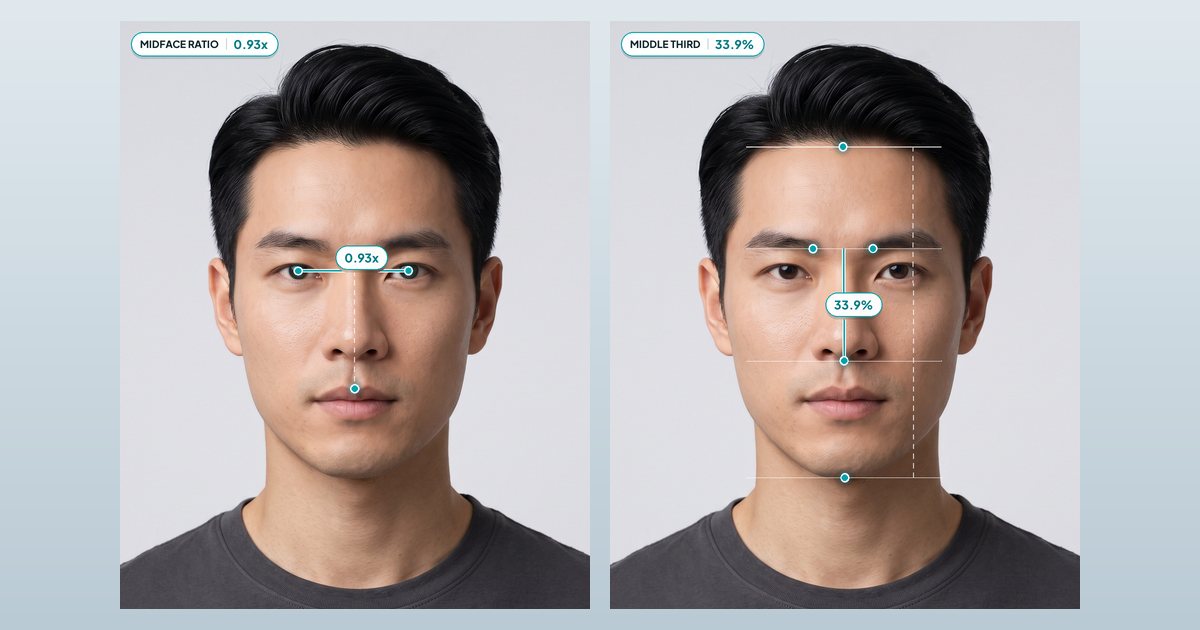
Your midface ratio comes from a box drawn on your face: across from pupil to pupil, and down from your pupils to the top edge of your upper lip. A square box is exactly 1.00. Taller than wide (under 1.00) leans toward a long midface, and wider than tall (over 1.00) toward a compact one, which some people call a short midface.
Online, the higher number gets treated as the better one. It isn’t. Of our four example men, the most compact, at 1.12, gets the lowest score for this ratio: 5.78 out of 10, against 9.47 to 9.77 for the other three.
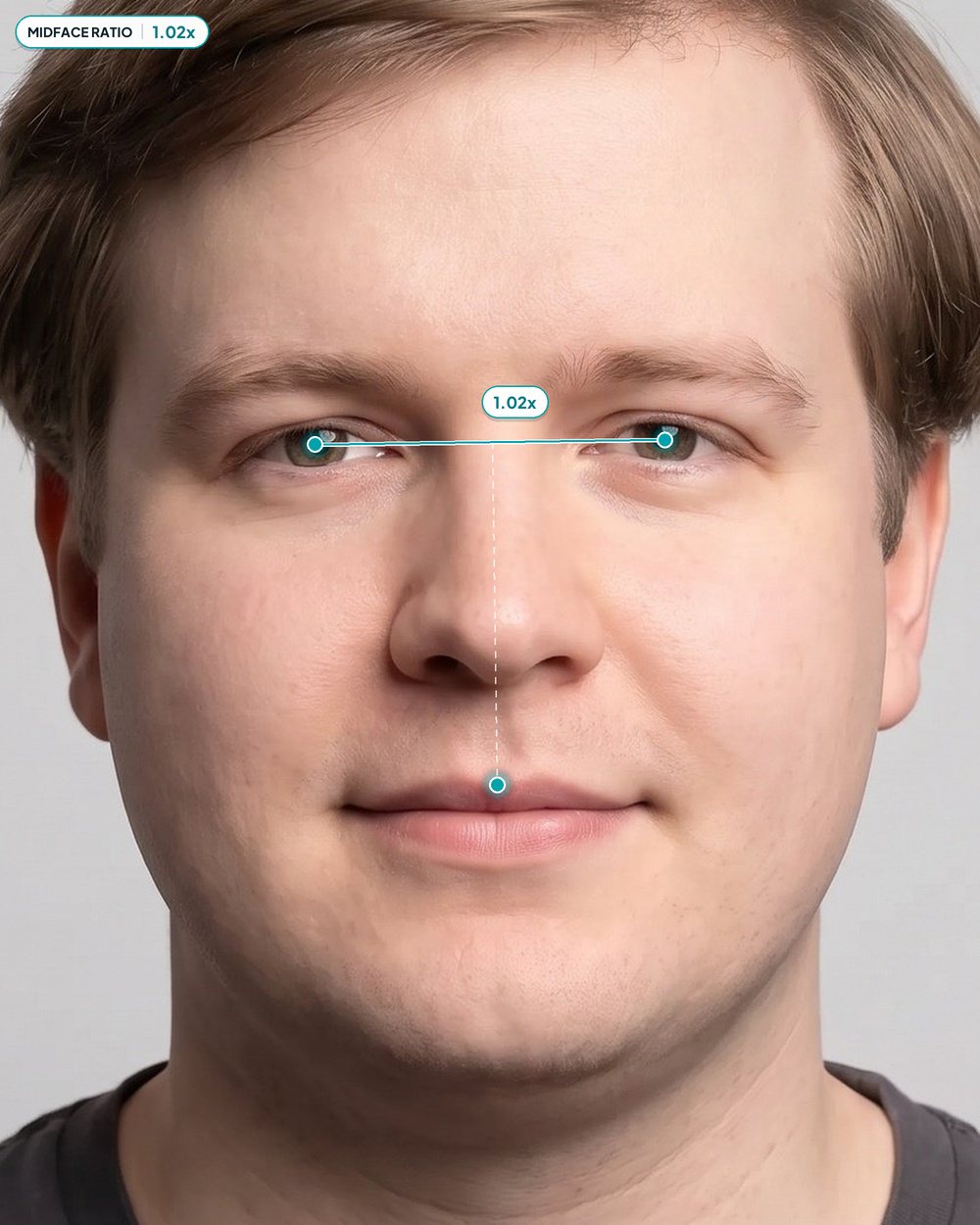
Here’s the arithmetic on the man in our sample report. On the full-size photo his pupils are 305 pixels apart (that gap is the interpupillary distance, or IPD), and the top of his upper lip sits 299 pixels below the pupil line. 305 divided by 299 is 1.02. Open the sample and you’ll see the same 1.02, labeled Great.
It’s a ratio, so photo size doesn’t matter, but camera angle does: by our calculation, tipping your chin 5 degrees can carry a reading right across the ideal window. And it isn’t the middle third of your face, though both get called “the midface”. On two of our men, the two methods give opposite answers.
Ideal midface ratio for men and women
Our ideal midface ratio is 0.97 to 1.00 for men and 1.04 to 1.07 for women. Your report picks the range from the sex and heritage you choose when you upload. East Asian heritage moves both windows, and every number in the table below, down 0.01.
That puts the top of the men’s window at exactly square. The women’s sits 0.07 higher, a box a touch wider than it is tall.
| Score in your report | Men | Women |
|---|---|---|
| Ideal | 0.97 to 1.00 | 1.04 to 1.07 |
| Great | 0.90 to 0.96, or 1.01 to 1.07 | 0.97 to 1.03, or 1.08 to 1.14 |
| Good | 0.86 to 0.89, or 1.08 to 1.11 | 0.93 to 0.96, or 1.15 to 1.18 |
| Fair | 0.81 to 0.85, or 1.12 to 1.16 | 0.88 to 0.92, or 1.19 to 1.23 |
| Focus area | 0.80 or lower, or 1.17 or higher | 0.87 or lower, or 1.24 or higher |
The window is narrow, but the score around it falls off slowly. Miss it by 0.03 and you still score about 9.5 out of 10. You’d need to be about 0.14 outside to fall to 5, and it makes no difference which side you miss on: our most compact man, at 1.12, and a man at 0.85 both land on Fair.
Our Great band also lines up with the ranges quoted online. The “0.9 to 1.1” you’ll see on one site is close to the men’s 0.90 to 1.07, and tighter versions like 0.95 to 1.05 sit inside it.
Of our four example men, Man A, the one in our sample report, measures 1.02. Man B is 0.94 and Man C is 1.12, both pictured in the next section. Man D, the man at the top of this page, is 0.93, judged against the East Asian range of 0.96 to 0.99. Not one of the four is inside the window. Three still score Great.
Between them they span 0.93 to 1.12, six times the width of the window, and that’s normal. In a study of 218 photos that measured this layout as an angle, the typical spread was 3 to 4 degrees either side of the average (one standard deviation), which works out to 0.08 to 0.10 on this ratio.1 A window 0.03 wide was never going to hold most people.
Short vs long midface, measured on two faces
A long midface means the drop from your pupils to the top of your upper lip is long for the gap between your pupils, which leaves more room between the eyes and the mouth. A compact one looks wide across the eyes for the height below them, with the nose and mouth packed in close.
Under 1.00 doesn’t automatically mean long, and 0.98 is inside the men’s ideal. For men, the midface only reads longer than ideal below 0.97, and it stops scoring Great below 0.90. The women’s line sits higher, at 1.04, so a woman at 1.02 is wider than tall and still reads slightly long for her range.
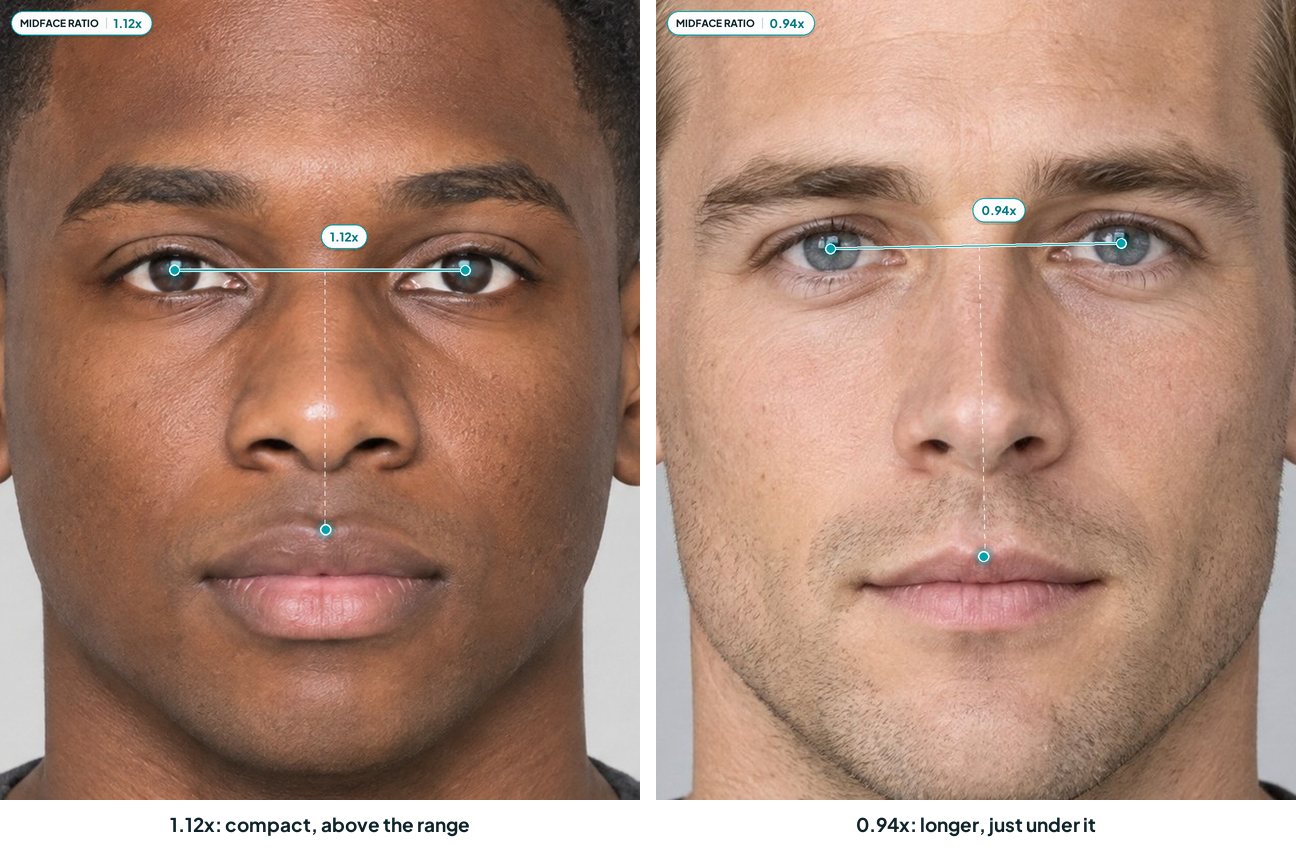
Man C, on the left, is the compact one, and the drop is only half his story. His pupils are set wider, at 35.1% of his face height against Man B’s 31.8%, and his drop is shorter, 31.3% against 33.9%. Both push his number up.
A compact reading can come from wide-set eyes as much as from a short middle face, and a long reading from closer-set eyes. If yours reads long, check your eye spacing before you put it down to length.
The labels also depend on the ruler. Man B, the long one by this ratio, has the shorter middle third of the two, and Man C’s middle third sits right in its ideal range.
How to measure your midface ratio from a photo
Take a level front photo from about 1.5 m, mark the center of each pupil and the top edge of your upper lip at its center, then divide the gap between the pupils by the straight-down drop to the lip.
- Have a friend shoot with the rear camera from about 1.5 m (5 feet), zoomed to about 2x rather than stepping closer, lens at nose height. No one to help? Prop the phone at nose height about 1.5 m away and use the self-timer. Hair off your face. With a mustache, trim it clear of the lip line or treat the lip point as an estimate.
- Look straight into the lens, chin level, neither raised nor tucked. Lips closed and relaxed, no smile. Take two or three shots.
- Open the photo in any editor that shows pixel positions. A ruler works too, on a big screen or on a phone zoomed until your face fills it. If your head leans, rotate the photo until both pupils sit level.
- Mark three points: the center of each pupil, and the top edge of your upper lip at its center, in the dip of the Cupid’s bow.
- Measure the gap between the pupil centers, then the drop straight down (vertical, not slanted) to the lip point, at the same zoom. Divide the gap by the drop: 305 / 299 = 1.02 in our sample report.
- Compare: men 0.97 to 1.00, women 1.04 to 1.07. Men score Great from 0.90 to 1.07, women from 0.97 to 1.14. Repeat on your other photos.
A drop about 10% longer than the gap (64 across, 70 down) gives 0.91, and a man at 0.91 still scores Great.
The photo is the weak link. Your upper lip sits well in front of your eyes, so a nod changes the drop the camera sees. A 5-degree chin lift or tuck moves the ratio roughly 0.03 to 0.05, as much as the whole ideal window or more.
A phone above eye level acts like a tucked chin and lowers the ratio. Held below your chin, it raises it. Smiling lifts the lip and raises it too. Lens and distance shift facial ratios as well,3 and we estimate a selfie at about 30 cm reads 0.03 to 0.10 lower than a photo from 1.5 m, more the higher you hold the phone.
If two of your photos disagree by more than about 0.03, the camera or your marking is moving the number, not your face.
A manual midface ratio calculator only divides the numbers you type in, and an app that reads your photo is only as good as where it puts the points. Our report draws all three points and both lines on your photo, so you can check exactly where it measured (how the points are placed).
Midface ratio vs the middle third of your face
They’re different measurements. The middle third runs from brow level to the base of the nose, as a share of the height from hairline to chin. Our ranges are 31.4 to 33.4% for men (31.9 to 33.9% for East Asian men) and 32.4 to 34.4% for women. The midface ratio starts at the pupils, runs past the nose to the top of the lip, and compares that drop with eye spacing instead of face height.
The old rule says a face splits into equal thirds. Real faces rarely do: tested on 153 young adults, the vertical rules fit worst of all the classical proportions.4 Our own men’s ranges aren’t equal thirds either: 30 to 32% for the top third and 33.9 to 37% for the lower one.
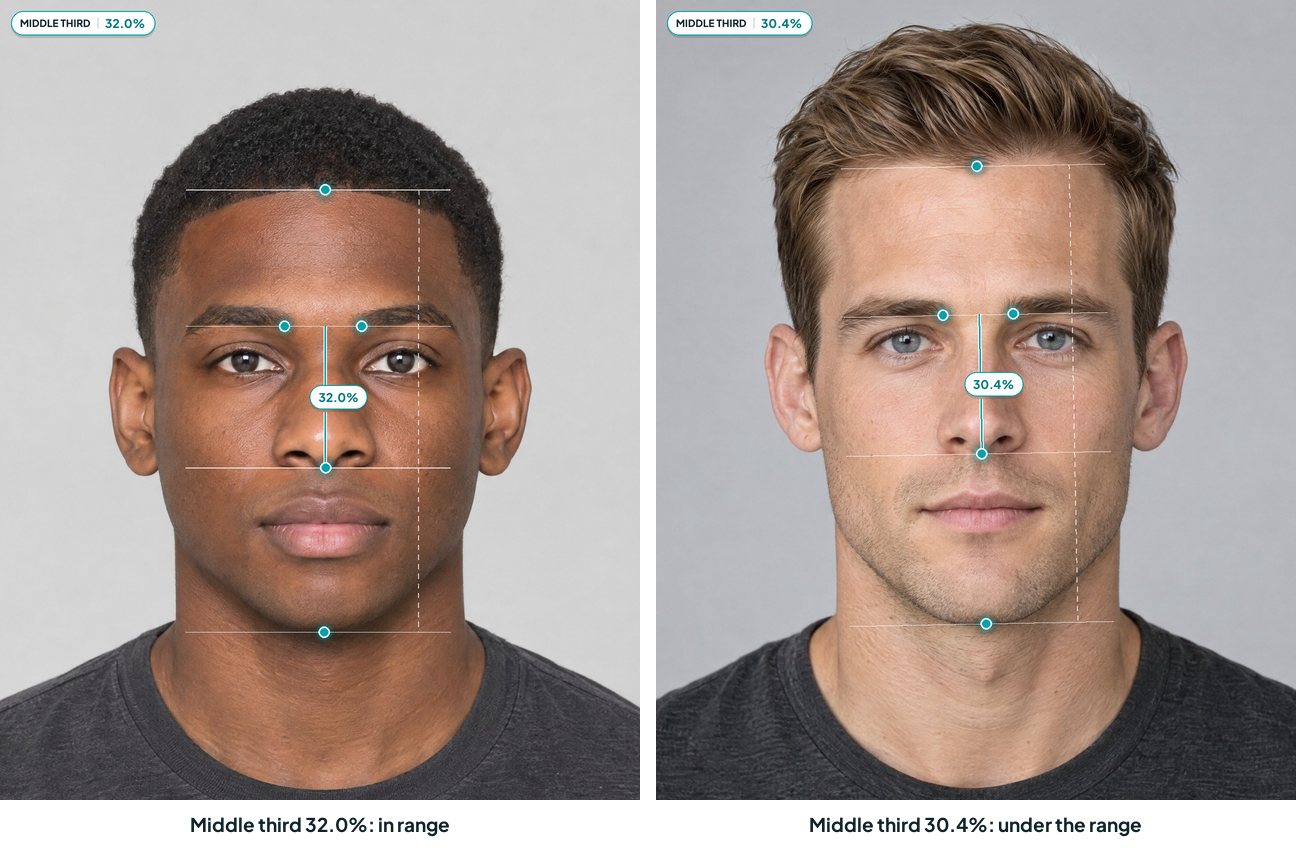
The difference comes from two short spans, shown here as shares of face height (the pupils-to-nose-base span counts in both, so it’s left out). Only Man B’s middle third falls outside its range, and only just.
| Face | Middle third (brows to nose base) | Ratio’s drop (pupils to lip) | Brows to pupils (middle third only) | Nose base to top of lip (ratio only) |
|---|---|---|---|---|
| Man C | 32.0% | 31.3% | 7.9% | 7.2% |
| Man B | 30.4% | 33.9% | 5.7% | 9.2% |
| Man D | 33.9% | 35.6% | 6.7% | 8.4% |
Man C’s brows sit higher above his eyes, 7.9% against 5.7%, and only the middle third counts that span. Man B’s nose-to-lip span is longer, 9.2% against 7.2%, and only the ratio counts that one. Add Man B’s closer-set pupils, and he comes out long on one ruler and short on the other.
People argue online about whether the philtrum, the skin between your nose and lip, belongs to the midface. It depends on which measurement you use. The thirds method puts it in the lower third. The midface ratio’s drop runs right through it, so a long upper lip can make the ratio read long while the middle third looks short. Man B is exactly that case.
Man D is where both agree: the longest middle third of the four (33.9%, at the top of his East Asian range) and the lowest ratio (0.93).
Looking for your midface length in millimeters? A phone photo has no scale, so our report gives ratios, which work on a photo of any size. A long face is a separate idea again: face shape compares the height of the whole face with its width.
Why midface ratio calculators give different numbers
They divide different things. Look up “midface ratio” and you’ll meet four more formulas besides ours, and one of them is ours turned upside down.
| What the tool divides | A typical result | What it tells you |
|---|---|---|
| Pupil gap (IPD) ÷ drop from pupils to upper lip (our method, and the most common version online) | About 1.0 | Lower = long, higher = compact |
| Drop from pupils to lip ÷ pupil gap | About 1.0 | The same thing upside down: lower = compact, and 1 divided by your result gives our number |
| Middle third: brows to nose base ÷ hairline to chin | About 33% | Height only, no eye spacing. It can rank two faces opposite to ours, as with Man B and Man C above |
| Brows to nose base ÷ face height measured without the hairline | About 0.42 to 0.46 | Height only, against a shorter face height. It can’t be converted to ours |
| Middle third vs lower third | 1:1 | Whether the middle and lower thirds match. Says nothing about eye spacing |
The upside-down version trips people up. Divide Man B’s numbers that way and his 0.94 becomes about 1.06, which looks compact if you don’t know. Before you compare any midface number, find out which way up it is.
FWHR measures something else. Face width to height ratio divides cheekbone width by the brow-to-lip height. Cheekbone height uses the very same pupil-to-lip span, but asks where along it the widest points of your cheeks sit.
Is a compact midface more attractive than a long one?
Not as a rule. In the studies we read, the best-rated faces sat near the average layout, and the only one on men favored a longer layout, not a more compact one.56
This pupils-to-lip version comes from online face-rating talk. The few papers that use the words “midface ratio” mean other things, such as the midface’s share of face height. Researchers measure the same eye-and-mouth layout as the eye-mouth-eye angle, with its point at the middle of the mouth and its arms through the pupil centers.61 Ours turns it into a ratio measured to the top of the lip, and on that scale an average adult face lands at roughly 1.0.
Average wins in the experiments. When researchers moved only the eyes and mouth on the same face, the best-liked spacing matched the average, and spacing pushed either way scored lower. That study used white female faces only.5 As a group, people building the most attractive face from three dots also landed near the average angle, though their picks varied about twice as much as real faces do.1
For men, the evidence is thin: one study,6 with no effect sizes we could check and no replication we could find. And none of these papers tests this exact pupils-to-lip ratio for attractiveness.
Online, a compact midface gets sold as masculine. If anything, the data runs the other way. Men average a slightly smaller angle than women, which means a relatively longer layout, though the gap is under 2 degrees and the sexes overlap heavily.1 Researchers who use the angle as a masculinity marker treat the smaller angle as the masculine end.62 Yet in one study of 147 men, the angle had no clear link with how masculine their faces looked to raters (r = 0.064).2 Our own ranges lean the same way: the men’s ideal, 0.97 to 1.00, sits 0.07 below the women’s, on the longer side.
Flat isn’t compact either. In a 3D study of 313 adults, a midface that sits back was linked with the biggest drop in attractiveness ratings of the face shapes measured.7 The midface ratio only sees your face from the front. A set-back midface shows from the side, as a flat or concave profile.
In our report the midface ratio is one of the Harmony ratios, and it carries little weight. Moved into the window on its own, Man C’s ratio would add 0.15 to his Harmony score and under 0.05 to his overall score. For the other three men, neither score would move by more than 0.02.
A ratio outside the window is, at most, one focus area, and one number never decides how attractive a face is.
Can you change your midface ratio?
Not by anything you can do yourself. Pupil spacing and where your upper lip sits are set by bone, teeth and the shape of your lip. There’s no good evidence that face exercises change how the face looks,8 and we found no trial of mewing at all. Day to day, only the photo moves the number you see (chin angle, camera height, a smile, a mustache over the lip), and the self-check covers that.
Age changes the look. The upper jaw loses some bone over the decades and the soft tissue over the mid-cheek shifts.9 In people X-rayed at about 17 and again at 47, the nose tip and the strip between the nostrils drifted down by about 3 mm, and the upper lip grew longer and thinner.10 The middle of the face can look flatter and longer later in life as a result, though we haven’t measured how the ratio itself changes with age.
Glasses, brows and makeup for a long midface
Styling can change how the middle of your face reads, though the ratio stays put. With glasses, stylists and frame retailers follow a convention: a low-set, darker or bolder bridge makes a long nose and middle face look shorter, and a high, keyhole or clear bridge makes a short one look longer.
If it’s your middle third that reads long, leave the lower edge of your brows alone: plucking there lifts the brow and lengthens the middle third as we measure it, though the ratio never sees it (measure your brows before you pluck).
For women, makeup for a long midface usually works across the middle of the face: blush high on the cheeks, some definition along the lower lash line, a softer, flatter brow, and no long contour line down the nose. That’s makeup-artist convention rather than research, so judge it in your own mirror.
Take two level photos and measure both. If they land anywhere in Great, there’s nothing here worth changing. If they land further out, it’s still one small Harmony ratio, and the styling above is the part you control.
Questions people ask
What is a good midface ratio?
Close to 1.0. On our scale the ideal is 0.97 to 1.00 for men and 1.04 to 1.07 for women. The scoring around that window is gentle: men score Great anywhere from 0.90 to 1.07, women from 0.97 to 1.14. Going above the window doesn't help: past 1.07, a man's score drops just as fast as it does below 0.90.
How do I know if I have a long midface?
Divide your pupil gap by the straight drop from your pupil line to the top of your upper lip, on a level photo taken from about 1.5 m. Under 1.00 leans long, but on our ranges a man only reads longer than ideal below 0.97 and stops scoring Great below 0.90. For a woman those points are 1.04 and 0.97. Close-set eyes lower the number too. A long midface also isn't the same as a long middle third or a long face.
Is a low midface ratio bad?
No. A low ratio means the drop from your eyes to your upper lip is long for your eye spacing, so the middle of your face reads long. That's common: two of our four example men sit below their window, at 0.94 and 0.93, and both score Great. A man only reaches Fair at about 0.85, a woman at about 0.92. The one study we found on men even linked a longer layout with higher attractiveness. Check your photo first, because a tucked chin lowers the number.
Is a compact midface attractive?
A slightly compact one can be: our women's ideal, 1.04 to 1.07, is a touch compact, while the men's tops out at square. But more compact doesn't keep getting better. In experiments on women's faces that moved only the eyes and mouth, the best-liked spacing matched the average face, and spacing pushed either way scored lower. In our report a man at 1.12 scores 5.78 for this ratio, while one at 0.94, a little long, scores 9.47.
How do you calculate midface ratio from a photo?
Divide the distance between your pupil centers by the vertical drop from the pupil line to the top edge of your upper lip at its center. Pixels work fine: on the man in our sample report it's 305 divided by 299, which gives 1.02. Two photo rules matter most. Have the picture taken from about 1.5 m away, and keep your chin level, since by our estimate a 5-degree nod can move the result by 0.03 to 0.05.
Is the midface ratio the same as the middle third of the face?
No. The middle third runs from brow level to the base of the nose as a share of face height, and our ranges for it are 31.4 to 33.4% for men and 32.4 to 34.4% for women. The midface ratio compares eye spacing with the drop from the pupils to the top of the lip. The two can disagree. On two of our example men, the one whose ratio reads longer has the shorter middle third, 30.4% against 32.0%.
Can you fix or improve your midface ratio?
Not by anything you can do yourself. Bone, teeth and the shape of your lip set it. There's no good evidence that face exercises change it, and we found no trial of mewing. Two things do change. One is the photo: a level chin, about 1.5 m of distance, relaxed closed lips and a mustache trimmed clear of the lip line give you a fair reading. The other is how the middle of your face reads, through the bridge of your glasses or, for women, makeup across the cheeks.
Does your midface get longer with age?
It can look longer. With age the upper jaw loses some bone and the soft tissue over the mid-cheek shifts. In one long-term study the nose tip drifted down about 3 mm between the late teens and the late 40s, and the upper lip grew longer. Together those can make the middle of the face look flatter and longer. We haven't measured how the midface ratio itself changes with age, so treat this as a change in how the face looks.
Sources
-
Frąckiewicz W. The aesthetics of the eyes and mouth position in a three-point face schema. Anthropol Rev. 2001;64:93-100. doi:10.18778/1898-6773.64.07. Full text via DOI ↩↩↩↩
-
Sanchez-Pages S, Rodriguez-Ruiz C, Turiegano E. Facial masculinity: how the choice of measurement method enables to detect its influence on behaviour. PLoS One. 2014;9(11):e112157. doi:10.1371/journal.pone.0112157. Full text on PMC ↩↩
-
Třebický V, Fialová J, Kleisner K, Havlíček J. Focal length affects depicted shape and perception of facial images. PLoS One. 2016;11(2):e0149313. doi:10.1371/journal.pone.0149313. Full text on PMC ↩
-
Farkas LG, Hreczko TA, Kolar JC, Munro IR. Vertical and horizontal proportions of the face in young adult North American Caucasians: revision of neoclassical canons. Plast Reconstr Surg. 1985;75(3):328-338. doi:10.1097/00006534-198503000-00005. Abstract on PubMed ↩
-
Pallett PM, Link S, Lee K. New “golden” ratios for facial beauty. Vision Res. 2010;50(2):149-154. doi:10.1016/j.visres.2009.11.003. Full text on PMC ↩↩
-
Danel D, Pawlowski B. Eye-mouth-eye angle as a good indicator of face masculinization, asymmetry, and attractiveness (Homo sapiens). J Comp Psychol. 2007;121(2):221-225. doi:10.1037/0735-7036.121.2.221. Abstract on PubMed ↩↩↩↩
-
Hatch CD, Wehby GL, Nidey NL, Moreno Uribe LM. Effects of objective 3-dimensional measures of facial shape and symmetry on perceptions of facial attractiveness. J Oral Maxillofac Surg. 2017;75(9):1958-1970. doi:10.1016/j.joms.2017.04.042. Full text on PMC ↩
-
Van Borsel J, De Vos MC, Bastiaansen K, Welvaert J, Lambert J. The effectiveness of facial exercises for facial rejuvenation: a systematic review. Aesthet Surg J. 2014;34(1):22-27. doi:10.1177/1090820X13514583. Abstract on PubMed ↩
-
Mendelson B, Wong CH. Changes in the facial skeleton with aging: implications and clinical applications in facial rejuvenation. Aesthetic Plast Surg. 2012;36(4):753-760. doi:10.1007/s00266-012-9904-3. Full text on PMC ↩
-
Pecora NG, Baccetti T, McNamara JA Jr. The aging craniofacial complex: a longitudinal cephalometric study from late adolescence to late adulthood. Am J Orthod Dentofacial Orthop. 2008;134(4):496-505. doi:10.1016/j.ajodo.2006.11.022. Abstract on PubMed ↩
Spotted a mistake? Email support@faceratinglab.com and we will fix it.